


Artificial Intelligence and Machine Learning Articles
Finance Manager to Data Analytics: Career Growth, Salary and Seniority
How to Evaluate LLM Outputs in Production Deployments
AI/ML Skills Gap 2026: Why Companies Can't Find Job-Ready Talent
20 AI/ML Interview Questions Recruiters Can Use Without a Tech Background - Best Guide


Get In Touch For Details! Request More Information

How AI and Machine Learning Are Revolutionizing Cybersecurity in 2026?
Jul 07, 2026 7 Min Read 3507 Views
(Last Updated)
The average global cost of a data breach now stands at $4.88 million. This estimate was reported in IBM’s 2024 Cost of a Data Breach Report. It marks a steady climb year over year and signals an environment where attackers refuse to slow down. Enterprises are investing more heavily in artificial intelligence and machine learning in response. They are recognizing that conventional security tools no longer keep pace with the tactics used by modern adversaries.
In this blog, you will see how AI in cybersecurity and machine learning work in practice, which algorithms and technologies power next-generation defenses, and how real-time detection redefines the industry’s standards.
Read on to find out why organizations investing in these solutions report stronger resilience and a measurable drop in successful breaches.
Table of contents
- What is Artificial Intelligence in Cybersecurity?
- What is Machine Learning in Cybersecurity?
- Benefits of AI and ML for Cybersecurity in 2026
- Key Applications of AI and ML in Cybersecurity
- How AI Identifies Threats Faster than Human Analysts?
- ML Models Spotting New and Evolving Malware
- Natural Language Processing for Email Security
- Real-Time Network Monitoring
- Detecting Insider Threats with ML
- Key Challenges and Limitations of AI and Machine Learning in Cybersecurity
- Future Trends: How Artificial Intelligence and Machine Learning Will Transform Cybersecurity
- Best Practices for Deploying AI-Driven Cybersecurity Solutions in Organizations
- Step-by-Step Guide to Integrating AI and ML into Existing Cybersecurity Infrastructure
- Upskilling Cybersecurity Teams for AI and Machine Learning
- Choose the Best AI-Powered Cybersecurity Tools and Vendors
- Conclusion
- FAQs
- What Types of Cyber Threats Can AI and Machine Learning Prevent in 2025?
- How Do Organizations Train Their Security Teams for AI-Driven Cyber Defense?
- Why Is Data Quality Critical for AI-Powered Security Solutions?
- What Should Enterprises Look for When Choosing an AI Cybersecurity Vendor?
- How Does AI Improve Incident Response Times Compared to Traditional Security Tools?
What is Artificial Intelligence in Cybersecurity?
AI in cybersecurity stands as a discipline where machines are built to replicate the reasoning and perception that humans naturally perform. AI does not by blindly following instructions but by mimicking how people process signals. It concludes and makes decisions under pressure. Automation via AI empowers organizations to automate threat detection and response. It drastically reduces reaction times to cyber incidents.
Key technologies in artificial intelligence for cybersecurity include:
- Expert Systems: AI in cybersecurity encodes the knowledge of human specialists. They translate decision rules into frameworks that can evaluate incidents and recommend responses.
- Natural Language Processing: Security teams depend on natural language processing to analyze written content. They can scrutinize everything including emails, documents or chat records, for potential threats or suspicious communications.
- Machine Perception: Systems that use pattern recognition across visual and audio data, such as biometric logins, rely on machine perception. This strengthens identity checks and helps reduce risk from compromised credentials.
What is Machine Learning in Cybersecurity?
Machine learning operates within artificial intelligence, yet its strength is in building models that improve with exposure to new data. Machine learning in cybersecurity enables systems to recognize never-before-seen threats. It does this by learning from previous patterns and outcomes in cybersecurity.
Key technologies in machine learning for cybersecurity include:
- Supervised Learning Models: These models use historical data labeled as benign or malicious. They also employ training algorithms to classify new events based on established patterns. Email spam filters frequently rely on supervised learning to separate safe messages from dangerous ones.
- Unsupervised Learning Models:
Unsupervised models scan for clusters and unusual behaviors that signal novel attacks without predefined labels. Security analytics platforms use these techniques to highlight deviations in user or network activity. - ML Anomaly Detection Algorithms:
Machine learning levels up anomaly detection. It establishes a normal baseline for network or user activity and flagging deviations that might indicate compromise. - Reinforcement Learning: Some advanced systems use reinforcement learning to test and refine defensive strategies. They execute this by learning which responses most effectively neutralize active threats.
Worried about the rise of cyber threats? See how AI and machine learning are changing the game with real-time detection and automated defense that keep you one step ahead.
Curious about building these powerful, in-demand skills for yourself? Earn an industry-recognized Intel Certification with the Intel & IITM Pravartak program. Check out the HCL GUVI AI/ML course and take the next step toward a future-proof cybersecurity career!
Benefits of AI and ML for Cybersecurity in 2026
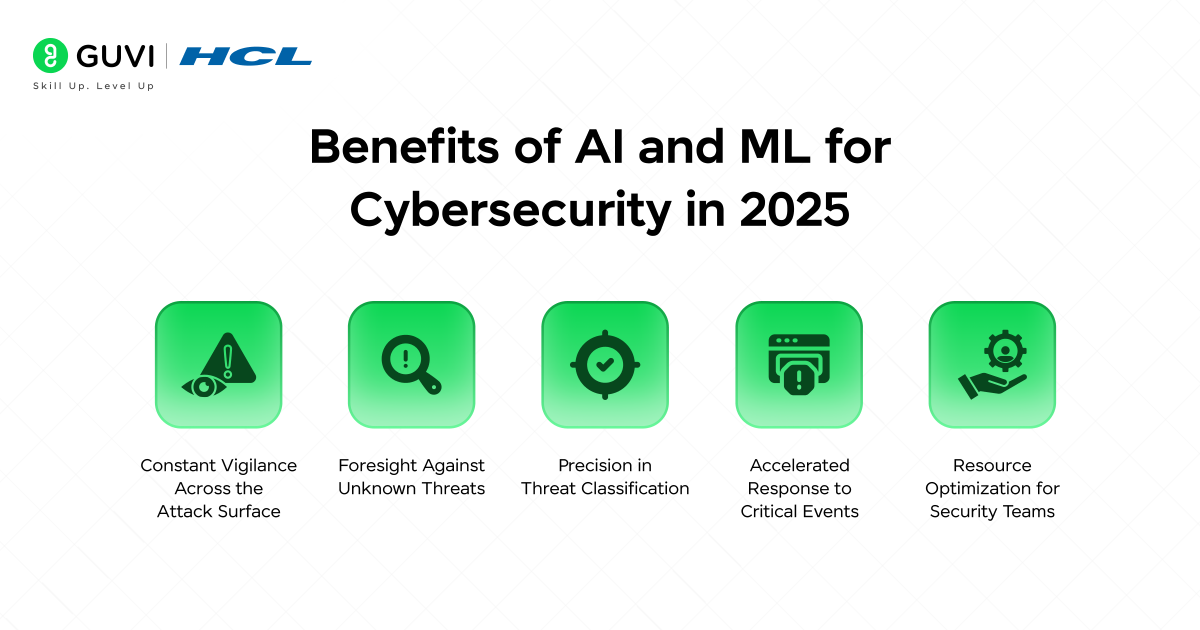
- Constant Vigilance Across the Attack Surface
Security teams use artificial intelligence and machine learning to strengthen non-stop oversight across endpoints and internal systems. These technologies authorize organizations to identify suspicious activity at any hour. They accomplish this without the gaps left by manual monitoring or shift changes.
- Foresight Against Unknown Threats
Machine learning models anticipate previously unseen attacks by investigating the smallest deviations in user and system behavior. The system draws from learned experience and blocks activity that falls outside established baselines, even when threat actors introduce novel exploits or fileless techniques.
Also Read: Complete Machine Learning Syllabus: Roadmap with Resources
- Precision in Threat Classification
AI draws from millions of labeled events and threat intelligence feeds to distinguish between genuine incidents and benign anomalies when it evaluates an alert. This precision sharply reduces the chance that security teams waste time chasing false leads or ignore subtle signs of compromise.
- Accelerated Response to Critical Events
Automated analysis means that when a threat emerges, whether in the form of ransomware or data access from suspicious sources, responses are triggered in near real time. Containment actions such as account suspension or network segmentation occur swiftly. This swiftness therefore, helps minimize potential fallout.
- Resource Optimization for Security Teams
Security operations centers often face overwhelming volumes of data and alerts. AI-driven tools prioritize the events that matter most. They allow human analysts to focus their energy on incidents that demand expertise while background threats are filtered or remediated automatically.
Key Applications of AI and ML in Cybersecurity
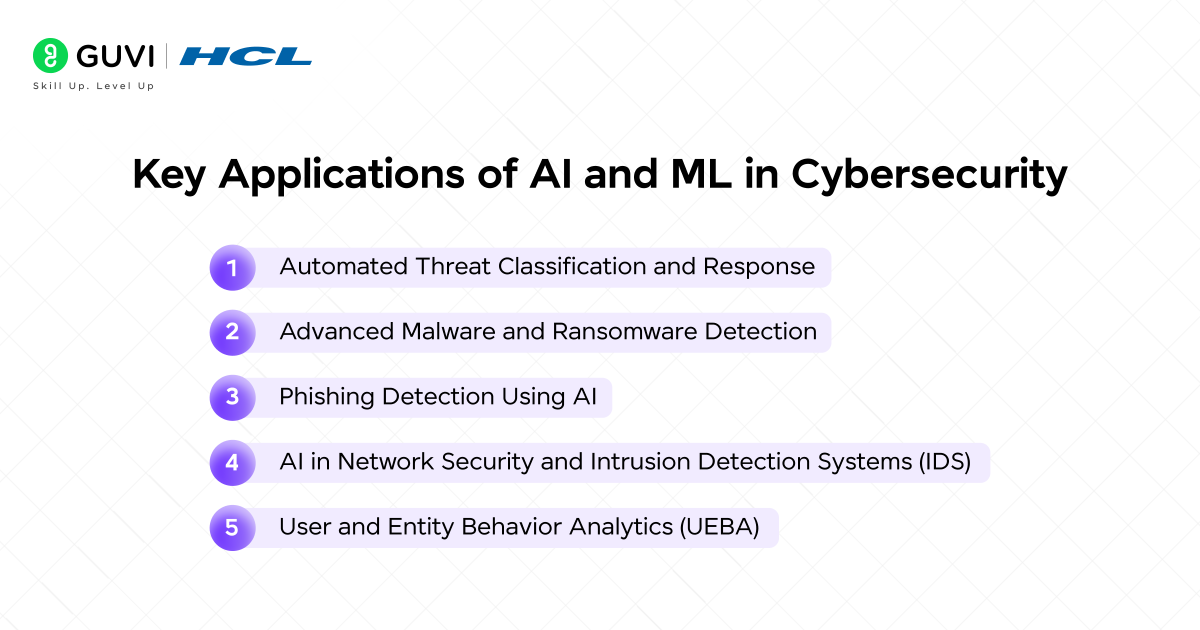
Here are the best use cases of AI and ML in the cybersecurity space:
- Automated Threat Classification and Response
Security operations centers often face a relentless barrage of alerts. Artificial intelligence filters through this stream by instantly prioritizing events that pose real danger. Models trained on vast threat datasets recognize patterns linked to known attacks. They can also highlight suspicious activity that falls outside expected norms.
Automated response systems act on these insights by isolating affected systems or blocking suspicious accounts with minimal human input. This shift allows analysts to focus on the most urgent and complex cases, while AI addresses the noise.
How AI Identifies Threats Faster than Human Analysts?
Human analysts possess experience and intuition, but they cannot match the speed at which artificial intelligence reviews data. A model trained on years of breach history and real-time telemetry now processes hundreds of signals every second, connecting events across multiple sources.
For example, an AI platform might identify a rapid series of failed logins on a remote device and immediately cross-check this with geolocation data and device posture. A response is triggered in seconds, containing a threat before it escalates.
- Advanced Malware and Ransomware Detection
Malware and ransomware no longer remain static. Attackers use polymorphic techniques to alter code and bypass signature-based defenses. Machine learning models excel at identifying subtle traits that reveal these threats, even as attackers modify their payloads. Algorithms trained on millions of known malware samples recognize patterns in file structure and command sequences.
ML Models Spotting New and Evolving Malware
Machine learning engines in 2026 analyze executable files at the byte and instruction sequence level. They do this by focusing on behavioral traits and structural anomalies rather than static signatures. These models assess not just file headers and embedded code fragments but also how files interact with system resources and network endpoints.
When the model detects unfamiliar patterns, such as suspicious API calls or irregular encryption routines, it flags the file for further investigation. This approach enables security systems to halt ransomware and advanced malware campaigns early, even when the malicious code has not appeared in any public repository or threat feed. These learning-based methods catch threats at inception as attackers experiment with polymorphic and fileless tactics. They further provide a level of defense that signature-based antivirus solutions simply cannot match.
- Phishing Detection Using AI
Phishing remains one of the most common attack vectors. It exploits trust and social engineering. Traditional filters struggle to block well-crafted lures. Natural language processing models now scan the content and structure of emails. They also search for deceptive language and links that redirect to malicious sites.
Natural Language Processing for Email Security
Enterprise email gateways use natural language processing to score inbound messages. They further flag those that fit phishing patterns. Security teams reported a dramatic drop in successful phishing incidents once these AI-powered tools were deployed, as attackers found it harder to bypass language and intent analysis.
- AI in Network Security and Intrusion Detection Systems (IDS)
Modern networks produce enormous volumes of data. Intrusion detection systems powered by artificial intelligence track traffic patterns and spot signs of lateral movement or exfiltration that would otherwise blend into the background noise. Real-time models scan for emerging threats as network sessions unfold.
Real-Time Network Monitoring
AI-driven intrusion detection models in 2025 track the flow of network sessions by continuously analyzing metadata and session behavior. These platforms monitor communication patterns between endpoints and critical assets. They further flag activity that diverges from established baselines. Algorithms correlate protocol anomalies and unauthorized access attempts to detect lateral movement or command-and-control activity.
AI-oriented intrusion detection models produce far fewer false positives while surfacing stealthy intrusion attempts. This real-time scrutiny delivers immediate visibility into unfolding threats and allows security teams to disrupt attacks in progress before any meaningful damage occurs.
- User and Entity Behavior Analytics (UEBA)
Insider threats remain among the most difficult challenges to address, as malicious actors already have legitimate access. Machine learning models profile normal behavior for users and applications. They help identify anomalies that suggest compromise or policy violations.
Detecting Insider Threats with ML
User and entity behavior analytics solutions powered by machine learning build individual behavioral profiles for every account and application. These models analyze variables such as:

- Login frequency
- Time of access
- Resource utilization
- File handling practices
When access patterns deviate, such as a user downloading sensitive records at odd hours or accessing data outside their usual responsibilities, the system triggers an alert for security review. Early identification of these anomalies prompts rapid investigation. It reduces the risk of data exfiltration before it escalates. Machine learning reveals subtle threats that escape conventional role-based access controls.
Key Challenges and Limitations of AI and Machine Learning in Cybersecurity
- Adversarial Attacks on AI/ML Cybersecurity Models: Hackers are developing sophisticated adversarial techniques to deceive and bypass AI-driven security systems. It further plays a part in exploiting model vulnerabilities.
- Data Privacy and AI Ethics in Cybersecurity: The massive data requirements of AI and ML raise serious concerns about data privacy and regulatory compliance (such as GDPR).
- Importance of High-Quality Data Sets for AI-Powered Security: Effective AI-based threat detection depends on large and diverse data sets. They are usually difficult and costly to acquire and maintain.
- Cybersecurity Talent Shortage and Resource Constraints for AI Implementation: There is a growing skills gap, with a shortage of professionals experienced in both cybersecurity and AI. It eventually makes successful adoption a challenge.
Future Trends: How Artificial Intelligence and Machine Learning Will Transform Cybersecurity
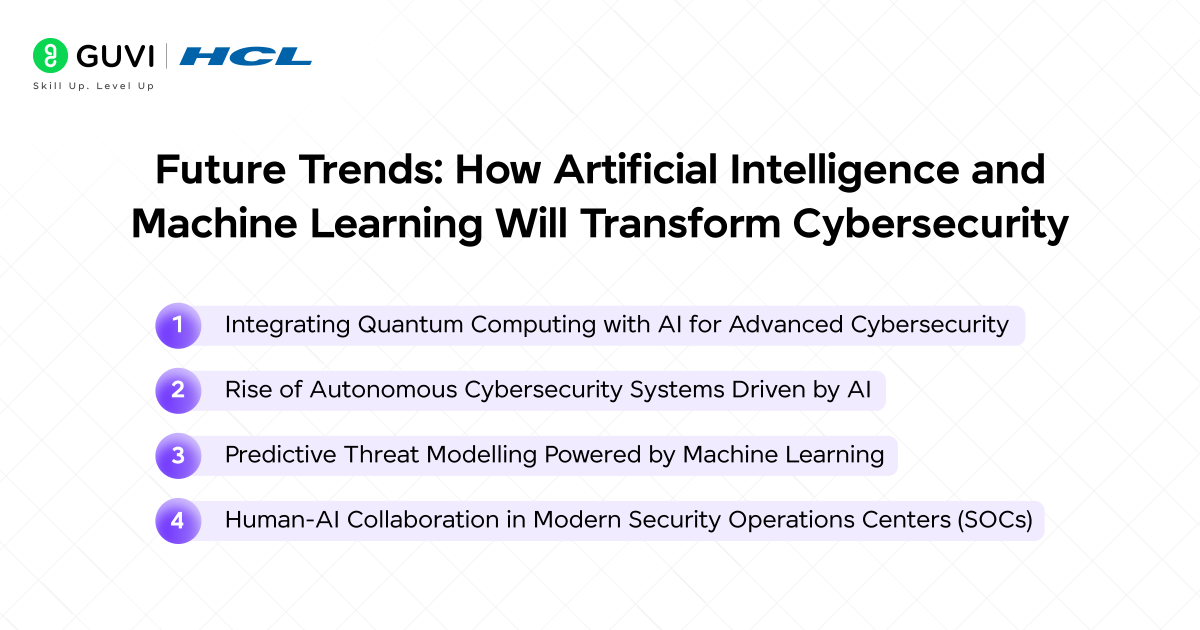
- Integrating Quantum Computing with AI for Advanced Cybersecurity: The convergence of AI and quantum computing will propose new opportunities for faster encryption and security analytics. It will also introduce novel security risks.
- Rise of Autonomous Cybersecurity Systems Driven by AI: Fully automated and AI-powered security platforms will be able to detect and respond to cyber threats in real time. It further decreases human intervention and response times.
- Predictive Threat Modelling Powered by Machine Learning: Utilizing machine learning for predictive analytics will encourage proactive identification. It will also support the prevention of cyber threats before they cause harm.
- Human-AI Collaboration in Modern Security Operations Centers (SOCs): Security analysts will work alongside AI tools. They will do this by blending human expertise with machine efficiency for smarter incident response and threat hunting.
Best Practices for Deploying AI-Driven Cybersecurity Solutions in Organizations
Organizations should adopt the following best practices to fully leverage the power of artificial intelligence and machine learning in cybersecurity.
Step-by-Step Guide to Integrating AI and ML into Existing Cybersecurity Infrastructure
- Start by thoroughly evaluating your current cybersecurity posture.
- Include existing technologies and vulnerabilities.
- Identify specific areas where AI and ML can add the most value, such as threat detection or automated analysis.
- Next, select appropriate AI-powered tools and create a phased implementation plan.
- Integrate these solutions gradually, ensuring they work seamlessly with your existing systems to minimize disruptions and maximize effectiveness.
Upskilling Cybersecurity Teams for AI and Machine Learning
The success of AI in cybersecurity depends on skilled professionals who comprehend both cybersecurity fundamentals and data science. Invest in ongoing training programs and industry certifications to help your teams stay up to date with the latest advancements in AI and ML. Encourage cross-functional learning so your cybersecurity experts can effectively collaborate with data scientists, further closing the critical skills gap and driving innovation.
Choose the Best AI-Powered Cybersecurity Tools and Vendors
Evaluate vendors based on their credibility and expertise in AI-driven security. Consider factors such as scalability and ease of integration. Also, assess support services and compliance with industry standards. Ultimately, choose solutions that align with your organization’s unique security requirements and offer ongoing updates to adapt to growing threats.
1. JPMorgan Chase: AI-Powered Fraud and Threat Detection
Challenge: JPMorgan Chase faces constant threats ranging from account takeovers to insider fraud as one of the world’s largest financial institutions.
AI/ML Solution:
The bank implemented machine learning algorithms across its fraud monitoring systems. AI models identify anomalies and flag suspicious behavior for further review by analyzing trillions of transactions.
Impact:
JPMorgan reported a double-digit percentage drop in financial fraud cases. Their AI-driven system detected and blocked sophisticated phishing and spear-phishing attacks that had previously bypassed legacy controls.
2. Microsoft: Using AI for Global Threat Intelligence
Challenge: Keeping pace with global threats is a monumental task with billions of devices connected through Microsoft products.
AI/ML Solution:
Microsoft Security employs its proprietary AI engine for analyzing over 65 trillion security signals daily. Machine learning identifies zero-day threats and powers the automated defense features in Microsoft Defender.
Impact:
Microsoft’s AI-driven threat intelligence now stops over 100 million phishing attempts per day and rapidly contains emerging malware outbreaks. It protects both enterprise and consumer users worldwide.
3. Darktrace: Self-Learning AI Protects Healthcare Providers
Challenge:
Healthcare organizations are heavily targeted by ransomware. This further risks patient data and operational uptime.
AI/ML Solution:
Darktrace’s “Enterprise Immune System” uses unsupervised machine learning to build a real-time understanding of what’s normal on a hospital’s network. The AI autonomously detects abnormal behaviors and can respond by isolating compromised devices within seconds.
Impact:
Darktrace’s self-learning AI has proven its proficiency in detecting and neutralizing ransomware attacks in their earliest stages. The technology prevents encryption of critical files and averts costly downtime by identifying abnormal behavior and automatically responding in real-time.
4. Facebook/Meta: AI Against Social Engineering and Account Takeover
Challenge:
Meta faces persistent attempts to compromise accounts through social engineering and phishing.
AI/ML Solution:
The company uses advanced AI models for user behavior analytics and automated responses to suspicious activities. Natural language processing scans billions of messages for fraud and malicious links.
Impact:
Meta has blocked millions of fake accounts and significantly reduced account takeovers. The platform now boasts industry-leading phishing and scam detection capabilities, thanks to continuous AI model training and updates.
Conclusion
Artificial intelligence and machine learning are fundamentally changing the cybersecurity landscape. They are facilitating faster and more adaptive defenses against emerging threats. Staying ahead of cybercriminals will require a balanced approach as organizations continue to innovate and invest in AI-powered security.
Combine technological advancement and a strong obligation to ethical AI practices and set strong guards against cybersecurity threats. Businesses can definitely achieve seamless security operations with minimal human intervention by executing automation via AI in cybersecurity.
FAQs
1. What Types of Cyber Threats Can AI and Machine Learning Prevent in 2025?
AI in cybersecurity and machine learning can detect and block a wide variety of cyber threats. It includes:
- Zero-day malware
- Ransomware
- Phishing attacks
- Insider threats
- Advanced persistent threats.
These intelligent systems use behavior analytics and anomaly detection to identify suspicious activities in real time. They additionally support organizations to reduce the risk of data breaches and costly cyber incidents.
2. How Do Organizations Train Their Security Teams for AI-Driven Cyber Defense?
Companies invest in continuous learning by providing cybersecurity professionals with specialized training in artificial intelligence and data analytics. Upskilling through certifications and hands-on workshops guarantees that teams stay current on emerging AI-powered security tools and techniques, ultimately closing the cybersecurity skills gap.
3. Why Is Data Quality Critical for AI-Powered Security Solutions?
High-quality and diverse data sets are essential for training accurate AI in cybersecurity and machine learning models. Poor data can result in missed threats or excessive false positives. It reduces the effectiveness of security defenses. Organizations prioritize robust data management and regular dataset updates to keep their AI-powered cybersecurity solutions effective against evolving threats.
4. What Should Enterprises Look for When Choosing an AI Cybersecurity Vendor?
When selecting AI cybersecurity vendors, enterprises should evaluate:
- Vendor’s track record
- Technology transparency
- Ease of integration
- Scalability
- Customer support
- Compliance with industry regulations.
Choosing a reliable AI security partner helps organizations guarantee a smooth implementation and long-term protection against cyber threats.
5. How Does AI Improve Incident Response Times Compared to Traditional Security Tools?
AI in cybersecurity automates the detection and containment of threats. It enormously speeds up incident response times. AI helps security teams contain breaches faster and minimize damage by processing massive amounts of data and triggering automated actions within seconds.
Success Stories

About the Author
Vaishali
I'm a seasoned writer with four years of experience across technical, non-technical, and just about every genre or niche you can imagine. Adaptable and curious, I enjoy exploring new topics and making information engaging and easy to understand. Fueled by a steady stream of tea, I approach each project with creativity, reliability, and genuine enthusiasm for storytelling.
View all posts by Vaishali
Connect with me @














Did you enjoy this article?