


UI/UX Designing Articles
What is a Design System? The Ultimate Guide to Building Consistent UIs
What is UX Writing? A Complete Guide to Mastering Microcopy and Content Design
What is a UX Audit? A Complete & Best Guide to User Experience Evaluation
How HCL GUVI Zen Class Helps You Build a Job-Ready UI/UX Portfolio


Get In Touch For Details! Request More Information

Mastering UX Case Study Structure: Storytelling That Stands Out
Sep 02, 2025 3 Min Read 4645 Views
(Last Updated)
“Design is not just what it looks like and feels like. Design is how it works.” — Steve Jobs
Ninety-four percent of first impressions about a product relate to its design, yet most UX case studies fail to capture what drives user trust and business outcomes. If you want to build a portfolio that moves beyond a collection of pretty screens, you need a case study structure rooted in real storytelling. The difference between a case study that gets skipped and one that sticks with a hiring manager often comes down to how you bring your process and insights to life.
In this blog, we’ll break down:
- Proven storytelling frameworks in UX
- How to structure a compelling case study
- Real-world UX examples and iterations
- How to tie design decisions to business or user outcomes
Let’s dive into the storytelling power behind a solid UX case study.
Table of contents
- Why Storytelling Matters in UX
- Project Overview
- Understanding the Problem (Discovery Phase)
- Defining the Problem (Synthesis Phase)
- Ideation and Solution Hypotheses
- Iteration and Testing
- 📊 Outcomes and Impact
- 💭 Reflection & Learnings
- 🎯 Final Takeaways (Optional Bonus)
- 🔄 UX Storytelling Frameworks You Can Use
- 🧶 1. The Hero’s Journey (UX Edition)
- 🎢 2. Before – After – Bridge
- 📊 3. Problem – Action – Result (PAR)
- 🔥 BONUS: A Unique UX Case Study Example – “Trash Track”
- 📚 References & Further Reading
- ✍️ Conclusion: Your Case Study Is a Narrative, Not a Report
Why Storytelling Matters in UX
Storytelling is not fluff—it’s UX in action.
Think of it this way: when you share your work, you’re not just explaining a solution; you’re narrating your thought process. Recruiters and clients want to see how you:
- Understand users deeply
- Define meaningful problems
- Validate your assumptions
- Adapt and iterate
- Deliver impact
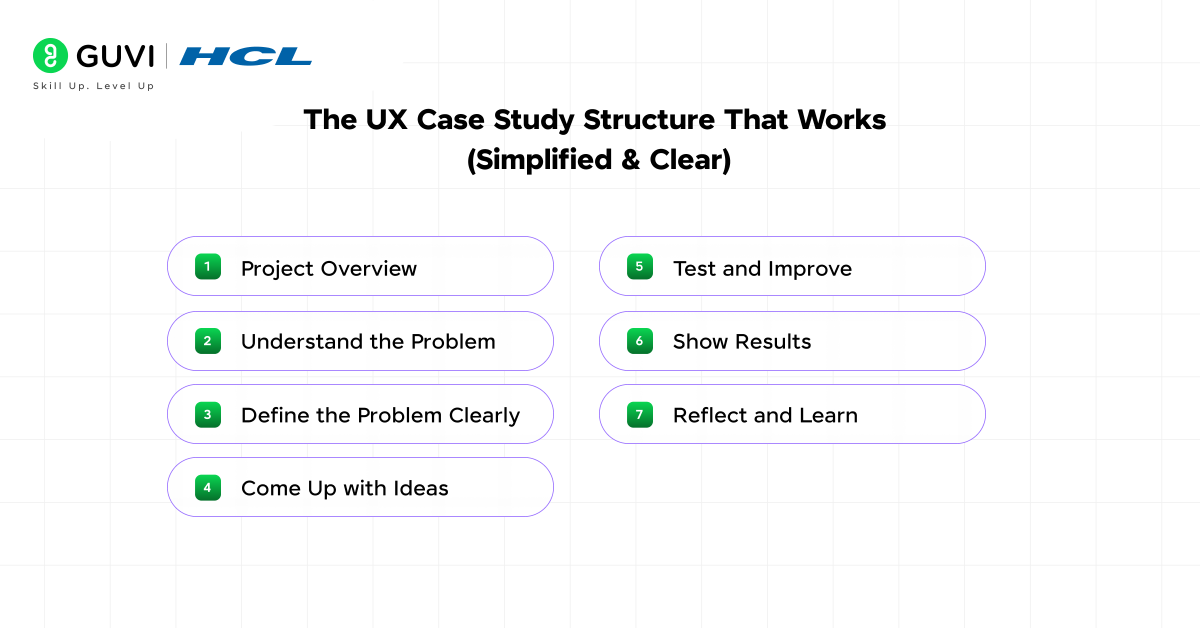
The UX Case Study Structure That Works
This structure mirrors the Design Thinking and Double Diamond methodologies. It’s human-centered, logical, and results-driven.
1. Project Overview
- Title
- Timeline
- Tools used
- Role
- Team vs individual work
Example:
Redesigning ‘HealthPal’: A mobile app to track pregnancy-safe foods for expectant mothers.
“I led the UX redesign of HealthPal, an app used by 50,000+ women during pregnancy. Over 6 weeks, I worked with one product manager and a nutrition consultant to increase daily engagement and simplify food safety categorization.”
Ready to turn your passion for design into a career that stands out? Join our Zen Class UI/UX Design Course and get hands-on mentorship, real-world projects, and industry-recognized certification. Build your portfolio with expert guidance and start creating user experiences that get noticed.
2. Understanding the Problem (Discovery Phase)
Use research to uncover what’s broken. Combine quantitative and qualitative data.
Include:
- Surveys, user interviews
- Market research
- Competitor analysis
- Heuristic evaluations
Example (Realistic Fiction):
Out of 18 interviewed pregnant users, 14 felt unsure if common Indian foods like ‘paneer tikka’ or ‘jeera rice’ were safe during specific trimesters. The current app showed Western food items only, leading to confusion and low trust.
3. Defining the Problem (Synthesis Phase)
This is where storytelling shines. Convert chaos into clarity.
Use:
- Empathy Maps
- Personas
- “How Might We” statements
- User journey maps
Example Statement:
How might we help pregnant Indian women feel confident about their daily food choices without needing to consult Google every time?
4. Ideation and Solution Hypotheses
Brainstorm. Go wide, then filter.
- Mind maps
- Crazy 8s
- Information architecture
- Sketches and early wireframes
Real UX Insight:
“We tried adding icons next to food items (✔️ Safe, ⚠️ Caution, ❌ Avoid) based on trimester. In testing, this reduced confusion time from 23 seconds to 8 seconds per item.”
5. Iteration and Testing
Show that your first idea wasn’t perfect, and how testing made it better.
Use:
- Usability testing (remote/in-person)
- A/B testing
- Feedback loops
- UI iterations
Before vs After UI Example (Mock):
| Feedback | Old UI | New UI |
| “Too much scrolling to find food.” | Scroll-heavy list | Search bar with filters |
| “Confusing color indicators.” | Random colors | Universal icons + labels |

6. 📊 Outcomes and Impact
What happened after launch or testing?
Quantitative KPIs:
- Engagement increased by 34%
- Support tickets reduced by 20%
- Onboarding time dropped from 3 min → 1.2 min
Qualitative Impact:
“Now I can check my lunch without googling everything,” said Anjali, a second-trimester user in our usability round 3.
7. 💭 Reflection & Learnings
Show humility and growth.
“Initially, I thought more data meant more confidence. But simplicity was key. Icons beat long paragraphs. I learned that real empathy means understanding what not to include.”
8. 🎯 Final Takeaways (Optional Bonus)
- What would you do if you had more time?
- Where can the product go next?
- What features could be scaled?
🔄 UX Storytelling Frameworks You Can Use
Here are 3 battle-tested frameworks to enhance your case study flow:
🧶 1. The Hero’s Journey (UX Edition)
- Call to Action: You receive a vague project brief
- Trials: Users hate the product; chaos ensues
- Transformation: Research leads to insights
- Resolution: You ship a design that solves it all
🎢 2. Before – After – Bridge
- Before: “The app was confusing and underused.”
- After: “Redesign led to 40% better task completion.”
- Bridge: “Here’s how we got there—through user testing and simplification.”
📊 3. Problem – Action – Result (PAR)
Great for resumes and LinkedIn too.
Problem: Users dropped off at sign-up.
Action: Redesigned form with fewer fields + social login.
Result: Sign-up rate increased by 29% in 2 weeks.
🔥 BONUS: A Unique UX Case Study Example – “Trash Track”
Project: Educating Students on Local Recycling
Problem: Students didn’t know what, where, or how to recycle in their district
Solution: Built an AI-powered dashboard that showed:
- Local drop-off points
- Category-wise sorting tips
- Gamified quizzes to increase awareness
Impact:
- 600+ students onboarded in 1 week
- 74% increase in daily logins
- Schools began integrating the tool in their EVS classes
Storytelling Hook:
“We turned everyday confusion—‘Where do I throw this plastic wrapper?’—into a 5-second learning moment.”
📚 References & Further Reading
- Nielsen Norman Group – UX Case Study Best Practices
- GUVI Blog on UX Research
- UX Collective on Medium
- IDEO Design Kit
✍️ Conclusion: Your Case Study Is a Narrative, Not a Report
A UX case study that reads like a story makes your work and your thinking memorable for anyone reviewing your portfolio. When you connect design choices with real impact and reveal your approach to overcoming challenges, you give your audience a reason to remember your process, not just your screens.
Each time you write a new case study, focus on guiding the reader through your journey from confusion to clarity so your portfolio reflects both your problem-solving ability and your understanding of human experience in design.
Success Stories

About the Author
Muppudathi S
As a UI/UX designer with three years of experience, I explore the essentials of design handoff in this blog. I share practical tips and best practices to ensure a smooth transition from design to development. Whether you're a designer or a developer, this guide will help bridge the gap between design and execution.
View all posts by Muppudathi S
Connect with me @








Did you enjoy this article?