


Artificial Intelligence and Machine Learning Articles
Finance Manager to Data Analytics: Career Growth, Salary and Seniority
How to Evaluate LLM Outputs in Production Deployments
AI/ML Skills Gap 2026: Why Companies Can't Find Job-Ready Talent
20 AI/ML Interview Questions Recruiters Can Use Without a Tech Background - Best Guide
Get In Touch For Details! Request More Information
Generative AI vs Traditional AI: Full Comparison with Examples (2026)
Jul 30, 2026 5 Min Read 20731 Views
(Last Updated)
The world is now filled with Artificial Intelligence right from your Google Maps to your voice assistant, AI is everywhere in every possible way.
There are different types of AI and one important type among all the others is Generative AI. Now, what’s the difference between generative AI and traditional AI? The answer to this question as well as a solution to the debate on generative AI vs traditional AI will be there in this article.
We’ll be covering key differences such as their applications, complexity, adaptability, and even cost and scalability. So, without further ado, let us get started!
Table of contents
- What is Generative AI and Traditional AI?
- Generative AI vs Traditional AI: Understanding the Key Differences
- GenAI Use Cases vs Traditional ML Use Cases: Which Fits Which Problem?
- Content Creation
- Fraud Detection
- Customer Support
- Recommendation Systems
- Demand and Sales Forecasting
- Document Processing
- Healthcare Applications
- Quick Decision Table
- Generative AI Salary vs Traditional ML Engineer Salary in India
- Should You Learn GenAI or Traditional ML First?
- Learn Traditional ML First When
- Learn Generative AI First When
- Best Learning Choice
- Conclusion
- FAQs
- What is the main difference between Generative AI and Traditional AI?
- How do Generative AI and Traditional AI approach data processing?
- How are the applications for Generative AI different from those for Traditional AI?
- What are the key advantages of using Generative AI?
- How does the development process differ between Generative AI and Traditional AI?
- What are some real-world examples of Generative AI and Traditional AI?
- What are the data requirements for Generative AI and Traditional AI?
What is Generative AI and Traditional AI?
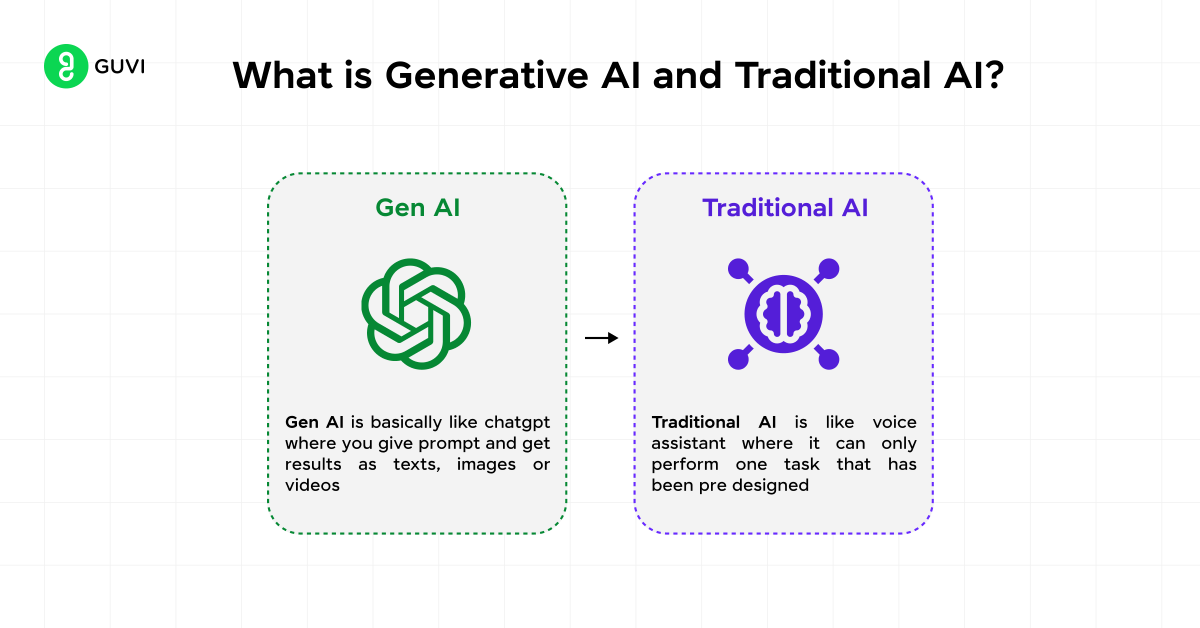
Before seeing the key difference between generative AI and traditional AI, the first major difference lies in their definition, so let us have a look at it.
Generative AI is a type of AI model that has the capability to produce its own texts, images, music, and even videos that have not existed before. It does so by the user providing proper prompts.
On the other hand, traditional AI is a set of AI models that are predesigned to perform a specific task by following a set of guidelines and patterns. These are majorly helpful in classification, prediction, and optimization. It cannot create or generate new content as Generative AI does effortlessly.
If you are intrigued by the working nature of Generative AI and want to learn more about it, consider enrolling in HCL GUVI’s Self-paced Generative AI course that provides you with all the necessary knowledge along with a certificate!
Generative AI vs Traditional AI: Understanding the Key Differences
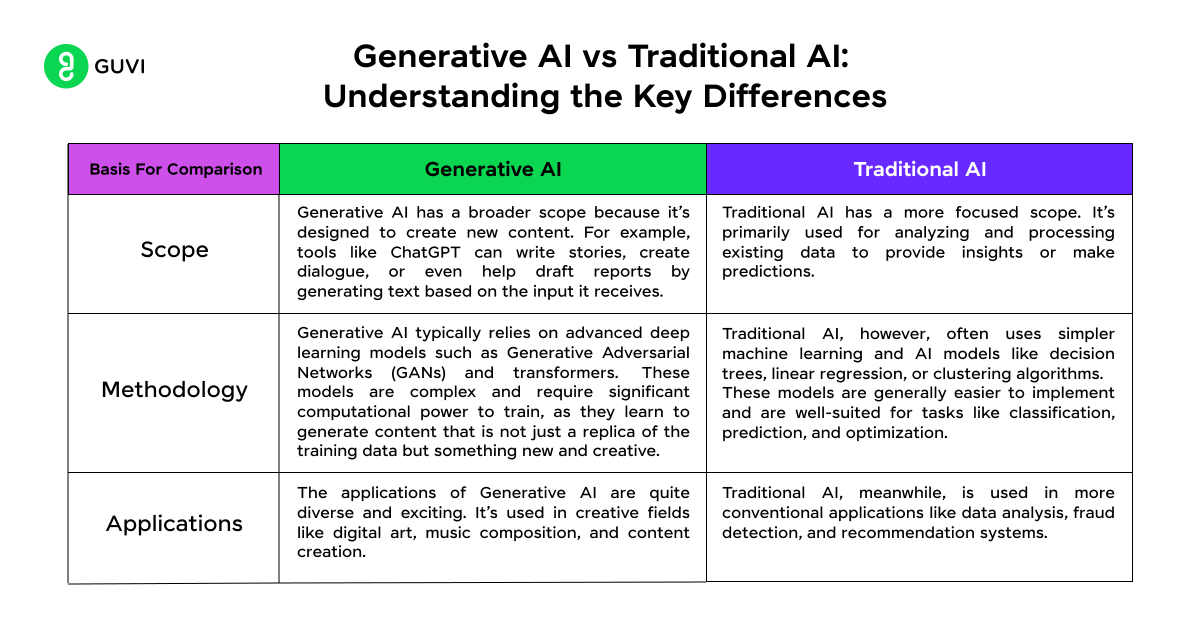
| Feature | Generative AI | Traditional ML | Examples |
|---|---|---|---|
| Primary Purpose | Creates new content based on user instructions. | Predicts outcomes or classifies existing data. | ChatGPT generates an email, while a churn model predicts which customers may leave. |
| Output | Produces text, images, audio, video, or code. | Produces a class, score, recommendation, or numerical prediction. | DALL-E creates an image, while a fraud model assigns a risk score. |
| Methodology | Commonly uses transformers and diffusion models. | Commonly uses regression and tree-based algorithms. | GPT uses transformer architecture, while a credit model may use logistic regression. |
| Training Data | Usually requires large and diverse datasets. | Can work with smaller task-specific datasets. | A language model learns from extensive text data, while a sales model learns from company records. |
| User Interaction | Often responds directly to natural-language prompts. | Usually works in the background after deployment. | A user prompts an AI assistant, while a spam filter automatically checks emails. |
| Applications | Supports content generation, summarisation, coding, and conversational systems. | Supports forecasting, classification, fraud detection, and recommendation systems. | A GenAI tool writes product descriptions, while ML predicts product demand. |
| Performance Measurement | Evaluated for relevance, factual accuracy, safety, and output quality. | Evaluated using metrics such as accuracy, precision, recall, or error rate. | A chatbot response is checked for relevance, while a classifier is tested for accuracy. |
| Resource Requirements | Often requires greater computing power during training and inference. | Usually requires fewer resources, depending on model complexity. | A large language model may need advanced GPUs, while a regression model can run on standard systems. |
| Adaptability | Can perform different content-related tasks through prompts. | Usually focuses on one clearly defined prediction task. | One GenAI assistant can summarise and rewrite text, while a churn model only predicts churn risk. |
| Explainability | Generated responses may be difficult to trace to one specific rule. | Some traditional models are easier to interpret. | An AI-generated answer may need validation, while a decision tree can display its decision path. |
| Cost | Development and deployment costs can be higher because of model size and computing needs. | Costs are often lower for smaller predictive models. | Hosting an LLM application may cost more than running a basic classification model. |
| Best Suited For | Problems requiring content creation or natural-language interaction. | Problems with a measurable prediction or classification target. | Use GenAI to summarise a report and ML to forecast next month’s sales. |
In case, you want to explore more generative AI and traditional AI, consider enrolling for HCL GUVI’S AIML Course which teaches everything related to it with an industry-grade certificate!
GenAI Use Cases vs Traditional ML Use Cases: Which Fits Which Problem?
The correct approach depends on the output required from the system. Generative AI works best when the task requires creating or transforming content. Traditional ML works better when the task has a measurable prediction, classification, or optimisation target.
1. Content Creation
Generative AI suits tasks involving:
- Blog and email drafting
- Product-description generation
- Image and video creation
- Code generation
- Content summarisation
- Translation
- Conversational responses
A marketing team can use Generative AI to create several campaign drafts from one brief. Traditional ML cannot independently write those drafts, but it can predict which audience is most likely to respond.
2. Fraud Detection
Traditional ML is generally more suitable for fraud detection. A model can study transaction amount, location, device, frequency, and historical behaviour to assign a fraud-risk score.
Generative AI may support investigators by summarising suspicious activity. However, the core detection decision usually requires a consistent predictive model.
3. Customer Support
Generative AI can answer questions, summarise conversations, and draft personalised responses.
Traditional ML can classify support tickets, predict urgency, and route each case to the correct team.
A complete customer-support system may use traditional ML for routing and Generative AI for composing the response.
4. Recommendation Systems
Traditional ML predicts which product, film, course, or article a user may prefer based on historical behaviour.
Generative AI can explain the recommendation or create a personalised description. The recommendation itself still depends heavily on ranking and predictive models.
5. Demand and Sales Forecasting
Traditional ML is the stronger choice for predicting future sales, inventory needs, customer churn, or delivery demand.
Generative AI can turn the forecast into a readable business summary. It should not replace a properly evaluated forecasting model.
Build strong AI and machine learning fundamentals to understand the difference between Generative AI and Traditional AI with HCL GUVI’s Machine Learning Course. Learn ML models, AI concepts, real-world applications, deployment workflows, and practical machine learning skills through structured, hands-on training designed for aspiring AI and ML professionals.
6. Document Processing
Generative AI can extract, summarise, rewrite, and answer questions about documents.
Traditional ML can classify documents, identify predefined entities, and flag records that meet specific conditions.

The best system may combine document classification with a Generative AI assistant.
7. Healthcare Applications
Traditional ML can predict disease risk, classify medical images, or identify unusual measurements.
Generative AI can summarise clinical notes or help prepare patient-friendly explanations. Human review remains necessary for high-stakes medical decisions.
Quick Decision Table
| Problem | Better Starting Choice | Reason |
| Generate an email | Generative AI | The required output is new text |
| Predict customer churn | Traditional ML | The task requires a probability or class |
| Detect a fraudulent payment | Traditional ML | The system must identify a measurable pattern |
| Build a conversational assistant | Generative AI | The task requires flexible natural-language responses |
| Forecast next month’s sales | Traditional ML | The output is a numerical prediction |
| Summarise a long report | Generative AI | The task transforms existing content |
| Recommend products | Traditional ML | The task requires ranking based on behaviour |
| Explain recommendations | Generative AI | The task requires natural-language generation |
Generative AI Salary vs Traditional ML Engineer Salary in India
Glassdoor currently reports an average annual salary of approximately ₹9.77 lakh for Generative AI Engineers in India. The typical reported range is around ₹4.36 lakh to ₹19.50 lakh per year, based on a comparatively small number of salary submissions.
Machine Learning Engineers have a reported average salary of approximately ₹11.30 lakh per year in India. Glassdoor lists a typical range of around ₹6.70 lakh to ₹17 lakh, based on substantially more salary submissions.
| Role | Average Salary in India | Typical Range | Main Skills |
| Generative AI Engineer | ₹9.77 LPA | ₹4.36–19.50 LPA | LLMs, prompt engineering, RAG, vector databases, APIs, and model evaluation |
| Machine Learning Engineer | ₹11.30 LPA | ₹6.70–17 LPA | Python, statistics, ML algorithms, data pipelines, deployment, and MLOps |
These figures do not prove that one career always pays more. Generative AI is a newer job category with fewer salary submissions, whereas Machine Learning Engineer is a broader and more established title.
Actual compensation depends on:
- Experience
- Employer
- Location
- Educational background
- Software engineering ability
- Cloud and deployment skills
- Model-building experience
- Portfolio quality
- Role responsibilities
Professionals who combine traditional ML knowledge with LLM application development may qualify for a wider range of AI roles.
Should You Learn GenAI or Traditional ML First?
Most beginners should learn traditional machine learning fundamentals before specialising in Generative AI.
Traditional ML teaches how data is collected, cleaned, prepared, and evaluated. It also introduces essential concepts such as overfitting, feature selection, model validation, bias, variance, and performance metrics.
These concepts make it easier to understand why an AI system works, where it may fail, and how its performance should be measured.
Learn Traditional ML First When
Choose traditional machine learning first when:
- You are completely new to AI.
- You want to become a Machine Learning Engineer or Data Scientist.
- You need stronger Python, statistics, and data-analysis skills.
- You want to understand model training and evaluation.
- You plan to work on prediction, classification, or forecasting problems.
A useful starting sequence is:
- Python
- NumPy and Pandas
- Statistics and probability
- Data visualisation
- Regression and classification
- Model evaluation
- Deep learning fundamentals
- Generative AI and large language models
Learn Generative AI First When
Generative AI may be a practical starting point when:
- You already understand Python and APIs.
- You are a developer building AI-powered applications.
- You want to create chatbots, search tools, or content systems.
- You need prompt engineering and LLM integration skills quickly.
- Your immediate goal involves RAG, AI agents, or workflow automation.
Starting with GenAI application development does not remove the need for ML fundamentals. Those foundations become increasingly important when evaluating outputs, fine-tuning models, managing data, and deploying reliable systems.
Best Learning Choice
Traditional ML provides the foundation. Generative AI adds modern content-generation and language-model capabilities.
Learning them in sequence is generally stronger than treating them as competing paths:
Python → Data Analysis → Machine Learning → Deep Learning → Generative AI → RAG and AI Agents → Deployment
Conclusion
In conclusion, the key differences between generative AI and traditional AI have been laid out in a clear and straightforward manner. Generative AI is the creation of a new world from nothing, while Traditional AI is more of making the already existing processes more efficient.
Whether you’re a tech enthusiast, a professional, or just someone curious about the future of AI, knowing the differences between Generative AI and Traditional AI is key to understanding the ever-changing world of AI.
FAQs
1. What is the main difference between Generative AI and Traditional AI?
The main difference is that Generative AI creates new content, while Traditional AI analyzes and processes existing data.
2. How do Generative AI and Traditional AI approach data processing?
Generative AI generates new data based on patterns it has learned, whereas Traditional AI processes and interprets existing data to make predictions or decisions.
3. How are the applications for Generative AI different from those for Traditional AI?
Generative AI is used in creative tasks like content creation, while Traditional AI is used in data-driven tasks like predictions, classifications, and optimizations.
4. What are the key advantages of using Generative AI?
Generative AI excels at creating new original content and offers high innovation potential in creative industries.
5. How does the development process differ between Generative AI and Traditional AI?
Generative AI development is more complex, requiring advanced models and more computational resources, while Traditional AI development is generally simpler and more resource-efficient.
6. What are some real-world examples of Generative AI and Traditional AI?
Examples of Generative AI include GPT-4 and DALL-E, while Traditional AI includes spam filters and recommendation systems.
7. What are the data requirements for Generative AI and Traditional AI?
Generative AI requires large, diverse datasets for training, while Traditional AI can often work with smaller, more specific datasets.
Success Stories

About the Author
Vaishali
I'm a seasoned writer with four years of experience across technical, non-technical, and just about every genre or niche you can imagine. Adaptable and curious, I enjoy exploring new topics and making information engaging and easy to understand. Fueled by a steady stream of tea, I approach each project with creativity, reliability, and genuine enthusiasm for storytelling.
View all posts by Vaishali
Connect with me @











Did you enjoy this article?