


Cyber Security Articles
How to Perform a Basic Penetration Test on Your Web App
Falco Runtime Security Tutorial: Catch Attacks as They Happen

Get In Touch For Details! Request More Information

What Is Hacking? Types, How It Works & Ethical Hacking Basics (2026)
Sep 09, 2026 8 Min Read 16749 Views
(Last Updated)
Hacking has become a major concern in today’s technology-driven world. Attackers can steal passwords, expose private data, disrupt businesses, or compromise entire networks. However, hacking skills can also help security professionals identify weaknesses before criminals exploit them.
Some hackers work with permission to improve security. Others access systems illegally for money, revenge, disruption, or political motives. The difference usually depends on authorization and intent.
This guide explains what hacking is and how it works. It also covers common hacking types, techniques, detection methods, and ethical hacking career opportunities in India.
Table of contents
- What Is Hacking?
- Historical Context: The Emergence of Hacking Culture
- Types of Hacking
- Hacking Types at a Glance
- White Hat vs Black Hat vs Grey Hat Hacker: Explained Simply
- Motivations Behind Hacking
- Financial Gain
- Curiosity and Technical Challenge
- Revenge
- State-Sponsored Espionage
- How Hacking Actually Works: Step by Step (For Education)
- Step 1: Choosing or Understanding the Target
- Step 2: Collecting General Information
- Step 3: Looking for Weaknesses
- Step 4: Validating the Vulnerability
- Step 5: Assessing Possible Impact
- Step 6: Documenting Evidence
- Step 7: Fixing and Retesting
- Common Hacking Techniques
- Phishing
- Malware
- Social Engineering
- Brute Force Attacks
- Hacking and Cybersecurity
- The Importance of Cybersecurity
- Protecting Sensitive Data
- Maintaining Business Continuity
- Supporting National Security
- Preserving Customer Trust
- Meeting Legal Requirements
- Cybersecurity Best Practices
- Use Strong and Unique Passwords
- Enable Multi-Factor Authentication
- Install Updates Promptly
- Review Links and Attachments
- Back Up Important Information
- Restrict User Access
- Conduct Authorized Security Testing
- Encrypt Sensitive Data
- Use AI in Cybersecurity
- Famous Hacking Incidents
- Stuxnet Worm (2010)
- Sony Pictures Hack (2014)
- Equifax Data Breach (2017)
- WannaCry Ransomware (2017)
- SolarWinds Cyberattack (2020)
- Ethical Hacking Career in India 2026: Salary, Demand, Certifications
- Ethical Hacking Job Roles
- Ethical Hacker Salary in India in 2026
- Certifications for an Ethical Hacking Career
- How to Start an Ethical Hacking Career
- Conclusion
- FAQs
- What Is the Difference Between White Hat and Black Hat Hacking?
- Are All Hackers Criminals?
- How Can I Protect Myself From Hacking?
- Is Ethical Hacking Legal in India?
- Does Ethical Hacking Require Coding?
What Is Hacking?
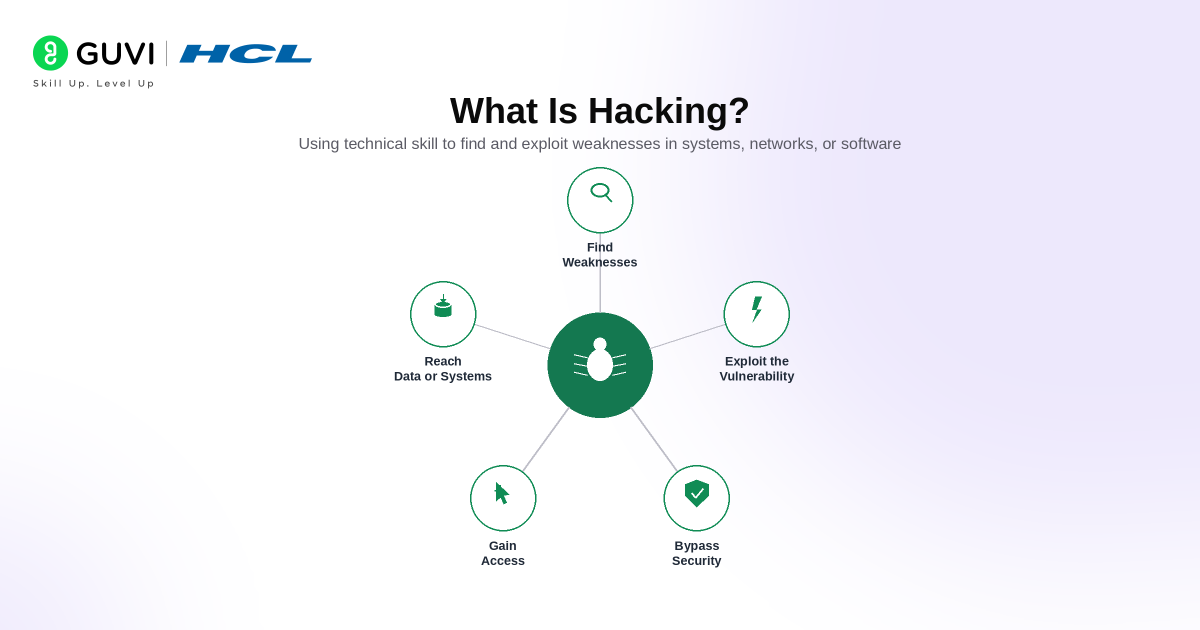
Hacking is the process of finding and using weaknesses in computer systems, applications, devices, or networks. A hacker may attempt to access data, change system behaviour, interrupt operations, or test existing security controls.
Hacking becomes illegal when someone accesses or tests a system without permission. Ethical hacking follows a defined scope and written authorization. Ethical hackers use controlled testing to help organizations discover and fix security weaknesses.
The word “hacking” originally described creative technical problem-solving. Early computer enthusiasts explored systems to understand how they worked. The term now covers both authorized cybersecurity testing and malicious cybercrime.
Historical Context: The Emergence of Hacking Culture
Hacking culture began during the early development of computing. Technology enthusiasts experimented with hardware and software to understand system limitations. These communities often shared discoveries and developed creative solutions to technical problems.
Personal computers and wider network access later expanded hacking culture. Different groups began using similar technical skills for very different purposes.
Security researchers used hacking knowledge to improve system protection. Cybercriminals used it to steal information or damage systems. Political groups also adopted hacking as a method of protest.
Modern hacking therefore covers a wide spectrum of activities. Authorization remains the most important distinction between legal security testing and unlawful intrusion.
Types of Hacking
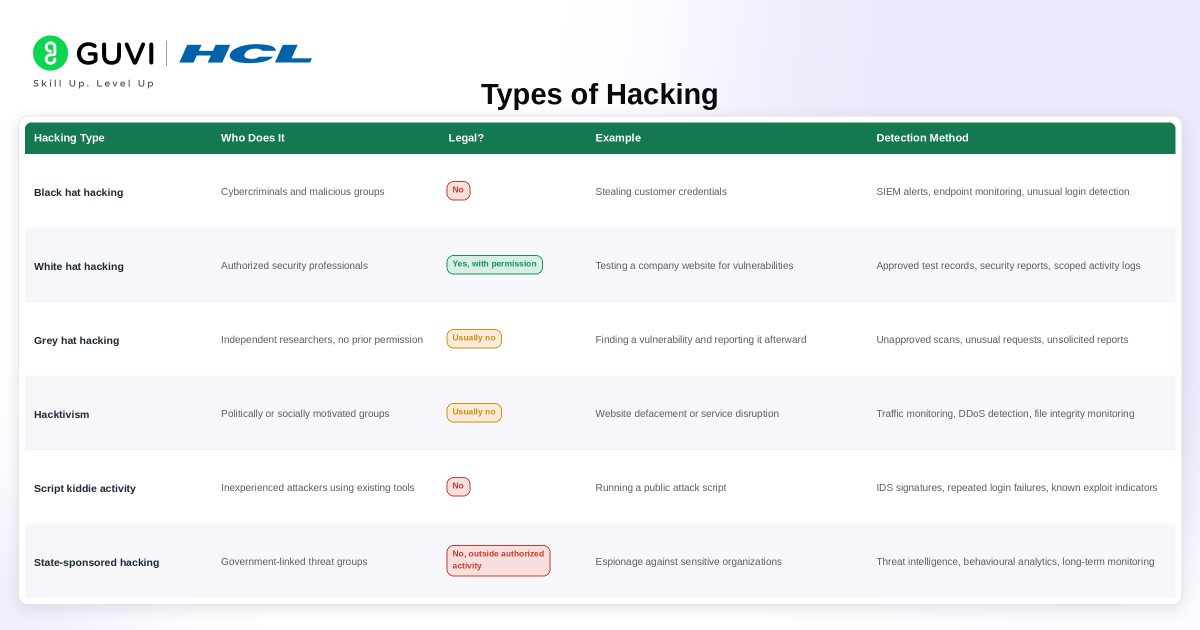
Hackers can be classified according to their intent, authorization, technical ability, and preferred targets.
Some hackers work under formal contracts. Others operate without permission. Certain groups focus on financial theft, political causes, surveillance, or recognition.
Hacking Types at a Glance
| Hacking Type | Who Does It | Legal? | Example | Detection Method |
|---|---|---|---|---|
| Black hat hacking | Cybercriminals and malicious groups | No | Stealing customer credentials | SIEM alerts, endpoint monitoring, unusual login detection |
| White hat hacking | Authorized security professionals | Yes, with written permission | Testing a company website for vulnerabilities | Approved test records, security reports, scoped activity logs |
| Grey hat hacking | Independent researchers acting without prior permission | Usually no | Finding a vulnerability and reporting it afterward | Unapproved scans, unusual requests, unsolicited vulnerability reports |
| Hacktivism | Politically or socially motivated groups | Usually no | Website defacement or service disruption | Traffic monitoring, DDoS detection, file integrity monitoring |
| Script kiddie activity | Inexperienced attackers using existing tools | No | Running a public attack script | IDS signatures, repeated login failures, known exploit indicators |
| State-sponsored hacking | Government-linked threat groups | No, outside authorized state activity | Espionage against sensitive organizations | Threat intelligence, behavioural analytics, long-term network monitoring |
Legal status can vary across jurisdictions. Testing should always follow written authorization and a clearly defined scope.
- Black Hat Hacking
Black hat hackers access systems with malicious intent. Their goals may include financial theft, data exposure, extortion, spying, or operational disruption.
They commonly target login credentials, payment data, business records, intellectual property, and confidential communications. Their actions can lead to financial losses and legal consequences for affected organizations.
The Equifax breach is a major example of malicious hacking. Attackers exploited an unpatched vulnerability and exposed information belonging to approximately 147 million people.
- White Hat Hacking
White hat hackers are cybersecurity professionals who test systems with permission. Organizations hire them to identify weaknesses before malicious attackers find them.
Their work may include:
- Vulnerability assessments
- Penetration testing
- Application security reviews
- Network security testing
- Cloud security assessments
- Security configuration reviews
- Responsible vulnerability disclosure
White hat hackers must follow the approved scope. They also document their findings and recommend practical fixes.
Bug bounty platforms allow approved researchers to report valid vulnerabilities. These programs provide defined rules and safe disclosure processes.
- Grey Hat Hacking
Grey hat hackers operate between ethical and malicious hacking. They may discover genuine security issues but test systems without receiving permission first.
Some grey hat hackers report the vulnerability to the organization. Others request payment or public recognition after discovering it.
Positive intent does not automatically make unauthorized testing legal. Accessing a system without permission may still violate cybersecurity laws and organizational policies.
Responsible researchers should use approved bug bounty programs or obtain written authorization before testing.
Also Read: Top 25 Real-Time Cybersecurity Project Ideas!
- Hacktivism
Hacktivism combines hacking with political or social activism. Hacktivists may target governments, companies, institutions, or public figures connected with a particular issue.
Common hacktivist activities include:
- Website defacement
- Distributed denial-of-service attacks
- Data leaks
- Account compromise
- Publication of confidential documents
Hacktivist groups often claim that their actions support public awareness or political change. However, unauthorized access and service disruption can still be illegal.
- Script Kiddies
Script kiddies are inexperienced attackers who use tools or scripts created by other people. They may not fully understand how the software works.
Recognition, entertainment, curiosity, or peer approval may motivate their actions. Limited technical knowledge does not make their attacks harmless.
Publicly available tools can still disrupt websites or compromise poorly protected accounts. Security systems often detect such attacks through known signatures and repeated activity patterns.
Build strong cybersecurity fundamentals to understand hacking, its types, real-world attack methods, and ethical hacking basics with HCL GUVI’s Cyber Security and Ethical Hacking for Beginners Course. Learn network security, ethical hacking concepts, threat detection, vulnerability basics, and safe cybersecurity practices through structured training designed for beginners and aspiring cybersecurity professionals.
White Hat vs Black Hat vs Grey Hat Hacker: Explained Simply
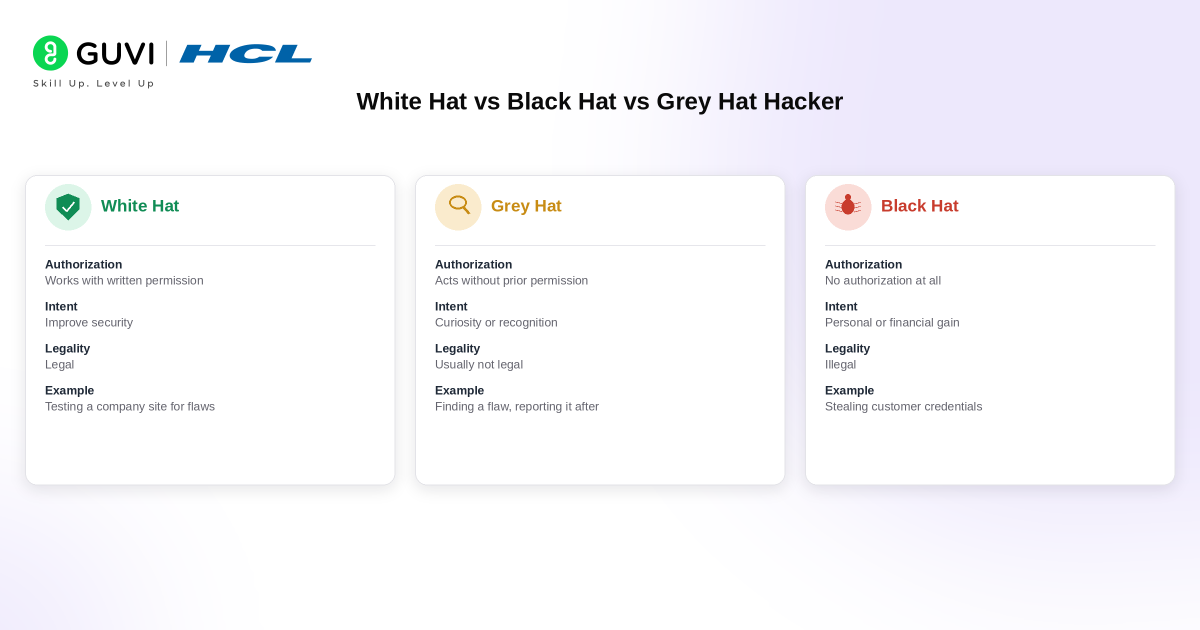
| Factor | White Hat Hacker | Black Hat Hacker | Grey Hat Hacker |
| Permission | Receives written permission | Has no permission | Usually has no prior permission |
| Main goal | Improve security | Steal, damage, disrupt, or profit | Find vulnerabilities or gain recognition |
| Legal status | Legal within the approved scope | Illegal | Often legally questionable or illegal |
| Reporting | Provides a structured security report | Hides activity | May disclose the issue afterward |
| Data handling | Protects and limits access | May steal or expose data | Handling varies |
| Typical role | Ethical hacker or penetration tester | Cybercriminal | Independent security researcher |
Motivations Behind Hacking
Hackers operate for several reasons. Their motivations influence their targets and methods.
Financial Gain
Cybercriminals may steal payment information, sell personal data, demand ransom, or commit online fraud.
Curiosity and Technical Challenge
Some individuals explore systems because they enjoy solving complex technical problems. Curiosity should remain limited to personal labs or authorized platforms.
Revenge
Disgruntled employees or former partners may misuse retained access to damage systems or expose information.
State-Sponsored Espionage
Government-linked groups may target defence systems, research institutions, infrastructure, or sensitive business information.
How Hacking Actually Works: Step by Step (For Education)
Step 1: Choosing or Understanding the Target
An attacker first identifies a possible target. It may be a website, application, employee account, device, or network.
Ethical hackers receive this information through an approved testing scope. Malicious hackers select targets without consent.
Step 2: Collecting General Information
The next stage involves understanding the target’s digital environment. This may include publicly available information about technologies, domains, or business operations.
Security teams call this reconnaissance. Ethical testing limits information collection according to the approved rules.
Step 3: Looking for Weaknesses
The hacker checks for possible security gaps. Common weaknesses include outdated software, poor access controls, exposed services, or unsafe configurations.
Ethical hackers use approved assessment tools and document each potential issue.
Step 4: Validating the Vulnerability
A suspected weakness must be verified. Ethical hackers perform controlled validation without causing unnecessary disruption.
Testing stops when the agreed evidence has been collected. Production data should not be copied or altered unless the scope specifically permits it.
Step 5: Assessing Possible Impact
Security professionals determine what an attacker could achieve through the weakness.
Possible impacts include:
- Unauthorized account access
- Exposure of sensitive information
- Modification of system settings
- Service disruption
- Movement into connected systems
This stage helps organizations prioritize serious vulnerabilities.
Step 6: Documenting Evidence
Ethical hackers record the affected system, risk level, evidence, and recommended solution.
A professional report should explain the business impact without exposing unnecessary confidential data.
Step 7: Fixing and Retesting
The organization applies patches or changes security controls. The ethical hacker then retests the issue to confirm that the fix works.
Malicious attackers do not follow reporting or remediation steps. They may maintain access, steal information, or cause further damage.
Common Hacking Techniques
1. Phishing
Phishing uses deceptive emails, messages, calls, or websites to trick people into sharing confidential information.
A phishing message may pretend to come from a bank, manager, delivery company, or online service. It may create urgency and ask the recipient to open a link or provide login details.
Common warning signs include:
- Unexpected requests for passwords
- Urgent payment instructions
- Misspelled domain names
- Unfamiliar attachments
- Login pages with unusual addresses
- Requests to bypass normal processes
Security awareness and email filtering can reduce phishing risks.
2. Malware
Malware means malicious software designed to damage systems or perform unauthorized actions.
Common malware categories include:
- Virus: Attaches itself to files and spreads through user actions.
- Worm: Spreads across systems or networks automatically.
- Trojan: Appears legitimate but performs harmful actions.
- Ransomware: Encrypts files or blocks access until payment is demanded.
- Spyware: Secretly collects information about users or devices.
Antivirus software and endpoint detection tools help identify suspicious programs. Regular updates also reduce exposure to known vulnerabilities.
3. Social Engineering
Social engineering manipulates people rather than directly attacking technology.
An attacker may pretend to be a trusted employee or support representative. The goal is often to obtain passwords, approve payments, reveal confidential information, or bypass security procedures.
Organizations can reduce this risk through identity verification and security awareness training. Employees should report unusual requests instead of acting under pressure.
4. Brute Force Attacks
A brute force attack repeatedly tests possible passwords until it finds a valid combination.
Automated tools can perform large numbers of login attempts. Weak and reused passwords make these attacks more effective.
Defensive measures include:
- Strong and unique passwords
- Multi-factor authentication
- Login attempt limits
- Account lockout controls
- Passwordless authentication
- Monitoring for repeated failures
Authorized security professionals may assess password controls during an approved engagement. They should follow strict limits to prevent account disruption.
Hacking and Cybersecurity
Hacking and cybersecurity are closely connected because both focus on how digital systems can be accessed, tested, and protected. Hackers look for weaknesses in networks, applications, devices, cloud platforms, and user accounts. Cybersecurity professionals build safeguards to reduce those risks and respond when an attack occurs.

The Importance of Cybersecurity
1. Protecting Sensitive Data
Security controls help protect personal information and confidential business records.
2. Maintaining Business Continuity
Cyberattacks can interrupt websites, payment systems, internal tools, and customer services. Recovery planning helps organizations restore operations.
3. Supporting National Security
Government systems and essential infrastructure require strong protection against espionage and disruption.
4. Preserving Customer Trust
Customers expect organizations to protect their information. A serious breach can damage confidence and brand reputation.
5. Meeting Legal Requirements
Organizations may need to follow data protection and industry-specific security requirements. Strong controls help them meet these responsibilities.
Cybersecurity Best Practices
Use Strong and Unique Passwords
Create a separate password for every important account. A password manager can securely store complex credentials.
Enable Multi-Factor Authentication
Multi-factor authentication requires an additional verification method. It can stop many account takeover attempts involving stolen passwords.
Install Updates Promptly
Software updates often fix known security weaknesses. Delayed patching gives attackers more time to exploit them.
Review Links and Attachments
Check the sender and destination before opening unfamiliar links or files.
Back Up Important Information
Maintain protected backups and test restoration regularly. Backups should remain separate from primary systems.
Restrict User Access
Employees should only receive the permissions required for their work.
Conduct Authorized Security Testing
Regular assessments help identify vulnerabilities before they cause serious damage.
Encrypt Sensitive Data
Encryption protects information during storage and transmission.
Use AI in Cybersecurity
AI in cybersecurity can help detect unusual behaviour, analyse large volumes of security data, and identify potential threats faster. However, organizations should combine AI-based tools with human review to reduce false alerts and improve response accuracy.
Famous Hacking Incidents
Major cyber incidents demonstrate how security failures can affect businesses, governments, and individuals.
1. Stuxnet Worm (2010)
Stuxnet was a sophisticated computer worm that targeted industrial control environments. It demonstrated that malware could affect physical infrastructure rather than only digital files.
CISA documented Stuxnet’s use of several previously unknown vulnerabilities. The incident increased global awareness of industrial cybersecurity risks.
2. Sony Pictures Hack (2014)
Attackers compromised Sony Pictures Entertainment and released confidential information. The incident also disrupted company systems.
The United States Department of Justice later linked the destructive attack to North Korean government-backed activity connected with the movie The Interview.
3. Equifax Data Breach (2017)
The Equifax breach exposed personal information belonging to approximately 147 million people.
Regulators alleged that the company failed to take reasonable steps to protect its network. The incident highlighted the risks created by delayed vulnerability patching.
4. WannaCry Ransomware (2017)
WannaCry spread across organizations worldwide and encrypted files on affected Windows systems.
The attack disrupted healthcare services, businesses, and public agencies. It showed how quickly ransomware could spread through vulnerable systems. United States authorities later attributed the WannaCry campaign to North Korean government-backed hackers.
5. SolarWinds Cyberattack (2020)
The SolarWinds incident involved the compromise of software distributed through trusted updates. Affected organizations unknowingly installed the altered software.
CISA described the event as an active compromise involving SolarWinds Orion products. The incident demonstrated the potential impact of software supply chain attacks.
Ethical Hacking Career in India 2026: Salary, Demand, Certifications
Ethical Hacking Job Roles
Common entry-level and experienced roles include:
- Cybersecurity analyst
- Security operations centre analyst
- Vulnerability assessment analyst
- Ethical hacker
- Penetration tester
- Application security tester
- Cloud security analyst
- Incident response analyst
- Security consultant
- Red team professional
- Security architect
- AI security engineer
Beginners often start as cybersecurity analysts, security operations centre analysts, or vulnerability assessment analysts. Practical experience can support progression into penetration testing, application security, red teaming, and advanced security research.
Ethical Hacker Salary in India in 2026
Public salary estimates vary because ethical hacking roles may appear under titles such as penetration tester, security consultant, or cybersecurity analyst.
Coursera’s India salary guide cites an average annual salary of approximately ₹5 lakh for ethical hackers based on Glassdoor data. It also cites a figure of around ₹5.4 lakh from Payscale. Related cybersecurity roles show different averages. Penetration testers earn approximately ₹6 lakh per year, while cybersecurity consultants and security engineers may earn around ₹10 lakh or more.
Note: These figures should be treated as broad market indicators rather than guaranteed salaries. Actual compensation can differ significantly based on the role, organization, city, and candidate profile.
Salary commonly depends on:
- Practical cybersecurity skills
- Years of relevant experience
- Professional certifications
- Programming and scripting knowledge
- Cloud security expertise
- Application security experience
- Location
- Employer size
- Industry
- Reporting and communication ability
Demand for Ethical Hackers in India
India continues to face a shortage of professionals with practical cybersecurity expertise.
The Indian Cyber Security Skilling Landscape Report 2025–26 found that 73% of surveyed enterprises and 68% of service providers experienced limited availability of qualified cybersecurity talent. It also found that 84% of organizations required between one and six months to fill cybersecurity roles.
Employers reported a particularly strong gap between theoretical knowledge and practical ability. Around 63% of enterprises and 59% of service providers said candidates lacked sufficient hands-on skills. Organizations also struggled to find professionals with knowledge spanning cloud platforms, applications, and identity systems.
Demand remains high for security architects, operational technology security specialists, threat intelligence professionals, and experts who can secure cloud-native systems. Reuters also reported that cybersecurity company N-able planned to expand its India workforce by at least 50% by the end of 2026. The company cited India’s AI and cybersecurity talent as a key reason for its Bengaluru expansion.
Cisco’s 2025 Cybersecurity Readiness Index found that only 7% of surveyed organizations in India had achieved a mature level of readiness against modern cybersecurity threats. Employers commonly seek candidates with practical knowledge of:
- Computer networking
- Linux and Windows security
- Web application security
- Identity and access management
- Vulnerability assessment
- Cloud security
- AI and generative AI security
- Incident response
- Threat intelligence
- Security documentation
- Basic scripting
- Responsible vulnerability disclosure
Certifications for an Ethical Hacking Career
Certifications are not a replacement for practical skills. However, they can help candidates structure their learning and demonstrate foundational knowledge.
- CompTIA Security+
CompTIA Security+ covers core security functions required across many cybersecurity roles. It can suit beginners who need a broad understanding of threats, access controls, security operations, and risk management.
- Certified Ethical Hacker
The Certified Ethical Hacker credential from EC-Council covers ethical hacking concepts, attack vectors, security tools, and defensive countermeasures. The certification includes knowledge-focused content for security professionals.
- OSCP and OSCP+
OffSec’s PEN-200 course prepares learners for the OSCP and OSCP+ certifications. The program focuses on practical penetration testing skills and lab-based learning. It is more suitable after candidates understand networking, Linux, and basic scripting.
How to Start an Ethical Hacking Career
- Learn computer networking fundamentals.
- Understand Linux and Windows operating systems.
- Study common web application vulnerabilities.
- Learn basic Python, Bash, or PowerShell scripting.
- Practise only in legal labs and training environments.
- Create reports for completed security projects.
- Build a portfolio of authorized assessments.
- Apply for cybersecurity internships or entry-level analyst roles.
- Pursue certifications aligned with the chosen career path.
- Continue learning as threats and security tools change.
Conclusion
Hacking can protect systems or harm them. Authorization and intent determine the difference.
Black hat hackers access systems illegally. White hat hackers test systems with permission. Grey hat hackers may report genuine issues but usually act without prior authorization.
Strong passwords and multi-factor authentication can reduce common risks. Regular updates and security awareness also provide important protection.
Ethical hacking offers a structured way to understand cyber threats. Learners must practise through approved labs and authorized programs. Responsible testing helps organizations identify weaknesses and build safer digital systems.
FAQs
What Is the Difference Between White Hat and Black Hat Hacking?
White hat hackers test systems with written permission. Their purpose is to identify weaknesses and improve security. Black hat hackers access systems without permission. They may steal information or disrupt operations.
Are All Hackers Criminals?
No. Ethical hackers work with authorization and follow an approved testing scope.
Unauthorized access may be illegal even when the person intends to report a vulnerability.
How Can I Protect Myself From Hacking?
Use unique passwords and enable multi-factor authentication. Install software updates promptly and avoid suspicious links. A password manager can also help maintain strong credentials.
Is Ethical Hacking Legal in India?
Ethical hacking is legal when the tester has clear permission from the system owner. The assessment should follow a written scope and agreed testing rules.
Unauthorized access or data collection may result in legal consequences.
Does Ethical Hacking Require Coding?
Advanced programming knowledge is not always required at the beginning. Basic scripting can make security testing and automation easier.
Python, Bash, PowerShell, JavaScript, and SQL are commonly useful across cybersecurity roles.
Success Stories

About the Author
Vaishali
I'm a seasoned writer with four years of experience across technical, non-technical, and just about every genre or niche you can imagine. Adaptable and curious, I enjoy exploring new topics and making information engaging and easy to understand. Fueled by a steady stream of tea, I approach each project with creativity, reliability, and genuine enthusiasm for storytelling.
View all posts by Vaishali
Connect with me @












Did you enjoy this article?