


Cyber Security Articles
How to Perform a Basic Penetration Test on Your Web App
Falco Runtime Security Tutorial: Catch Attacks as They Happen


Get In Touch For Details! Request More Information
CTF (Capture the Flag) for Beginners: How to Start Your Cybersecurity Journey
Sep 13, 2026 3 Min Read 711 Views
(Last Updated)
Table of contents
- TL;DR Summary
- Introduction
- What Is CTF (Capture the Flag)?
- Why Should Beginners Learn CTF?
- Types of CTF Challenges
- Web Exploitation
- Cryptography
- Digital Forensics
- Reverse Engineering
- Network Security
- How to Start Your First CTF
- Step 1: Learn Basic Cybersecurity Concepts
- Step 2: Set Up Your Learning Environment
- Step 3: Start With Beginner-Friendly Platforms
- Step 4: Practice Consistently
- Step 5: Participate in Community CTFs
- Best Platforms for CTF Beginners
- picoCTF
- OverTheWire
- TryHackMe
- CTFlearn
- Root Me
- Common Mistakes Beginners Make
- Jumping Into Advanced Challenges Too Early
- Memorizing Writeups
- Ignoring Fundamentals
- Giving Up Too Quickly
- Learning Alone
- Tips for Success in CTF Competitions
- Focus on Learning, Not Winning
- Keep Notes
- Learn Linux
- Use Hints Wisely
- Review Every Challenge
- Conclusion
- FAQs
- What does CTF stand for in cybersecurity?
- Is CTF suitable for beginners?
- Do I need programming knowledge for CTFs?
- Which CTF platform is best for beginners?
- Are CTF competitions legal?
- How often should beginners practice CTFs?
- Can CTFs help me get a cybersecurity job?
TL;DR Summary
- CTF for beginners is one of the best ways to learn cybersecurity through hands-on challenges.
- Capture the Flag competitions help learners practice skills such as web security, cryptography, networking, and digital forensics.
- Beginners can start with user-friendly platforms like picoCTF, OverTheWire, and TryHackMe.
- Regular participation in CTFs boosts problem-solving skills and practical cybersecurity knowledge.
- A structured learning approach can help new cybersecurity professionals build skills and confidence more quickly.
Introduction
Cybersecurity is a rapidly growing field, but many beginners struggle to apply their knowledge in practical situations. Capture the Flag (CTF) competitions provide a hands-on way to learn real-world security concepts in a safe environment. To build practical cybersecurity skills, HCL GUVI’s Cybersecurity Course offers hands-on labs, guided learning paths, and industry-focused training for aspiring security professionals.
What Is CTF (Capture the Flag)?
Capture the Flag (CTF) is a cybersecurity competition where participants solve security challenges to find hidden pieces of information known as “flags.” These challenges teach cybersecurity concepts through practical problem-solving and hands-on learning.
CTFs often cover several cybersecurity areas, including:
- Web Security
- Cryptography
- Digital Forensics
- Reverse Engineering
- Network Security
- Binary Exploitation
- Steganography
Unlike actual cyberattacks, CTFs happen in controlled environments that focus on learning and skill development.
Example
A beginner might tackle a simple cryptography challenge by decoding an encrypted message to reveal a hidden flag. As they gain experience, they can tackle challenges in web security, forensics, or reverse engineering.
Why Should Beginners Learn CTF?
Many learners start their cybersecurity journey by reading books, watching tutorials, or taking theoretical courses. While these resources provide valuable knowledge, cybersecurity is ultimately a hands-on field that needs practical experience.
CTF challenges help beginners:
- Apply cybersecurity concepts in real situations
- Develop problem-solving skills
- Learn industry tools
- Gain exposure to real attack techniques
- Build confidence in technical environments
- Prepare for cybersecurity jobs
CTFs are widely seen as an effective way to connect theoretical knowledge with practical cybersecurity skills.
Types of CTF Challenges
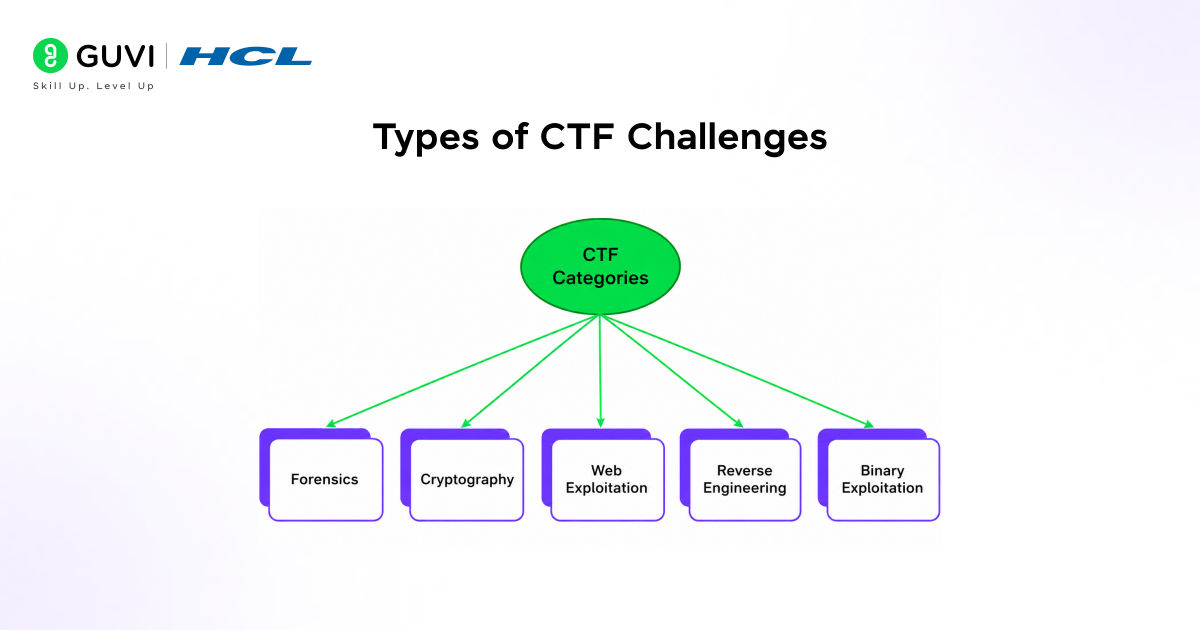
Understanding different challenge types helps beginners focus their learning.
Web Exploitation
Participants find vulnerabilities in web applications to retrieve hidden flags.
Skills Learned:
- SQL Injection
- Authentication flaws
- Web security concepts
Cryptography
These challenges require decrypting encoded messages or breaking encryption methods.
Skills Learned:
- Basics of encryption
- Encoding techniques
- Introduction to cryptanalysis
Digital Forensics
Participants analyze files, logs, memory dumps, or network captures to find evidence.
Skills Learned:
- Incident investigation
- File analysis
- Log analysis
Reverse Engineering
Learners look at compiled software to understand how it works and find hidden information.
Skills Learned:
- Program analysis
- Basics of assembly language
- Software security
Network Security
Challenges focus on analyzing network traffic and understanding communication protocols.
Skills Learned:
- Packet analysis
- Understanding protocols
- Troubleshooting networks
How to Start Your First CTF

Starting your first CTF can feel overwhelming, but a structured approach can simplify the process.
Step 1: Learn Basic Cybersecurity Concepts
Before joining a CTF, gain foundational knowledge in:
- Linux
- Networking
- Web technologies
- Cybersecurity fundamentals
Step 2: Set Up Your Learning Environment
Install tools used in beginner CTFs, such as:
- Wireshark
- Burp Suite Community Edition
- Nmap
- CyberChef
Step 3: Start With Beginner-Friendly Platforms
Several platforms offer challenges specifically for beginners. Popular options include:
- picoCTF
- OverTheWire
- TryHackMe
- CTFlearn
- Root Me
These platforms introduce cybersecurity concepts while keeping the learning curve manageable.
Step 4: Practice Consistently
Consistency is more important than difficulty.
Focus on:
- Solving challenges regularly
- Reading walkthroughs when needed
- Understanding solutions instead of just memorizing them
Step 5: Participate in Community CTFs
After building confidence, join beginner-friendly online competitions listed on platforms like CTFtime.
Best Platforms for CTF Beginners

1. picoCTF
One of the most beginner-friendly CTF platforms designed specifically for learning cybersecurity fundamentals.
2. OverTheWire
Offers structured wargames that teach Linux, networking, and security concepts step by step.
3. TryHackMe
Provides guided learning paths in cybersecurity along with beginner-friendly CTF-style rooms.
4. CTFlearn
Features hundreds of beginner-friendly challenges across various cybersecurity areas.
5. Root Me
Includes practical security challenges covering web, network, and cryptography topics.
Many cybersecurity professionals consider Capture The Flag (CTF) competitions an essential part of their learning journey. These challenges simulate real-world security scenarios, helping participants develop practical skills in areas such as cryptography, web security, reverse engineering, digital forensics, and network analysis. Employers increasingly value CTF experience because it demonstrates strong problem-solving abilities, hands-on technical expertise, and the ability to think like both an attacker and a defender.
Common Mistakes Beginners Make
Jumping Into Advanced Challenges Too Early
Tackling complex challenges too soon can frustrate beginners and harm motivation.
Memorizing Writeups
Understanding the reasoning behind a solution is far more valuable than merely following step-by-step instructions.
Ignoring Fundamentals
Having a solid grasp of networking, Linux, and web basics makes CTF challenges much easier.
Giving Up Too Quickly
Many challenges require patience and determination.
Learning Alone
Joining cybersecurity communities can speed up learning and introduce beginners to new techniques.
To avoid these mistakes and build a strong cybersecurity foundation, HCL GUVI’s Cybersecurity Course offers guided labs, hands-on projects, and structured learning paths tailored for aspiring cybersecurity professionals.
Tips for Success in CTF Competitions
Focus on Learning, Not Winning
The main goal of beginner CTFs should be skill development.
Keep Notes
Write down useful commands, tools, and techniques for future reference.
Learn Linux
Many cybersecurity tools and environments rely heavily on Linux systems.
Use Hints Wisely
Hints can help learners progress without getting completely stuck.
Review Every Challenge
After solving a challenge, spend time understanding different approaches and techniques.
Conclusion
CTF competitions offer a practical and engaging way to learn cybersecurity. By tackling real-world challenges in a safe environment, beginners can develop technical skills, improve problem-solving abilities, and gain hands-on experience across various cybersecurity areas. Whether your aim is ethical hacking, security analysis, or penetration testing, participating in CTFs can be an excellent starting point for your cybersecurity journey.
FAQs
1. What does CTF stand for in cybersecurity?
CTF stands for Capture the Flag, a cybersecurity competition where participants solve challenges to find hidden flags.
2. Is CTF suitable for beginners?
Yes. Many CTF platforms offer challenges that are friendly for newcomers.
3. Do I need programming knowledge for CTFs?
Basic programming knowledge can help, but many beginner challenges require only fundamental cybersecurity concepts.
4. Which CTF platform is best for beginners?
Popular beginner-friendly platforms include picoCTF, OverTheWire, TryHackMe, and CTFlearn.
5. Are CTF competitions legal?
Yes. CTFs occur in controlled environments designed for learning and skill development.
6. How often should beginners practice CTFs?
Consistent weekly practice is usually more effective than occasional intensive sessions.
7. Can CTFs help me get a cybersecurity job?
CTFs can help you develop practical skills and demonstrate hands-on experience, which many employers value when hiring.
Success Stories

About the Author
Vishalini Devarajan
An Aerospace Engineer turned content writer, I focus on making complex concepts easy to understand through well-structured, reader-friendly blogs. Whether it’s a technical topic or a non-technical one, I love creating content that is clear, engaging, and impactful.
View all posts by Vishalini Devarajan
Connect with me @












Did you enjoy this article?