


Human Resource Articles
AI in HR and Recruitment: Resume Screening and Bias Risks
Technical Interview vs HR Interview: 7 Key Differences


Get In Touch For Details! Request More Information
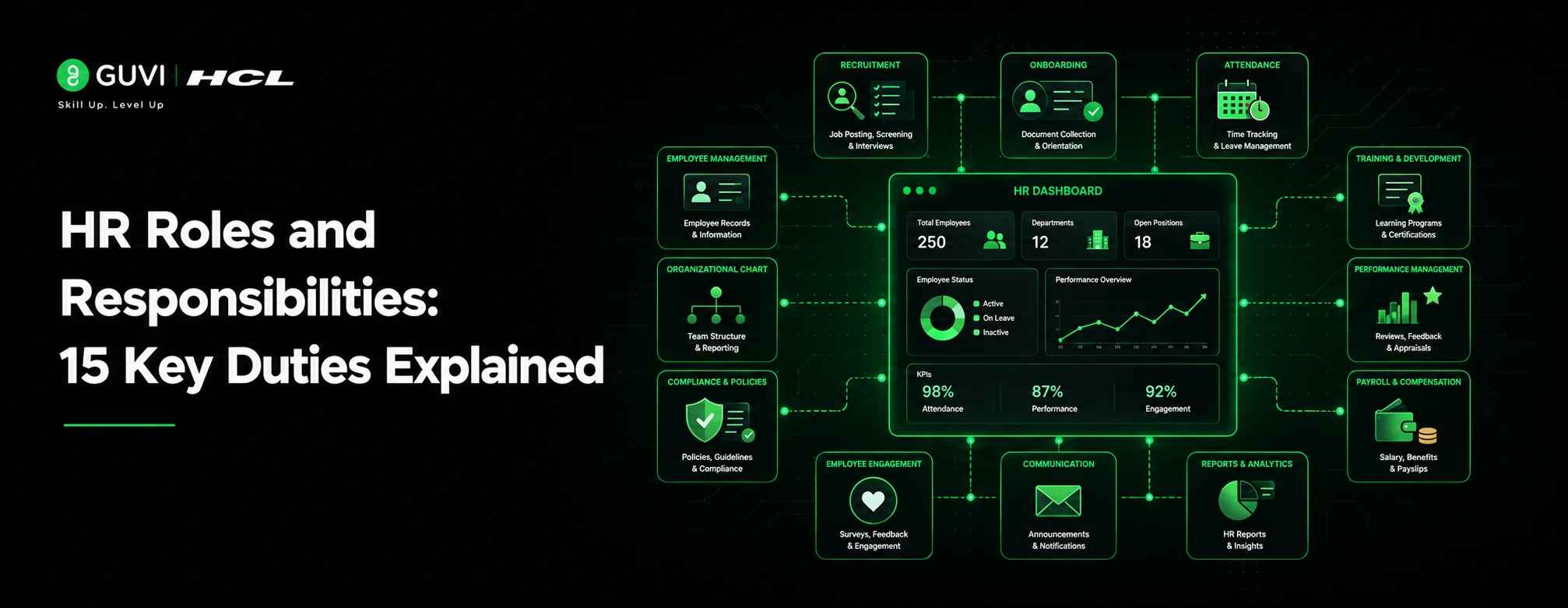
HR Roles and Responsibilities: 15 Key Duties Explained
Jun 29, 2026 7 Min Read 1247 Views
(Last Updated)
Table of contents
- TL;DR Summary
- What are HR Roles and Responsibilities?
- 15 Key HR Roles and Responsibilities
- Recruitment and Hiring
- Employee Onboarding
- Payroll and Salary Management
- Attendance and Leave Management
- Employee Records and Documentation
- Training and Development
- Performance Management
- Employee Engagement
- Employee Relations
- HR Policies and Workplace Rules
- Compliance and Labour Law Support
- Compensation and Benefits
- Workplace Culture Building
- Employee Grievance Handling
- Exit Management
- Day-to-Day Responsibilities of an HR Professional
- How HR Responsibilities Change Based on Company Size?
- HR Responsibilities in Startups
- HR Responsibilities in Mid-Sized Companies
- HR Responsibilities in Large Companies
- Common HR Job Roles
- Skills Needed to Handle HR Roles and Responsibilities
- Pro Tip
- How HR Roles are Changing Today?
- Common Myths About HR
- Key Takeaway on HR Roles and Responsibilities
- FAQs
- What are HR roles and responsibilities?
- What does an HR professional do daily?
- Is HR only responsible for hiring?
- What are the main duties of HR in a company?
- What skills are required for HR roles?
- Is HR a good career today?
- What is the role of HR in recruitment?
- What is the role of HR in employee onboarding?
- What is the role of HR in employee engagement?
- What is the difference between HR and recruiter?
- Can freshers start a career in HR?
- How are HR responsibilities changing today?
TL;DR Summary
HR roles and responsibilities include managing the people-related functions of a company, such as hiring, onboarding, employee support, payroll coordination, HR policies, documentation, engagement, and workplace culture. HR is not only about recruitment; it also helps improve employee experience, maintain company processes, support managers, and create a positive work environment. Today, HR roles are becoming more digital with HR software, analytics, remote work support, and employee experience management. Good HR professionals need communication, problem-solving, confidentiality, documentation, and people management skills. Freshers can start with roles like HR trainee, HR executive, recruiter, or HR operations assistant.
HR is one of those career roles that looks attractive because it involves people, communication, hiring, and workplace management.
You get to interact with candidates, support employees, solve workplace concerns, and help create a better work environment.
But HR is not only about conducting interviews or sending offer letters.
An HR professional plays an important role in:
- Hiring the right people for the company
- Supporting employee growth and workplace comfort
- Managing HR policies, attendance, payroll, and compliance
- Handling employee concerns and workplace issues
- Helping the company maintain a positive work culture
Today, HR roles are becoming more important as companies focus on employee experience, digital HR tools, workplace culture, remote work support, and people-first policies.
So, let’s understand HR roles and responsibilities in a simple and practical way.
What are HR Roles and Responsibilities?
- HR roles and responsibilities are the tasks handled by the Human Resources team to manage employees and support the company’s workplace needs.
- This includes hiring, onboarding, payroll, training, employee engagement, performance reviews, workplace policies, and exit formalities.
- In simple words, HR connects employees and the company. HR helps employees with their queries and concerns, while also helping the company build a strong, disciplined, and positive work environment.
Did you know HR is often the first and last impression an employee has of a company?
From the first interview call to onboarding, workplace support, growth discussions, and even exit formalities, HR is involved in almost every important stage of an employee’s journey.
That is why HR is not just a “people management” role. It directly shapes how employees feel about the company, how smoothly teams work, and how professionally the organization is represented.
15 Key HR Roles and Responsibilities
HR handles many tasks that directly affect employees and the company. Some responsibilities are related to hiring, while others focus on employee support, workplace rules, payroll, training, performance, and company culture. Here are the 15 key HR roles and responsibilities explained in a simple way.
1. Recruitment and Hiring
Recruitment is one of the most important HR responsibilities. HR helps the company find the right candidates for the right roles by creating job descriptions, posting job openings, screening resumes, scheduling interviews, coordinating with hiring managers, and sharing offer letters.
Real-world example: If a company wants to hire a software developer, HR first understands the skills needed, shortlists suitable candidates, arranges interviews, discusses salary expectations, and helps complete the joining process.
2. Employee Onboarding
Once a candidate is selected, HR helps them settle into the company through onboarding. This includes collecting documents, explaining company policies, introducing the new employee to the team, helping with system access, and making sure they understand their role clearly.
Real-world example: When a fresher joins a company, HR may guide them through document submission, ID card creation, laptop allocation, team introduction, and first-day orientation.
3. Payroll and Salary Management
HR also plays an important role in salary-related processes. In many companies, HR works with the finance team to make sure employees receive their salaries, payslips, reimbursements, bonuses, and deductions correctly.
Real-world example: If an employee has taken unpaid leave or submitted a travel reimbursement, HR checks the details and coordinates with finance so the salary is processed correctly.
4. Attendance and Leave Management
HR manages employee attendance, leave records, shift timings, holidays, and work-from-home updates. This helps the company track working hours properly and helps employees understand their leave balance and attendance status.
Real-world example: If an employee applies for sick leave or work from home, HR checks the policy, updates the leave record, and ensures the attendance system reflects it correctly.
5. Employee Records and Documentation
HR maintains important employee records such as resumes, offer letters, joining forms, ID proofs, salary details, performance records, warning letters, appraisal documents, and exit papers.
Real-world example: When an employee joins, HR collects Aadhaar, PAN, bank details, education certificates, and previous employment documents to maintain a proper employee file.
6. Training and Development
HR helps employees improve their skills through training programs, workshops, learning sessions, and development activities. These programs help employees perform better and grow in their roles.
Real-world example: If a customer support team is struggling with communication, HR may arrange a soft skills training session to improve call handling and customer interaction.
7. Performance Management
HR supports the performance review process by helping managers track employee goals, collect feedback, conduct appraisal cycles, and discuss performance improvement plans.
Real-world example: During appraisal time, HR may ask managers to review employee performance, collect ratings, schedule feedback discussions, and support decisions related to promotion or salary revision.
8. Employee Engagement
Employee engagement means keeping employees motivated, connected, and involved in the workplace. HR may plan feedback surveys, recognition programs, team activities, wellness sessions, or appreciation programs.
Real-world example: If employees feel disconnected in a hybrid work setup, HR may conduct online team activities, feedback sessions, or monthly recognition programs to improve team bonding.
9. Employee Relations
HR acts as a support system when employees face workplace issues, misunderstandings, or conflicts. HR listens to both sides and helps solve the matter professionally.
Real-world example: If there is a communication issue between an employee and a manager, HR may arrange a meeting, understand both perspectives, and help them reach a fair solution.
10. HR Policies and Workplace Rules
HR creates and explains workplace policies so employees know what is expected from them. These policies may include leave policy, attendance policy, code of conduct, dress code, remote work policy, notice period policy, and anti-harassment policy.
Real-world example: If an employee wants to know how many paid leaves they can take or what the notice period rule is, HR explains the policy clearly.
11. Compliance and Labour Law Support
HR helps the company follow employment rules and labour laws. This may include PF, ESI, gratuity, maternity benefits, working hours, workplace safety, and employee rights.
Real-world example: HR ensures eligible employees are registered for PF or ESI and that the company follows proper rules for maternity leave, working hours, and statutory benefits.
12. Compensation and Benefits
HR helps manage employee benefits along with salary structure. This may include health insurance, bonuses, incentives, paid leaves, wellness benefits, and other perks.
Real-world example: If a company offers health insurance to employees, HR explains the coverage, shares the policy details, and helps employees understand how to claim benefits.
13. Workplace Culture Building
HR plays an important role in building a positive workplace culture. This includes encouraging respectful communication, fairness, teamwork, transparency, employee recognition, and a safe work environment.
Real-world example: If a company wants to build a more open culture, HR may introduce feedback forms, manager check-ins, appreciation programs, and employee-friendly policies.
14. Employee Grievance Handling
Employees may sometimes face issues related to salary, workload, behaviour, policies, harassment, leave, or managers. HR provides a proper channel for employees to raise such concerns.
Real-world example: If an employee feels they are facing unfair treatment or excessive workload, HR listens to the concern, keeps the matter confidential, and works toward a fair solution.
15. Exit Management
HR also manages the exit process when an employee resigns or leaves the company. This includes resignation acceptance, notice period tracking, exit interviews, asset collection, full and final settlement, experience letters, and feedback collection.
Real-world example: When an employee resigns, HR confirms the last working day, collects the laptop or ID card, conducts an exit interview, and coordinates the final salary settlement.
If you are planning to start a career in HR, go through common HR interview questions to understand what recruiters usually ask and how you can prepare better.
Day-to-Day Responsibilities of an HR Professional
The day-to-day responsibilities of an HR professional are not limited to one task.
To understand it better, here is a simple example of how a normal HR workday may look.
A Day in the Life of an HR Professional
Hi, I am the HR executive of a company. Here is how my normal day as an HR professional may look in a company:
9:30 AM: I reach the office and check attendance records, leave requests, and urgent employee messages.
10:30 AM: I follow up with candidates, confirm their availability, and schedule interviews with the hiring team.
12:00 PM: I coordinate with managers to understand open hiring requirements and update them about shortlisted candidates.
2:00 PM: I help a new employee with joining documents, company policies, ID creation, and system access.
3:30 PM: I handle employee queries related to salary, leave balance, attendance, benefits, or workplace policies.
4:30 PM: I update employee records, prepare HR reports, and check pending documentation work.
5:30 PM: I plan an employee engagement activity or follow up on pending HR tasks before closing the day.
How HR Responsibilities Change Based on Company Size?
HR roles and responsibilities are not the same in every company.
In a small company, one HR person may handle almost everything. But in a large company, HR work is usually divided among different teams.

HR Responsibilities in Startups
In startups, HR professionals usually handle multiple tasks at the same time. One HR person may take care of hiring, onboarding, attendance, employee documents, basic payroll coordination, company policies, and employee engagement.
Real-world example: If a startup is hiring 10 new employees, the same HR person may post jobs, schedule interviews, collect documents, explain policies, and help new employees settle into the team.
HR Responsibilities in Mid-Sized Companies
In mid-sized companies, HR work becomes more structured. There may be separate people for recruitment, payroll, HR operations, employee engagement, and training.
Real-world example: One HR executive may handle hiring, while another person manages attendance, payroll coordination, and employee records. This helps the HR team work faster and avoid confusion.
HR Responsibilities in Large Companies
In large companies, HR responsibilities are usually divided into specialized departments. There may be separate teams for talent acquisition, learning and development, payroll, compliance, employee relations, HR operations, and HR business partnering.
Real-world example: A large IT company may have one HR team only for recruitment, another team for employee training, another for salary and benefits, and another for handling employee concerns.
So, the bigger the company, the more specialized HR roles become. But the main purpose remains the same: supporting employees and helping the company manage its people better.
Common HR Job Roles
| HR Job Role | What They Usually Do |
| HR Intern | Supports resume screening, interview scheduling, document collection, and employee data updates. |
| HR Executive | Handles daily HR tasks like onboarding, attendance, employee records, leave management, and employee queries. |
| HR Recruiter | Focuses on sourcing candidates, screening resumes, scheduling interviews, and coordinating hiring rounds. |
| HR Generalist | Manages multiple HR functions such as recruitment, payroll coordination, employee engagement, policies, and documentation. |
| HR Operations Executive | Handles HRMS updates, joining formalities, employee records, internal documentation, and exit formalities. |
| Payroll Specialist | Manages salary processing, payslips, deductions, reimbursements, and payroll-related queries. |
| Learning and Development Specialist | Plans employee training programs, workshops, upskilling sessions, and development activities. |
| Employee Relations Executive | Handles employee concerns, workplace conflicts, grievances, and internal communication. |
| HR Manager | Leads HR policies, manages the HR team, supports leadership, and ensures smooth people management. |
| HR Business Partner | Aligns HR practices with business goals, workforce planning, performance, and employee needs. |
If you are still exploring whether HR is the right path for you, learning how to find your perfect career field can help you make a clearer decision.
Skills Needed to Handle HR Roles and Responsibilities
To handle HR roles and responsibilities well, a person needs more than just communication skills. HR professionals deal with people, policies, documents, conflicts, salary queries, and sensitive employee information every day.
Some important HR skills include:
- Clear communication
- Good listening ability
- Basic recruitment knowledge
- Payroll and compliance awareness
- Conflict handling
- Employee data management
- HR tools and Excel knowledge
- Confidentiality and problem-solving
These skills help HR professionals manage employees better and support the company in a more professional way.
Along with HR knowledge, strong communication and soft skills for professionals can help you handle candidates, employees, and managers better.
Pro Tip
If you want to build a career in HR, don’t focus only on recruitment. Try to understand the full employee journey, from hiring and onboarding to engagement, performance, policies, and employee support.
This will help you understand HR roles and responsibilities better and prepare for real HR work, not just interview questions.
How HR Roles are Changing Today?
HR roles and responsibilities are no longer limited to hiring, payroll, and employee records.
Today, HR professionals are also expected to understand people, technology, culture, and employee experience.
Here are a few changes happening in HR today:
- AI in HR: HR teams use tools for resume screening, interview scheduling, attendance, payroll, and employee feedback.
- Skills-based hiring: Companies now look beyond degrees and focus more on practical skills, communication, projects, and job readiness.
- Hybrid work support: HR manages remote onboarding, flexible work policies, online communication, and virtual employee engagement.
- People analytics: HR uses employee data to understand hiring, performance, attrition, and engagement better.
- Employee experience: HR now focuses on making employees feel supported, valued, and comfortable at work.
In simple words, modern HR is not just about managing employees. It is about creating a better workplace for both employees and the company.
If you are planning to start your HR career, building the right professional skills to get hired can make your profile stronger.
Common Myths About HR
Many people have a very limited idea about HR roles and responsibilities. They think HR only takes interviews or sends offer letters, but the actual role is much bigger.
Myth 1: HR only conducts interviews
HR does handle recruitment, but it also manages onboarding, payroll coordination, employee engagement, policies, compliance, training, and workplace concerns.
Myth 2: HR is an easy job
HR may look easy from the outside, but it involves handling people, emotions, conflicts, deadlines, confidential data, and company expectations every day.
Myth 3: HR always supports only the company
A good HR professional balances both sides. HR supports the company’s goals, but also listens to employees and helps create a fair workplace.
Once you understand HR roles and responsibilities, the next step is to prepare for a job interview with clear answers and confidence.
Key Takeaway on HR Roles and Responsibilities
HR roles and responsibilities are much more than hiring candidates or managing employee records. HR supports the complete employee journey, from recruitment and onboarding to payroll, training, employee engagement, workplace policies, and exit management.
For anyone planning to build a career in HR, understanding these responsibilities clearly is the first step. It helps you know what the role actually involves, what skills you need, and how HR contributes to both employees and the company.
In simple words, HR is not just about managing people. It is about creating a workplace where people can work better, grow better, and feel supported
FAQs
1. What are HR roles and responsibilities?
HR roles and responsibilities include hiring employees, onboarding new joiners, managing employee records, supporting payroll, handling employee concerns, maintaining workplace policies, and helping the company build a better work environment.
2. What does an HR professional do daily?
An HR professional may screen resumes, schedule interviews, coordinate with managers, help employees with queries, update records, support onboarding, track attendance, and handle HR-related communication.
3. Is HR only responsible for hiring?
No, hiring is only one part of HR. HR also manages onboarding, employee engagement, performance support, training, payroll coordination, compliance, workplace policies, and employee relations.
4. What are the main duties of HR in a company?
The main duties of HR include recruitment, onboarding, employee management, payroll support, training coordination, performance tracking, policy implementation, and resolving employee concerns.
5. What skills are required for HR roles?
HR professionals need communication, problem-solving, people management, decision-making, documentation, confidentiality, negotiation, conflict handling, and basic knowledge of HR tools and labour policies.
6. Is HR a good career today?
Yes, HR can be a good career today because companies need skilled HR professionals to manage hiring, employee experience, workplace culture, compliance, and people operations.
7. What is the role of HR in recruitment?
In recruitment, HR writes job descriptions, screens resumes, schedules interviews, coordinates with hiring managers, communicates with candidates, and supports the final hiring process.
8. What is the role of HR in employee onboarding?
HR helps new employees complete joining formalities, understand company policies, meet teams, access tools, and settle smoothly into the organization.
9. What is the role of HR in employee engagement?
HR supports employee engagement by planning activities, collecting feedback, improving communication, resolving concerns, and helping create a positive workplace culture.
10. What is the difference between HR and recruiter?
A recruiter mainly focuses on finding and hiring candidates. HR has a broader role that includes recruitment, onboarding, employee support, payroll coordination, policies, performance, and workplace management.
11. Can freshers start a career in HR?
Yes, freshers can start in HR roles such as HR executive, recruiter, HR trainee, talent acquisition associate, or HR operations assistant by building communication, recruitment, and basic HR process knowledge.
12. How are HR responsibilities changing today?
Today, HR responsibilities include traditional tasks like hiring and onboarding, along with modern responsibilities such as employee experience, HR analytics, remote work support, digital HR tools, and workplace culture building.
Success Stories

About the Author
Reemsha Khan
Always been a storyteller at heart. Now, I turn complex topics into simple, easy-to-understand stories through content. Hope you find it helpful.
View all posts by Reemsha Khan
Connect with me @










Did you enjoy this article?