


Mechanical CAD Articles
Who Is a Mechanical CAD Designer? A Complete Beginner's Guide
How to Prepare for Mechanical Engineering Technical Interview Questions: A Practical Guide
CAD Designer Resume Examples & Tips to Land Your Dream Job
CAD Designer Career in India: Salary, Job Roles & Growth Path

Get In Touch For Details! Request More Information
7 Important Roles and Responsibilities of a Mechanical Engineer
Jun 03, 2026 5 Min Read 30874 Views
(Last Updated)
Ever wondered what happens behind the scenes before a product reaches your hands, whether it’s your bike, your AC, or a factory machine?
Mechanical engineers are the people making all of it work. They design the systems, test them under stress, ensure quality, and keep them running long after launch. It’s one of the broadest engineering disciplines out there.
If you’re exploring it as a career or just want to understand what the job really looks like, this article breaks down the roles and responsibilities of a mechanical engineer, including what’s changing in 2026.
Table of contents
- TL;DR Summary
- What is Mechanical Engineering?
- Skills Required for a Mechanical Engineer
- Technical Proficiency
- Mathematics and Physics
- Problem-Solving and Analytical Thinking
- Mechanical Systems and Materials Knowledge
- Roles and Responsibilities of a Mechanical Engineer
- Design and Development
- Analysis and Testing
- Manufacturing and Production
- Quality Assurance and Control
- Maintenance and Repair
- Project Management
- Research and Innovation
- Specialisations in Mechanical Engineering
- How the Role is Evolving in 2026?
- Mechanical Engineer Salary in India (2026)
- A Day in the Life of a Mechanical Engineer
- Conclusion
- FAQs
- What are the main roles and responsibilities of a mechanical engineer?
- What specializations are available in mechanical engineering?
- How is the mechanical engineer's role changing in 2026?
- What is the salary of a mechanical engineer in India?
- What software should a mechanical engineer know?
TL;DR Summary
- Mechanical engineers design, develop, test, and maintain mechanical systems across industries.
- Their core responsibilities span design & development, analysis & testing, manufacturing, quality control, maintenance, project management, and R&D.
- Key skills include CAD proficiency (AutoCAD, SolidWorks, CATIA), physics and math, problem-solving, and teamwork.
- In 2026, mechanical engineers are also expected to work with simulation software, digital twins, and AI-assisted design tools.
- The role goes far beyond manufacturing; specialisations span aerospace, automotive, robotics, HVAC, and more.
- Entry-level salaries start at ₹3–5 LPA and can grow to ₹20+ LPA with experience and specialisation.
What is Mechanical Engineering?
Mechanical engineering is the branch of engineering focused on the design, analysis, development, and maintenance of mechanical systems. It applies principles from physics, mathematics, and materials science to build everything from simple components to complex machines.
Any device that involves movement, energy transfer, or physical force has a mechanical engineer behind it. That includes cars, turbines, medical devices, aerospace components, and even the escalators in your mall.
It’s not a narrow field at all. You could be designing a prosthetic limb one day and working on a jet engine the next.
Mechanical engineering is one of the oldest engineering disciplines, it traces back to the ancient use of pulleys and levers. Today, it spans industries from robotics to biomedical devices to renewable energy.
Skills Required for a Mechanical Engineer
Before we get into the day-to-day responsibilities, it’s worth understanding what skills the role actually demands. These aren’t just textbook checkboxes, they’re tools you’ll use on the job every single day.
Technical Proficiency
Technical skills are the foundation of a mechanical engineer’s career. You’ll work with tools and software that turn ideas into real-world systems.
Key areas include:
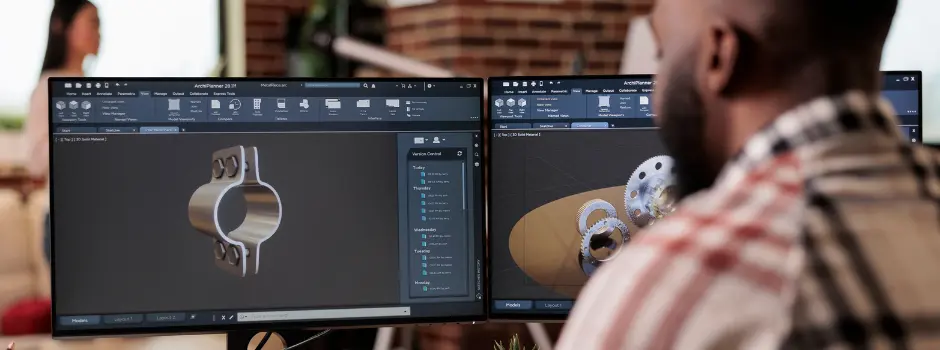
- CAD Software: Tools like AutoCAD, SolidWorks, and CATIA are used to create detailed 2D and 3D models of components.
- Simulation & Analysis: Software like ANSYS, COMSOL, and MATLAB help you predict how a design will behave under stress, heat, or pressure.
- Technical Drawing: Reading and creating engineering drawings is essential for communicating designs to manufacturing teams.
Want to build strong CAD skills from the ground up? Check out HCL GUVI’s CAD Course for Mechanical Engineers, it covers AutoCAD, SolidWorks, CATIA, ANSYS, and GD&T with real project experience.
Mathematics and Physics
Math and physics are the language of mechanical engineering. You’ll use calculus and differential equations to model dynamic systems, and physics principles like mechanics, thermodynamics, and fluid dynamics to understand how those systems behave under real-world conditions.
Without a solid grasp of these, predicting how a design will actually perform is guesswork.
Problem-Solving and Analytical Thinking
Mechanical engineers deal with complex, sometimes unexpected challenges. A machine breaking down mid-production, a design failing a stress test, a material behaving differently than expected, these are everyday scenarios.
Strong analytical thinking helps you break problems into parts, identify the best solution, and implement it efficiently.
Mechanical Systems and Materials Knowledge
Choosing the wrong material can compromise a product’s durability, safety, or cost. You need to understand how metals, polymers, composites, and alloys behave under stress, temperature, and environmental conditions.
Materials knowledge isn’t glamorous, but it’s what separates a good design from a failed one.
Roles and Responsibilities of a Mechanical Engineer
Now here’s the part you came for. The roles and responsibilities of a mechanical engineer are far broader than most people expect. Let’s break each one down clearly.
1. Design and Development
Every product starts with a plan. Mechanical engineers create detailed design plans for systems, components, or products, from initial concept to a manufacturable specification.
This involves:
- Creating 2D and 3D models using CAD software
- Simulating performance under stress, heat, and fluid flow
- Collaborating with electrical engineers, product designers, and manufacturing teams to ensure everything fits together
Real-world example:
When an automotive company develops a new engine component, the mechanical engineer designs it in CAD, simulates its performance across temperature and load ranges, and refines it before a single physical part is made. This saves both time and money.
2. Analysis and Testing
Design alone isn’t enough, you need to prove it works. Mechanical engineers run both virtual simulations and physical tests to validate designs before production begins.
This includes:
- Building prototypes and running stress or performance tests
- Collecting and interpreting test data
- Identifying gaps between expected and actual performance, then refining accordingly
Testing is where good designs become great ones. No product reaches the market without going through multiple rounds of this.
3. Manufacturing and Production
This is what most people associate with mechanical engineering, and it’s a significant part of the job. Turning a design into a physical product requires deep knowledge of manufacturing processes.
Mechanical engineers in this role:
- Develop manufacturing processes that are efficient and cost-effective
- Collaborate with factory and production teams to implement designs
- Troubleshoot problems that arise on the production floor in real time
They act as the bridge between design intent and physical output.
India is among the top 10 manufacturing nations globally. The demand for skilled mechanical engineers in sectors like automotive, defence, and aerospace is growing year on year, making this an excellent time to build specialised skills.
4. Quality Assurance and Control
A product that doesn’t perform safely is a liability, legally, financially, and ethically. Quality assurance is one of the most critical responsibilities of a mechanical engineer, especially in aerospace, automotive, and medical device manufacturing.
Their job involves:
- Establishing quality control standards and procedures
- Conducting inspections and audits to detect defects or deviations
- Analysing quality data and implementing corrective actions
Even a small error in tolerance can cause a component to fail catastrophically. That’s why quality control isn’t a one-time checklist; it’s a continuous process throughout the product lifecycle.
5. Maintenance and Repair
The work doesn’t stop after a product launches. Mechanical engineers ensure that equipment and systems continue operating reliably over time.
This means:
- Performing routine and preventive maintenance checks
- Diagnosing mechanical faults and identifying root causes
- Developing maintenance schedules to minimise unplanned downtime
In heavy industries like power plants or oil & gas, even an hour of unexpected downtime can cost crores. Preventive maintenance by mechanical engineers directly protects both safety and the bottom line.

6. Project Management
Experienced mechanical engineers often step into project management roles, especially for projects involving complex machinery or industrial systems. Their technical background makes them uniquely effective in this capacity.
Responsibilities here include:
- Defining project scope, objectives, and deliverables
- Allocating resources, time, budget, and personnel
- Coordinating across engineering disciplines to keep projects on track
Many senior mechanical engineers naturally transition into full-time project or program management roles over time.
7. Research and Innovation
This is where mechanical engineering shapes the future. R&D teams rely on mechanical engineers to develop new materials, processes, and technologies that don’t yet exist.
Key activities include:
- Staying updated on emerging technologies and materials
- Contributing to new product concept development
- Participating in research projects that push engineering boundaries
In 2026, this increasingly involves working with generative design tools, digital twins, and AI-assisted simulation, which we’ll cover in a dedicated section below.
Specialisations in Mechanical Engineering
One of the biggest strengths of a mechanical engineering degree is the range of directions you can take your career. Here are the most in-demand specializations right now:
| Specialization | What You Work On |
| Automotive Engineering | Vehicle design, powertrains, EVs, safety systems |
| Aerospace Engineering | Aircraft structures, propulsion, aerodynamics |
| HVAC Engineering | Heating, ventilation, and air conditioning systems |
| Robotics & Automation | Industrial robots, automated production lines |
| Thermal/Energy Engineering | Power plants, turbines, renewable energy systems |
| Biomedical Engineering | Prosthetics, surgical instruments, implants |
| CAD/Product Design | Detailed component design and manufacturing drawings |
Each specialisation has its own toolset, industry norms, and salary trajectory. Your undergraduate degree gives you the foundation, but specialisation is what makes you highly hireable.
How the Role is Evolving in 2026?
Mechanical engineering in 2026 looks different from what it did a decade ago. AI, automation, and digital tools are changing how engineers design, test, and collaborate.
Here’s what’s actively changing the profession:
Generative Design: AI-powered design tools can now generate optimised component shapes based on constraints like weight, stress, and material. Engineers define the goals; the software explores thousands of design possibilities. Tools like Autodesk Fusion 360 already offer this capability.
Digital Twins: A digital twin is a real-time virtual replica of a physical system. Mechanical engineers use them to monitor performance, predict failures, and test changes without touching the actual machine. Industries like aerospace and manufacturing are adopting them at scale.
AI-Assisted Simulation: Simulations that used to take hours now run in minutes with AI-enhanced solvers. This means faster iteration cycles and more testing before a prototype is ever built.
Sustainability Engineering: In 2026, companies face growing pressure to design products with lower carbon footprints. Mechanical engineers are increasingly involved in lifecycle analysis, material selection for recyclability, and energy-efficient system design.
The bottom line? The core fundamentals of mechanical engineering haven’t changed, but the tools are getting smarter. Engineers who combine traditional expertise with digital fluency will have a significant career edge.
Mechanical Engineer Salary in India (2026)
Salary in mechanical engineering varies significantly based on your specialisation, industry, and the skills you bring to the table. Here’s a realistic breakdown:
| Experience Level | Average Annual Salary (India) |
| Fresher (0–2 years) | ₹3 – 5 LPA |
| Mid-level (3–6 years) | ₹6 – 10 LPA |
| Senior (7–12 years) | ₹12 – 20 LPA |
| Lead / Manager | ₹20 – 35 LPA |
A few factors that move the needle significantly:
- Specialization: Aerospace and automotive roles typically pay more than general manufacturing.
- CAD/Simulation skills: Engineers proficient in CATIA, ANSYS, or SolidWorks command higher salaries.
- Industry: Defence, EV, and energy sectors are currently among the highest-paying for mechanical engineers in India.
- Certifications: Structured courses and certifications visibly improve early-career salary prospects.
A Day in the Life of a Mechanical Engineer
Wondering what it actually looks like day-to-day? Here’s a quick snapshot of a typical workday:
| Time | Activity |
| 9:00 AM | Review CAD drawings and flag design issues |
| 10:30 AM | Cross-functional meeting with the production team |
| 12:00 PM | Run simulation tests on a new component |
| 2:00 PM | Analyze test data and update design specs |
| 4:00 PM | Inspect a prototype for quality deviations |
| 5:00 PM | Document findings and plan next steps |
No two days are identical, and that variety is a big reason why people who love mechanical engineering rarely get bored of it.
If you’re just starting out, building strong CAD and simulation skills is one of the fastest ways to increase your market value. HCL GUVI’s Mechanical CAD Course is a good place to start, with mentorship, placement support, and real-world project work included.
Conclusion
Mechanical engineering isn’t just about factories and machines. From designing a component to managing a production line to running R&D on next-gen technologies, the scope of this profession is genuinely vast.
And in 2026, it’s expanding further. AI tools, digital twins, and sustainable design are creating new opportunities for mechanical engineers who are willing to evolve alongside the field.
If you’re looking to build a career in this space, start with the right skills. Strong CAD proficiency, simulation knowledge, and an understanding of manufacturing processes will make you job-ready in today’s market.
FAQs
What are the main roles and responsibilities of a mechanical engineer?
Mechanical engineers are responsible for designing systems, testing prototypes, managing manufacturing processes, ensuring quality, maintaining equipment, and contributing to R&D.
What specializations are available in mechanical engineering?
Popular specializations include automotive, aerospace, HVAC, robotics & automation, thermal/energy engineering, biomedical engineering, and CAD/product design.
How is the mechanical engineer’s role changing in 2026?
Engineers are increasingly working with AI-assisted design tools, digital twins, generative design software, and sustainable engineering frameworks. Digital fluency is becoming as important as traditional technical knowledge.
What is the salary of a mechanical engineer in India?
Freshers typically earn ₹3–5 LPA. With experience and specialization, salaries grow to ₹12–20 LPA at senior levels and ₹20–35 LPA for lead or managerial roles.
What software should a mechanical engineer know?
Core tools include AutoCAD, SolidWorks, CATIA, ANSYS, MATLAB, and COMSOL. Familiarity with generative design and simulation tools is increasingly valued.
Success Stories

About the Author
Lukesh S
A professional content writer who has experience in freelancing and now working as a Technical Content Writer at HCL GUVI having sound knowledge in Blog Writing and Creative Writing!
View all posts by Lukesh S
Connect with me @

Did you enjoy this article?
Comments








Fantastic post! You’ve highlighted key responsibilities that truly define the role of a mechanical engineer. From designing systems to ensuring safety and efficiency, each task plays a critical part in innovation. It’s great to see a clear breakdown of these roles, especially for aspiring engineers. Keep up the great work
this is amazing and educative, it displays an art of teaching yet retains the conscience of a person who has experience in the field.