


Data Science Articles
Treasury Manager to Data Analytics: Skills and Career Growth
Tax Professional to Data Analyst: Is Tax Analytics a Good Niche?
From Investment Research to Data Analytics: How to Bridge the Technical Skills Gap
How Banking and Financial Services Professionals Can Move into Data Analytics


Get In Touch For Details! Request More Information
AI vs ML vs Data Science: What is the Difference & Which to Learn? (2026)
Oct 16, 2026 5 Min Read 29924 Views
(Last Updated)
Confused about AI vs ML vs Data Science and how they differ? AI is the broad goal of building machines that think and act intelligently. ML is one technique for reaching that goal, where systems learn patterns from data instead of following fixed rules. Data Science uses both AI and ML, along with statistics, to extract insights from data.
Mixing these up can cost you time when choosing a course or career path. Learning the wrong skills first could mean months spent on something that doesn’t match your goals. This guide compares all three clearly and helps you decide where to start.
Table of contents
- TL;DR Summary
- What is AI, ML, and Data Science? Definitions & Real-World Examples
- Artificial Intelligence (AI)
- Machine Learning (ML)
- Data Science
- AI vs ML vs Data Science: Dimension-Wise Comparison Table
- AI vs ML vs Data Science Salary Comparison in India 2026
- Which to Learn First: AI, ML, or Data Science? — Learning Path
- Job Titles Under Each Field — Who Does What
- Conclusion: Making the Right Career Choice
- FAQs
- What is the main difference between AI vs ML vs Data Science?
- Which pays more in the AI vs ML vs Data Science comparison?
- Should I learn AI, ML, or Data Science first?
- Is Data Science a part of AI?
- Can one person learn all three — AI, ML, and Data Science?
- Which has more job demand in 2026, AI, ML, or Data Science?
TL;DR Summary
- AI vs ML vs Data Science are related but different: AI is the broad goal, ML is a technique to achieve it, and Data Science uses both to extract insights from data.
- In the AI vs ML vs Data Science comparison, Data Scientists currently earn slightly more on average in India (₹12.2 LPA) than AI or ML Engineers.
- Job titles overlap heavily, with roles like ML Engineer and Data Scientist often sharing similar day-to-day tasks.
- Beginners should start with Data Science fundamentals like Python and statistics before moving into ML and then AI.
- Where you start in AI vs ML vs Data Science depends on your interests—data analysis, model building, or advanced intelligent systems.
- The global AI market was valued at roughly $390.9 billion in 2026 and is projected to reach $3.5 trillion by 2033.
- Around 85% of machine learning projects fail, most often due to poor data quality.
- Specialized AI and big data roles, including data science and machine learning, are expected to grow by 30–35% in the coming years.
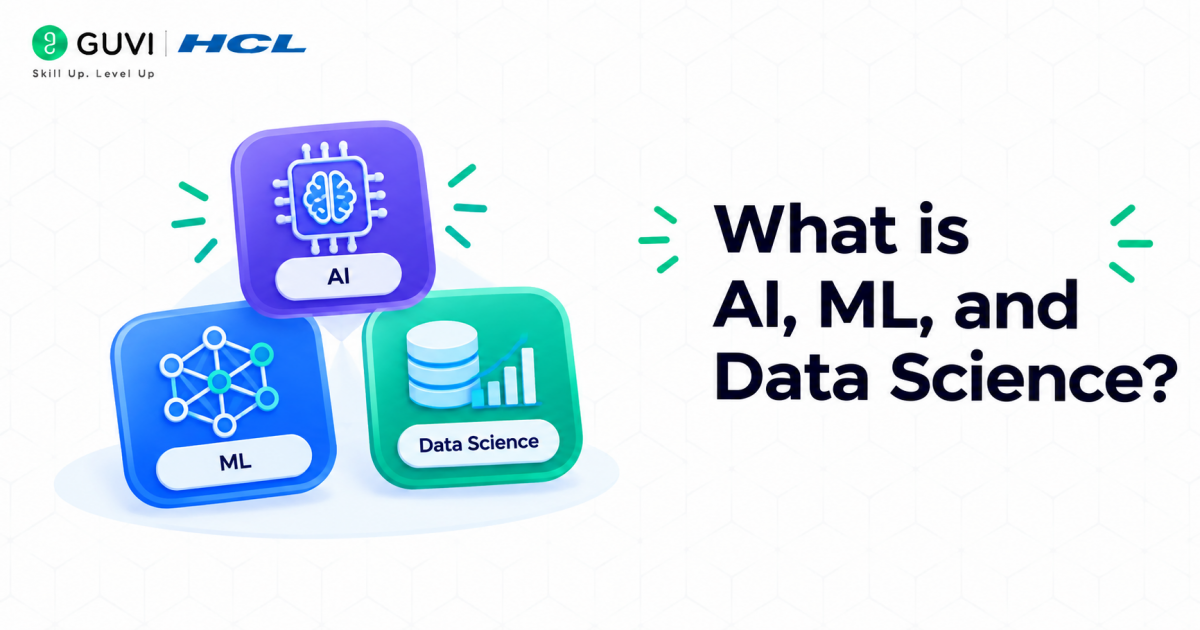
What is AI, ML, and Data Science? Definitions & Real-World Examples
Artificial Intelligence (AI)
Artificial Intelligence is the science of building machines that can think, reason, and act the way humans do — understanding language, recognizing patterns, or making decisions on their own. Think of it as teaching a computer to behave a little more like a human brain, capable of handling tasks that once needed a person.
Real-World Examples:
- Siri and Alexa understand voice commands and respond intelligently
- Tesla Autopilot perceives its surroundings and makes driving decisions in real time
- Google Translate understands and converts language between multiple languages instantly
Machine Learning (ML)
Machine Learning is a subset of AI where systems learn directly from data instead of following fixed, pre-written rules. The more data they see, the better they get at predicting outcomes. Imagine showing a child thousands of pictures of cats until they learn to recognize one on their own — that’s essentially how ML works.
Real-World Examples:
- Netflix studies your watch history to recommend shows you’ll actually like
- Gmail’s spam filter learns from flagged emails to catch spam more accurately over time
- Instagram’s feed algorithm learns what content you engage with and shows more of it
Data Science
Data Science is the field focused on collecting, cleaning, and analyzing data to find useful patterns and insights — using statistics, and often AI/ML, as tools to get there. Picture a detective sifting through clues in a massive pile of numbers to uncover a story hidden inside the data.
Real-World Examples:
- Amazon analyzes millions of purchase records to spot buying trends and plan inventory
- Spotify Wrapped turns your yearly listening data into personalized insights
- Zomato/Swiggy analyze order data to predict delivery times and demand in different areas
Level Up Before Everyone Else Does. The AI/ML space is moving fast, and reading about it only gets you so far. HCL GUVI’s Artificial Intelligence and Machine Learning Course takes you from zero to job-ready with 120+ hrs live classes, 25+ modules covering Python to LLMs & AI agents, 1:1 mentor support, and real placement assistance. No cap, no fluff — just skills that actually pay. Enroll now and future-proof your career!
AI vs ML vs Data Science: Dimension-Wise Comparison Table
| Dimension | AI | ML | Data Science | Overlap |
|---|---|---|---|---|
| Goal | Build systems that mimic human intelligence | Enable systems to learn from data without explicit programming | Extract insights and knowledge from data | All three aim to make data/systems useful for decisions |
| Scope | Broadest field, includes ML and more (robotics, NLP, vision) | Subset of AI | Independent field that uses AI/ML as tools | ML is part of AI; Data Science borrows from both |
| Core Technique | Rule-based systems, ML models, deep learning, expert systems | Algorithms like regression, decision trees, neural networks | Statistics, data cleaning, visualization, ML models | ML algorithms are commonly used inside Data Science workflows |
| Example Tool/Product | Siri, self-driving cars (Tesla Autopilot) | Netflix recommendations, Gmail spam filter | Amazon sales trend analysis, Spotify’s Wrapped insights | A single product (like Spotify) can use AI, ML, and Data Science together |
| Skills Needed | Programming, logic, ML, sometimes robotics/NLP | Python/R, statistics, ML algorithms | SQL, statistics, Python, data visualization, business understanding | Python and statistics are common to all three |
| Output | Intelligent behavior (decisions, predictions, automation) | A trained model that predicts or classifies | Reports, dashboards, insights, or predictive models | Insights from Data Science often feed into AI/ML systems |
Your Data, Your Career, Your Move. Every dataset tells a story — the question is whether you’re the one who can read it. That’s exactly what HCL GUVI’s Advanced Data Science & Generative AI Course trains you for: 6 months of live classes, placement assistance, expert mentor support, and hands-on projects that turn theory into a portfolio recruiters actually notice. 4.5M+ learners have already made the shift. Your turn now.
AI vs ML vs Data Science Salary Comparison in India 2026
AI vs ML vs Data Science salaries in India stay fairly close, with Data Science currently leading slightly because of its broader demand across statistics and business analytics.
| Role | Average Salary (Annual) | Entry-Level Range | Experienced Range |
|---|---|---|---|
| AI Engineer | ₹10.9 LPA | ₹6.5 LPA | Up to ₹28.6 LPA |
| ML Engineer | ₹11.5 LPA | ₹7 LPA | Up to ₹29 LPA |
| Data Scientist | ₹12.2 LPA | ₹7.6 LPA | Up to ₹29.9 LPA |
[Sources: Glassdoor – AI Engineer Salary, Glassdoor – Machine Learning Engineer Salary, Glassdoor – Data Scientist Salary ]

Which to Learn First: AI, ML, or Data Science? — Learning Path
There’s no universal answer to AI vs ML vs Data Science when it comes to what to learn first — it genuinely depends on your background, career goal, and how much time you can commit.
What works for someone aiming to become a software engineer won’t necessarily work for someone coming from a business or analytics background.
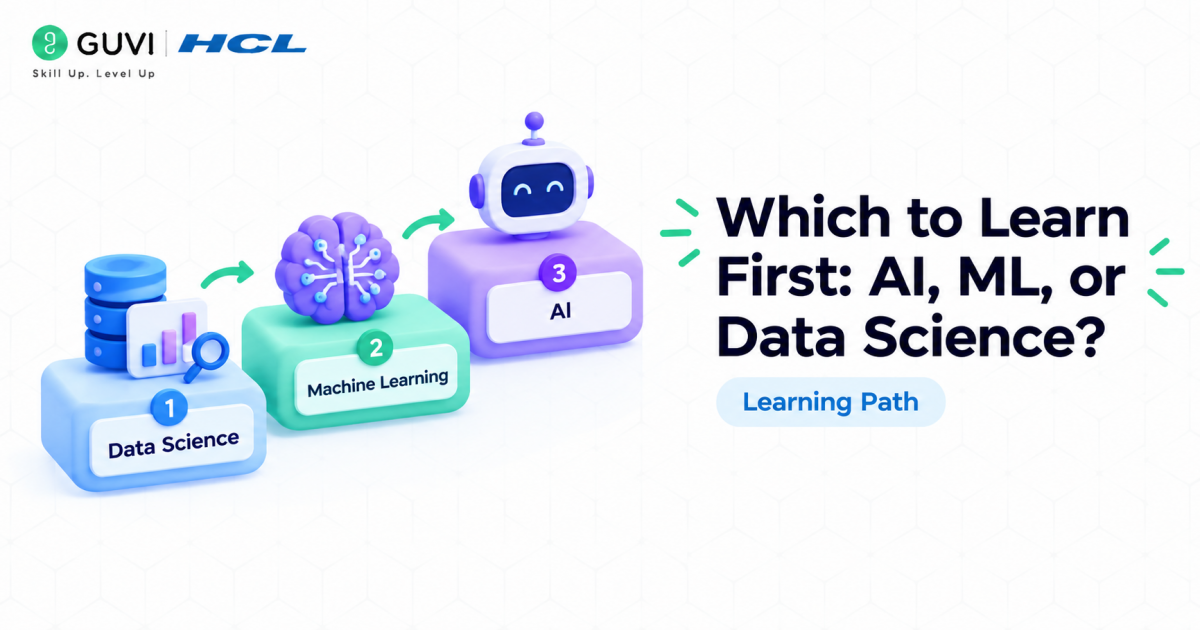
That said, most learning paths follow a logical order because each field builds on the previous one:
- Start with Data Science fundamentals if you’re a complete beginner — learn Python, SQL, and statistics first. These are the foundation skills every path needs, regardless of which direction you go later.
- Move into Machine Learning next once you’re comfortable with data handling — this is where you start building models and understanding algorithms like regression, classification, and clustering.
- Specialize in AI last if your goal is advanced work like deep learning, NLP, or generative AI — this typically requires solid ML fundamentals first, plus additional math (linear algebra, calculus) and frameworks like PyTorch or TensorFlow.
However, this order isn’t mandatory. If you already work in analytics or business intelligence, jumping straight into Data Science tools like Power BI, Excel, and SQL might make more sense than starting from scratch with ML theory.
Similarly, if you’re a software developer with strong programming skills, you could move into ML or even AI-focused roles faster since coding won’t be your bottleneck.
The more practical way to decide is by working backward from your goal:
- Want to work with data-driven business insights? Prioritize Data Science.
- Want to build predictive models and algorithms? Prioritize ML.
- Want to work on cutting-edge systems like chatbots, computer vision, or LLMs? Prioritize AI.
In the end, comparing AI vs ML vs Data Science isn’t about picking a “winner” — it’s about matching the field to where you want to end up.
Most professionals in this space end up learning all three to some degree anyway, since real-world projects rarely stay confined to just one.
Job Titles Under Each Field — Who Does What
Understanding AI vs ML vs Data Science also means knowing which job titles fall under each field, since job listings often use these terms loosely and can confuse candidates about what a role actually involves.
| Field | Common Job Titles | What They Actually Do |
|---|---|---|
| Artificial Intelligence | AI Engineer, AI Architect, NLP Engineer, Computer Vision Engineer, Robotics Engineer | Build intelligent systems that perceive, reason, and act — covering language, vision, and automation |
| Machine Learning | ML Engineer, ML Ops Engineer, Applied Scientist, Deep Learning Engineer | Design, train, and deploy models that learn patterns from data and improve over time |
| Data Science | Data Scientist, Data Analyst, Business Intelligence Analyst, Data Engineer | Collect, clean, and analyze data to generate insights, reports, and predictive models for decision-making |
Many of these roles overlap in practice — a Data Scientist might build an ML model, and an ML Engineer might use AI frameworks — so the job title alone doesn’t always tell you the full scope of the work.
Conclusion: Making the Right Career Choice
Choosing between AI, ML, and Data Science ultimately comes down to what kind of problems excite you. If you enjoy working with numbers and telling stories through data, Data Science fits naturally. If you’re drawn to building systems that learn and improve on their own, ML is the better path. And if you want to push boundaries with intelligent, autonomous systems, AI offers that challenge.
Don’t overthink the choice — start with whichever pulls you in the most, since the foundational skills carry over across all three anyway. The field will likely expand once you’re in it.
FAQs
1. What is the main difference between AI vs ML vs Data Science?
AI is the broad goal of building intelligent machines, ML is a technique to achieve it, and Data Science uses both to analyze data for insights.
2. Which pays more in the AI vs ML vs Data Science comparison?
Data Scientists currently earn slightly more on average in India, though all three fields offer strong, comparable salaries.
3. Should I learn AI, ML, or Data Science first?
Most beginners start with Data Science fundamentals like Python and statistics before moving into ML and then AI.
4. Is Data Science a part of AI?
Data Science overlaps with AI but is a separate field that uses statistics, analytics, and sometimes AI/ML tools to find patterns in data.
5. Can one person learn all three — AI, ML, and Data Science?
Yes, many professionals learn all three since real-world projects often require skills from each field.
6. Which has more job demand in 2026, AI, ML, or Data Science?
Demand is rising sharply across AI vs ML vs Data Science roles, with AI and ML specializations currently growing the fastest.
Success Stories

Did you enjoy this article?
Comments











This blog does an excellent job of clarifying the often confusing relationship between Artificial Intelligence (AI), Machine Learning (ML), and Data Science. The way you’ve broken down their distinct roles, especially highlighting AI as the parent field that encompasses both ML and Data Science, provides a clearer understanding of how these technologies intersect. It’s fascinating to see how companies like WhatsApp, DeepMind, and Tesla are leveraging AI and data to shape the future, as you pointed out. The demand for skilled professionals in AI, ML, and Data Science is truly immense, and it’s great to see courses like those offered by GUVI making it easier for people to gain practical skills and enter this fast-growing field. The real-world applications, such as smart assistants and facial recognition, demonstrate just how integral these technologies have become in our daily lives.
Great Article!