


Full Stack Development Articles
Can a Business Analyst Transition into a Technical Development/FSD Role?
How Can a Database Administrator Transition into Full Stack Development?
From Application Support to Application Development: Skills Professionals Need to Build
Full Stack Development Course for Working Professionals: Is It Worth It After 3–5 Years?


Get In Touch For Details! Request More Information
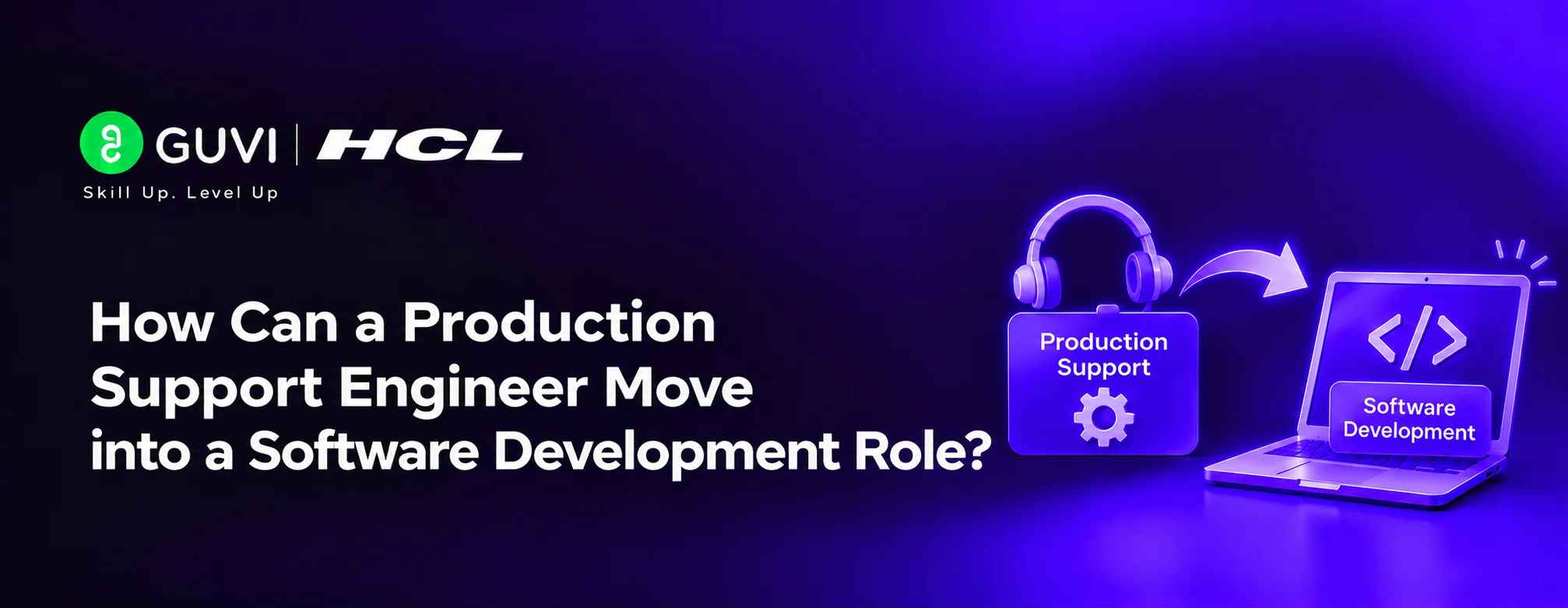
How Can a Production Support Engineer Move into a Software Development Role?
Nov 13, 2026 5 Min Read 25 Views
(Last Updated)
At 2 AM an alert fires. You read the stack trace, find the failing line, run a data fix, and close the ticket. By morning a developer ships the permanent fix, and you wonder why you could not be the one to write it.
So is production support to software development a realistic move? Yes. You already read real code failures, query live data, and work under pressure, which many new developers have never done. What you add is writing code for a living. Plan for about eight months at ten hours a week.
In this guide to production support to software development, you will find which of your skills developers value, four ways in, the software development skills to learn, a 32 week plan built from your own incidents, how to turn a root cause analysis into a code change, and what the pay data says.
Table of contents
- TL;DR Summary
- What is Production Support to Software Development?
- What Production Support Already Teaches You
- Four Ways In
- 💡 Did You Know?
- Software Development Skills to Learn
- One Language, Chosen From Your Stack
- SQL Beyond Quick Fixes
- Linux and the Command Line
- Git, Branches, and Code Review
- APIs and One Framework
- Testing and DSA
- A 32 Week Plan: Learn From Your Own Incidents
- Weeks 1 to 8: Automate a Repeated Fix
- Weeks 9 to 16: Build a Small Internal Tool
- Weeks 17 to 24: Fix a Real Defect
- Weeks 25 to 32: Portfolio and Interviews
- Turn a Root Cause Analysis Into a Code Change
- Projects Only Production Support Can Inspire
- How to Rewrite Your Resume
- Pay and Career Growth
- What HCL GUVI's Full Stack Development Course Offers a Support Engineer
- Common Mistakes in Production Support to Software Development Moves
- Conclusion
- FAQs
- Is production support to software development a good career move?
- How long does production support to developer take?
- Which language should I learn first for production support to software development?
- Can I move from production support to software development inside my company?
- Do I need DSA for production support to software development?
TL;DR Summary
- What it is: Production support to software development means moving from fixing live problems to building the software that has them.
- Your edge: Production support to software development moves start with real knowledge of how code fails in the wild.
- Four ways in: An internal move, a sustaining or L3 role, an SRE or DevOps bridge, or an external developer role.
- Plan: A production support to software development plan takes 32 weeks, with each stage tied to something from your incident history.
- Proof: Production support to software development hiring rewards a fix merged into a real codebase, plus two or three projects of your own.
- Next step: Start production support to software development by turning one repeated fix into a small, tested script.
What is Production Support to Software Development?
Production support to software development is the shift from keeping live applications healthy to designing and writing the code behind them. Instead of handling alerts and tickets, you plan features, write tests, and ship releases.
You already know how software behaves after launch. To see the building side, read what the software development life cycle covers, from planning to maintenance.
Rotas and release nights leave little free time. HCL GUVI’s Full Stack Development course offers live weekday and weekend batches with recordings, so you can learn beside your shifts and rewatch any class that clashes with an incident.
What Production Support Already Teaches You
Production support to software development is easier than it looks, because each support task trains a developer skill.
| In Production Support You | As a Developer You |
|---|---|
| Read stack traces and logs | Debug code and add useful logging |
| Run SQL to fix bad data | Design tables and write safe queries |
| Write root cause analysis notes | Write design notes and pull request descriptions |
| Follow runbooks | Turn runbooks into scripts and services |
| Handle hotfixes and change requests | Work with branches, reviews, and releases |
| Watch alerts and dashboards | Build monitoring into the code |
Four Ways In
Production support to software development has four common doors, and a production support engineer career transition rarely uses just one.
| Route | How It Works | Best If |
|---|---|---|
| Internal move | Ask to join the team that owns your application | Your company has an engineering team |
| Sustaining or L3 role | Fix defects in code as part of support | You want code in your week now |
| SRE or DevOps bridge | Automate operations and build tooling | You like systems and reliability |
| External developer role | Apply with projects and a portfolio | You want the fastest change of title |
An internal move keeps your reputation, so many people try it first. Developers work through seven SDLC phases, and you already know maintenance well.
💡 Did You Know?
- During Apollo 11’s descent in 1969, the guidance computer raised 1202 and 1201 alarms, but its software restarted fast enough to lose no data, and Houston gave a GO after judging the alarms safe.
Software Development Skills to Learn
For production support to software development, learn these in order, and use your own application as a guide.
1. One Language, Chosen From Your Stack
Pick the language your production code uses, such as Java, Python, or JavaScript, and read real code in it. Reading the code you support is the fastest start.
2. SQL Beyond Quick Fixes
You already run queries. If SQL is only for lookups so far, start with SQL for support teams, then learn to design tables, add indexes, and write queries that are safe on large data. These SQL queries with examples help you practise.
3. Linux and the Command Line
Strong command line habits carry straight into development work. This guide to Linux command line skills shows what developers use daily.
4. Git, Branches, and Code Review
Learn to branch, commit, and open pull requests. Reviews show how teams think about quality.
5. APIs and One Framework
Build a small web service with a framework from your language, and learn how requests and responses flow.
6. Testing and DSA
Write tests before fixing bugs, and practise arrays, strings, and hash maps for interviews. This guide to software testing strategies explains how teams plan tests.
A 32 Week Plan: Learn From Your Own Incidents
This plan for production support to software development assumes ten hours a week, so it runs about eight months. Each stage uses something from your real work.
Weeks 1 to 8: Automate a Repeated Fix
Learn the basics of your language and turn one manual step into a script. Use test data only.
Weeks 9 to 16: Build a Small Internal Tool
Create a web page and API for a common support task, with a database behind it.
Weeks 17 to 24: Fix a Real Defect
Ask the owning team for a small bug, write the fix and a test, and open a pull request. Use these types of software development life cycle to see how your team works.

Weeks 25 to 32: Portfolio and Interviews
Deploy your projects, practise DSA, and do mock interviews. This overview of how to become a software developer covers the final steps.
Turn a Root Cause Analysis Into a Code Change
This habit sits at the heart of production support to software development.
- Find the cause: Trace the failure to a line, query, or setting.
- Propose the fix: Write down the change and its risk.
- Add a test: Prove the bug stays fixed.
- Open a pull request: Link the incident and explain the change.
- Learn from review: Note every comment.
Always follow your company’s access and change rules. For the debugging side, read about debugging in software development.
Projects Only Production Support Can Inspire
Production support to software development projects can come from your experience, but never copy company data or code.
- Batch job monitor: Show which scheduled jobs passed or failed from sample data.
- Safe data fix script: Add a dry run mode that shows changes before applying them.
- Alert noise analyser: Group repeated alerts from sample logs.
- Post incident report builder: Turn a timeline into a clean report.
- Runbook search: Let users find steps by symptom.
How to Rewrite Your Resume
In production support to software development applications, recruiters may file support under operations, so write your work as engineering.
- Before: “Handled production incidents.”
- After: “Traced a failed batch job to a bad SQL filter, shipped the fix with a test, and wrote the runbook.”
- Add GitHub: Link your scripts and projects.
- Lead with projects: Put them above your support history.
Pay and Career Growth
Production support to software development often raises pay at the same experience, as reported ranges show.
| Experience | Production Support Engineer | Software Developer |
|---|---|---|
| 1 to 3 years | about ₹3.9 to ₹4.3 lakh a year | about ₹7 to ₹7.8 lakh a year |
| 3 to 6 years | about ₹5.8 to ₹6.4 lakh a year | about ₹9.5 to ₹10.5 lakh a year |
Note: Salary figures may change over time as users update their reported data. Please refer to the linked source for the latest salary ranges.
Without development experience, an employer may place you nearer a junior level, so build proof before you negotiate.
What HCL GUVI’s Full Stack Development Course Offers a Support Engineer
- Fits a rota: 130+ hours of live online classes in weekday or weekend batches, with recordings.
- Starts gently: It begins with programming fundamentals, then HTML, CSS, JavaScript, React, Node.js, Express.js, and MongoDB.
- Deployment practice: A cloud deployment pipeline project, plus DevOps and GenAI modules.
- More projects: An e-commerce web application, an order management system, and an AI chatbot that answers questions from documents.
- Help along the way: Live mentors, one to one doubt solving, mock interviews, resume review, and portfolio and GitHub guidance.
- Credentials: An IITM Pravartak certification and a complimentary MongoDB certification.
Classes run in English, Tamil, Hindi, and Telugu. This suits production support to software development learners who want structure beside shifts. See the syllabus and choose a batch on the Full Stack Development course page.
Common Mistakes in Production Support to Software Development Moves
- Only automating: In production support to software development prep, scripts alone do not make a portfolio.
- Practising on production: In production support to software development prep, use test systems only.
- Skipping DSA: Product company interviews often include coding rounds.
- Learning many languages: Pick one and finish a project.
- Sharing real data: Use sample data in public work.
Conclusion
Production support to software development works because you already know how real software fails. Add code, tests, and reviews, then prove it with a fix and a few projects.
Follow the 32 weeks, keep one project moving, and tell your manager where you are headed. A steady production support engineer career transition beats a rushed one.
HCL GUVI’s Full Stack Development course puts live mentors beside you while you build and deploy projects, then adds interview practice and two certifications. Pick a batch and start your production support to software development plan this week.
FAQs
1. Is production support to software development a good career move?
It is a good move if you want to build software, not only keep it running. Support remains a solid path, so choose based on the work you enjoy.
2. How long does production support to developer take?
About eight months at ten hours a week, or longer if on-call weeks are heavy.
3. Which language should I learn first for production support to software development?
Start with the language your production code uses. It lets you read real code from day one.
4. Can I move from production support to software development inside my company?
Often yes. Ask the owning team for small defects, and show a tested fix in a pull request.
5. Do I need DSA for production support to software development?
Many product company interviews include coding rounds, so practise arrays, strings, and hash maps. Other employers weigh projects more.
Success Stories

About the Author
Jebasta
I translate the language of data into stories that anyone can understand. As a writer with a data science background, I simplify analytics, AI, and decision-making so beginners and enthusiasts can confidently explore the world of data.
View all posts by Jebasta
Connect with me @






















Did you enjoy this article?