


DevOps Articles
How Network Administrators Can Transition into DevOps Engineering
Is DevOps Training a Good Investment for Experienced IT Professionals?

Get In Touch For Details! Request More Information
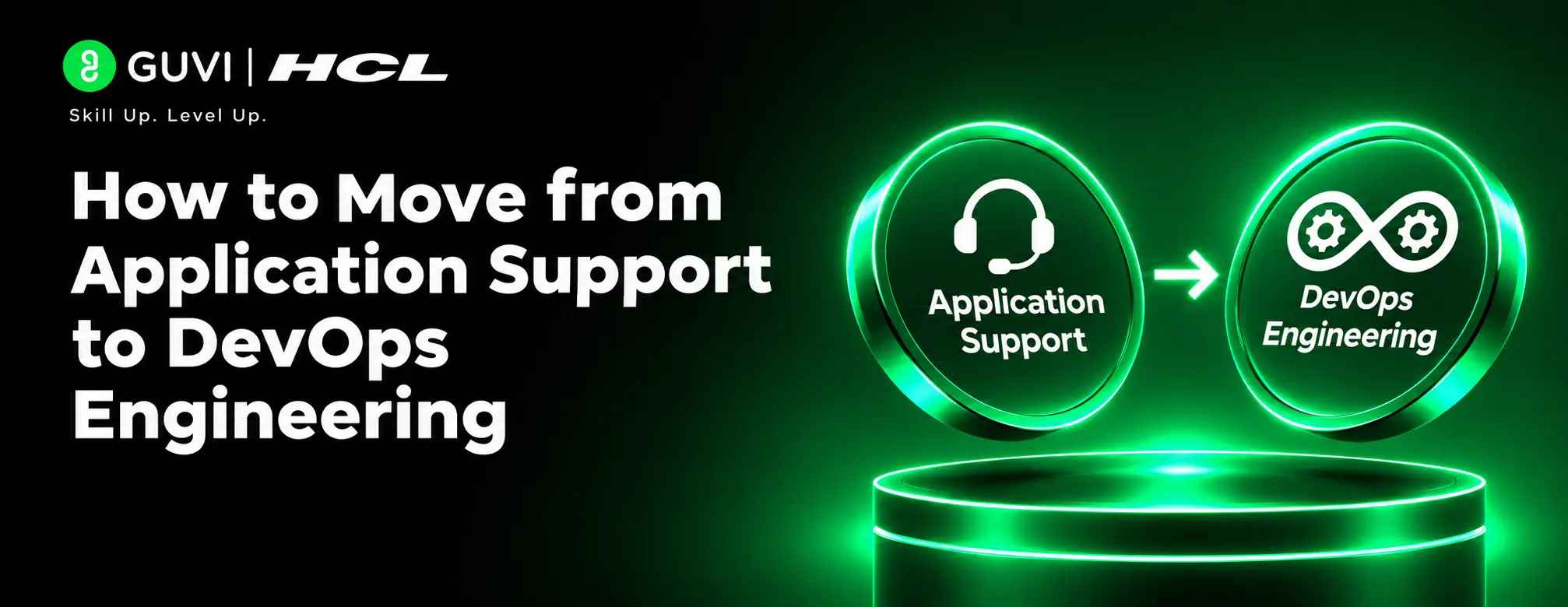
How to Move from Application Support to DevOps Engineering
Nov 10, 2026 3 Min Read 43 Views
(Last Updated)
Application support professionals already understand how business applications behave, how incidents affect users, and how to investigate technical problems. These skills provide a useful starting point for moving into DevOps engineering, but the transition requires additional technical knowledge.You need to develop practical skills in automation, cloud infrastructure, deployment pipelines, and monitoring. A focused learning plan can help you turn your support experience into engineering capabilities.
Table of contents
- TL;DR
- Quick Answer
- Understand the Difference Between Application Support and DevOps
- Application support provides a useful foundation
- Understand the responsibilities of a DevOps engineer
- Identify Your Transferable Skills
- Use troubleshooting experience to your advantage
- Build on your application and release knowledge
- Learn the Essential DevOps Skills
- Start with Linux, networking, Git, and scripting
- Progress to CI/CD, containers, and cloud
- Build Practical Projects
- Automate a common application support task
- Create a complete CI/CD deployment project
- Gain DevOps Experience in Your Current Workplace
- Volunteer for release and automation tasks
- Learn from development and infrastructure teams
- Prepare Your Resume for DevOps Roles
- Highlight technical experience instead of listing duties
- Apply for suitable transition roles
- Conclusion
- Frequently Asked Questions
- Can an application support engineer become a DevOps engineer?
- Do I need programming skills to move into DevOps?
- Which skills should I learn first?
- How long does it take to transition from application support to DevOps?
- Can I move into DevOps without leaving my current company?
- Which projects should I add to my DevOps portfolio?
- Which roles can help me transition into DevOps?
TL;DR
- Application support experience provides a foundation in troubleshooting and production operations.
- Learn Linux, networking, Git, scripting, CI/CD, Docker, and cloud fundamentals.
- Build projects that automate common support tasks.
- Seek opportunities to participate in releases and deployment activities.
- Update your resume with technical achievements and practical project experience.
Quick Answer
| To move from application support to DevOps engineering, build on your experience with incidents, logs, troubleshooting, and application operations. Learn Linux, scripting, Git, CI/CD, Docker, cloud platforms, and infrastructure as code. Build practical projects and seek opportunities to support deployments or automate recurring tasks. |
Understand the Difference Between Application Support and DevOps
1. Application support provides a useful foundation
Application support professionals maintain applications, investigate incidents, resolve user issues, and escalate technical defects. DevOps engineers also work with production systems, but take greater responsibility for automating software delivery and improving operational processes.
Your troubleshooting experience is valuable because you already understand application behaviour and common production failures. The next step is learning how to prevent recurring problems through automation.
2. Understand the responsibilities of a DevOps engineer
DevOps engineers work across development, testing, deployment, infrastructure, and monitoring. Their responsibilities may include maintaining CI/CD pipelines, provisioning cloud resources, managing containers, and improving release reliability.
Compare these responsibilities with your current work. Identify which skills you already possess and which areas require additional training.
Identify Your Transferable Skills
1. Use troubleshooting experience to your advantage
Investigating incidents teaches you to read logs, identify patterns, reproduce errors, and determine possible causes. These abilities are equally useful when diagnosing failed builds, deployment errors, and service interruptions.
Highlight experience involving:
- Application log analysis.
- Incident investigation and resolution.
- Root cause analysis.
- Production monitoring.
- Technical documentation and escalation.
2. Build on your application and release knowledge
Support professionals often understand application dependencies, configuration issues, user workflows, and production environments. This knowledge helps explain why deployment order, environment variables, database changes, and rollback procedures matter.
Observe how your organisation moves applications from development to testing and production. Understanding this process creates a practical connection between support and DevOps.
Professionals from technical support and infrastructure backgrounds can transition into DevOps because their existing experience often includes production troubleshooting and operational knowledge. Practical automation and deployment experience help bridge the remaining skills gap.
Learn the Essential DevOps Skills
1. Start with Linux, networking, Git, and scripting
These fundamentals make advanced DevOps technologies easier to understand. Learn Linux commands, file permissions, process management, DNS, connectivity troubleshooting, and basic version control.
Practise using Bash or Python to automate simple tasks. For example, write a script that checks service availability, searches logs for errors, or monitors disk usage.
2. Progress to CI/CD, containers, and cloud
Learn how continuous integration and continuous delivery pipelines build, test, and deploy applications. Then practise packaging applications with Docker and deploying them using one cloud platform, such as AWS, Azure, or Google Cloud.
Once you understand these workflows, explore Terraform for infrastructure as code and Kubernetes for container orchestration. Learn technologies progressively instead of trying to master every tool simultaneously.
Build Practical Projects
1. Automate a common application support task
Choose a repetitive task from your existing responsibilities, such as checking application availability or identifying recurring log errors. Write a script that performs the check automatically and produces a readable result.
Document the original problem, the script, setup instructions, and sample output. Upload the project to GitHub so employers can review your work.
2. Create a complete CI/CD deployment project
Build a small application and store its source code in Git. Configure a pipeline to run tests, build a Docker image, and deploy the application to a test environment.

Add a health check and basic monitoring. Document how you would investigate a failed deployment and restore the previous version.
Gain DevOps Experience in Your Current Workplace
1. Volunteer for release and automation tasks
An internal transition can be easier because you already understand the applications and business processes. Ask whether you can assist with deployment validation, release checklists, log analysis, or monitoring improvements.
Start with supervised tasks and follow your organisation’s change-management procedures. Never make unauthorised production changes to gain experience.
2. Learn from development and infrastructure teams
Connect with developers, cloud engineers, infrastructure teams, and release managers. Understand how they manage deployments, investigate recurring failures, and identify opportunities for automation.
Use this knowledge to choose your next learning goal. For example, you could start by improving deployment documentation before assisting with pipeline maintenance.
Ready to move beyond traditional IT roles? HCL GUVI’s AI Cloud Computing & DevOps Programme helps you develop practical cloud and DevOps skills through expert-led learning, real-world projects and career preparation.
Prepare Your Resume for DevOps Roles
1. Highlight technical experience instead of listing duties
Avoid describing your experience only through ticket handling and user support. Explain the applications you supported, technical issues you investigated, tools you used, and improvements you contributed to.
Include relevant experience with Linux, scripting, monitoring, databases, cloud platforms, and automation when you can demonstrate actual usage. Add GitHub project links to support your claims.
2. Apply for suitable transition roles
You do not have to move directly into a full DevOps engineer position. Build and release engineering, cloud operations, infrastructure support, and junior DevOps roles can provide relevant experience.
Review job descriptions and identify the core skills employers expect. Apply when you meet the main requirements rather than waiting until you know every technology.
Conclusion
Moving from application support to DevOps engineering involves progressing from resolving operational issues to improving the systems and processes behind software delivery.
Start with technical fundamentals, build projects based on real support problems, and seek supervised exposure to deployment activities. Apply for relevant roles when you can demonstrate your skills through practical work.
Frequently Asked Questions
1. Can an application support engineer become a DevOps engineer?
Yes. Application support provides experience with production systems, troubleshooting, logs, and incidents. Develop automation, scripting, CI/CD, and cloud skills to prepare for DevOps responsibilities.
2. Do I need programming skills to move into DevOps?
Basic scripting knowledge is useful for automation and pipeline tasks. Bash or Python is a practical starting point, and you can improve through small projects.
3. Which skills should I learn first?
Start with Linux, networking, Git, and scripting. Then progress to CI/CD, Docker, cloud services, Terraform, and Kubernetes.
4. How long does it take to transition from application support to DevOps?
There is no fixed timeline. It depends on your existing technical knowledge, study schedule, practical experience, and target job requirements.
5. Can I move into DevOps without leaving my current company?
Yes, if internal opportunities are available. Ask to assist with release activities, deployment validation, monitoring, or automation projects under appropriate supervision.
6. Which projects should I add to my DevOps portfolio?
Build a script that automates a support task and a complete CI/CD deployment project. Include Git, automated testing, Docker, deployment, monitoring, and clear documentation.
7. Which roles can help me transition into DevOps?
Consider junior DevOps engineer, build and release engineer, cloud operations engineer, infrastructure support engineer, and production engineer positions. Prioritise roles that offer practical exposure to automation and deployments.
Success Stories

About the Author
HCL GUVI
This article was selected and published as part of the HCL GUVI AI Blogathon 2026, an initiative designed to encourage students, AI enthusiasts, and aspiring tech writers to simplify complex AI concepts through impactful technical content. The contest recognized high-quality, original, and insightful AI-focused blogs, with selected authors receiving publication opportunities on the HCL GUVI blog platform along with official author credits and recognition.
View all posts by HCL GUVI
Connect with me @
























Did you enjoy this article?