


Cloud Computing Articles
From Beginner to DevOps Engineer: How HCL GUVI Zen Class Helps You Get There
12 Important Azure Admin Roles and Responsibilities- Complete Guide

Get In Touch For Details! Request More Information

Roles and Responsibilities of a Cloud Engineer in 2026 : A Comprehensive Guide
Sep 08, 2026 7 Min Read 23923 Views
(Last Updated)
Understanding the roles and responsibilities of a cloud engineer has become increasingly important as businesses continue to migrate applications, data, and operations to cloud platforms. This rapid shift has created strong demand for professionals who can efficiently build, manage, and maintain cloud environments.
Cloud engineers work behind the scenes to improve scalability, security, and performance while helping companies reduce infrastructure costs. Knowing what they do, the skills they require, and the career opportunities available helps explain why this profession is attracting so much attention.
Table of contents
- TL;DR Summary
- Roles and Responsibilities of a Cloud Engineer at a Glance
- What is Cloud Computing
- Importance of Cloud Computing
- Roles and Responsibilities of a Cloud Engineer
- Cloud Engineer Roles
- Key Responsibilities
- Difference Between a Cloud Engineer and a Software Engineer
- Daily Tasks of a Cloud Engineer
- a. Data Management and Storage
- b. Infrastructure Setup and Management
- c. Application Support and Deployment
- d. Security and Compliance Management
- e. Monitoring and Maintaining Availability
- f. Evaluating New Technologies
- Key Skills Required for a Cloud Engineer
- Cloud Computing Certifications
- Cloud Engineer Salary and Career Progression
- Cloud Engineer Career Path
- How to Build a Successful Career in Cloud Computing
- 1) Continuous Learning and Skill Enhancement
- 2) Networking and Building Professional Relationships
- 3) Gaining Hands-on Experience
- 4) Keeping up with Industry Trends
- Conclusion
- FAQs
- What does a Cloud Engineer actually do?
- Which skills are important for a Cloud Engineer?
- Is coding required for a Cloud Engineer?
- What is the difference between cloud and traditional IT systems?
- Which certifications are useful in cloud computing?
- Can a Cloud Engineer grow in their career?
- Why is understanding the Roles and Responsibilities of a Cloud Engineer important?
- What tools does a Cloud Engineer use?
- What is the difference between a Cloud Engineer and a DevOps Engineer?
- Is coding required for a Cloud Engineer?
TL;DR Summary
- Cloud Computing is a service model that delivers computing resources like servers, storage, databases, networking, and software over the internet, enabling flexible, scalable, and cost-efficient access for businesses and individuals.
- The blog explains the Importance of Cloud Computing, highlighting benefits such as cost-effectiveness, scalability, accessibility, data security, collaboration, and disaster recovery in modern digital systems.
- It clearly defines the Roles and Responsibilities of a Cloud Engineer, including cloud infrastructure design, deployment, maintenance, security management, data handling, and cross-team collaboration.
- It compares Cloud Engineers with Software Engineers, showing how cloud professionals focus on infrastructure and system management while software engineers focus on application development and coding.
- The blog also covers Daily Tasks of a Cloud Engineer, required Certifications (AWS, Azure, Google Cloud), and Career Growth paths for building a successful future in cloud computing.
Roles and Responsibilities of a Cloud Engineer at a Glance
A cloud engineer handles multiple aspects of cloud infrastructure, from designing and deploying systems to securing, monitoring, and optimizing them. The table below summarizes the key roles and responsibilities of a Cloud Engineer and the technologies commonly associated with each area.
| Key Responsibility | What a Cloud Engineer Does | Common Tools & Services |
| Cloud Infrastructure Design | Plans scalable cloud architectures based on application, performance, and business requirements. | AWS, Microsoft Azure, Google Cloud |
| Infrastructure Management | Configures and maintains compute, storage, networking, databases, and other cloud resources. | EC2, Azure Virtual Machines, Google Compute Engine |
| Application Deployment | Supports application deployment and helps maintain reliable cloud-based environments. | Docker, Kubernetes, CI/CD tools |
| Infrastructure Automation | Automates infrastructure provisioning and configuration to reduce repetitive manual work. | Terraform, AWS CloudFormation, Azure ARM/Bicep |
| Security & Access Management | Configures permissions, encryption, security policies, and other controls to protect cloud resources. | AWS IAM, Microsoft Entra ID, Google Cloud IAM |
| Monitoring & Troubleshooting | Monitors infrastructure health, investigates failures, and resolves performance or availability issues. | Amazon CloudWatch, Azure Monitor, Google Cloud Monitoring |
| Backup & Disaster Recovery | Implements backup, recovery, and resilience strategies to protect workloads and data. | Cloud-native backup and recovery services |
| Cost Optimization | Reviews resource usage and helps eliminate unnecessary cloud spending while maintaining performance. | AWS Cost Explorer, Microsoft Cost Management, Google Cloud cost tools |
| Collaboration & Documentation | Works with developers, DevOps, security, and IT teams while documenting cloud configurations and processes. |
Cloud adoption continues to surge, with over 90% of enterprises using cloud services as reported in the Flexera State of the Cloud Report, highlighting strong demand for cloud engineers worldwide.
What is Cloud Computing

Cloud computing is the delivery of computing services, such as servers, storage, databases, networking, and software, over the internet rather than relying solely on physical systems.
It allows businesses and individuals to access and use resources as needed without purchasing and maintaining large amounts of physical infrastructure, making it easier to scale resources in response to demand.
Cloud computing is widely used because it offers flexibility, scalability, and cost efficiency, supporting applications, data storage, websites, and many business operations.
Importance of Cloud Computing
Cloud computing has become increasingly important in today’s digital landscape. It offers numerous benefits, including:
- Cost-Effective: Cloud computing eliminates the need for organisations to invest in expensive hardware and infrastructure. Instead, they can pay for the resources they use on a pay-as-you-go basis.
- Scalability: Cloud services can be scaled up or down based on the organization’s needs, allowing businesses to quickly adapt to changing demands.
- Accessibility: Cloud-based applications and data can be accessed from anywhere, at any time, as long as there is an internet connection.
- Data Security: Cloud service providers often have robust security measures in place to protect sensitive data, making it more secure than storing data on local servers.
- Collaboration: Cloud computing enables real-time collaboration and data sharing among team members, regardless of their physical location.
- Disaster Recovery: Cloud-based backups ensure that data is protected and can be easily restored in the event of a system failure or disaster.
Roles and Responsibilities of a Cloud Engineer
Here’s a list of some of the roles that might interest you:
Cloud Engineer Roles
The following key cloud engineer job roles in the industry define how cloud systems are managed, designed, and secured:
a. Cloud Administrator: Manages cloud resources like servers, storage, networks, and ensures system availability and smooth operation.
b. Cloud Specialist: Works on specific cloud areas such as networking, storage, deployment, or platform configuration.
c. Cloud Architect: Designs the overall cloud infrastructure, defines system structure, and ensures scalability, security, and cost efficiency.
d. DevOps Specialist: Automates deployment processes, manages CI/CD pipelines, and ensures smooth integration between development and operations.
e. Cloud Security Specialist: Focuses on protecting cloud systems through access control, security policies, monitoring, and compliance management.
Key Responsibilities
The roles and responsibilities of a Cloud Engineer cover the complete lifecycle of cloud infrastructure, from planning and deployment to security, monitoring, and cost management. While the exact responsibilities vary across organizations and cloud platforms, these are the core areas most cloud engineers work across:
a. Cloud Infrastructure Design
Cloud engineers plan cloud environments based on application and business requirements. They select suitable compute, storage, networking, and database services while considering scalability, availability, security, performance, and cost.
b. Infrastructure Management
They provision, configure, and maintain cloud resources such as virtual machines, storage, databases, networks, and containers. They also ensure that infrastructure continues to support changing workloads and application requirements.
c. Application Deployment
Cloud engineers work with development and DevOps teams to deploy applications, configure the required cloud resources, manage deployment environments, and troubleshoot infrastructure-related issues that affect releases.
d. Infrastructure Automation
Rather than configuring resources manually, cloud engineers use Infrastructure as Code (IaC), scripts, and automation tools to provision and manage infrastructure consistently. Tools such as Terraform, CloudFormation, and Bicep are commonly used for this purpose.
e. Security and Access Management
They configure identity and access management (IAM), permissions, encryption, network security, and other controls to protect cloud resources. They may also work with security teams to meet organizational and regulatory compliance requirements.
f. Monitoring and Troubleshooting
Cloud engineers monitor logs, metrics, resource usage, and system health to detect performance or availability problems. They investigate incidents, troubleshoot infrastructure issues, and help restore affected cloud services.
g. Backup and Disaster Recovery
They establish backup, recovery, and resilience strategies to protect applications and data from outages, failures, or accidental loss. This can include automated backups, replication, and recovery procedures.
h. Cloud Cost Optimization
Another important responsibility is keeping cloud usage financially efficient. Cloud engineers monitor resource consumption, identify underused resources, adjust capacity, and use scaling strategies to reduce unnecessary spending without compromising performance.
i. Collaboration and Documentation
Cloud engineers work closely with developers, DevOps teams, security professionals, architects, and other stakeholders. They also document configurations, infrastructure changes, operational procedures, and troubleshooting processes to make cloud environments easier to maintain.
Also Read: 7 Essential Cloud Computing Skills For Cloud Engineers
Difference Between a Cloud Engineer and a Software Engineer

The table below provides a clearer understanding of how cloud engineers and software engineers differ in their responsibilities, focus areas, and daily work:
| Aspect | Cloud Engineer | Software Engineer |
|---|---|---|
| Primary Focus | Builds, manages, and maintains cloud infrastructure and cloud services | Designs, develops, tests, and maintains software applications |
| Main Work | Manages cloud resources, infrastructure, deployment, and system reliability | Writes code, develops features, tests applications, and fixes bugs |
| Technologies Used | Works with cloud platforms, networking, storage, containers, and infrastructure tools | Works with programming languages, frameworks, databases, and development tools |
| Main Responsibility | Focuses on infrastructure management and cloud operations | Focuses on application and software development |
| Performance Focus | Improves scalability, availability, and infrastructure efficiency | Improves software functionality, speed, and user experience |
| End Goal | Ensure systems run securely, reliably, and efficiently | Build software that solves user or business problems |
Also Read: Promising Scope of Cloud Computing
Daily Tasks of a Cloud Engineer
The daily work of cloud engineers can vary depending on company size, infrastructure complexity, and business requirements. However, most roles and responsibilities of a cloud engineer involve maintaining cloud systems, improving performance, and supporting business operations.
a. Data Management and Storage
- Migrate data from existing systems to cloud environments.
- Configure and manage storage solutions based on business needs.
- Implement backup and recovery strategies to improve data protection.
b. Infrastructure Setup and Management
- Configure networking, virtual machines, containers, and cloud resources.
- Manage cloud infrastructure to support applications and workloads.
- Optimize infrastructure performance and resource utilization.
c. Application Support and Deployment
- Work with development teams to deploy applications in cloud environments.
- Configure applications to use cloud-native services and cloud features.
- Support deployment processes and maintain application availability.

d. Security and Compliance Management
- Implement security controls, encryption, and access management practices.
- Monitor cloud environments for security risks and vulnerabilities.
- Help maintain compliance with business and industry requirements.
e. Monitoring and Maintaining Availability
- Monitor system health and identify performance issues.
- Troubleshoot problems affecting services and infrastructure.
- Ensure cloud services remain available, reliable, and scalable.
f. Evaluating New Technologies
- Research new cloud tools, services, and infrastructure improvements.
- Recommend technologies that improve cloud operations and efficiency.
- Since the roles and responsibilities of a cloud engineer continually evolve, staying up to date with new technologies is an important part of the job.
These daily activities collectively shape the roles and responsibilities of a cloud engineer and help organizations maintain efficient cloud operations.
Key Skills Required for a Cloud Engineer
To handle the roles and responsibilities of a Cloud Engineer effectively, professionals need a mix of technical, automation, and problem-solving skills. Some of the most important cloud engineer skills include:
- Cloud Platforms: Practical knowledge of AWS, Microsoft Azure, or Google Cloud and their core services.
- Networking: Understanding of DNS, IP addressing, subnets, routing, load balancing, VPNs, and firewalls.
- Linux: Familiarity with command-line tools, permissions, processes, and basic system administration.
- Infrastructure as Code: Ability to automate infrastructure provisioning using tools such as Terraform, CloudFormation, or Bicep.
- Containers: Knowledge of Docker and Kubernetes for deploying and managing containerized applications.
- Scripting & Automation: Basic Python, Bash, or PowerShell skills for automating repetitive cloud tasks.
- Cloud Security: Understanding of IAM, encryption, access controls, secrets management, and security best practices.
- Monitoring & Troubleshooting: Ability to use logs, metrics, and monitoring tools to identify and resolve cloud infrastructure issues.
Cloud Computing Certifications
The following certifications are widely recognized in the cloud industry and help build strong skills in cloud architecture, design, and management.
| Course Name | Official Link | Description |
|---|---|---|
| AWS Certified Solutions Architect | https://aws.amazon.com/certification/certified-solutions-architect-associate/ | Validates skills in designing and deploying scalable, secure, and reliable cloud solutions using AWS services. |
| Microsoft Certified: Azure Solutions Architect Expert | https://learn.microsoft.com/en-us/credentials/certifications/azure-solutions-architect/ | Focuses on designing and implementing cloud solutions on Microsoft Azure, including networking, storage, and security. |
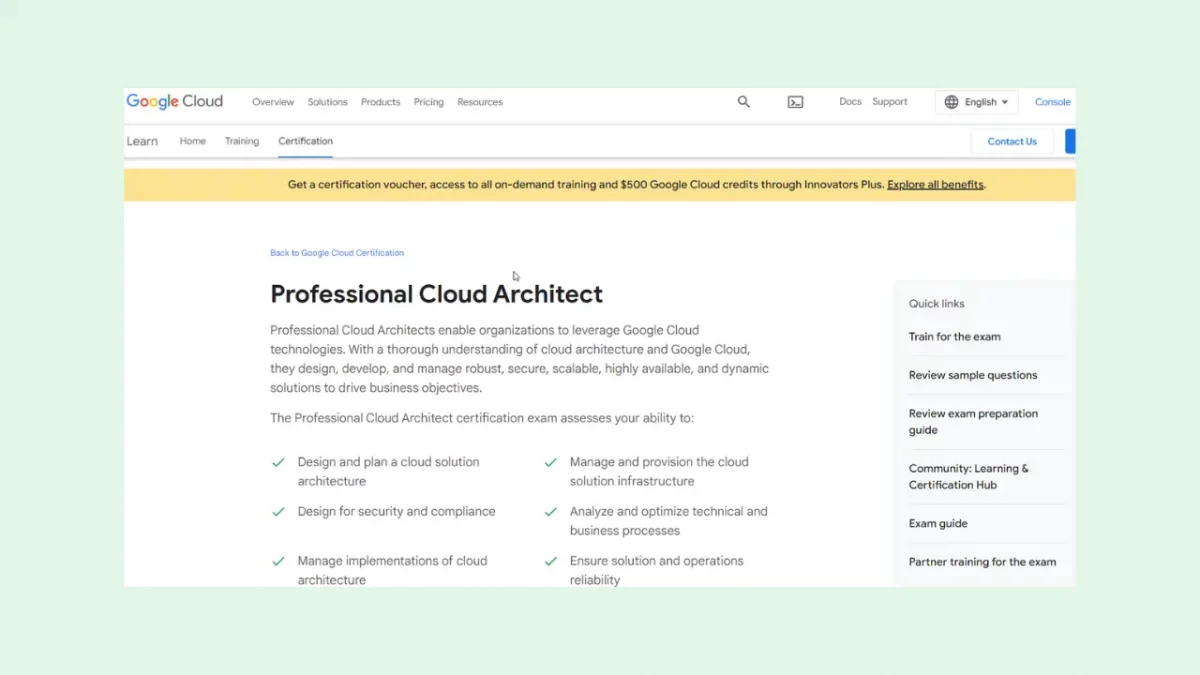
| Google Cloud Certified – Professional Cloud Architect | https://cloud.google.com/learn/certification/cloud-architect | Demonstrates expertise in designing, developing, and managing secure and scalable cloud solutions on Google Cloud Platform. |

Also Read: Top 10 High-Paying Cloud-Computing Jobs without Coding
Cloud Engineer Salary and Career Progression
Cloud Engineer salaries in India vary based on experience, employer, location, specialization, and cloud platform expertise. According to AmbitionBox, cloud engineers with around 1 to 7 years of experience earn approximately ₹3 lakh to ₹15 lakh per year. The earning potential generally increases as professionals gain experience and develop expertise in areas such as AWS, Azure, GCP, Kubernetes, automation, security, and cloud architecture.
Cloud Engineer Career Path
A cloud engineer career path typically starts with junior or associate-level positions and progresses as professionals take responsibility for increasingly complex infrastructure, automation, security, and architecture. A common progression is Junior Cloud Engineer → Cloud Engineer → Senior Cloud Engineer → Lead Cloud Engineer or Cloud Architect. Professionals can also specialize in related areas such as DevOps, platform engineering, site reliability engineering (SRE), or cloud security.
How to Build a Successful Career in Cloud Computing
Building a successful career in cloud computing requires continuous learning, skill development, and staying up to date with industry trends. Here are some tips to help you excel in your cloud computing career:
1) Continuous Learning and Skill Enhancement
Cloud computing is a rapidly evolving field, with new technologies and services emerging regularly. To stay ahead, it’s essential to continually learn and enhance your skills.
Stay up to date with the latest industry trends, explore new cloud technologies, and invest in professional development through online courses, certifications, and workshops.
2) Networking and Building Professional Relationships

Networking is crucial in any career, and cloud computing is no exception. Build professional relationships with colleagues, industry experts, and cloud computing communities.
Attend conferences, webinars, and meetups to connect with like-minded professionals and stay informed about the latest developments in the field.
3) Gaining Hands-on Experience
Hands-on experience is invaluable in cloud computing. Look for opportunities to work on real-world projects, participate in hackathons, and contribute to open-source projects.
Building a portfolio of practical projects will demonstrate your skills and make you more marketable to potential employers.
4) Keeping up with Industry Trends
Cloud computing is a dynamic field, with new technologies and trends emerging regularly. Stay updated with the latest industry news and trends by following industry blogs, podcasts, and publications. Join online communities and discussion forums to engage with experts and peers in the field.
Building a successful career in cloud computing requires dedication, continuous learning, and a passion for technology. By staying up-to-date with industry trends, enhancing your skills, and gaining hands-on experience, you can position yourself for growth and advancement in this exciting field.
Take the next step toward building your cloud career with HCL GUVI’s Cloud Computing Course. Gain hands-on experience through real-world projects while learning in-demand technologies like Azure Command-Line Interface (CLI), Azure Monitor, Azure Resource Manager (ARM) Templates, and many more tools used by industry professionals.
Conclusion
As businesses continue expanding their cloud adoption, the demand for skilled professionals keeps growing. Understanding the Roles and Responsibilities of a Cloud Engineer, building strong technical skills, staying up to date with new technologies, and earning relevant certifications can help professionals build a successful, future-ready career in this rapidly growing field.
Also Read: Top 10 Cloud Computing Trends You Should Know
FAQs
What does a Cloud Engineer actually do?
A Cloud Engineer builds and manages cloud systems, ensuring they run smoothly, securely, and efficiently.
Which skills are important for a Cloud Engineer?
Cloud platforms, networking basics, security knowledge, and understanding of deployment and storage systems are essential.
Is coding required for a Cloud Engineer?
Basic coding knowledge helps in automation, scripting, and managing cloud-based applications.
What is the difference between cloud and traditional IT systems?
Cloud systems use internet-based resources, while traditional IT depends on physical hardware and local infrastructure.
Which certifications are useful in cloud computing?
AWS, Microsoft Azure, and Google Cloud certifications are widely accepted in the industry.
Can a Cloud Engineer grow in their career?
Career growth includes roles in architecture, security, DevOps, and senior cloud positions with higher responsibilities.
Why is understanding the Roles and Responsibilities of a Cloud Engineer important?
Understanding the Roles and Responsibilities of a Cloud Engineer helps clarify the job scope and real-world expectations.
What tools does a Cloud Engineer use?
Cloud engineers use different tools depending on their responsibilities and cloud platform. Common technologies include AWS, Microsoft Azure, and Google Cloud for cloud services; Terraform and CloudFormation for Infrastructure as Code; Docker and Kubernetes for containers; Jenkins and GitHub Actions for CI/CD; and Prometheus, Grafana, and cloud-native monitoring tools for observability. They may also use Python, Bash, or PowerShell to automate routine cloud tasks.
What is the difference between a Cloud Engineer and a DevOps Engineer?
A Cloud Engineer primarily focuses on building, configuring, securing, and maintaining cloud infrastructure, while a DevOps Engineer focuses more broadly on automating software delivery and improving collaboration between development and operations. The roles often overlap in areas such as CI/CD, Infrastructure as Code, containers, monitoring, and cloud automation.
Is coding required for a Cloud Engineer?
Cloud Engineers do not usually need the same depth of programming knowledge as software developers, but basic coding and scripting skills are valuable. Languages such as Python, Bash, and PowerShell are commonly useful for automating infrastructure tasks, managing cloud resources, and reducing repetitive manual work.
Success Stories














Did you enjoy this article?