


Mechanical CAD Articles
Types of Mechanical Stress with Examples
LinkedIn Profile Tips for Mechanical Engineers: How to Build a Recruiter-Friendly Profile
Stress and Strain in Mechanical Engineering: Types, Formulas and Applications


Get In Touch For Details! Request More Information
Torque and Moment of Force: Meaning, Formula, Types and Applications
Nov 04, 2026 5 Min Read 43 Views
(Last Updated)
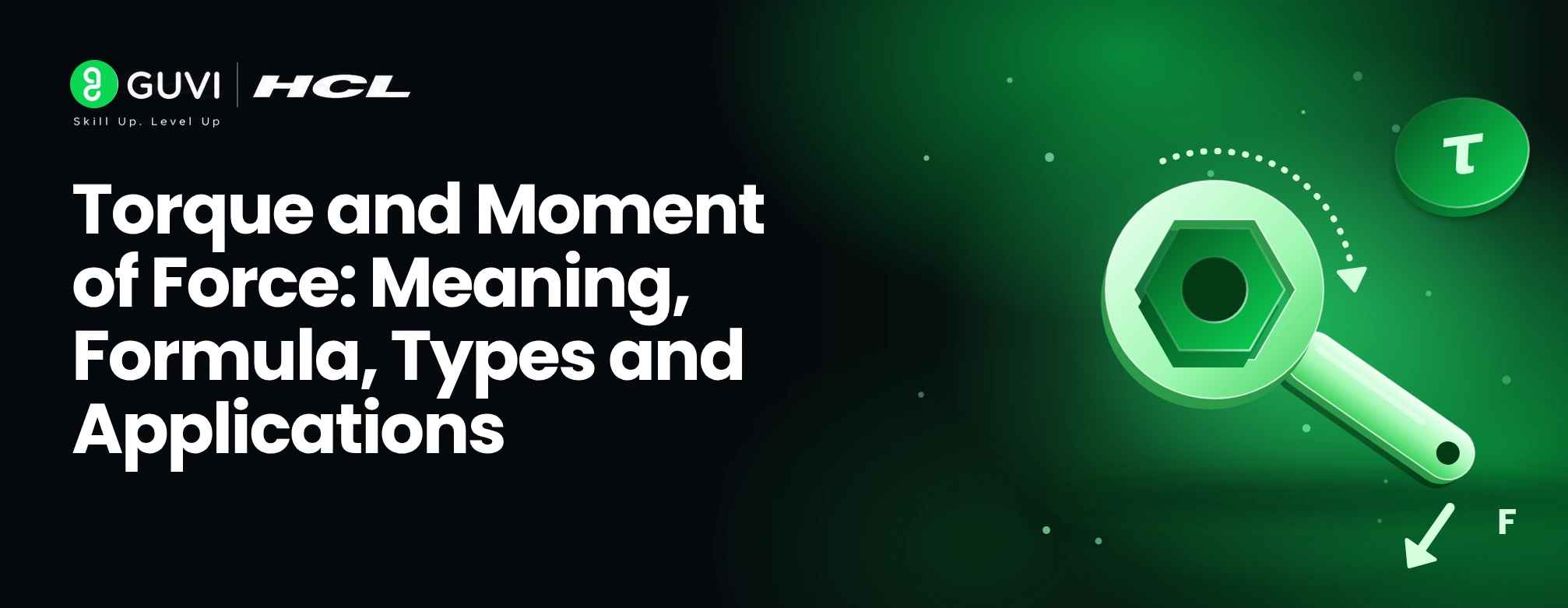
Tighten a bolt with a short spanner and it barely moves. Switch to a long-handled one and the same effort does the job. The difference is torque. Torque and moment of force describe how a force turns an object about a point or axis, and they sit behind almost every rotating machine, from a car’s crankshaft to a robot’s joint.
This blog covers what torque and moment of force mean, the formula, the factors that change it, the types of torque, and where engineers use it.
Table of contents
- TL;DR
- What Is Torque and Moment of Force?
- Formula for Torque and Moment of Force
- Special case: force perpendicular to the lever arm
- Numerical example
- Factors Affecting Torque
- Difference Between Torque and Force
- Types of Torque
- Clockwise and anticlockwise torque
- Static torque
- Dynamic torque
- Real-World Applications of Torque in Mechanical Engineering
- Why Is Understanding Torque Important for Mechanical Engineers?
- Conclusion
- Frequently Asked Questions (FAQs)
- What is the difference between torque and moment of force?
- What is the SI unit of torque?
- What is the formula for calculating torque?
- How does lever arm distance affect torque?
- What are some real-world applications of torque in mechanical engineering?
TL;DR
- Torque, or moment of force, is the turning effect a force produces about a pivot or axis.
- A force makes an object rotate when its line of action does not pass through the pivot.
- The formula is τ = F × r × sin(θ), and the SI unit is the newton-metre (N·m).
- Torque depends on the size of the force, the distance from the pivot, and the angle of application.
- Engines, motors, gears, shafts, wrenches, and robots are all designed around torque calculations.
What Is Torque and Moment of Force?
Torque, or moment of force, is the turning effect produced when a force acts on a body at a distance from its pivot or axis of rotation. It measures how effectively a force can rotate an object, not just push it.
Think about opening a door. You push near the handle, far from the hinges, and the door swings easily. Push near the hinge and you need far more effort. The hinge is the pivot, and the distance between your hand and the hinge decides how much turning effect your push creates.
The same thing happens with a spanner on a nut. The nut’s centre is the axis of rotation, and the spanner’s handle gives you the distance.
Are torque and moment of force the same? Mathematically, yes. Both are the product of force and distance about a point or axis. The difference is mostly in usage. “Torque” is the usual word when a force twists something around its own axis, such as a shaft, a bolt, or an engine crankshaft. “Moment of force” (or just “moment”) is more common in statics, for example in beams, levers, and structures, where the force tends to rotate or bend a body. In most mechanical engineering problems you can treat them as the same quantity.
Also checkout: Engineering Mechanics: Fundamentals of Force and Motion
Formula for Torque and Moment of Force
The torque formula is:
τ = F × r × sin(θ)
Where:
- τ is the torque or moment of force, in newton-metres (N·m)
- F is the applied force, in newtons (N)
- r is the distance from the axis of rotation to the point where the force is applied, in metres (m)
- θ is the angle between the position vector (the line from the axis to the point of application) and the force
The part r × sin(θ) is the perpendicular distance from the axis to the line of action of the force. This is also called the lever arm or moment arm. So the formula can also be written as torque = force × perpendicular distance. Only the force component perpendicular to the lever arm produces rotation. The component along the lever arm just pulls or pushes on the pivot.
Special case: force perpendicular to the lever arm
When the force acts at 90° to the lever arm, sin(90°) = 1. The formula becomes:
τ = F × r
This gives the maximum torque for a given force and distance. It is why you pull a spanner at a right angle to its handle, not along it.
Take Your Mechanical Engineering Skills Further with HCL GUVI!
Understanding concepts like torque and moment of force is essential for designing efficient mechanical systems. Take the next step in your engineering career with HCL GUVI’s Mechanical CAD course. Build practical CAD skills, gain hands-on experience with industry-relevant tools, and learn to create accurate mechanical designs.
Start building industry-ready mechanical design skills with HCL GUVI today!
Numerical example
A force of 50 N is applied at the end of a 0.4 m spanner, at an angle of 30° to the handle.
τ = F × r × sin(θ)
τ = 50 × 0.4 × sin(30°)
τ = 50 × 0.4 × 0.5
τ = 10 N·m
Now apply the same force at 90°:
τ = 50 × 0.4 × 1 = 20 N·m
The same force and the same spanner give double the torque, just because the push is now perpendicular.
Also checkout: Best Way to Learn Mechanical Engineering in 2026: Complete Roadmap
Factors Affecting Torque
Three things control how much torque you get.
Magnitude of force. Torque is directly proportional to force. Double the force while keeping everything else the same, and the torque doubles. A mechanic leaning harder on a wrench produces more turning effect.
Lever arm distance. Torque also grows in direct proportion to the distance from the pivot. This is why a breaker bar, which is just a long handle, can loosen a rusted wheel nut that a standard wrench cannot. Same effort, longer arm, more torque.
Angle of application. Torque is highest at 90° and falls as the angle shrinks. At 0° or 180°, the force points along the lever arm, sin(θ) becomes zero, and there is no torque at all. Pushing a door straight toward its hinge edge will never open it.
Also checkout: Best Way to Learn Mechanical Engineering in 2026: Complete Roadmap
Difference Between Torque and Force
Force pushes or pulls an object and tends to change its linear motion. Torque describes the turning effect of that force about a point. A force can exist without producing any torque, but torque always comes from a force acting at a distance from an axis.
| Parameter | Force | Torque (Moment of Force) |
| Definition | A push or pull on an object | Turning effect of a force about an axis |
| Type of effect | Linear motion | Rotational motion |
| Nature | Vector, acts along a line | Vector, acts along the axis of rotation |
| SI unit | Newton (N) | Newton-metre (N·m) |
| Formula | F = m × a | τ = F × r × sin(θ) |
| Example | Pushing a box across the floor | Tightening a nut with a spanner |
Torque is a vector quantity. Its direction follows the right-hand rule: curl your fingers in the direction of rotation and your thumb points along the torque vector. Do not confuse torque with “rotational force”. Torque is the moment of a force, not a separate type of force.

Types of Torque
Torque is classified in two ways: by direction of rotation and by whether the body is accelerating.
Clockwise and anticlockwise torque
These describe the direction in which the force tends to rotate the body. A clockwise moment turns the body the way a clock’s hands move, and an anticlockwise moment turns it the opposite way. Tightening a standard right-hand screw is clockwise, and loosening it is anticlockwise.
By convention, anticlockwise moments are usually taken as positive and clockwise as negative. In a balanced see-saw, the clockwise moment equals the anticlockwise moment, so the net torque is zero. This is the principle of moments.
Static torque
Static torque acts on a body that is not accelerating in rotation. The body may be stationary, or it may be rotating at a steady speed. A tightened bolt holding a flange under load carries static torque. So does a motor shaft turning at constant speed against a steady load.
Dynamic torque
Dynamic torque acts when the rotational speed is changing. When a car engine pulls the crankshaft from idle to higher speed, the net torque is producing angular acceleration. Starting a motor, braking a flywheel, and shifting gears all involve dynamic torque.
Also checkout: Mechanical Engineering Careers in 2026: The Top Jobs
Real-World Applications of Torque in Mechanical Engineering
Automobile engines and transmissions. Engine torque is what you feel as pulling power. Engine specifications are given in N·m, and gearboxes multiply this torque at lower gears so a car can climb a slope or pull away with a load.
Electric motors. Every motor is rated for its rated torque. Engineers match this to the load, since a motor with too little torque will stall at startup. Electric vehicles are known for delivering high torque from zero speed.
Gear systems. A small gear driving a larger one gives more torque at lower speed. Gear ratios let engineers trade speed for torque, as in a lifting winch or a bicycle’s low gear.
Shafts and rotating machinery. Shafts in pumps, turbines, and compressors transmit torque. Engineers calculate the twisting stress on a shaft to choose its diameter and material so it does not fail.
Spanners, wrenches, and fasteners. Bolts have specified tightening torques. Too little and the joint loosens under vibration. Too much and the thread or bolt can be damaged. Torque wrenches are used precisely to hit these values, for example on cylinder heads and wheel nuts.
Industrial machines. Conveyors, mixers, lathes, and presses all need the drive system sized for the required torque, including the extra torque needed at startup.
Robotics and automation. A robot arm’s joint motors must produce enough torque to hold and move the arm and its payload. The farther the load is from the joint, the larger the torque required, which is the same lever-arm effect seen earlier.
Engineers use these calculations to size motors, choose gear ratios, and check that components can carry the loads without failing or wasting energy.
Also checkout: 8 Important Skills Required for Mechanical Engineering
Why Is Understanding Torque Important for Mechanical Engineers?
Torque appears at almost every stage of mechanical design. Knowing it helps engineers:
- Design rotating components such as shafts, couplings, and flywheels
- Select motors and engines that can deliver the required turning effect
- Calculate the turning effect of forces on levers, beams, and linkages
- Analyse stresses in gears, shafts, and bolted assemblies
- Improve efficiency by matching torque and speed to the actual load
- Understand rotational motion in machines, including how power relates to torque
One related point is worth keeping straight. Torque and power are different. Torque is the turning effect, while power is how fast work is done. They are linked by P = τ × ω, where ω is angular speed in rad/s. A machine can have high torque but low power if it turns slowly.
Conclusion
Torque and moment of force describe how a force turns an object about a pivot. The turning effect depends on how big the force is, how far from the axis it acts, and the angle at which it is applied. Once you can work with τ = F × r × sin(θ), problems involving spanners, shafts, gears, and motors become much easier to analyse and design.
If you are starting out in mechanical engineering, practise a few lever and spanner problems with different angles. The pattern becomes obvious quickly.
Frequently Asked Questions (FAQs)
1. What is the difference between torque and moment of force?
They have the same formula and unit. “Torque” is usually used for twisting about a shaft’s own axis, while “moment of force” is common in statics and structural problems.
2. What is the SI unit of torque?
The newton-metre (N·m). Although it looks like the unit of energy, torque is a vector and is not measured in joules.
3. What is the formula for calculating torque?
τ = F × r × sin(θ). When the force is perpendicular to the lever arm, it simplifies to τ = F × r.
4. How does lever arm distance affect torque?
Torque is directly proportional to it. Doubling the distance from the pivot, with the same force, doubles the torque.
5. What are some real-world applications of torque in mechanical engineering?
Engines, electric motors, gearboxes, shafts, torque wrenches for fasteners, industrial machinery, and robotic joints all depend on torque calculations.
Success Stories

About the Author
Vishalini Devarajan
An Aerospace Engineer turned content writer, I focus on making complex concepts easy to understand through well-structured, reader-friendly blogs. Whether it’s a technical topic or a non-technical one, I love creating content that is clear, engaging, and impactful.
View all posts by Vishalini Devarajan
Connect with me @







Did you enjoy this article?