


Career Articles
Treasury Manager to Data Analytics: Skills and Career Growth
Tax Professional to Data Analyst: Is Tax Analytics a Good Niche?
From Investment Research to Data Analytics: How to Bridge the Technical Skills Gap
How Banking and Financial Services Professionals Can Move into Data Analytics


Get In Touch For Details! Request More Information
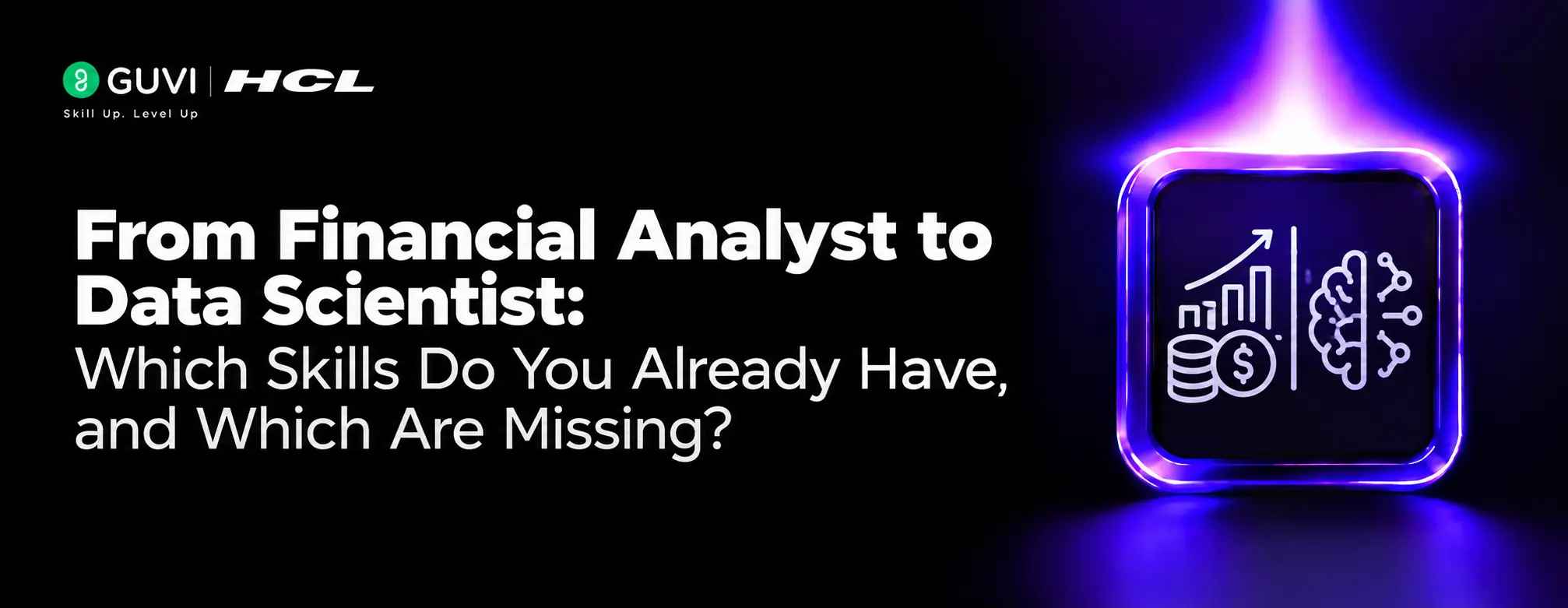
From Financial Analyst to Data Scientist: Which Skills Do You Already Have, and Which Are Missing?
Oct 26, 2026 3 Min Read 24 Views
(Last Updated)
Working as a Financial Analyst gives you experience interpreting numbers, evaluating business performance, and identifying financial trends. If you want to become a Data Scientist, you already have a foundation in analytical thinking. The next step is learning how to use programming, statistics, and machine learning to solve more complex problems.
Balancing this transition with a full-time job can be challenging, especially when you need to learn SQL, Python, and Power BI alongside your existing responsibilities. Instead of trying to master everything at once, identify your current strengths, prioritize missing skills, and follow a manageable learning schedule.
Table of contents
- TL;DR
- Quick Answer
- Which Data Science Skills Do Financial Analysts Already Have?
- Financial and Business Analysis
- Data Interpretation and Reporting
- Spreadsheet Skills
- Which Skills Are Missing for a Data Scientist Role?
- SQL
- Python and Statistics
- Machine Learning
- Power BI
- How Can You Learn SQL, Python, and Power BI While Working Full-Time?
- Which Projects Can Connect Financial Analysis With Data Science?
- Financial Performance Dashboard
- Financial Data Analysis With Python
- Revenue Forecasting
- When Should You Apply for Data Scientist Jobs?
- Conclusion
- FAQs
- Can a Financial Analyst become a Data Scientist?
- Which skill should I learn first: SQL, Python, or Power BI?
- Can I learn Data Science while working full-time?
- Is Power BI necessary to become a Data Scientist?
- Do Financial Analysts need to learn Python?
- Which projects should a Financial Analyst build?
- How long does it take to transition from Financial Analyst to Data Scientist?
TL;DR
- Financial Analysts already have useful skills in data interpretation, financial analysis, and business problem-solving.
- SQL, Python, statistics, and machine learning are important areas to develop.
- Power BI can help you communicate findings through dashboards and visualizations.
- A consistent learning schedule can help you study while working full-time.
- Build finance-related projects to demonstrate your skills before applying for Data Scientist roles.
Quick Answer
| Financial Analysts moving into Data Science can build on their existing knowledge of financial metrics, trend analysis, and business decision-making. Focus first on SQL for data retrieval, Python for analysis, and statistics for understanding data. Learn Power BI to communicate findings, then progress to machine learning and model evaluation. If you work full-time, dedicate short, consistent study sessions to each skill and apply what you learn through practical projects. |
Which Data Science Skills Do Financial Analysts Already Have?
1. Financial and Business Analysis
You may already work with revenue, expenses, profitability, forecasts, budgets, and financial performance indicators. These skills help you understand business objectives and identify patterns that deserve further investigation.
2. Data Interpretation and Reporting
If you regularly prepare reports, compare financial analyses, or explain variances, you have experience turning numbers into useful information. This foundation can help you communicate analytical findings to business stakeholders.
3. Spreadsheet Skills
If you use Excel for formulas, PivotTables, lookups, or financial models, you already have experience organizing and analysing structured data. These skills can make the transition to SQL and Power BI easier.
Financial services use Data Science for applications such as fraud detection, credit risk assessment, customer segmentation, and forecasting. Your financial knowledge can help you understand these problems, while programming and statistical modelling can help you develop technical solutions.
Which Skills Are Missing for a Data Scientist Role?
The biggest gaps usually involve technical analysis, statistical modelling, and building predictive solutions.
1. SQL
SQL helps you retrieve, filter, join, and summarize data stored in databases. Start with SELECT, WHERE, aggregate functions, GROUP BY, and joins. Practise answering questions using financial transaction or sales datasets.
2. Python and Statistics
Python supports data cleaning, exploratory analysis, automation, and machine learning. Begin with basic syntax, pandas, and NumPy. Alongside programming, learn probability, distributions, hypothesis testing, correlation, and regression.
3. Machine Learning
Data Scientists often build models to predict outcomes or identify patterns. Learn the basics of regression, classification, decision trees, model validation, and evaluation metrics after developing a foundation in Python and statistics.
4. Power BI
Power BI is useful for transforming data into interactive dashboards and communicating insights. Although dashboard development alone does not make someone a Data Scientist, it can strengthen your ability to present findings clearly.
How Can You Learn SQL, Python, and Power BI While Working Full-Time?
A realistic schedule is more useful than an ambitious plan you cannot maintain. Begin with around 30–60 minutes on weekdays, adjusting the duration to your workload and energy levels.
- Monday and Tuesday — SQL: Practise queries, filtering, joins, and aggregations.
- Wednesday and Thursday — Python: Work on fundamentals, pandas, and small data analysis exercises.
- Friday — Review: Revisit difficult concepts and solve practice questions.
- Weekend — Power BI and projects: Build a dashboard or combine your learning into a small project.
You can adjust this schedule around work commitments. If you have only 30 minutes available, use that time consistently rather than skipping study because you cannot complete a longer session.

Which Projects Can Connect Financial Analysis With Data Science?
Projects based on familiar financial problems can help you practise new technical skills while demonstrating your domain knowledge.
1. Financial Performance Dashboard
Use Power BI to visualize revenue, expenses, profit margins, and monthly trends. Practise cleaning the dataset and explaining the patterns you identify.
2. Financial Data Analysis With Python
Use pandas to clean a public or synthetic financial dataset, calculate summary statistics, compare periods, and investigate unusual changes. Document your process and conclusions.
3. Revenue Forecasting
Once you understand the basics of statistics and machine learning, build a simple forecasting project using suitable historical data. Compare your model with a basic baseline and explain its limitations rather than presenting predictions as guaranteed outcomes.
Use public or synthetic datasets, and never upload confidential employer or customer financial information to a public repository.
When Should You Apply for Data Scientist Jobs?
You do not need to master every tool before exploring opportunities. Start reviewing job descriptions early to understand the expectations of different employers and identify the skills you need to strengthen.
Apply for Data Scientist roles when you can demonstrate relevant programming, statistical reasoning, and machine learning knowledge through projects or professional experience. The transition is based on demonstrated ability, not simply the number of courses completed.
Conclusion
Moving from Financial Analyst to Data Scientist does not require you to discard your existing experience. Your understanding of financial metrics, reporting, and business performance can provide useful context for analytical work.
Identify your skill gaps, learn SQL and Python, strengthen your statistical foundations, and use Power BI to communicate insights. With a manageable study schedule and relevant projects, you can develop your skills while continuing to work full-time. Focus on consistent progress and practical ability rather than trying to learn every tool at once.
FAQs
1. Can a Financial Analyst become a Data Scientist?
Yes. Financial Analysts can transition by developing programming, statistics, and machine learning skills and demonstrating their abilities through relevant projects.
2. Which skill should I learn first: SQL, Python, or Power BI?
Start with SQL and basic data analysis, then learn Python for more advanced analysis. Power BI can be learned alongside these skills when dashboard reporting is relevant to your goals.
3. Can I learn Data Science while working full-time?
Yes. A consistent schedule of short weekday sessions and longer weekend practice sessions can help you progress without leaving your job.
4. Is Power BI necessary to become a Data Scientist?
Not always. Power BI is useful for visualization and reporting, but many Data Scientist roles place greater emphasis on programming, statistics, machine learning, and model evaluation.
5. Do Financial Analysts need to learn Python?
Python is valuable for data cleaning, automation, statistical analysis, and machine learning. It is particularly useful when moving toward technical Data Scientist roles.
6. Which projects should a Financial Analyst build?
Financial performance dashboards, Python-based financial analysis, and revenue forecasting projects can help demonstrate relevant analytical and technical skills.
7. How long does it take to transition from Financial Analyst to Data Scientist?
There is no fixed timeline. It depends on your current technical skills, study schedule, project experience, and the requirements of your target roles.
Success Stories

About the Author
HCL GUVI
This article was selected and published as part of the HCL GUVI AI Blogathon 2026, an initiative designed to encourage students, AI enthusiasts, and aspiring tech writers to simplify complex AI concepts through impactful technical content. The contest recognized high-quality, original, and insightful AI-focused blogs, with selected authors receiving publication opportunities on the HCL GUVI blog platform along with official author credits and recognition.
View all posts by HCL GUVI
Connect with me @










Did you enjoy this article?