


Career Articles
Finance Managers: Could Data Science Be Your Next Career Move?
Insurance Claims Executive to Data Analyst: Is It a Good Switch?
Banking Executive (Loans, KYC) to Data Analyst: Skills and Career Path
BPO Fresher: Switch to Data Analytics Now or Gain More Experience First?


Get In Touch For Details! Request More Information
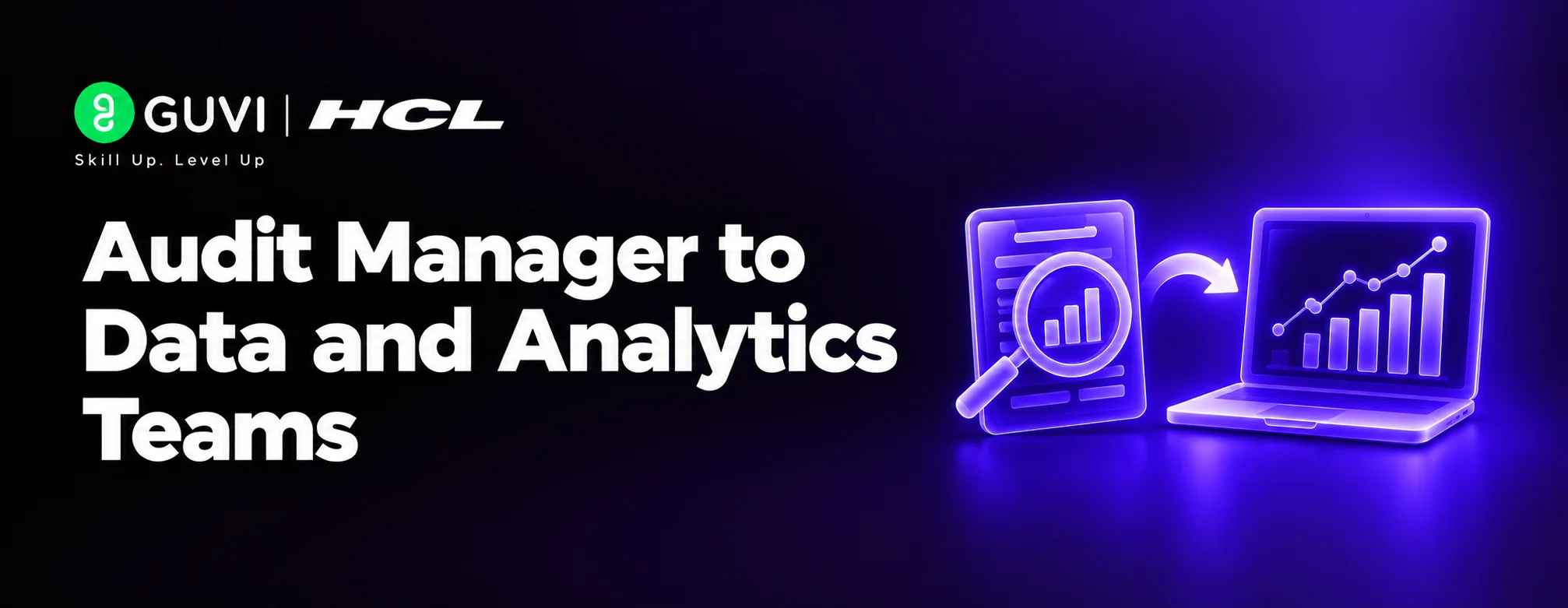
Audit Manager to Data and Analytics Teams: Internal Move in a Big 4 Firm
Oct 23, 2026 6 Min Read 24 Views
(Last Updated)
Most audit managers in a Big 4 firm have already worked alongside the data and analytics team. They run the journal entry testing, build the risk dashboards, and turn a week of sampling into a few hours of full population analysis. Sooner or later, many managers start asking whether they should be on that team instead.
The audit manager to data and analytics teams move answers that question from inside the firm. Instead of resigning and starting over, you use your firm’s internal mobility route to shift from leading audits to leading analytics work, often for the same banking and financial services clients.
Since you already know audit methodology and client data, this guide skips the basics and focuses on how the audit manager to data and analytics teams move works: the teams to target, the skills to build, how banking roles feed the same teams, and what salaries look like in India.
Table of contents
- TL;DR Summary
- What is the Audit Manager to Data and Analytics Teams Move?
- Which Data and Analytics Teams Exist Inside a Big 4 Firm
- Why Audit Managers Fit Data and Analytics Teams
- Risk and Controls Thinking
- Client Data Familiarity
- Engagement and Team Management
- Regulatory Awareness
- Skills to Build Before You Apply Internally
- How the Internal Move Works in a Big 4 Firm
- Check the Internal Mobility Policy
- Build Proof on Live Engagements
- Talk to Analytics Leadership Early
- Try a Rotation or Secondment
- Apply Through Internal Postings
- Banking Career Switch: The Same Teams Hire From Banks
- KYC Executive to Data Analyst
- Loan Processing to Data Analytics
- Data Analyst Skills for Banking
- Roadmap for an Audit Manager to Data and Analytics Teams Move
- Months 1 to 3: SQL and Data Preparation
- Months 4 to 6: Dashboards and Visualisation
- Months 7 to 9: Engagement Proof
- Months 9 to 12: Rotation and Transfer
- Audit Manager to Data and Analytics Teams Salary in India
- 💡 Did You Know?
- Common Audit Manager to Data and Analytics Teams Mistakes
- Conclusion
- FAQs
- Can an audit manager move to data and analytics teams in a Big 4 firm?
- Will I lose my grade in an audit manager to data and analytics teams move?
- How long does an audit manager to data and analytics teams move take?
- Can a KYC executive become a data analyst?
- Which tools matter most for an audit manager to data and analytics teams move?
TL;DR Summary
- What it is: The audit manager to data and analytics teams move is an internal transfer from an assurance team into a data, digital assurance, forensic technology, or consulting analytics team within the same firm.
- Why it works: Big 4 analytics teams need people who understand audit risk, controls, and client data, not just tools.
- What to learn: SQL, Power BI or Tableau, Alteryx or Python, and data governance basics.
- How to move: Build credibility on audit analytics engagements, speak to the analytics leadership, and apply through internal mobility.
- Salary reality: The move is usually lateral at manager level, with the bigger salary jump coming at senior manager and director levels.
- Next step: Volunteer to lead the analytics workstream on your next audit engagement as your first audit manager to data and analytics teams proof point.
What is the Audit Manager to Data and Analytics Teams Move?
The audit manager to data and analytics teams move is an internal career transition in which an audit manager in a Big 4 firm shifts from statutory or internal audit delivery into a team that builds data-driven audit tools, analytics solutions, or data consulting work for clients.
Unlike an external career switch, an audit manager to data and analytics teams move keeps your firm, your network, and usually your grade. What changes is the work: you move from signing off on audit files to designing the analytics that make audits, risk reviews, and client advisory work faster and deeper.
If you want structured mentoring and real projects while you build these skills, HCL GUVI’s Data Science Program, offered with IITM Pravartak, covers SQL, Python, Power BI, and statistics in weekday and weekend batches built for working professionals.
Which Data and Analytics Teams Exist Inside a Big 4 Firm
Big 4 firms organise data work differently, but most have the same kinds of teams. Knowing which one fits your background makes the audit manager to data and analytics teams move far easier to plan.
| Team Type | What It Does | Fit for Audit Managers |
|---|---|---|
| Audit analytics or digital assurance | Builds data tools used on audit engagements | Very high |
| Forensic technology | Fraud analytics, investigations, e-discovery | High |
| Risk advisory data and analytics | Controls analytics, regulatory reporting, KYC and AML analytics | High |
| Consulting data and analytics | Data strategy, BI, and AI projects for clients | Medium |
| Firm-wide analytics or AI centres of excellence | Internal tools and global delivery | Medium |
Audit analytics and risk advisory teams are usually the smoothest landing spots for an audit manager to data and analytics teams transfer, because they still serve assurance and regulatory work where your audit experience counts directly.
Why Audit Managers Fit Data and Analytics Teams
An audit manager brings things that pure analysts take years to build, and every audit manager to data and analytics teams application should lead with them. These strengths make the audit manager to data and analytics teams move credible to analytics leadership.
1. Risk and Controls Thinking
You know which processes fail, where fraud hides, and which controls matter, which is the core of any audit manager to data and analytics teams pitch. That judgement decides which analytics are worth building.
2. Client Data Familiarity
You have seen dozens of ERP systems, ledgers, and data quality problems. Analytics teams spend much of their time on exactly these issues.
3. Engagement and Team Management
Running audit timelines, staff, and partner reviews maps directly to running analytics projects and analyst teams, so the audit manager to data and analytics teams shift keeps your leadership experience relevant.
4. Regulatory Awareness
Knowledge of auditing standards and regulatory expectations is valuable for analytics work in banking, insurance, and listed company clients.
For a closer look at how individual audit skills carry over, the shift from auditor to data analyst maps tasks like vouching, sampling, and reconciliation to their analytics equivalents.
Skills to Build Before You Apply Internally
Analytics teams will not expect an audit manager to data and analytics teams candidate to match a data engineer, but they will expect hands-on capability. This table shows priorities for an audit manager to data and analytics teams move.
| Priority | Skill | Why It Matters | Target Depth |
|---|---|---|---|
| 1 | SQL | Pull and test client data directly | Joins, CTEs, window functions |
| 2 | Power BI or Tableau | Build risk and controls dashboards | Data modelling, DAX basics |
| 3 | Alteryx or Python | Automate data preparation and testing | Workflows or pandas basics |
| 4 | Data governance | Assess data quality and lineage | Frameworks and controls |
| 5 | Statistics | Support sampling and anomaly detection | Distributions, outliers |
| 6 | Cloud data basics | Work with client data platforms | Azure or AWS fundamentals |
Start by rewriting your audit data requests as SQL queries with examples you can run yourself, then move to dashboards. The best Power BI courses with certificate prepare you for Microsoft’s PL-300 credential, which analytics teams recognise.
How the Internal Move Works in a Big 4 Firm
Every firm has its own policy, but the audit manager to data and analytics teams move usually follows the same steps.
1. Check the Internal Mobility Policy
Most firms expect a minimum time in your current role and your counselor or engagement leader’s support. Read your firm’s mobility policy before you start conversations.
2. Build Proof on Live Engagements
Volunteer for the analytics workstream on your audits. Leading journal entry analytics or a risk dashboard gives you real work to point to. Clear, well-designed output matters, so follow the principles of a data dashboard that people actually use.
3. Talk to Analytics Leadership Early
Speak to a director or partner in the target team about your audit manager to data and analytics teams plans. Ask what skills they need and whether a rotation, secondment, or shadow project is possible.
4. Try a Rotation or Secondment
Short rotations let you prove your audit manager to data and analytics teams fit without a full transfer, and they reduce the risk for both teams.
5. Apply Through Internal Postings
Once you have proof of work and a sponsor, apply formally to complete the audit manager to data and analytics teams move. Internal candidates with engagement credibility are often preferred over external hires.
Banking Career Switch: The Same Teams Hire From Banks
The audit manager to data and analytics teams path is not the only route into these teams. Risk advisory and forensic analytics teams also hire heavily from banking operations, which makes them a natural target for any banking career switch.
Banks generate structured, regulated data: KYC records, loan files, transaction logs, and compliance reports. Professionals who understand that data, and who learn to analyse it, are valuable to Big 4 teams serving banking clients.
| Banking Role | Data It Works With | Analytics Role It Leads To |
|---|---|---|
| KYC Executive or Analyst | Customer identity and risk data | KYC and AML analytics |
| Loan Processing Officer | Application, credit, and repayment data | Credit risk analytics |
| Credit Analyst | Financial statements and ratios | Credit modelling and portfolio analytics |
| Compliance Executive | Regulatory and transaction data | Regulatory reporting analytics |
| Bank Internal Auditor | Controls and exception data | Audit and controls analytics |
KYC Executive to Data Analyst
The KYC executive to data analyst move is one of the most practical banking career switches. KYC work already involves checking documents, flagging mismatches, and rating customer risk, which is the manual version of data validation and risk scoring.

To make the move, learn SQL and Excel deeply, then Power BI. Build projects such as a customer risk scoring dashboard or a duplicate customer detection analysis on public or synthetic data. KYC and AML analytics teams in banks, fintechs, and Big 4 risk practices are the most natural targets.
Loan Processing to Data Analytics
Loan processing to data analytics is another strong path. Loan processors handle application data, credit scores, income checks, and repayment status every day, which is the raw material of credit risk analytics.
Start with SQL and Excel, then learn statistics and Python for credit modelling. Strong portfolio projects include loan default prediction, approval time analysis, and portfolio delinquency dashboards. Banks, NBFCs, fintechs, and Big 4 credit risk teams all hire for these skills.
Professionals coming from operations roles follow a similar pattern, as seen in the move from BPO to data analytics, where domain knowledge of the process becomes the biggest advantage.
Data Analyst Skills for Banking
Data analyst skills for banking combine standard analytics tools with an understanding of regulation and risk. Whether you are an audit manager or a KYC executive, these are the skills banking analytics teams test for.
| Skill | Banking Use Case |
|---|---|
| SQL | Querying transaction, customer, and loan databases |
| Excel and Power Query | Reconciliations and regulatory working files |
| Power BI or Tableau | Risk, compliance, and portfolio dashboards |
| Python | Fraud detection, credit scoring, and automation |
| Statistics | Default probability, anomaly detection, sampling |
| Regulatory knowledge | RBI reporting, KYC norms, and AML rules |
| Data governance | Data quality, lineage, and privacy controls |
The broader list of top data analytics skills overlaps heavily with this table, so building SQL and Power BI first gives you the widest set of options across audit and banking roles.
Roadmap for an Audit Manager to Data and Analytics Teams Move
This audit manager to data and analytics teams roadmap assumes 6 to 8 hours of study a week alongside busy season commitments.
1. Months 1 to 3: SQL and Data Preparation
Learn SQL and Alteryx or pandas. Rebuild one audit test, such as duplicate payments or journal entry testing, as a repeatable workflow.
2. Months 4 to 6: Dashboards and Visualisation
Build a Power BI risk dashboard on anonymised or sample data. Learn data modelling and basic DAX.
3. Months 7 to 9: Engagement Proof
Lead the analytics workstream on at least one live engagement. Document the time saved and the issues found for your audit manager to data and analytics teams application.
4. Months 9 to 12: Rotation and Transfer
Request a rotation or apply internally with your engagement results and a sponsor from the analytics team. A targeted credential from these data analytics certifications for finance professionals can strengthen the case.
Want to build these skills faster with mentors and live projects? HCL GUVI’s Data Science Program follows a similar sequence, from SQL and Python to dashboards and machine learning, with weekend batches for working professionals.
Audit Manager to Data and Analytics Teams Salary in India
Salary works differently for an audit manager to data and analytics teams move than for an external switch. The figures below are averages for India, and actual offers vary by firm, city, and grade.
| Role | Average Annual Salary |
|---|---|
| KYC Analyst | ₹4.8 LPA |
| Data Analyst | ₹6.5 LPA |
| Credit Analyst | ₹9 LPA |
| Senior Data Analyst | ₹11 LPA |
| Analytics Manager | ₹23.8 LPA |
| Audit Manager | ₹30.2 LPA |
| Senior Manager, Analytics | ₹41.7 LPA |
Two things stand out. First, an audit manager already earns more than the average analytics manager, so an external switch at the same level can mean a pay cut. An internal audit manager to data and analytics teams move avoids that, because Big 4 firms usually transfer you at your existing grade.
Second, the bigger audit manager to data and analytics teams salary gains come later. Senior analytics managers average far more than audit managers, and analytics leaders with audit backgrounds are rare enough to command a premium.
For banking professionals, the jump is even sharper. A KYC analyst moving into a data analyst role sees a clear rise, and a senior data analyst earns more than double a typical KYC salary. Managers outside audit see similar gains, as the path from finance manager to data analytics shows.
💡 Did You Know?
- Big Four audit teams increasingly use data analytics to test entire populations of transactions rather than relying only on samples, increasing the need for audit analytics skills.
- Alteryx and Power BI are useful tools to learn for audit analytics roles, making them a sensible starting point for audit managers moving into data and analytics teams.
- KYC and AML analytics is an important area in risk advisory, supported by regulatory requirements and the growth of digital onboarding.
Common Audit Manager to Data and Analytics Teams Mistakes
- Resigning before exploring an internal move: This is the costliest audit manager to data and analytics teams mistake. Internal routes protect your grade and salary.
- Waiting until you feel technically perfect: Analytics teams value audit judgement in an audit manager to data and analytics teams candidate. Apply once you have engagement proof.
- Skipping engagement proof: Certificates alone rarely convince analytics leadership. Live engagement work does.
- Targeting the wrong team: Consulting data teams expect deeper technical skills than most audit manager to data and analytics teams movers have at first. Audit analytics and risk teams are better first steps.
- Ignoring stakeholder support: Moves stall without a sponsor in the target team and support from your current leadership.
Conclusion
The audit manager to data and analytics teams move is one of the smartest career paths inside a Big 4 firm. You keep your grade and network, build on your audit judgement, and position yourself for analytics leadership roles that pay well above audit at senior levels.
If you are ready to build the technical side with mentors and real projects, explore HCL GUVI’s Data Science Program and start turning your audit experience into an analytics career.
FAQs
1. Can an audit manager move to data and analytics teams in a Big 4 firm?
Yes. The audit manager to data and analytics teams move is common through internal mobility, especially into audit analytics, digital assurance, and risk advisory teams.
2. Will I lose my grade in an audit manager to data and analytics teams move?
Usually not. An audit manager to data and analytics teams transfer typically happens at your existing grade, which is a key advantage over an external career switch.
3. How long does an audit manager to data and analytics teams move take?
Most managers need 9 to 12 months to build skills, gain engagement proof, and complete a rotation or transfer.
4. Can a KYC executive become a data analyst?
Yes. The KYC executive to data analyst move works well because KYC work already involves data validation and risk rating. SQL, Excel, and Power BI are the first skills to learn.
5. Which tools matter most for an audit manager to data and analytics teams move?
SQL, Power BI, Tableau, Alteryx, and Python are the most common, along with cloud platforms such as Azure for client data work.
Success Stories

About the Author
Jebasta
I translate the language of data into stories that anyone can understand. As a writer with a data science background, I simplify analytics, AI, and decision-making so beginners and enthusiasts can confidently explore the world of data.
View all posts by Jebasta
Connect with me @











Did you enjoy this article?