


Data Analysis Articles
Can a BPO Team Leader Become a Data Analyst?
BPO vs Data Analyst Salary in India: What Changes After the Switch?
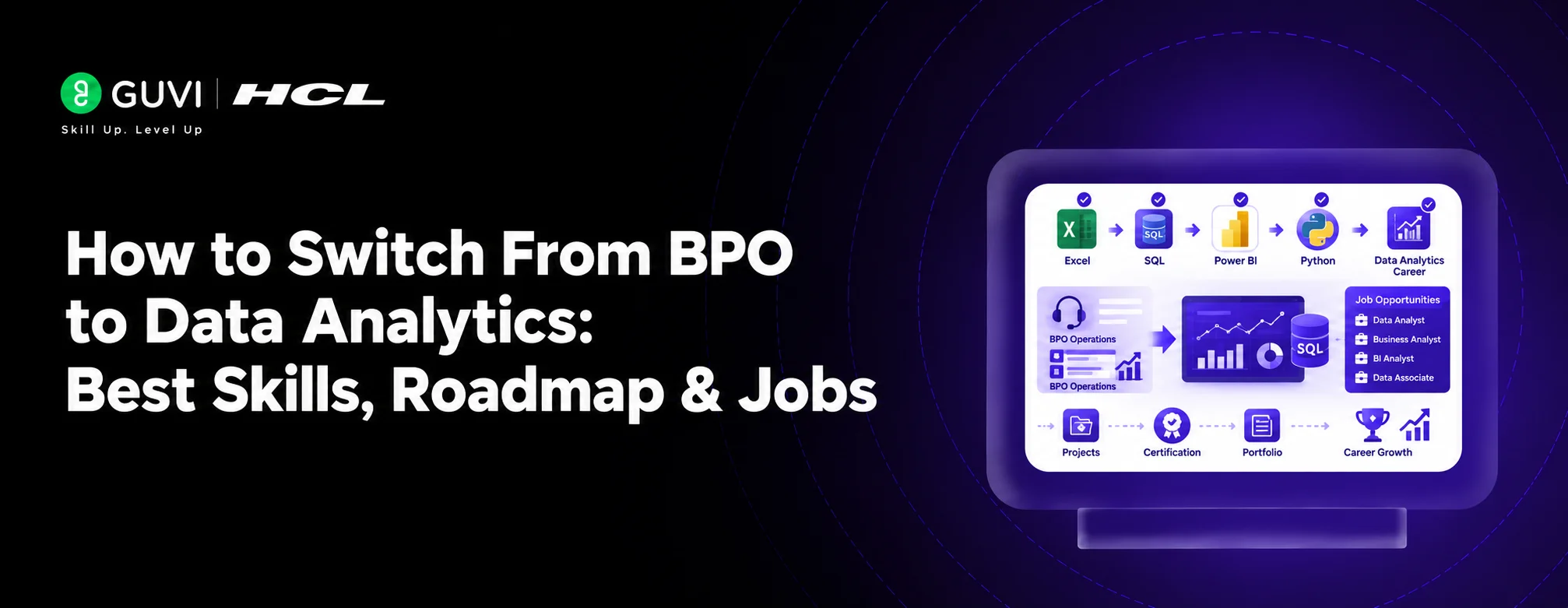
How to Switch From BPO to Data Analytics in 2026: Best Skills, Roadmap & Jobs
Will Moving From Team Lead to Data Analyst Reduce Salary or Seniority?


Get In Touch For Details! Request More Information
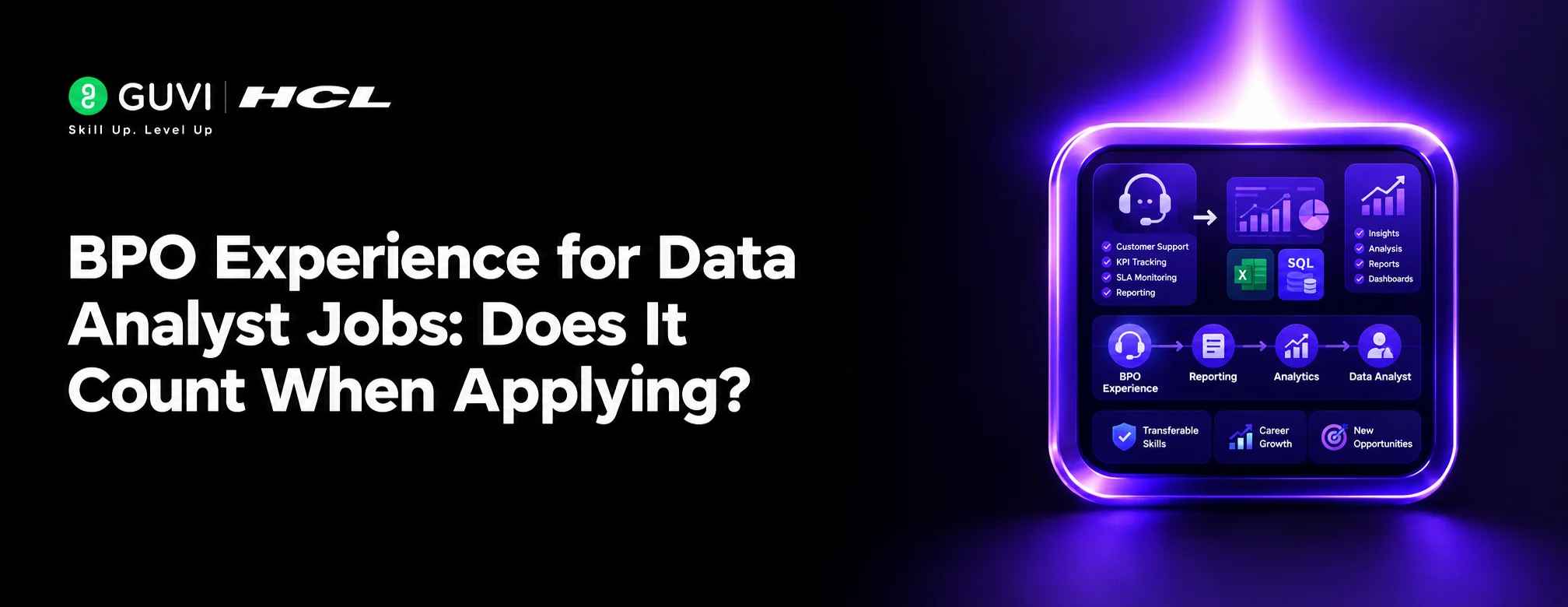
BPO Experience for Data Analyst Jobs Does It Count When Applying? – Best Guide
Oct 08, 2026 6 Min Read 28 Views
(Last Updated)
BPO experience for data analyst roles can be more valuable than you may think. If your BPOwork involves reports, KPIs, customer data, quality metrics, or process improvement, you already have some relevant business experience.
The challenge is turning that experience into a profile that recruiters recognise as analytics-ready.
For both early-career and senior non-IT switchers, the goal is not to erase your BPO background. It is to combine it with the technical skills and projects required for data analytics.
Table of contents
- TL;DR Summary
- Does BPO Experience Count for Data Analyst Jobs?
- BPO Experience vs Data Analyst Experience
- Which BPO Skills Transfer to Data Analytics?
- How KPI experience strengthens BPO experience for data analyst profiles
- How reporting experience helps
- Communication is another transferable skill
- What Career Options Can You Explore After BPO Experience?
- Which career path should you choose?
- How to Move From BPO to Data Analytics
- Step 1: Strengthen Excel
- Step 2: Learn SQL
- Step 4: Learn basic statistics and Python
- Step 5: Build 2–3 relevant projects
- Step 6: Rewrite your resume
- What If You Have 4+ Years of BPO Experience?
- Real-World Examples
- Example 1: Customer Support Executive
- Example 2: BPOTeam Leader
- Common Mistakes to Avoid
- Treating your BPO experience as irrelevant
- Calling BPO years analytics years
- Depending only on a certificate
- Learning too many tools at once
- Using the same resume for every job
- Ready to Build Your Career in Data Science?
- Conclusion
- FAQs
- Does BPO experience count for Data Analyst jobs?
- Can I move from BPO to Data Analytics without an IT background?
- Is BPO to Data Analyst a realistic career transition?
- Will four years of BPO experience help me get a Data Analyst job?
- Should I remove my BPO experience from my Data Analyst resume?
- What skills should I learn first for BPO to Data Analytics?
- Can I become a Data Analyst while working in BPO?
- What jobs can I apply for after BPO experience?
- Do I need to start as a fresher after leaving BPO?
TL;DR Summary
BPO experience for data analyst jobs can count, but BPO tenure is not automatically treated as direct analytics experience. Your value depends on the work you have actually done, such as KPI tracking, SLA reporting, customer analysis, quality monitoring, reporting, or process improvement. For a successful BPO to data analyst transition, add SQL, Excel, Power BI, statistics, and basic Python, then prove those skills through relevant projects. You do not need to hide your BPO background. Instead, connect your existing business and operations experience with practical data analytics skills.
Does BPO Experience Count for Data Analyst Jobs?
Yes, but usually as transferable experience rather than direct Data Analyst experience.
BPO experience for data analyst applications becomes valuable when your previous role involved working with business metrics, operational data, reports, or performance trends.
For example, you may already have worked with:
- Average Handle Time (AHT)
- First Call Resolution (FCR)
- Customer Satisfaction (CSAT)
- Service Level Agreements (SLAs)
- Quality scores
- Productivity reports
- Attendance and workforce data
- Customer complaints
- Escalation data
- Process performance
These are business metrics. The difference is that a Data Analyst uses technical tools and analytical methods to investigate them more deeply.
BPO Experience vs Data Analyst Experience
| BPOExperience | How It Helps in a Data Analyst Role | What You Still Need to Learn |
| KPI tracking | Builds understanding of business performance | SQL and statistics |
| SLA monitoring | Helps analyse operational performance | Data cleaning |
| Excel reporting | Provides spreadsheet experience | Advanced Excel and SQL |
| Customer data handling | Helps understand customer behaviour | Data visualisation |
| Quality analysis | Develops problem-solving skills | Power BI or Tableau |
| Process improvement | Shows business problem-solving ability | Analytics projects |
| Team performance tracking | Builds experience with productivity metrics | Dashboard development |
| Client reporting | Develops communication skills | Data storytelling |
| Workforce reporting | Creates relevant operations experience | SQL and forecasting |
| 4+ years of BPO experience | Provides domain and process knowledge | Technical analytics skills |
So, BPO experience for data analyst candidates is not useless. It becomes valuable when you can connect your previous responsibilities to analytical thinking and measurable business outcomes.
Which BPO Skills Transfer to Data Analytics?
How KPI experience strengthens BPO experience for data analyst profiles
If you regularly tracked KPIs, you already understand how businesses measure performance.
The next step is learning how to investigate those numbers. For example, instead of simply reporting that SLA dropped from one week to another, you could analyse which teams, shifts, issue types, or locations contributed to the change.
How reporting experience helps
Many BPO professionals prepare daily, weekly, or monthly reports. That experience can support a move toward reporting and analytics roles.
However, preparing a report is different from analysing data. Learn SQL, data cleaning, visualisation, and basic statistics so you can move from reporting what happened to explaining why it happened.
Communication is another transferable skill
Data analysts often work with people who are not technical. They need to explain findings clearly to managers, clients, and other teams.
If you already present operational metrics or explain performance issues to stakeholders, that communication experience is useful.
BPO experience can build transferable skills such as communication, problem-solving, adaptability, customer handling, and familiarity with business processes. These skills can become useful foundations when moving into data-focused roles.
What Career Options Can You Explore After BPO Experience?
You do not have to move directly from a BPO role into a traditional Data Analyst position.
Similar career transitions can also help you understand how existing business experience can be repositioned during a career switch to Data Analyst.
For many professionals, a reporting, operations, or workforce analytics role can be a practical bridge.
| Career Option | Best For | BPO Skills That Transfer | Skills to Add |
|---|---|---|---|
| MIS Analyst | BPO professionals experienced in reporting | Excel reports, KPI tracking | Advanced Excel, SQL |
| Reporting Analyst | Professionals who regularly prepare reports | Data reporting, performance tracking | SQL, Power BI |
| Operations Analyst | BPO professionals with process experience | Process improvement, SLA tracking | SQL, Excel, Power BI |
| Customer Data Analyst | BPO professionals with customer-facing experience | Customer data, feedback, KPI tracking | SQL, Excel, Power BI |
| Business Analyst | Professionals with strong business/process knowledge | Problem-solving, process understanding | SQL, analytics, documentation |
| Data Analyst | Professionals ready for a broader analytics role | Reporting, data handling, KPI analysis | SQL, Power BI, Python |
| BI Analyst | Professionals interested in dashboards and business insights | Reporting, metrics, performance analysis | Power BI, SQL, data modeling |
If you eventually want to specialise by industry, you can also explore areas such as healthcare analytics and the skills required for Healthcare Data Analyst roles.
Which career path should you choose?
If you have less than four years of BPO experience, MIS Analyst, Reporting Analyst, Operations Analyst, and Junior Data Analyst roles can be practical targets.
If you have four or more years, your process knowledge and stakeholder experience can make Operations Analyst, Workforce Analyst, Business Analyst, and Reporting Analyst roles particularly relevant.
For a direct BPO to data analyst transition, focus on building technical skills and projects rather than expecting your BPO title to carry over automatically.
Customer-facing BPOprofessionals can also consider domain specialisations such as marketing analytics by developing relevant Marketing Data Analyst skills.
How to Move From BPO to Data Analytics
A successful BPO to data analytics transition is less about starting again and more about adding technical depth to what you already know.
Step 1: Strengthen Excel
Start with formulas, PivotTables, lookups, conditional logic, charts, data cleaning, and basic dashboard creation.
Because many BPO professionals already use spreadsheets, Excel can provide a comfortable starting point.
Step 2: Learn SQL
SQL should become a major part of your career transition. Start with this practical guide to SQL for data analysis and focus on queries that answer real business questions.
Focus on:
- SELECT and filtering
- GROUP BY
- JOINs
- CASE statements
- Subqueries
- Common table expressions
- Window functions
The goal is not simply to memorise syntax. Learn to answer business questions with data.
Once your SQL fundamentals are strong, you can also explore how AI tools for SQL can support query writing and learning.
Build dashboards around problems you understand.
For example, create a customer-support dashboard showing:
- Total tickets
- Resolution time
- SLA performance
- Customer satisfaction
- Escalation rate
- Team performance
This makes your BPO experience for data analyst applications easier to explain because your project reflects your existing domain knowledge.
Once you are comfortable with dashboard creation, you can also compare Power BI and Tableau to understand which visualisation platform better matches the roles you want to target.
Step 4: Learn basic statistics and Python
Statistics helps you understand trends, distributions, averages, relationships, and comparisons.
Python can then help with data cleaning, exploratory analysis, and automation. You do not need to master every Python library before applying for entry-level analytics roles.
If you are already comfortable with Excel, learning Python in Excel can also be an approachable way to see how Python can complement spreadsheet-based analysis.
Step 5: Build 2–3 relevant projects
Choose projects that connect your BPO knowledge with analytics.
Good examples include:
- Customer support performance dashboard
- SLA breach analysis
- Customer complaint analysis
- Employee productivity dashboard
- Call centre performance analysis
Each project should explain the business problem, data cleaning, analysis, visualisation, findings, and recommendations.
If you need ideas for your portfolio, these Power BI project ideas can help you choose projects that demonstrate practical analytics skills.
Step 6: Rewrite your resume
Your resume should show the analytical parts of your real experience.
For more practical guidance, use these Data Analyst resume tips to position your transferable BPO experience more effectively.
Weak:
“Prepared daily reports and handled customer queries.”
Stronger:
“Analysed customer issues and SLA data to identify recurring service gaps and support process improvements.”
Do not change your previous job title or claim analytics experience you did not have.
Instead, make the relevant parts of your existing work easier for recruiters to see.

Once your resume and portfolio are ready, your next step is Data Analyst interview preparation, especially around SQL, Excel, dashboards, and business-case questions.
Anjali, a B.Com graduate who started as a Customer Support Executive, transitioned into a Junior Data Analyst role in seven months after building skills in Excel, SQL, Power BI, Tableau and basic Python. One of her projects focused on customer churn analysis, showing how customer-facing experience can connect naturally with analytics.
What If You Have 4+ Years of BPO Experience?
This is where many experienced professionals become unsure about their career transition.
Four or five years in BPO does not automatically equal four or five years of Data Analyst experience. However, it also does not mean you need to start your career from zero.
Your advantage is business and domain knowledge.
You may already understand customer operations, service metrics, team performance, escalation processes, workforce planning, and stakeholder communication.
If you are moving from a senior BPO or team-lead position, understanding how a leadership role translates into analytics can also help you plan your team lead to Data Analyst career transition.
That knowledge can be particularly useful in roles such as:
- Operations Analyst
- Reporting Analyst
- Workforce Analyst
- Business Analyst
- MIS Analyst
- Data Analyst
For senior professionals, a good strategy is to target roles where your previous experience remains relevant while you build analytics experience.
That makes the career transition more logical than applying randomly to every Data Analyst vacancy.
Real-World Examples
Example 1: Customer Support Executive
Imagine you worked in a customer-support BPO and noticed that repeat contacts increased for a particular product category.
For a portfolio project, you could analyse customer tickets by category, resolution time, repeat contacts, and escalation rates.
Using SQL and Power BI, you could identify the categories creating the most repeat contacts and recommend process improvements.
That gives your BPO experience for data analyst profile a clear connection to analytics.
Example 2: BPOTeam Leader
Suppose you managed a team and regularly monitored AHT, quality, attendance, productivity, and SLA performance.
You can build a workforce analytics project that investigates the relationship between staffing, attendance, workload, and SLA performance.
Your previous experience helps you understand the business problem. Your new analytics skills help you prove that you can investigate it with data.
Cyril spent 12 years in Customer Care, eventually becoming a Team Lead and Head of Customer Care, before deciding to move into data analytics. After training in data analytics and completing a practical project, he successfully transitioned into a Data Analyst role at a German fintech company. His journey shows that even long-term customer-service experience can become a strong foundation for analytics when combined with the right technical skills.
Common Mistakes to Avoid
1. Treating your BPO experience as irrelevant
Your previous experience may contain useful KPI, reporting, customer, and process knowledge. Identify those transferable skills instead of removing them.
2. Calling BPO years analytics years
BPO experience for data analyst applications should be presented honestly. Four years in BPO is not the same as four years working as a Data Analyst.
3. Depending only on a certificate
A certificate shows that you studied a subject. Projects demonstrate that you can apply it.
Build practical SQL analyses and dashboards that recruiters can understand quickly.
4. Learning too many tools at once
You do not need ten tools to begin.
Start with:
Excel → SQL → Power BI → Statistics → Python
Then expand based on the roles you want.
5. Using the same resume for every job
A Reporting Analyst position may require stronger reporting and dashboard language.
An Operations Analyst position may value process improvement, SLA, workforce, and productivity experience.
Tailor your resume to the role.
Ready to Build Your Career in Data Science?
Your BPO experience can give you valuable business and process knowledge. The next step is building the technical skills that help you work with data, solve business problems, and move toward data-focused roles.
HCL GUVI’s Advanced Data Science & Generative AI Program
Build deeper skills in Data Science and Generative AI through live classes, expert mentoring, real-world projects, 1:1 doubt sessions, and placement assistance.
HCL GUVI’s Data Science and Analytics Course
Learn core Data Science and Analytics concepts and build the technical foundation needed to work with data and explore career opportunities in the field.
Conclusion
BPO experience for data analyst jobs can be valuable when you connect your previous work to measurable business and analytical skills. Your BPO background may give you useful knowledge of customers, KPIs, operations, reporting, and process improvement, but it does not replace technical analytics skills. Build your foundation in Excel, SQL, Power BI, statistics, and Python, then create projects that connect those skills to problems you already understand. You can also explore MIS, Reporting Analyst, Operations Analyst, Workforce Analyst, Business Analyst, and Data Analyst roles. A BPO to data analytics career transition is not about starting from zero. It is about adding technical depth to experience you already have.
FAQs
Does BPO experience count for Data Analyst jobs?
Yes. BPO experience for data analyst roles can count as transferable experience, particularly when your work involved KPIs, reporting, customer data, quality metrics, or process improvement.
Can I move from BPO to Data Analytics without an IT background?
Yes. A non-IT to data transition is possible when you build relevant technical skills and demonstrate them through practical projects.
Is BPO to Data Analyst a realistic career transition?
Yes. BPO to data analyst is a realistic path when you combine your business and operations knowledge with SQL, Excel, Power BI, statistics, and portfolio projects.
Will four years of BPO experience help me get a Data Analyst job?
It can help, but four years of BPO experience is not equivalent to four years of analytics experience. Target roles where your operations and domain knowledge can provide an advantage.
Should I remove my BPO experience from my Data Analyst resume?
No. Keep relevant BPO experience for data analyst applications and highlight responsibilities involving metrics, reporting, analysis, process improvement, and business outcomes.
What skills should I learn first for BPO to Data Analytics?
Start with Excel and SQL, followed by Power BI and statistics. Add Python once you are comfortable with the fundamentals.
Can I become a Data Analyst while working in BPO?
Yes. You can learn while working, build projects using analytics tools, and gradually apply for reporting, operations, and Data Analyst positions.
What jobs can I apply for after BPO experience?
Depending on your skills, you can explore MIS Analyst, Reporting Analyst, Operations Analyst, Workforce Analyst, Business Analyst, BI Analyst, Customer/Data Analyst, and Data Analyst roles.
Do I need to start as a fresher after leaving BPO?
Not necessarily. Your BPO experience can remain valuable for roles that match your domain knowledge. However, your analytics seniority will depend on your actual analytics experience and technical capability.
Success Stories

About the Author
Reemsha Khan
Always been a storyteller at heart. Now, I turn complex topics into simple, easy-to-understand stories through content. Hope you find it helpful.
View all posts by Reemsha Khan
Connect with me @










Did you enjoy this article?