


Forward Deployed Engineer Articles
Best Career Paths Into Forward Deployed Engineering
The Rise of the T-Shaped Engineer and Why FDEs Are the Model
FDE Project Lifecycle: From Discovery to Deployment
Is Forward Deployed Engineering a Real Engineering Discipline?


Get In Touch For Details! Request More Information
Why Every AI Startup Is Suddenly Hiring Forward Deployed Engineers
Sep 05, 2026 4 Min Read 87 Views
(Last Updated)
AI startups are building increasingly powerful models, but creating a model is only the beginning. Companies still need to connect AI systems to customer data, existing software, internal workflows, and production infrastructure. This is one reason AI startups hiring forward deployed engineer roles are becoming increasingly common.
Forward Deployed Engineers (FDEs) sit close to customers and turn AI capabilities into practical solutions. They combine software engineering, system integration, product thinking, and customer problem-solving. For startups, this can help shorten the distance between an impressive AI demo and a system that customers actually use.
Table of contents
- TL;DR Summary
- Why AI Startups Need FDEs
- The Gap Between AI Demos and Production
- What Does a Forward Deployed Engineer Do at an AI Startup?
- Why Startups Benefit From FDEs
- The "Build Once, Deploy Many" Advantage
- Why AI Makes This Role Different
- Skills AI Startups Look For
- Why Startups Are Hiring This Role Now
- What Does a Typical FDE Project Look Like?
- Is FDE a Good Career for Software Engineers?
- How to Prepare for an AI FDE Role
- Key Takeaways
- Conclusion
- FAQs
- Why are AI startups hiring Forward Deployed Engineers?
- What does an AI Forward Deployed Engineer do?
- What skills are needed for an AI FDE role?
- Is an FDE the same as a software engineer?
- Is Forward Deployed Engineering a good career in AI?
TL;DR Summary
- AI startups need more than powerful models; customers need working solutions.
- FDEs connect AI products to real-world customer workflows.
- They help startups move from prototypes to production faster.
- The role combines coding, AI, cloud, APIs, debugging, and communication.
- FDEs can uncover recurring customer problems that influence product development.
- The role is particularly valuable when AI deployments require significant customization.
Why AI Startups Need FDEs
Traditional software can often be deployed with relatively standardized configurations.
AI applications can be different.
A customer may have:
- Proprietary data
- Existing APIs
- Legacy systems
- Strict security requirements
- Unique business processes
- Internal approval workflows
A general-purpose AI product may not immediately fit all of these requirements.
An FDE helps bridge that gap.
The process can look like:
AI Product → Customer Environment → Custom Integration → Production WorkflowThis makes the FDE an important link between what an AI startup has built and what customers actually need.
Read More: Is a Career in AI/ML Sustainable for Someone with a Web Dev Background
Get ready for the growing AI industry with HCL GUVI’s Artificial Intelligence & Machine Learning Course. Learn AI, machine learning, and hands-on skills to build real-world intelligent applications.
The Gap Between AI Demos and Production
AI demos can look impressive.
A chatbot can answer questions about a document in seconds. An AI agent can demonstrate an automated workflow. A model can generate sophisticated text or analyze an image.
But production deployment introduces harder questions:
- Where does the data come from?
- How is access controlled?
- What happens when the model makes a mistake?
- How does the system integrate with existing applications?
- How should outputs be monitored?
- What happens when an API fails?
An FDE helps solve these practical problems.
The hardest part of an enterprise AI project is often not demonstrating that a model works, but integrating it reliably into an organization’s existing systems and processes.
What Does a Forward Deployed Engineer Do at an AI Startup?
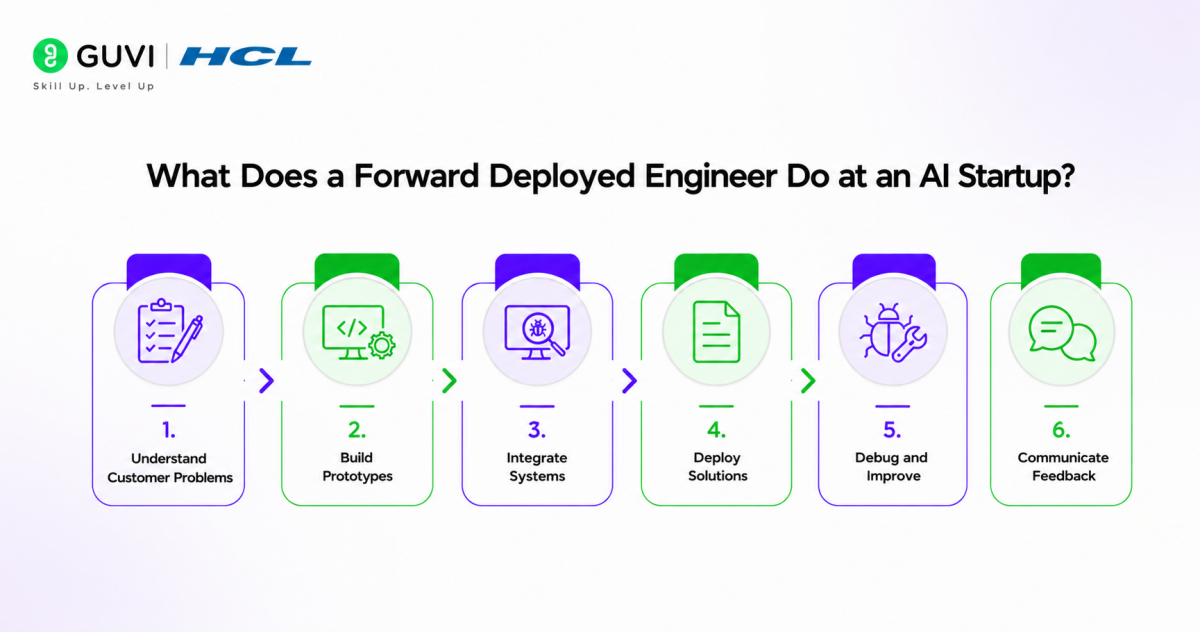
The exact responsibilities vary, but an FDE may:
- Understand Customer Problems
They meet customers and identify the underlying problem rather than simply implementing the first requested feature.
- Build Prototypes
They quickly create proof-of-concepts to determine whether an AI approach is viable.
- Integrate Systems
They connect AI applications with:
- APIs
- Databases
- Cloud services
- Internal tools
- Data pipelines
- Deploy Solutions
They help move prototypes into production environments.
- Debug and Improve
They investigate failures, evaluate model outputs, and improve the system based on real-world usage.
- Communicate Feedback
They identify recurring customer requirements and communicate them to product and engineering teams.
Pro Tip: A strong FDE does not just ask, “How can I implement this?” They ask, “What outcome is the customer actually trying to achieve?”
Why Startups Benefit From FDEs
- Faster Customer Adoption
Customers may struggle to implement a new AI product on their own.
An FDE can accelerate the process.
- Faster Feedback
Instead of waiting for customers to submit feature requests, engineers directly observe how the product is being used.
- Better Product-Market Fit
Repeated customer problems can reveal which features should become part of the core product.
- Stronger Customer Relationships
Technical teams working directly with customers can understand their requirements at a deeper level.
Best Practice: Use customer deployments as a learning loop. Repeated custom requests should be analyzed to determine whether they indicate an opportunity for a reusable product feature.
The “Build Once, Deploy Many” Advantage
One of the most valuable outcomes of FDE work is identifying patterns.
Suppose an FDE builds a custom document-processing workflow for one customer.
Then another customer requests something similar.
Instead of building the same solution repeatedly, the startup can turn the common functionality into a reusable product capability.
The cycle becomes:
Customer 1 → Custom Solution → Identify Pattern → Product Feature → Customer 2, 3, 4...This allows the company to gradually reduce the amount of customization required.
Why AI Makes This Role Different
AI systems introduce uncertainty that traditional software systems may not have.
For example, an AI application may produce different outputs for different inputs.
An FDE may therefore need to think about:
- Prompt design
- Model selection
- Evaluation
- Retrieval
- Context management
- Hallucination reduction
- Guardrails
- Observability
They aren’t simply connecting APIs. They are helping determine how AI should behave inside a real workflow.
Skills AI Startups Look For
A strong FDE typically combines several skill areas.
- Software Engineering
- Python
- JavaScript or TypeScript
- Git
- APIs
- Databases
- Testing
- Cloud and Infrastructure
Knowledge of platforms such as AWS, Azure, or Google Cloud can be valuable.

Understanding:
- Docker
- Kubernetes
- CI/CD
- Networking
- Authentication
- Monitoring
can also help.
- AI and ML
Depending on the company, useful knowledge may include:
- LLMs
- RAG
- Embeddings
- Vector databases
- AI agents
- Prompt engineering
- Model evaluation
- Communication
FDEs need to explain technical concepts to customers and translate business requirements into engineering tasks.
Data Point: FDE roles often require breadth as much as depth because engineers may move between application development, cloud infrastructure, data, AI, and customer requirements within the same project.
Why Startups Are Hiring This Role Now
Several trends are contributing to the growth of FDE roles.
- AI Products Are Becoming More Specialized
Customers increasingly expect AI to work with their own data and workflows.
- Enterprise Adoption Is Growing
Large organizations require integrations, security, governance, and deployment support.
- AI Infrastructure Is Changing Quickly
Engineers may need to work across models, APIs, retrieval systems, agents, and cloud infrastructure.
- Startups Need Faster Iteration
Young companies cannot always afford long product cycles. Direct customer exposure can provide faster feedback.
Warning: A startup hiring FDEs isn’t necessarily looking for “developers who talk to customers.” The role can involve significant ownership, ambiguity, travel, deployment responsibility, and customer pressure.
What Does a Typical FDE Project Look Like?
Consider an AI startup selling an enterprise document assistant.
A customer wants employees to search thousands of internal documents.
An FDE could work through:
Discovery → Data Integration → RAG Prototype → Evaluation → Authentication → Deployment → MonitoringThe engineer needs to make sure the system doesn’t just work in a demo but fits the customer’s actual environment.
Is FDE a Good Career for Software Engineers?
It can be a strong option for engineers who enjoy variety and real-world problem-solving.
The role can provide exposure to:
- Different industries
- Modern AI technologies
- Cloud infrastructure
- Product development
- Customer requirements
- System architecture
However, engineers who prefer working quietly on a stable codebase with minimal customer interaction may prefer traditional software engineering.
How to Prepare for an AI FDE Role
A practical preparation path is:
Programming → APIs → Cloud → AI Applications → Deployment → Customer Problem-SolvingBuild projects that demonstrate complete solutions rather than isolated models.
For example:
LLM Application → RAG → API → Authentication → Docker → Cloud Deployment → MonitoringThen document:
- The customer problem
- Your architecture
- Technical decisions
- Challenges
- Results
This demonstrates the mindset required for the role.
Key Takeaways
- AI startups are hiring FDEs because deploying AI is often more complicated than demonstrating it.
- FDEs connect AI products with customer data, infrastructure, and workflows.
- They combine engineering, AI, cloud, integration, and communication skills.
- Customer deployments can provide valuable product feedback.
- Repeated custom solutions can eventually become reusable product features.
- The role is well suited to engineers who enjoy ambiguity and solving practical problems.
- Building end-to-end projects is a strong way to prepare for FDE positions.
Get ready for the growing AI industry with HCL GUVI’s Artificial Intelligence & Machine Learning Course. Learn AI, machine learning, and hands-on skills to build real-world intelligent applications.
Conclusion
The rise of AI startups hiring forward deployed engineer roles reflects a fundamental reality of enterprise AI: powerful models alone do not create business value.
Someone still needs to connect those models to real data, existing systems, security requirements, and human workflows. Forward Deployed Engineers fill that gap.
For AI startups, they can accelerate customer deployments, uncover product opportunities, and turn experimental technology into reliable solutions. For engineers, the role offers an opportunity to work at the intersection of AI, software engineering, infrastructure, product development, and customer problem-solving.
As AI moves from experimental demos into everyday business operations, that intersection is likely to become increasingly important.
FAQs
Why are AI startups hiring Forward Deployed Engineers?
AI startups hire FDEs to help customers integrate, deploy, customize, and use AI products in real-world environments.
What does an AI Forward Deployed Engineer do?
They build prototypes, integrate APIs and data, deploy AI applications, troubleshoot production issues, and work directly with customers.
What skills are needed for an AI FDE role?
Programming, APIs, cloud infrastructure, databases, AI/LLM concepts, debugging, system design, and strong communication skills are useful.
Is an FDE the same as a software engineer?
Both roles require engineering skills, but FDEs typically spend more time solving customer-specific problems and working directly with users.
Is Forward Deployed Engineering a good career in AI?
Yes, particularly for engineers who enjoy modern AI technologies, rapid learning, customer interaction, and building practical solutions from ambiguous requirements.
Success Stories

About the Author
HCL GUVI
This article was selected and published as part of the HCL GUVI AI Blogathon 2026, an initiative designed to encourage students, AI enthusiasts, and aspiring tech writers to simplify complex AI concepts through impactful technical content. The contest recognized high-quality, original, and insightful AI-focused blogs, with selected authors receiving publication opportunities on the HCL GUVI blog platform along with official author credits and recognition.
View all posts by HCL GUVI
Connect with me @









Did you enjoy this article?