


Forward Deployed Engineer Articles
Best Career Paths Into Forward Deployed Engineering
The Rise of the T-Shaped Engineer and Why FDEs Are the Model
Is Forward Deployed Engineering a Real Engineering Discipline?
Forward Deployed Engineering Explained for Non-Technical Founders


Get In Touch For Details! Request More Information
FDE Project Lifecycle: From Discovery to Deployment
Sep 08, 2026 4 Min Read 29 Views
(Last Updated)
Many people exploring Forward Deployed Engineering are unsure what actually happens after an FDE takes on a customer project. Unlike traditional software development, FDE work involves solving real-world problems directly within customer environments, often with changing requirements and tight deadlines.
The FDE project lifecycle provides a structured way to understand how these projects move from an initial customer problem to a working technical solution. It typically involves discovery, requirements gathering, solution design, development, testing, deployment, monitoring, and continuous improvement.
Understanding the FDE project lifecycle can help aspiring FDEs see how engineering, customer collaboration, and problem-solving come together. It also shows why FDEs need more than coding skills—they must be able to understand problems, design practical solutions, work with different technologies, and deliver measurable customer value.
Table of contents
- TL;DR Summary
- What Is the FDE Project Lifecycle?
- Discovery and Problem Understanding
- Requirements Gathering
- Solution Design
- Development and Integration
- Testing and Validation
- Deployment
- Monitoring and Support
- Iteration and Improvement
- What Makes the FDE Project Lifecycle Different?
- Best Practices for Managing an FDE Project
- What Skills Are Needed to Manage an FDE Project Lifecycle?
- Start Your Learning Journey with HCL GUVI
- Conclusion
- FAQs
- What is the FDE project lifecycle?
- What is the first stage of an FDE project?
- Do FDEs write code during projects?
- How long does an FDE project take?
- Is the FDE project lifecycle linear?
- What is the most important skill for an FDE?
TL;DR Summary
- The FDE project lifecycle takes a customer problem from discovery to a working technical solution.
- It typically includes requirements gathering, solution design, development, testing, deployment, and monitoring.
- FDEs work closely with customers throughout the project to understand requirements and provide practical solutions.
- The lifecycle is usually iterative, with engineers refining solutions based on feedback and real-world results.
- FDEs may handle coding, integrations, cloud infrastructure, automation, debugging, and deployment.
- Successful FDE projects balance customer needs, engineering quality, scalability, and delivery speed.
What Is the FDE Project Lifecycle?
The FDE project lifecycle is the series of stages an FDE follows to solve a customer’s technical problem and deliver a usable solution.
A typical lifecycle includes discovery, solution design, development, testing, deployment, monitoring, and iteration. However, the exact process varies depending on the company, customer, technology, and complexity of the project.
Unlike a traditional product engineering lifecycle, FDE projects often begin with an ambiguous customer requirement. The engineer must first understand what the customer actually needs before deciding what to build.
Want to develop practical AI engineering skills? HCL GUVI’s Artificial Intelligence & Machine Learning Course covers AI, machine learning, and real-world project implementation to help you prepare for evolving technology roles.
1. Discovery and Problem Understanding
The first stage is understanding the customer’s problem.
An FDE works directly with customers, stakeholders, and internal teams to identify business goals, technical constraints, existing systems, and expected outcomes.
For example, a customer might say, “We need AI to automate our support process.” The FDE must investigate what that actually means.
They may discover that the real requirement involves integrating an AI model with an existing ticketing system, retrieving information from internal documents, and automatically routing certain requests.
This stage prevents engineers from building technically impressive solutions that do not solve the customer’s actual problem.
2. Requirements Gathering
Once the problem is understood, the FDE converts it into technical and functional requirements.
Important questions may include:
- What should the system accomplish?
- Which existing systems need to be integrated?
- What data is available?
- What security requirements exist?
- What are the performance expectations?
- Who will use the system?
- What does success look like?
Because customer requirements can be incomplete or change during development, FDEs often need to make reasonable technical decisions while keeping stakeholders aligned.
3. Solution Design
The next stage is designing the technical solution.
The FDE determines the architecture, technologies, APIs, infrastructure, data flow, and integration strategy required to solve the problem.
For example, an FDE building an AI-powered workflow might design a system involving an application layer, APIs, an LLM, a vector database, authentication, monitoring, and the customer’s existing business systems.
The design should be practical rather than unnecessarily complex. FDEs often work under tight timelines, so the goal is to create a solution that can deliver measurable value quickly while remaining maintainable.
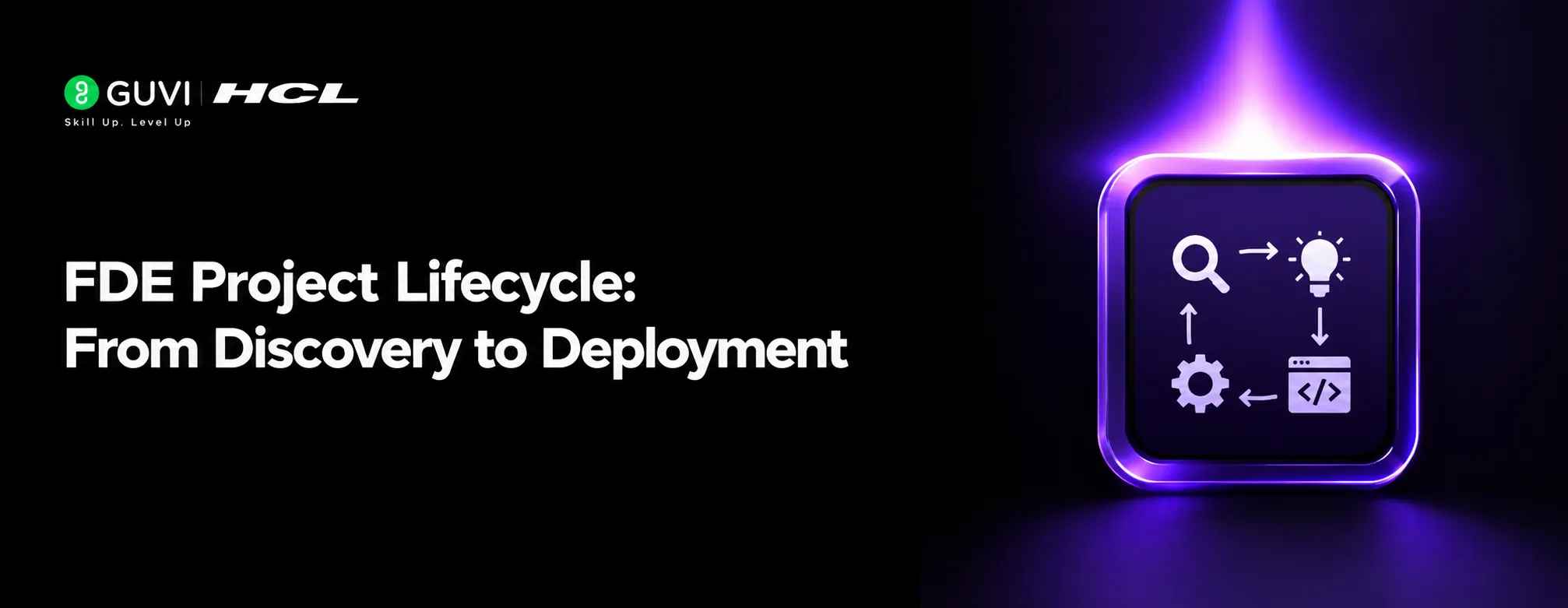
An FDE project can move from customer discovery to solution design, development, deployment, and iteration, making the engineer involved throughout the complete delivery process.
4. Development and Integration
After the solution is designed, the FDE begins building it.
This is where the engineering aspect of the role becomes particularly visible. Depending on the project, an FDE may:
- Write application code
- Build APIs
- Integrate third-party services
- Create automation scripts
- Develop AI or data workflows
- Configure cloud infrastructure
- Build dashboards
- Connect existing enterprise systems
- Debug technical issues
Integration is especially important because FDE projects often need to work with systems that were not designed specifically for the new solution.
5. Testing and Validation
Before deployment, the solution needs to be tested.
FDEs may perform unit testing, integration testing, functional testing, performance testing, and customer acceptance testing depending on the project.
Testing also happens in the context of the customer’s actual environment.
An application that works perfectly in development may encounter authentication problems, unexpected data formats, network restrictions, or performance issues after being connected to real customer systems.
The FDE therefore validates both technical functionality and whether the solution actually addresses the original customer problem.
6. Deployment
Once the solution is validated, it can be deployed.
Deployment may involve cloud infrastructure, containers, CI/CD pipelines, configuration management, authentication, networking, and production monitoring.
The deployment process depends heavily on the customer’s environment. Some customers may use public cloud platforms, while others may have strict enterprise infrastructure or security requirements.

A successful deployment means more than simply making the application available. The system should be reliable, secure, observable, and usable by the intended users.
7. Monitoring and Support
The FDE project lifecycle does not necessarily end after deployment.
Once the system is live, engineers may monitor performance, investigate errors, analyze user feedback, and resolve production issues.
Monitoring can include metrics such as application performance, error rates, latency, infrastructure utilization, and AI system performance.
This stage helps identify problems that may not have appeared during testing.
8. Iteration and Improvement
Customer projects are rarely perfect after the first deployment.
Feedback from users can reveal new requirements, usability problems, performance limitations, or additional opportunities for automation.
FDEs use this feedback to improve the solution.
This makes the FDE project lifecycle iterative. Instead of following a simple start-to-finish process, teams may repeatedly move between development, testing, deployment, and improvement.
Unlike traditional development workflows, FDE projects often require engineers to adapt solutions based on real-time customer feedback and changing business requirements.
What Makes the FDE Project Lifecycle Different?
The biggest difference is the level of customer involvement.
Traditional software engineers may primarily build features for a product used by thousands or millions of users. FDEs often build solutions for specific customers and their environments.
This means FDEs must balance three priorities:
- Customer requirements
- Engineering quality
- Speed of delivery
An FDE may need to deliver a working prototype quickly and then improve its architecture as the solution proves its value.
Best Practices for Managing an FDE Project
A successful FDE project benefits from a few important practices:
- Define the customer’s problem before choosing a technology.
- Establish measurable success criteria.
- Start with a practical minimum viable solution.
- Document important technical decisions.
- Build with security and scalability in mind.
- Test using realistic customer data and environments.
- Communicate progress and limitations clearly.
- Monitor the system after deployment.
- Collect customer feedback continuously.
- Avoid creating unnecessary technical complexity.
What Skills Are Needed to Manage an FDE Project Lifecycle?
FDEs need a combination of technical and communication skills.
On the technical side, useful skills include programming, APIs, cloud platforms, databases, DevOps, system design, debugging, and increasingly AI and machine learning tools.
Communication is equally important. FDEs need to understand customer requirements, explain technical decisions, manage expectations, and collaborate with different stakeholders.
The strongest FDEs can move comfortably between a customer conversation, a system architecture diagram, and a code editor.
Start Your Learning Journey with HCL GUVI
Want to develop practical AI engineering skills? HCL GUVI’s Artificial Intelligence & Machine Learning Course covers AI, machine learning, and real-world project implementation to help you prepare for evolving technology roles.
Conclusion
The FDE project lifecycle provides a practical framework for turning customer problems into deployed technical solutions. It typically moves through discovery, requirements gathering, solution design, development, testing, deployment, monitoring, and iteration.
However, the lifecycle is not always linear. Customer feedback, technical constraints, and changing requirements can cause FDEs to revisit earlier stages.
For aspiring Forward Deployed Engineers, understanding this lifecycle is valuable because it highlights the full scope of the role. FDEs are not simply developers who work with customers. They are engineers who understand problems, build solutions, deploy them in real environments, and continuously improve them based on customer needs.
FAQs
What is the FDE project lifecycle?
The FDE project lifecycle is the process an FDE follows to solve a customer’s technical problem, from initial discovery through design, development, testing, deployment, monitoring, and improvement.
What is the first stage of an FDE project?
The first stage is usually discovery. The FDE works with the customer to understand the business problem, technical environment, constraints, and desired outcome.
Do FDEs write code during projects?
Yes. Depending on the role and company, FDEs may write application code, build integrations, develop APIs, automate processes, create AI workflows, and troubleshoot production systems.
How long does an FDE project take?
Project duration varies significantly. A small proof of concept may take days or weeks, while complex enterprise implementations can take several months or longer.
Is the FDE project lifecycle linear?
Not always. FDE projects are often iterative. Customer feedback or technical challenges may require engineers to return to requirements, design, development, or testing.
What is the most important skill for an FDE?
Strong problem-solving ability is one of the most important skills. FDEs need to understand ambiguous problems, make sound technical decisions, build practical solutions, and communicate effectively with customers.
Success Stories

About the Author
HCL GUVI
This article was selected and published as part of the HCL GUVI AI Blogathon 2026, an initiative designed to encourage students, AI enthusiasts, and aspiring tech writers to simplify complex AI concepts through impactful technical content. The contest recognized high-quality, original, and insightful AI-focused blogs, with selected authors receiving publication opportunities on the HCL GUVI blog platform along with official author credits and recognition.
View all posts by HCL GUVI
Connect with me @







Did you enjoy this article?