


Artificial Intelligence and Machine Learning Articles
AI in Retail: Demand Forecasting and Personalization
The Cold Start Problem in Recommender Systems


Get In Touch For Details! Request More Information
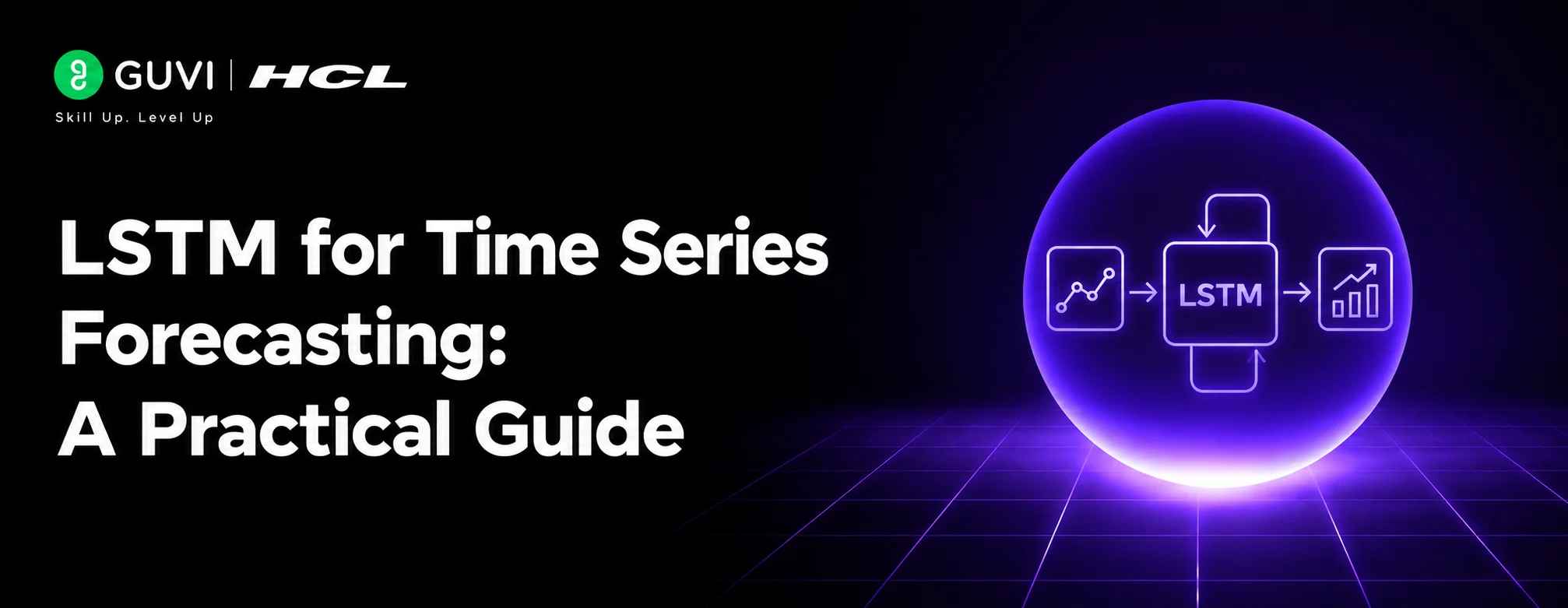
LSTM for Time Series Forecasting: A Practical Guide
Sep 04, 2026 3 Min Read 13 Views
(Last Updated)
Time series forecasting involves predicting future values based on historical observations. Long Short-Term Memory (LSTM) networks are a type of recurrent neural network designed to learn patterns and dependencies across sequences. They are particularly useful when past observations contain information that can help predict future values, such as sales, demand, temperature, or financial data.
Table of contents
- TL;DR Summary
- What Is LSTM?
- Why Use LSTM for Time Series?
- How LSTM Forecasting Works
- Step 1: Collect Historical Data
- Step 2: Clean the Data
- Step 3: Normalize the Data
- Step 4: Create Time Windows
- Step 5: Train the LSTM
- Step 6: Generate Predictions
- Step 7: Evaluate the Model
- LSTM Gates
- Forget Gate
- Input Gate
- Output Gate
- Common Applications
- Sales Forecasting
- Demand Forecasting
- Energy Forecasting
- Sensor Data
- Financial Time Series
- Key Concepts to Remember
- A Practical LSTM Forecasting Workflow
- Define the Forecasting Objective
- Prepare the Time Series
- Split the Data Chronologically
- Scale the Values
- Create Sequences
- Build the LSTM
- Train the Model
- Evaluate Predictions
- Forecast Future Values
- Real-World Applications
- Retail
- Energy
- Manufacturing
- Transportation
- Best Practices
- Conclusion
- FAQs
- What is LSTM in time series forecasting?
- Why are LSTMs useful for time series?
- What are LSTM gates?
- What is a time window?
- Can LSTM predict multiple future values?
- Should time series data be randomly split?
- Is LSTM always the best model for time series forecasting?
TL;DR Summary
- LSTM is a type of recurrent neural network.
- It is designed to learn patterns across sequences.
- LSTM uses memory cells and gates to manage information.
- It can capture longer-term dependencies in sequential data.
- It is useful for many time series forecasting tasks.
Quick Answer
| LSTM for Time Series Forecasting uses Long Short-Term Memory networks to learn patterns from historical sequential data and predict future values. LSTMs use specialized gates to control what information is retained, updated, or discarded, allowing them to capture dependencies across time. They can be applied to forecasting problems involving sales, demand, sensor readings, energy consumption, and other sequential measurements. |
What Is LSTM?
Long Short-Term Memory (LSTM) is a type of recurrent neural network designed to handle sequential information.
Traditional RNNs can struggle to retain useful information across long sequences. LSTMs address this using a memory mechanism controlled by specialized gates.
An LSTM cell contains:
- Cell state
- Forget gate
- Input gate
- Output gate
These components help determine which information should be retained or discarded.
Why Use LSTM for Time Series?
Time series data contains observations ordered by time.
For example:
Monday → Tuesday → Wednesday → Thursday → Friday
The value at one point can be related to previous observations.
LSTMs can learn patterns such as:
- Trends
- Repeated patterns
- Temporal dependencies
- Changes over time
How LSTM Forecasting Works
A typical workflow looks like:
Historical Data → Preprocessing → Time Windows → LSTM → Prediction → Evaluation
Step 1: Collect Historical Data
Gather time-ordered observations for the variable you want to forecast.
Step 2: Clean the Data
Handle missing values, inconsistent records, and other data-quality issues.
Step 3: Normalize the Data
Scale numerical values so the neural network can train more effectively.
Step 4: Create Time Windows
Convert the historical series into input sequences.
For example, the previous five observations can be used to predict the next observation.
Step 5: Train the LSTM
Feed the sequences into the LSTM and train it to predict the target value.
Step 6: Generate Predictions
Use the trained model to forecast future observations.
Step 7: Evaluate the Model
Compare predictions with actual values using appropriate forecasting metrics.
LSTM Gates
Forget Gate
Determines which information from the previous cell state should be discarded.
Input Gate
Determines which new information should be added to the cell state.
Output Gate
Controls which information from the cell state is passed to the next output.
Together, these gates allow the LSTM to manage information over time.
Example
Suppose you want to forecast daily sales.
You could use:
Previous 7 days of sales → LSTM → Next day’s sales
The model can learn patterns from historical sequences and use them to estimate future demand.
Common Applications
Sales Forecasting
Predict future sales based on historical sales patterns.
Demand Forecasting
Estimate future product or service demand.
Energy Forecasting
Predict electricity consumption or generation.
Sensor Data
Forecast future readings from connected devices and industrial systems.
Financial Time Series
Model sequential patterns in financial datasets, although forecasting financial markets remains particularly difficult.
LSTMs can be used for both single-step forecasting and multi-step forecasting. Single-step forecasting predicts one future value, while multi-step forecasting predicts several future values.
Key Concepts to Remember
- LSTM is a recurrent neural network architecture.
- Cell state carries information through the sequence.
- Gates control information flow.
- Time windows convert historical observations into training sequences.
- Normalization can improve neural network training.
- Single-step forecasting predicts one future value.
- Multi-step forecasting predicts multiple future values.

A Practical LSTM Forecasting Workflow
1. Define the Forecasting Objective
Determine what variable you want to predict and how far into the future you need to forecast.
2. Prepare the Time Series
Sort observations chronologically and handle missing or inconsistent data.
3. Split the Data Chronologically
Create training, validation, and test sets without randomly mixing future observations into the past.
4. Scale the Values
Apply an appropriate scaling method to numerical features.
5. Create Sequences
Use historical time windows as model inputs and future values as targets.
6. Build the LSTM
Define the LSTM architecture and output layer appropriate for the forecasting task.
7. Train the Model
Train using the prepared sequences and monitor validation performance.
8. Evaluate Predictions
Compare forecasts against unseen observations using suitable metrics.
9. Forecast Future Values
Use the trained model to generate predictions for future time periods.
The HCL GUVI’s Artificial Intelligence eBook introduces artificial intelligence, machine learning, generative AI, and intelligent automation concepts, helping learners build a broader understanding of modern AI technologies.
Real-World Applications
Retail
Forecast product sales and inventory demand.
Energy
Predict electricity consumption based on historical usage patterns.
Manufacturing
Forecast sensor measurements and support predictive maintenance workflows.
Transportation
Predict demand patterns and other time-dependent measurements.
Professionals interested in artificial intelligence, machine learning, and deep learning can strengthen their expertise through HCL GUVI’s Artificial Intelligence and Machine Learning Course.
Best Practices
- Keep time series data in chronological order.
- Avoid data leakage from future observations.
- Create meaningful input windows.
- Scale numerical features appropriately.
- Use chronological train, validation, and test splits.
- Compare LSTM results with simpler forecasting baselines.
- Evaluate predictions using metrics suited to the forecasting problem.
- Monitor performance when the underlying time series changes.
Conclusion
LSTM for Time Series Forecasting provides a neural-network approach for learning patterns and dependencies in sequential data. Its memory cells and gates allow it to retain relevant information across time, making it useful for forecasting sales, demand, energy consumption, sensor readings, and other time-dependent variables. However, LSTM is not automatically the best choice for every forecasting problem, so its performance should be compared with suitable simpler and alternative models.
FAQs
1. What is LSTM in time series forecasting?
LSTM is a recurrent neural network architecture that learns patterns and dependencies in sequential data to make future predictions.
2. Why are LSTMs useful for time series?
LSTMs can retain relevant information across sequences and learn temporal dependencies that may help with forecasting.
3. What are LSTM gates?
LSTM gates control information flow through the network. The main gates are the forget gate, input gate, and output gate.
4. What is a time window?
A time window is a sequence of previous observations used as input to predict one or more future values.
5. Can LSTM predict multiple future values?
Yes. LSTMs can be designed for multi-step forecasting, where several future observations are predicted.
6. Should time series data be randomly split?
Generally, no. Forecasting datasets should normally be split chronologically to avoid using future information during training.
7. Is LSTM always the best model for time series forecasting?
No. LSTM performance depends on the dataset and forecasting problem. Simpler statistical models and other machine learning or deep learning approaches should also be considered and evaluated.
Success Stories

About the Author
HCL GUVI
This article was selected and published as part of the HCL GUVI AI Blogathon 2026, an initiative designed to encourage students, AI enthusiasts, and aspiring tech writers to simplify complex AI concepts through impactful technical content. The contest recognized high-quality, original, and insightful AI-focused blogs, with selected authors receiving publication opportunities on the HCL GUVI blog platform along with official author credits and recognition.
View all posts by HCL GUVI
Connect with me @










Did you enjoy this article?