


Artificial Intelligence and Machine Learning Articles
Finance Manager to Data Analytics: Career Growth, Salary and Seniority
How to Evaluate LLM Outputs in Production Deployments
AI/ML Skills Gap 2026: Why Companies Can't Find Job-Ready Talent
20 AI/ML Interview Questions Recruiters Can Use Without a Tech Background - Best Guide
Get In Touch For Details! Request More Information
TensorFlow Developer Certificate: Complete Prep Guide
Aug 27, 2026 5 Min Read 476 Views
(Last Updated)
The TensorFlow Developer Certificate validates your ability to build and train machine learning models using TensorFlow.
This professional credential demonstrates practical skills in computer vision, natural language processing, and time series forecasting.
This guide covers everything you need to know to prepare for and pass the TensorFlow Developer Certificate exam.
Table of contents
- Direct Answer
- TL;DR Summary Box
- What Is the TensorFlow Developer Certificate?
- Why Get Certified?
- Exam Format and Structure
- Exam Details
- Exam Content Areas
- Computer Vision (40–50% of exam)
- Natural Language Processing (20–30% of exam)
- Time Series Forecasting (15–25% of exam)
- Model Deployment and Best Practices (10–15% of exam)
- Key Topics to Master
- Computer Vision Fundamentals
- Natural Language Processing Essentials
- Time Series Forecasting
- TensorFlow Best Practices
- Study Plan and Timeline
- Phase 1: Foundation Building (Weeks 1–4)
- Phase 2: Domain Specialization (Weeks 5–10)
- Phase 3: Exam Simulation (Weeks 11–14)
- Phase 4: Final Preparation (Weeks 15–16)
- Practice Projects for Exam Preparation
- Computer Vision Projects
- NLP Projects
- Time Series Projects
- Exam Day Strategies
- Before the Exam
- During the Exam
- Common Mistakes to Avoid
- Conclusion
- FAQs
- What is the TensorFlow Developer Certificate?
- How long does it take to prepare?
- What is the exam format?
- How much does the exam cost?
- What topics are covered?
- Is the exam difficult?
- Do I need a degree to take the exam?
- How long is the certificate valid?
Direct Answer
The TensorFlow Developer Certificate is a professional credential that validates your ability to use TensorFlow to solve real-world machine learning problems. The exam is 5 hours long, consists of hands-on coding tasks, and requires you to build, train, and evaluate models for computer vision, NLP, and time series problems. You must achieve at least 80% accuracy on the evaluation tests to pass. Preparation typically takes 3–6 months of dedicated study and practice.
TL;DR Summary Box
- The exam is 5 hours of hands-on coding with no multiple-choice questions.
- You must build models for computer vision, NLP, and time series problems.
- Models must achieve at least 80% accuracy on hidden evaluation tests.
- Preparation requires 3–6 months of dedicated study and practice.
- Focus on practical implementation, not just theoretical knowledge.
What Is the TensorFlow Developer Certificate?
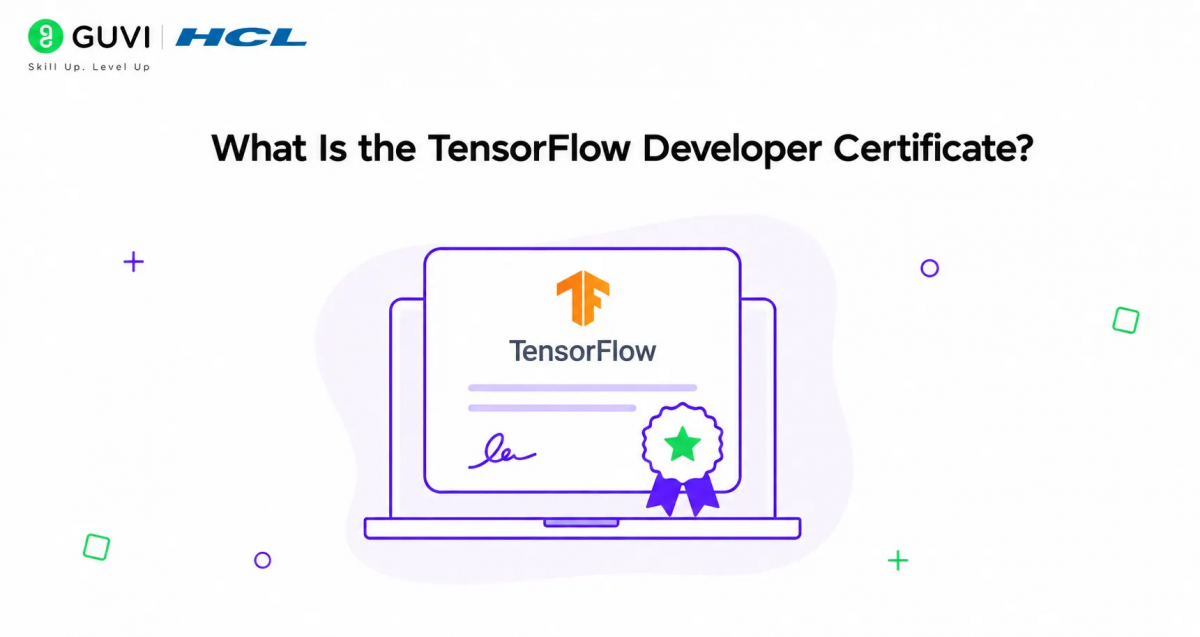
The TensorFlow Developer Certificate is a professional credential offered by Google that validates your ability to use TensorFlow to solve real-world machine learning problems. It is designed for developers, data scientists, and ML engineers who want to demonstrate practical TensorFlow skills.
Unlike traditional certifications that focus on multiple-choice questions, this exam is entirely hands-on. You will write code, build models, train them on real datasets, and achieve specific performance targets.
Why Get Certified?
The TensorFlow Developer Certificate offers several benefits:
- Industry Recognition: Validates your TensorFlow skills with a Google-issued credential.
- Career Advancement: Demonstrates practical ML implementation abilities to employers.
- Skill Validation: Proves you can build production-ready TensorFlow models.
- Professional Credibility: Sets you apart in a competitive job market.
- Structured Learning: Provides a clear path to master TensorFlow fundamentals.
Google’s standalone TensorFlow Developer Certificate ended in 2024; the closest today is DeepLearning.AI’s TensorFlow Developer Professional Certificate (CV, NLP, time-series, 16 coding assignments).Master AI & ML at HCL GUVI’s Artificial Intelligence and Machine Learning.
Exam Format and Structure
Understanding the exam format is critical for effective preparation.
Exam Details
- Duration: 5 hours
- Format: Hands-on coding exam (no multiple-choice questions)
- Delivery: Online, proctored exam
- Questions: Multiple coding tasks covering different ML domains
- Passing Score: Models must achieve at least 80% accuracy on evaluation tests
- Prerequisites: Basic Python programming and machine learning knowledge
- Cost: $100 USD (subject to change)
Exam Content Areas
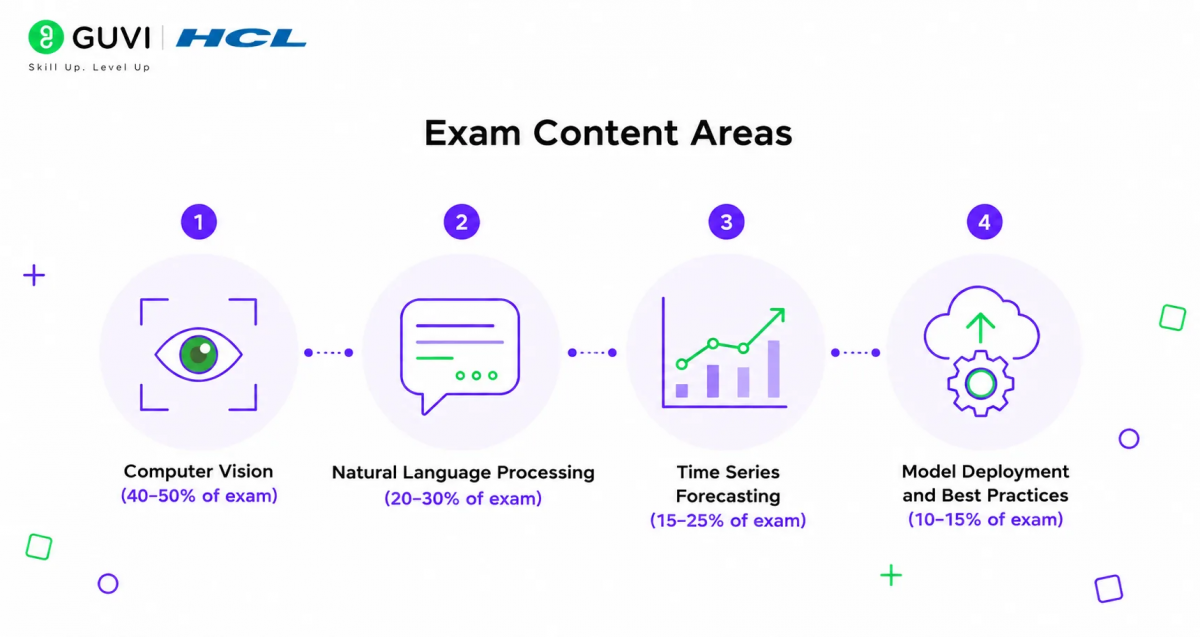
The exam covers four main domains:
1. Computer Vision (40–50% of exam)
- Image classification with CNNs
- Transfer learning with pre-trained models
- Data augmentation and preprocessing
- Handling image datasets with tf.data
- Building custom convolutional architectures
2. Natural Language Processing (20–30% of exam)
- Text preprocessing and tokenization
- Word embeddings (Word2Vec, embedding layers)
- Sequence models (RNNs, LSTMs, GRUs)
- Text classification tasks
- Handling variable-length sequences
3. Time Series Forecasting (15–25% of exam)
- Time series data preparation
- Windowing and batching time series data
- Building forecasting models
- Evaluating forecast accuracy
- Handling seasonal patterns
4. Model Deployment and Best Practices (10–15% of exam)
- Model saving and loading
- Serving models with TensorFlow Serving
- Model optimization techniques
- Best practices for production models
Key Topics to Master
Focus your preparation on these essential topics.
Computer Vision Fundamentals
Convolutional Neural Networks (CNNs):
- Understand convolution, pooling, and fully connected layers
- Build custom CNN architectures from scratch
- Implement dropout and batch normalization
- Use callbacks for training control (early stopping, model checkpoint)
Transfer Learning:
- Load pre-trained models (MobileNetV2, EfficientNet, ResNet)
- Freeze and unfreeze layers appropriately
- Add custom classification heads
- Fine-tune models for specific tasks
Image Data Handling:
- Use ImageDataGenerator for augmentation
- Build efficient data pipelines with tf.data
- Handle different image sizes and formats
- Implement on-the-fly data augmentation
Natural Language Processing Essentials
Text Preprocessing:
- Tokenization with Tokenizer class
- Padding and truncating sequences
- Building vocabulary from training data
- Handling out-of-vocabulary words
Embeddings:
- Use embedding layers in Keras
- Understand embedding dimensions
- Implement pre-trained embeddings (optional)
- Visualize embeddings with Embedding Projector
Sequence Models:
- Build RNNs, LSTMs, and GRUs
- Understand bidirectional layers
- Handle variable-length sequences
- Implement sequence-to-sequence models
Text Classification:
- Build sentiment analysis models
- Implement multi-class text classification
- Use global pooling layers
- Optimize for accuracy and generalization
Time Series Forecasting
Data Preparation:
- Create windowed datasets for time series
- Implement feature and label windows
- Handle train/validation/test splits
- Normalize and scale time series data
Forecasting Models:
- Build dense models for simple forecasting
- Implement RNNs and LSTMs for sequences
- Use convolutional layers for time series
- Create multi-step forecasting models
Evaluation:
- Calculate MAE and MSE for forecasts
- Visualize predictions vs. actual values
- Understand forecast horizon implications
- Handle seasonal and trend components
TensorFlow Best Practices
Model Building:
- Use Keras Sequential and Functional APIs
- Implement custom training loops when needed
- Apply proper regularization techniques
- Follow TensorFlow coding conventions
Training Optimization:
- Choose appropriate optimizers and learning rates
- Implement learning rate schedules
- Use mixed precision training (advanced)
- Monitor training with TensorBoard
Model Management:
- Save and load models correctly
- Export models for serving
- Version control your models
- Document your code and architecture
Study Plan and Timeline
A structured approach maximizes your chances of success.
Phase 1: Foundation Building (Weeks 1–4)
Goals:
- Master Python fundamentals for ML
- Understand TensorFlow basics and Keras API
- Complete introductory TensorFlow tutorials
- Build simple models for practice
Activities:
- Complete TensorFlow in Practice specialization
- Practice with MNIST and CIFAR-10 datasets
- Build basic CNNs and RNNs
- Learn tf.data API for efficient data pipelines
Phase 2: Domain Specialization (Weeks 5–10)
Goals:
- Deep dive into computer vision
- Master NLP techniques
- Understand time series forecasting
- Build production-quality models
Activities:
- Complete 3–5 computer vision projects
- Build 2–3 NLP text classification models
- Create time series forecasting models
- Practice transfer learning extensively
Phase 3: Exam Simulation (Weeks 11–14)
Goals:
- Simulate exam conditions
- Identify knowledge gaps
- Improve speed and accuracy
- Build exam stamina
Activities:
- Take timed practice exams (4–5 hours)
- Solve previous exam-style questions
- Review and refactor your code
- Practice debugging under time pressure
Phase 4: Final Preparation (Weeks 15–16)
Goals:
- Review weak areas
- Consolidate knowledge
- Prepare mentally for exam day
- Ensure technical setup is ready
Activities:
- Review key concepts and formulas
- Practice common exam patterns
- Test your development environment
- Rest and prepare mentally

Practice Projects for Exam Preparation
Build these projects to develop exam-ready skills.
Computer Vision Projects
Project 1: Image Classification Pipeline
- Build a CNN for CIFAR-10 classification
- Achieve >70% test accuracy
- Implement data augmentation
- Use callbacks for training optimization
Project 2: Transfer Learning Application
- Fine-tune MobileNetV2 on custom dataset
- Achieve >85% accuracy on validation set
- Implement proper layer freezing strategy
- Create efficient data pipeline
Project 3: Custom CNN Architecture
- Design and implement custom CNN
- Compare with transfer learning approach
- Optimize hyperparameters
- Document architecture decisions
NLP Projects
Project 1: Sentiment Analysis
- Build LSTM model for IMDB reviews
- Achieve >85% test accuracy
- Implement proper text preprocessing
- Handle variable-length sequences
Project 2: Text Classification
- Create multi-class text classifier
- Use embedding layers effectively
- Implement bidirectional LSTMs
- Optimize for speed and accuracy
Project 3: Sequence Modeling
- Build sequence-to-sequence model
- Handle padding and masking
- Implement attention mechanism (optional)
- Evaluate with appropriate metrics
Time Series Projects
Project 1: Univariate Forecasting
- Forecast single time series
- Implement windowing correctly
- Build dense and LSTM models
- Achieve low MAE on test set
Project 2: Multi-step Forecasting
- Predict multiple future time steps
- Handle seasonal patterns
- Compare different model architectures
- Visualize forecasts effectively
Project 3: Real-world Dataset
- Use weather or stock price data
- Implement complete pipeline
- Handle missing values appropriately
- Deploy model for inference
Exam Day Strategies
Maximize your performance on exam day.
Before the Exam
Technical Setup:
- Test your computer and internet connection
- Ensure TensorFlow and required packages are installed
- Verify webcam and microphone work properly
- Close all unnecessary applications
Mental Preparation:
- Get adequate sleep the night before
- Eat a light meal before the exam
- Arrive early for check-in process
- Stay calm and focused
During the Exam
Time Management:
- Read all questions first (10 minutes)
- Allocate time per question based on difficulty
- Leave 30 minutes for final review
- Don’t get stuck on one problem
Coding Strategy:
- Start with problems you’re most confident about
- Write clean, readable code from the start
- Comment your code for clarity
- Test incrementally as you build
Debugging Tips:
- Use print statements to check tensor shapes
- Verify data pipeline outputs
- Check model architecture summary
- Validate accuracy metrics
Google’s standalone TensorFlow Developer Certificate ended in 2024; the closest today is DeepLearning.AI’s TensorFlow Developer Professional Certificate (CV, NLP, time-series, 16 coding assignments).Master AI & ML at HCL GUVI’s Artificial Intelligence and Machine Learning.
Common Mistakes to Avoid
- Not reading instructions carefully: Each question has specific requirements.
- Ignoring data preprocessing: Garbage in, garbage out applies to ML.
- Overfitting on training data: Always validate on held-out data.
- Poor time management: Don’t spend too long on one problem.
- Not testing code: Run your code before submitting.
- Ignoring warnings: Address deprecation warnings and errors.
- Hardcoding paths: Use relative paths and proper file handling.
- Not saving models: Save your trained models as required.
The TensorFlow Developer Certificate exam is entirely practical with no theoretical questions. You must write working code that achieves specific performance targets on hidden test data. Over 50,000 developers have earned the TensorFlow Developer Certificate since its launch, with pass rates improving significantly for those who complete structured preparation programs.
Conclusion
The TensorFlow Developer Certificate is a valuable credential that validates your practical machine learning skills with TensorFlow. Success requires dedicated preparation, hands-on practice, and a deep understanding of computer vision, NLP, and time series forecasting.
With 3–6 months of focused study, consistent practice on real projects, and strategic exam preparation, you can earn this credential and advance your ML career. Focus on building production-quality models, understanding TensorFlow best practices, and developing the speed and accuracy needed for the 5-hour exam.
Remember: the goal is not just to pass the exam, but to become a proficient TensorFlow developer capable of solving real-world ML problems.
FAQs
What is the TensorFlow Developer Certificate?
The TensorFlow Developer Certificate is a professional credential from Google that validates your ability to build and train machine learning models using TensorFlow through a 5-hour hands-on coding exam.
How long does it take to prepare?
Most candidates need 3–6 months of dedicated study, depending on their prior experience with Python, machine learning, and TensorFlow.
What is the exam format?
The exam is 5 hours long, entirely hands-on coding with no multiple-choice questions. You must build models that achieve at least 80% accuracy on hidden evaluation tests.
How much does the exam cost?
The exam costs $100 USD (subject to change). Check the official TensorFlow website for current pricing.
What topics are covered?
The exam covers computer vision (40–50%), natural language processing (20–30%), time series forecasting (15–25%), and model deployment best practices (10–15%).
Is the exam difficult?
The exam is challenging but passable with proper preparation. Candidates who complete structured study programs and build multiple practice projects have significantly higher pass rates.
Do I need a degree to take the exam?
No formal degree is required. You need basic Python programming skills and fundamental machine learning knowledge.
How long is the certificate valid?
The TensorFlow Developer Certificate does not expire, but staying current with TensorFlow updates is recommended for maintaining relevant skills.
Success Stories

About the Author
HCL GUVI
This article was selected and published as part of the HCL GUVI AI Blogathon 2026, an initiative designed to encourage students, AI enthusiasts, and aspiring tech writers to simplify complex AI concepts through impactful technical content. The contest recognized high-quality, original, and insightful AI-focused blogs, with selected authors receiving publication opportunities on the HCL GUVI blog platform along with official author credits and recognition.
View all posts by HCL GUVI
Connect with me @





Did you enjoy this article?