


Artificial Intelligence and Machine Learning Articles
Finance Manager to Data Analytics: Career Growth, Salary and Seniority
How to Evaluate LLM Outputs in Production Deployments
AI/ML Skills Gap 2026: Why Companies Can't Find Job-Ready Talent
20 AI/ML Interview Questions Recruiters Can Use Without a Tech Background - Best Guide


Get In Touch For Details! Request More Information
What is Tokenization Explained: How LLMs Read Text
Aug 27, 2026 5 Min Read 485 Views
(Last Updated)
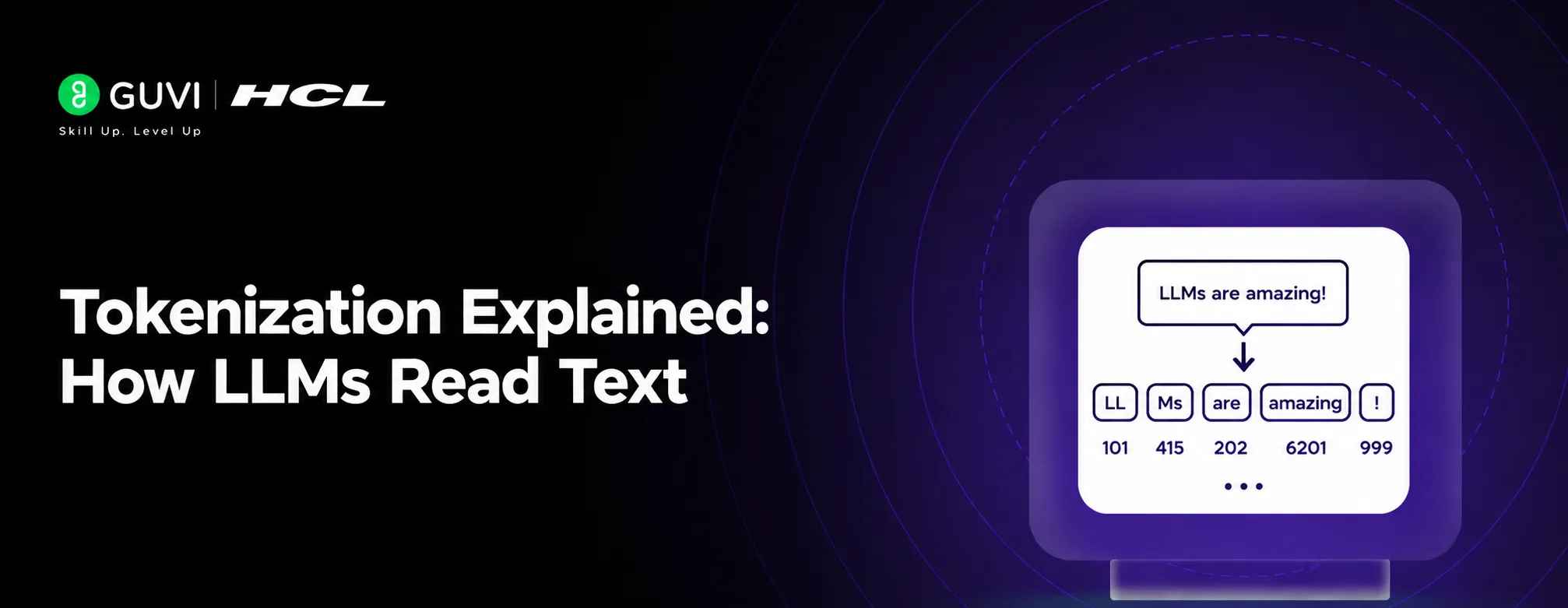
Before an AI model can “understand” language, it has to break text into tiny, meaningful pieces. That step is tokenization, and it is the very first thing that happens when you send a prompt to any large language model.
Without tokenization, an LLM would just see a string of characters. With it, the model sees a structured sequence of tokens that it has learned to reason about during training.
Table of contents
- Direct Answer
- TL;DR Summary
- What Is Tokenization in LLMs?
- Why Do LLMs Need Tokenization?
- How Tokenization Works: Step by Step
- Step 1: Raw Text Input
- Step 2: Splitting Into Tokens
- Step 3: Mapping to Token IDs
- Step 4: Generating Output Tokens
- Types of Tokenization
- Word Tokenization
- Character Tokenization
- Subword Tokenization
- Popular Subword Tokenization Algorithms
- Byte Pair Encoding (BPE)
- WordPiece
- SentencePiece
- Tiktoken and Model-Specific Tokenizers
- Why Tokenization Matters in Practice
- Context Length and Token Limits
- Pricing and Cost
- Handling Rare and Unseen Words
- Multilingual Support
- Common Mistakes to Avoid
- What to Do Next
- Conclusion
- FAQs
- What is tokenization in LLMs?
- What is a token in an LLM?
- Why do LLMs use tokenization?
- What is subword tokenization?
- What are BPE and WordPiece?
- Does tokenization affect token limits and cost?
- Do all LLMs use the same tokenizer?
Direct Answer
Tokenization in LLMs is the process of converting raw text into smaller units called tokens, which the model can process. A token can be a word, part of a word (subword), a character, or punctuation. The tokenizer maps each token to a unique integer ID, turning text into a sequence of numbers that the transformer can understand. This step is essential because LLMs cannot read raw text directly; they operate on token IDs.
TL;DR Summary
- Tokenization splits text into tokens (words, subwords, or characters) that LLMs can process.
- Each token is mapped to a unique integer ID in the model’s vocabulary.
- Modern LLMs mostly use subword tokenization like BPE and WordPiece.
- Tokenization affects context length, cost, and how the model understands rare words.
- Good tokenization balances vocabulary size, coverage, and efficiency.
What Is Tokenization in LLMs?
Tokenization in LLMs is the process of converting raw text into a sequence of tokens. A token is the basic unit of text that the model processes. It can be:
- A full word (for example, “cat”).
- A subword fragment (for example, “ing”, “tion”, “un”).
- A single character.
- Punctuation or whitespace.
The tokenizer does two things:
- Splits the input text into tokens.
- Maps each token to a unique integer ID from a fixed vocabulary.
These IDs are what the transformer actually sees. The model never operates directly on raw strings.
Tokenization splits text into subword tokens and maps them to numbers so LLMs can process language efficiently. Learn AI & ML with HCL GUVI’s Artificial Intelligence and Machine Learning course.
💡 Pro Tip: Think of tokenization as translating human-readable text into the model’s native “language” of numbers.
Why Do LLMs Need Tokenization?
LLMs cannot read text the way humans do. They are mathematical models that operate on sequences of integers.
Tokenization matters because it:
- Converts text into a format the model can process (token IDs).
- Defines the model’s vocabulary and how it represents words.
- Determines how many tokens a sentence uses, which affects context limits and cost.
- Influences how well the model handles rare or unseen words.
If tokenization is poor, the model struggles with uncommon words, misspellings, or mixed languages. Good tokenization helps the model generalize better.
How Tokenization Works: Step by Step
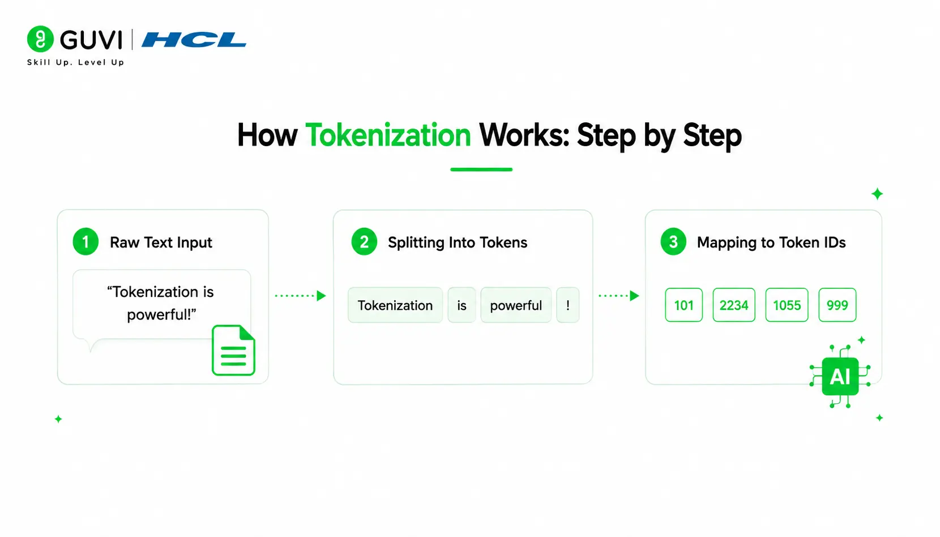
Step 1: Raw Text Input
You send a prompt like:
“Tokenization is important.”
Step 2: Splitting Into Tokens
The tokenizer breaks this into pieces. Depending on the algorithm, it might become:
- Word-level: [“Tokenization”, “is”, “important”, “.”]
- Subword-level: [“Token”, “ization”, “is”, “im”, “port”, “ant”, “.”]
- Character-level: [“T”, “o”, “k”, “e”, “n”, “i”, “z”, “a”, “t”, “i”, “o”, “n”, …]
Most modern LLMs use subword tokenization, which balances vocabulary size and coverage.
Step 3: Mapping to Token IDs
Each token is looked up in a vocabulary table and replaced with an integer ID.
For example:
- “Token” → 1234
- “ization” → 5678
- “is” → 42
- “im” → 910
- “port” → 112
- “ant” → 314
- “.” → 17
The model then sees:
[1234, 5678, 42, 910, 112, 314, 17]
This numeric sequence is what flows through the transformer layers.
Step 4: Generating Output Tokens
When the model generates text, it outputs token IDs one by one. The tokenizer then converts those IDs back into human-readable text.
This is why LLMs generate text token-by-token, not word-by-word.
Types of Tokenization
There are several ways to split text into tokens. Each has trade-offs.
1. Word Tokenization
Splits text into whole words.
- Example: [“Tokenization”, “is”, “important”]
- Pros: Simple, human-readable.
- Cons: Large vocabulary, poor handling of rare or misspelled words, struggles with new words not in the vocabulary.
Word tokenization is rarely used in modern LLMs.
2. Character Tokenization
Splits text into individual characters.
- Example: [“T”, “o”, “k”, “e”, “n”, “i”, “z”, “a”, “t”, “i”, “o”, “n”, …]
- Pros: Small vocabulary, can represent any word.
- Cons: Very long sequences, weak semantic meaning per token, harder for the model to learn patterns.
Character tokenization is useful for some tasks but not ideal for large-scale language modeling.
3. Subword Tokenization
Splits words into meaningful subword units.
- Example: [“Token”, “ization”, “is”, “im”, “port”, “ant”]
- Pros: Balances vocabulary size and coverage, handles rare words well, efficient sequences.
- Cons: More complex to implement, tokens are less human-intuitive.
Subword tokenization is the standard in modern LLMs.
Popular Subword Tokenization Algorithms
Byte Pair Encoding (BPE)
BPE starts with a character-level vocabulary and iteratively merges the most frequent adjacent token pairs.
- Frequent pairs like “ing”, “tion”, or “un” become single tokens.
- Rare words are represented as combinations of subwords.
- Used in GPT-style models.
BPE offers a good balance between vocabulary size and the ability to represent rare or unseen words.
WordPiece
WordPiece is similar to BPE but uses a probabilistic approach to decide which subwords to merge.
- It is used in models like BERT.
- Often prepends special markers (like “▁”) to indicate word boundaries.
- Works well for multilingual and masked language modeling tasks.
WordPiece is another widely adopted subword tokenization method.
SentencePiece
SentencePiece treats the entire sentence as a sequence and can operate directly on raw text without pre-tokenization.
- Useful for languages without clear word boundaries (for example, Chinese, Japanese).
- Supports both BPE-like and unigram-based tokenization.
- Common in multilingual and sequence-to-sequence models.
SentencePiece is popular when working with diverse languages and non-Latin scripts.
Tiktoken and Model-Specific Tokenizers
Some models use custom tokenizers optimized for their training data and architecture.
- OpenAI’s tiktoken is used in GPT-4 and related models.
- These tokenizers are tuned for efficiency and specific token distributions.
- They often have large vocabularies (tens of thousands to over 100k tokens).
When working with a specific model, it is important to use its official tokenizer to match token counts and behavior.

Why Tokenization Matters in Practice
Tokenization is not just a technical detail. It affects real-world behavior and costs.
Context Length and Token Limits
LLMs have a maximum context length measured in tokens, not characters or words.
- A 128k-token model can handle more text with efficient tokenization.
- Poor tokenization can waste tokens on unnecessary splits.
Understanding tokenization helps you estimate how much text fits in a prompt.
Pricing and Cost
Many APIs charge per token (input + output).
- Better tokenization can reduce token count for the same content.
- Subword tokenization usually compresses common patterns better than character-level approaches.
If you build applications on top of LLMs, tokenization directly impacts your costs.
Handling Rare and Unseen Words
Good subword tokenization ensures that rare or new words can still be represented.
- Instead of “unknown,” the model sees familiar subword pieces.
- This improves robustness for misspellings, domain-specific terms, and new words.
This is one reason subword methods dominate modern LLMs.
Multilingual Support
Tokenizers designed for multilingual use handle many scripts and languages.
- They learn subword units across languages.
- This helps the model share representations and generalize better.
SentencePiece and similar tokenizers are common in multilingual models.
⚠️ Warning: Do not assume that token counts match word counts. A 100-word prompt can easily become 130–150 tokens depending on the tokenizer.
Common Mistakes to Avoid
- Assuming tokens are the same as words.
- Ignoring tokenization when estimating prompt length or API costs.
- Mixing tokenizers from different models and expecting consistent behavior.
- Overlooking special tokens (for example, <bos>, <eos>, <pad>) in model inputs.
- Forgetting that tokenization affects how the model sees misspellings and rare terms.
- Not testing tokenization on your actual data before deploying.
✅ Best Practice: Always use the official tokenizer for the model you are working with. For OpenAI models, use tiktoken. For Hugging Face models, use the tokenizer provided with the model card.
What to Do Next
If you want to understand tokenization more deeply:
- Install a tokenizer library (for example, Hugging Face transformers or OpenAI tiktoken).
- Tokenize sample sentences and inspect the token IDs and decoded text.
- Compare how different tokenizers split the same text.
- Count tokens in your typical prompts to estimate context usage and cost.
- Read documentation for your chosen model’s tokenizer to learn about special tokens and edge cases.
Tokenization is a foundational concept for working with LLMs. A clear mental model of how text becomes tokens will make you better at prompt engineering, debugging, and building AI applications.
Most modern LLMs use subword tokenization, which means a single word can be represented by multiple tokens (for example, “unbelievable” → “un”, “believ”, “able”). Token counts are not universal: the same sentence can have different token counts depending on which model’s tokenizer you use.
Tokenization splits text into subword tokens and maps them to numbers so LLMs can process language efficiently. Learn AI & ML with HCL GUVI’s Artificial Intelligence and Machine Learning course.
Conclusion
Tokenization in LLMs is the process of converting raw text into tokens and then into integer IDs that the model can process. Tokens can be words, subwords, or characters, with subword methods like BPE and WordPiece being the most common in modern models.
Tokenization defines the model’s vocabulary, affects context length and cost, and determines how well the model handles rare and unseen words. Understanding tokenization is essential for anyone working with LLMs, from prompt engineers to application developers.
FAQs
What is tokenization in LLMs?
Tokenization in LLMs is the process of splitting text into tokens (words, subwords, or characters) and mapping them to integer IDs that the model can process.
What is a token in an LLM?
A token is the basic unit of text that an LLM processes. It can be a word, part of a word, a character, or punctuation, depending on the tokenization method.
Why do LLMs use tokenization?
LLMs use tokenization to convert text into numeric sequences. They cannot operate on raw strings, so tokenization translates human language into a format the model understands.
What is subword tokenization?
Subword tokenization splits words into meaningful fragments (for example, “un”, “believ”, “able”). It balances vocabulary size and coverage, and handles rare words better than word-level tokenization.
What are BPE and WordPiece?
BPE (Byte Pair Encoding) and WordPiece are popular subword tokenization algorithms. BPE iteratively merges frequent token pairs, while WordPiece uses a probabilistic approach. Both are widely used in LLMs.
Does tokenization affect token limits and cost?
Yes. Tokenization determines how many tokens a given text produces, which directly affects context usage and API pricing in token-based billing models.
Do all LLMs use the same tokenizer?
No. Different models use different tokenizers and vocabularies. The same sentence can have different token counts depending on the model and tokenizer used.
Success Stories

About the Author
HCL GUVI
This article was selected and published as part of the HCL GUVI AI Blogathon 2026, an initiative designed to encourage students, AI enthusiasts, and aspiring tech writers to simplify complex AI concepts through impactful technical content. The contest recognized high-quality, original, and insightful AI-focused blogs, with selected authors receiving publication opportunities on the HCL GUVI blog platform along with official author credits and recognition.
View all posts by HCL GUVI
Connect with me @












Did you enjoy this article?