


Artificial Intelligence and Machine Learning Articles
Finance Manager to Data Analytics: Career Growth, Salary and Seniority
How to Evaluate LLM Outputs in Production Deployments
AI/ML Skills Gap 2026: Why Companies Can't Find Job-Ready Talent
20 AI/ML Interview Questions Recruiters Can Use Without a Tech Background - Best Guide


Get In Touch For Details! Request More Information
AI Bias Mitigation Techniques: A Practical Guide
Sep 07, 2026 4 Min Read 320 Views
(Last Updated)
AI systems learn from data, and biased data can lead to biased predictions and decisions. AI Bias Mitigation involves identifying, measuring, and reducing unfair patterns throughout the machine learning lifecycle. From improving training data to evaluating model outputs, organizations can use multiple techniques to make AI systems more fair, reliable, and responsible. This guide explains practical AI Bias Mitigation techniques and how they can be applied to real-world machine learning workflows.
Table of contents
- TL;DR Summary
- Why AI Bias Mitigation Matters
- What Is AI Bias?
- Biased Training Data
- Sampling Bias
- Labeling Bias
- Algorithmic Bias
- Deployment Bias
- How to Identify AI Bias
- Analyze Training Data
- Compare Model Performance
- Examine Prediction Outcomes
- Conduct Fairness Audits
- Practical AI Bias Mitigation Techniques
- Improve Dataset Representation
- Balance Training Data
- Review Labels
- Use Fairness Metrics
- Apply Fairness-Aware Training
- Human Oversight
- AI Bias Mitigation Across the ML Lifecycle
- Real-World Applications
- Hiring
- Financial Services
- Healthcare
- Computer Vision
- Benefits of AI Bias Mitigation
- Fairer AI Systems
- Better Reliability
- Greater Trust
- Responsible Deployment
- When Should You Apply AI Bias Mitigation?
- High-Impact Decisions
- Diverse User Groups
- Imbalanced Datasets
- Model Evaluation
- Production Monitoring
- Key Concepts to Remember
- A Practical AI Bias Mitigation Workflow
- Identify Potential Sources of Bias
- Analyze the Dataset
- Train the Model
- Evaluate Group-Level Results
- Apply Mitigation Techniques
- Validate Again
- Monitor After Deployment
- Best Practices
- Conclusion
- FAQs
- What is AI Bias Mitigation?
- Where can AI bias originate?
- Does high model accuracy mean an AI system is fair?
- How can biased training data be addressed?
- Why are fairness metrics important?
- Is bias mitigation only needed before deployment?
- Why is human oversight important?
TL;DR Summary
- AI bias can originate from data, models, or deployment.
- Bias should be assessed throughout the ML lifecycle.
- Better data can reduce biased model behavior.
- Fairness metrics help identify disparities.
- Regular monitoring is essential after deployment.
Direct Answer
| AI Bias Mitigation involves identifying and reducing unfair patterns in AI systems through better data, model evaluation, fairness-aware training, and continuous monitoring. Techniques such as dataset balancing, bias testing, representative sampling, fairness constraints, and human review can help reduce discriminatory outcomes and make machine learning systems more reliable across different groups and use cases. |
Why AI Bias Mitigation Matters
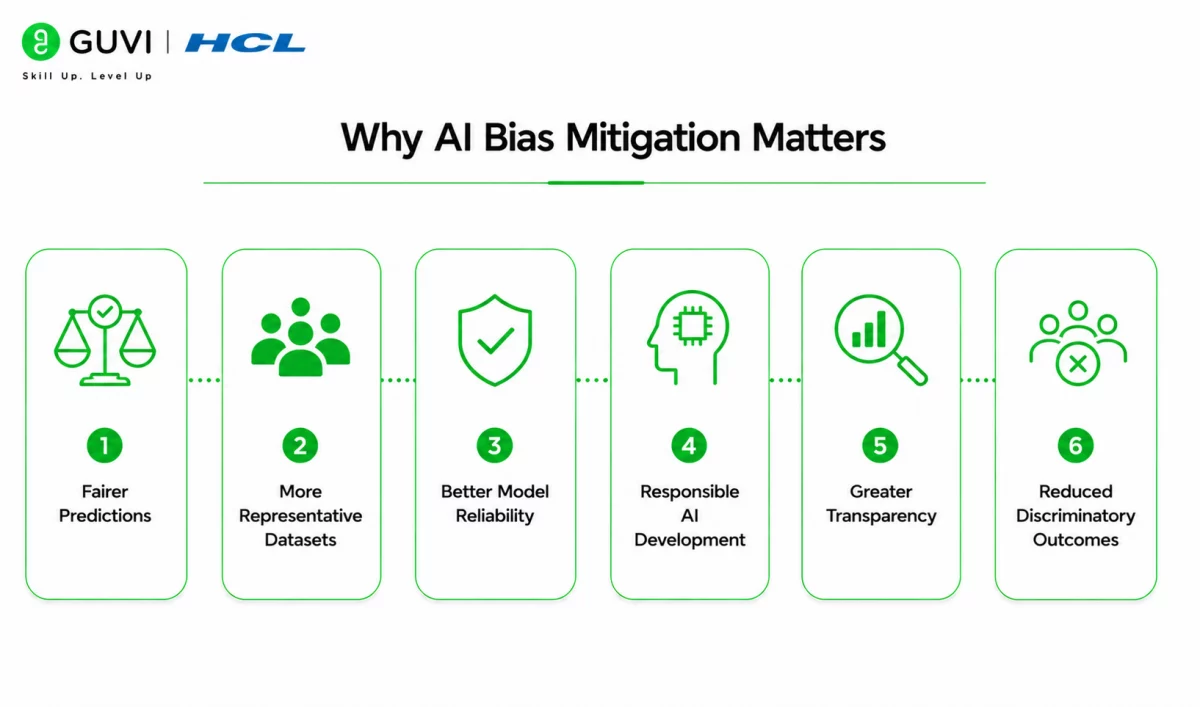
AI systems can influence decisions involving hiring, lending, healthcare, education, advertising, and other important areas. If biased patterns exist in training data or model behavior, they can be reproduced or amplified by the system.
Effective bias mitigation helps support:
- Fairer predictions
- More representative datasets
- Better model reliability
- Responsible AI development
- Greater transparency
- Reduced discriminatory outcomes
What Is AI Bias?
AI bias occurs when an AI system produces systematically unfair or unequal outcomes for certain individuals or groups.
Bias can enter an AI system through several sources.
Biased Training Data
Historical datasets may contain existing inequalities or underrepresent certain groups.
Sampling Bias
A dataset may not accurately represent the population where the model will be used.
Labeling Bias
Human annotators may introduce subjective or inconsistent judgments into training labels.
Algorithmic Bias
Model design or optimization objectives can produce unequal outcomes.
Deployment Bias
A model that performs well in one environment may behave unfairly when applied to a different population or context.
How to Identify AI Bias
Before mitigating bias, teams need to measure where it exists.
Analyze Training Data
Check whether important groups are adequately represented and whether historical patterns may introduce bias.
Compare Model Performance
Evaluate model performance separately across relevant groups instead of relying only on overall accuracy.
Examine Prediction Outcomes
Look for systematic differences in false positives, false negatives, approval rates, or other outcomes.
Conduct Fairness Audits
Regular audits can help identify disparities that may not be visible through standard performance metrics.
Practical AI Bias Mitigation Techniques
Improve Dataset Representation
Use diverse and representative datasets to reduce underrepresentation.
Balance Training Data
Where appropriate, address significant class or group imbalances before model training.
Review Labels
Check whether annotation guidelines and labeling decisions introduce systematic bias.
Use Fairness Metrics
Evaluate model outcomes using appropriate fairness measures alongside traditional performance metrics.
Apply Fairness-Aware Training
Modify model training or optimization approaches when fairness requirements are part of the system’s objectives.
Human Oversight
Use human review for high-impact decisions and cases where automated predictions require additional context.
AI Bias Mitigation Across the ML Lifecycle
Bias mitigation should not happen only after a model has been trained.
Data Collection → Labeling → Training → Evaluation → Deployment → Monitoring
At each stage, teams can evaluate whether the system is producing unexpected disparities and take corrective action where necessary.
Real-World Applications
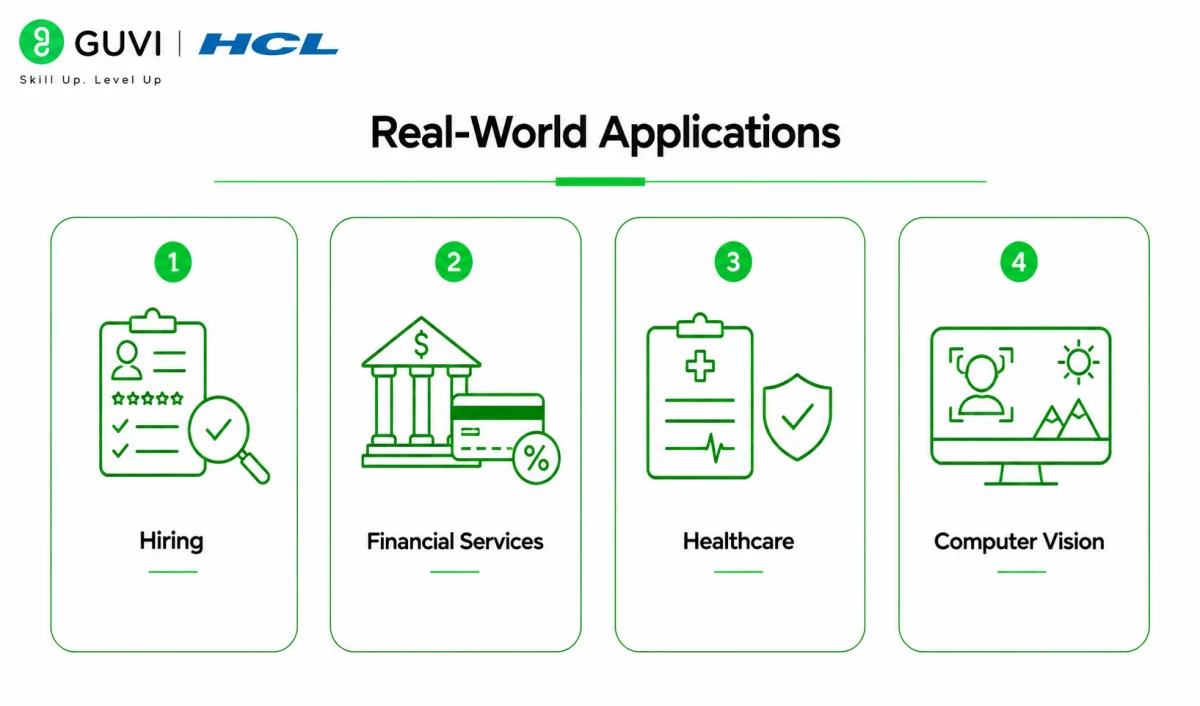
Hiring
Evaluate whether automated screening systems produce systematically different outcomes across candidate groups.
Financial Services
Monitor lending or credit models for potentially unfair differences in approval or risk outcomes.
Healthcare
Evaluate AI systems across relevant patient populations to identify performance disparities.
Computer Vision
Test recognition systems across diverse demographic and environmental conditions.
Don’t rely on overall accuracy alone when evaluating an AI system for fairness. A model can achieve high overall accuracy while performing significantly worse for a particular group. Always examine performance across relevant groups and use fairness measures appropriate to the application.
Benefits of AI Bias Mitigation
Fairer AI Systems
Mitigation techniques can reduce systematic disparities in model outcomes.
Better Reliability
Testing across different groups can reveal weaknesses that overall metrics hide.
Greater Trust
Transparent evaluation and monitoring can improve confidence in AI systems.
Responsible Deployment
Bias assessment helps organizations make more informed decisions about where and how AI should be used.
Professionals interested in responsible AI, machine learning, and AI development can strengthen their expertise through HCL GUVI’s Artificial Intelligence and Machine Learning Course.

When Should You Apply AI Bias Mitigation?
AI Bias Mitigation should be applied throughout the machine learning lifecycle, especially when AI systems influence decisions that can significantly affect people.
High-Impact Decisions
Use bias evaluation when AI supports decisions related to hiring, lending, healthcare, education, or other sensitive areas.
Diverse User Groups
Evaluate models when they are expected to serve populations with different demographic, geographic, or behavioral characteristics.
Imbalanced Datasets
Apply mitigation techniques when certain groups or classes are significantly underrepresented in training data.
Model Evaluation
Check group-level performance before deployment instead of relying only on overall accuracy.
Production Monitoring
Continue monitoring deployed models because changes in data or user populations can introduce new sources of bias.
Key Concepts to Remember
- Bias can originate from data, labeling, model design, or deployment.
- Representation matters when building training datasets.
- Overall accuracy does not guarantee fairness.
- Group-level performance can reveal hidden disparities.
- Human review can be valuable for high-impact decisions.
- Bias mitigation should continue after deployment.
A Practical AI Bias Mitigation Workflow
A structured approach can help teams identify and reduce bias.
1. Identify Potential Sources of Bias
Review data collection, sampling, labels, model objectives, and deployment conditions.
2. Analyze the Dataset
Check representation, missing information, class imbalance, and historical patterns that could affect outcomes.
3. Train the Model
Build the model while considering relevant fairness requirements alongside predictive performance.
4. Evaluate Group-Level Results
Compare important performance and outcome metrics across relevant groups.
5. Apply Mitigation Techniques
Depending on the problem, improve the dataset, adjust training methods, or introduce additional safeguards.
6. Validate Again
Re-evaluate the model after mitigation to determine whether disparities have actually been reduced without creating unacceptable performance trade-offs.
7. Monitor After Deployment
Continue checking model behavior as real-world data and user populations change.
The HCL GUVI’s Artificial Intelligence eBook introduces the fundamentals of artificial intelligence, machine learning, generative AI, and intelligent automation. It helps learners build a broader understanding of AI technologies and responsible approaches to developing intelligent systems.
Best Practices
- Use representative and relevant training data.
- Document dataset and labeling decisions.
- Evaluate performance across relevant groups.
- Select fairness metrics appropriate to the use case.
- Keep fairness evaluation separate from overall accuracy.
- Include human oversight for high-impact applications.
- Monitor deployed systems for changing patterns.
- Reassess models when data or use cases change.
Conclusion
AI Bias Mitigation is an ongoing process rather than a single model-training step. By examining data, evaluating group-level outcomes, improving training approaches, and monitoring deployed systems, organizations can identify and reduce unfair patterns more effectively. A responsible approach combines fairness evaluation with model performance, human oversight, and continuous monitoring to build AI systems that are more reliable and appropriate for real-world use.
FAQs
1. What is AI Bias Mitigation?
AI Bias Mitigation refers to techniques used to identify, reduce, and monitor unfair patterns in AI systems throughout the machine learning lifecycle.
2. Where can AI bias originate?
Bias can come from training data, sampling, labeling, model design, optimization objectives, or differences between development and deployment environments.
3. Does high model accuracy mean an AI system is fair?
No. A model can have high overall accuracy while performing differently across specific groups. Group-level evaluation is therefore important.
4. How can biased training data be addressed?
Teams can improve representation, review sampling methods, examine historical patterns, and apply appropriate data-balancing or preprocessing techniques.
5. Why are fairness metrics important?
Fairness metrics help teams identify differences in model outcomes or performance across relevant groups that may not be visible through overall accuracy.
6. Is bias mitigation only needed before deployment?
No. Models should also be monitored after deployment because changes in data, users, or operating conditions can introduce new disparities.
7. Why is human oversight important?
Human oversight can provide additional context and review for high-impact decisions where automated predictions may have significant consequences for individuals.
Success Stories

About the Author
HCL GUVI
This article was selected and published as part of the HCL GUVI AI Blogathon 2026, an initiative designed to encourage students, AI enthusiasts, and aspiring tech writers to simplify complex AI concepts through impactful technical content. The contest recognized high-quality, original, and insightful AI-focused blogs, with selected authors receiving publication opportunities on the HCL GUVI blog platform along with official author credits and recognition.
View all posts by HCL GUVI
Connect with me @









Did you enjoy this article?