


Deep Learning Articles
VGGNet Architecture: A Beginner's Guide
Generative Adversarial Networks (GANs): The Complete Guide
What is Object Detection? A Beginner’s Guide [2026]
What is the Minerva Deep Learning Model? An Exclusive Beginner’s Guide [2025]


Get In Touch For Details! Request More Information
Dropout Regularization in Neural Networks
Aug 26, 2026 4 Min Read 485 Views
(Last Updated)
Every machine learning practitioner hits the same wall at some point: your neural network performs brilliantly on training data but falls apart on new data it has never seen. This is overfitting, and it is one of the most common problems in deep learning. Dropout Regularization is one of the simplest and most effective solutions ever discovered for this problem. Instead of adding complexity to your model or gathering more data, Dropout randomly switches off neurons during training, forcing your network to become more resilient and less dependent on any particular path through the network.
Table of contents
- TL;DR Summary
- What Is Overfitting and Why Should You Care?
- What Is Dropout Regularization?
- How Dropout Works: Training vs Inference
- Why Dropout Regularization Works: The Intuition
- Implementing Dropout in Keras and PyTorch
- Syntax Reference
- Dropout Rate: How to Choose the Right Value
- Conclusion
- FAQ
- What is Dropout Regularization in neural networks?
- What dropout rate should I start with?
- Is Dropout applied during inference?
- What is the difference between Dropout and Spatial Dropout?
- Can I use Dropout and Batch together?
- When should I not use Dropout?
TL;DR Summary
- Dropout Regularization randomly turns off a fraction of neurons during each training step, forcing the network to learn more robust features
- It was introduced by Geoffrey Hinton and colleagues in 2012 and became one of the most widely used regularization techniques in deep learning
- The dropout rate controls what fraction of neurons are deactivated, typically between 0.2 and 0.5
- Dropout is applied only during training and turned off during inference, where all neurons are active but their outputs are scaled
- It works best on large networks with many parameters where overfitting is a significant risk
- For convolutional layers, Spatial Dropout is preferred over standard Dropout because it drops entire feature maps rather than individual values
What Is Overfitting and Why Should You Care?
Overfitting happens when a neural network memorizes the training data instead of learning general patterns. The network becomes so good at the specific examples it has seen that it fails on new examples that are slightly different.
Think of it like a student who memorizes every past exam question word for word instead of understanding the underlying concepts. They score perfectly on practice tests but struggle on the real exam when questions are phrased differently.
In neural networks, overfitting usually happens when:
- The network has too many parameters relative to the training data
- Training continues for too many epochs
- The training dataset is too small or not diverse enough
Signs of overfitting include a training loss that keeps decreasing while validation loss starts increasing or plateauing. That divergence is the clearest signal that your model is memorizing rather than learning.
Want to build strong deep learning skills and learn how to train neural networks that generalize well to real-world data? Explore HCL GUVI’s Artificial Intelligence & Machine Learning Course, designed to help you develop the practical deep learning foundations modern AI roles demand
What Is Dropout Regularization?
Dropout Regularization is a training technique that randomly deactivates a fraction of neurons in a layer at each training step. Deactivated neurons contribute nothing to the forward pass and receive no gradient updates during the backward pass.
The fraction of neurons dropped is controlled by the dropout rate. A dropout rate of 0.3 means 30 percent of neurons are randomly turned off at each step. The remaining 70 percent process the input normally.
Critically, a different random set of neurons is dropped at each training step. No neuron is permanently disabled. By the end of training, every neuron has been active for some steps and inactive for others.
This randomness is the key to why Dropout works. The network cannot rely on any single neuron always being available. It has to learn to represent information redundantly across multiple neurons, which produces a more robust and generalizable model.
Read More: Regularization in Machine Learning: L1, L2, Dropout Explained with Code (2026)
How Dropout Works: Training vs Inference
Dropout behaves differently during training and inference, and understanding this difference is essential for using it correctly.
- During Training
At each training step a random mask is generated for each dropout layer. Neurons selected by the mask are set to zero. The remaining neurons process the input as normal. Because different neurons are dropped each step, the network is effectively training a different sub-network configuration at every step.
- During Inference
During inference all neurons are active. No dropout occurs. However, because neurons were only active a fraction of the time during training, their outputs need to be scaled down to match the expected output magnitude. If a neuron had a dropout rate of 0.5, it was active only half the time during training, so its output is scaled by 0.5 during inference.
Modern frameworks use inverted dropout, which scales activations up during training rather than down during inference. This keeps inference fast and simple since no scaling adjustment is needed at prediction time. PyTorch and Keras both use inverted dropout by default.
Why Dropout Regularization Works: The Intuition
There are two complementary ways to understand why Dropout is so effective.
- The Ensemble Interpretation
With a network of n neurons, each training step uses a different random subset of those neurons. This is equivalent to training a huge ensemble of many different smaller networks that all share weights. At inference time, using all neurons simultaneously approximates averaging the predictions of the entire ensemble. Ensemble methods almost always outperform single models, and Dropout gives you ensemble-like behavior without the cost of actually training multiple separate networks.

- The Co-Adaptation Prevention Interpretation
Without Dropout, neurons can develop co-dependencies where neuron A only works correctly because neuron B is always there to correct its mistakes. These co-adapted groups of neurons do not generalize well because the specific pattern of co-dependence is unlikely to be useful on new data.
Dropout breaks these co-dependencies by randomly removing neurons. Each neuron cannot rely on its neighbors always being present, so it learns to be useful on its own. The result is that individual neurons develop more meaningful, independent representations.
Implementing Dropout in Keras and PyTorch
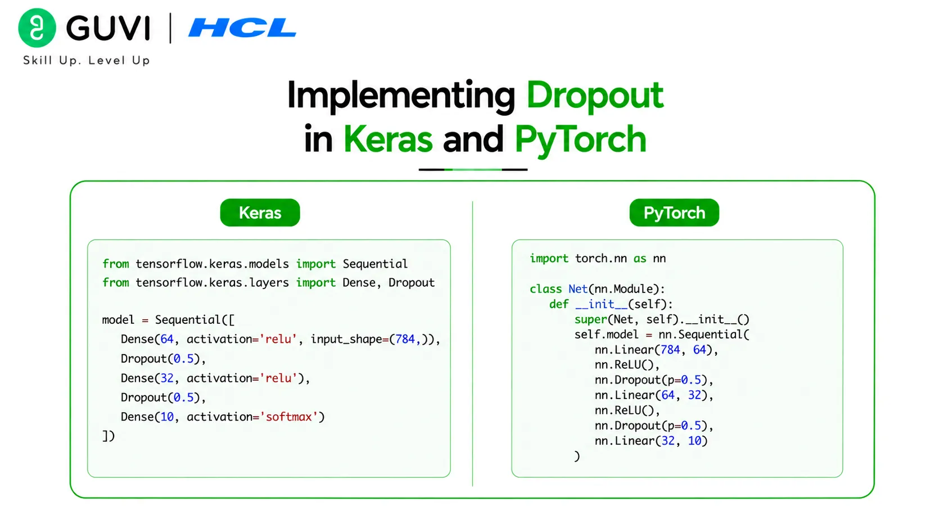
Adding Dropout to your network is straightforward in both major frameworks.
Syntax Reference
| Framework | Layer Type | Code |
| Keras | After Dense layer | model.add(Dropout(0.5)) |
| Keras | In Sequential | layers.Dropout(0.5) |
| PyTorch | After Linear layer | nn.Dropout(p=0.5) |
| PyTorch | Spatial (CNN) | nn.Dropout2d(p=0.2) |
| Keras | Spatial (CNN) | SpatialDropout2D(0.2) |
| PyTorch | Eval mode | model.eval() |
| Keras | Inference | model.predict() (auto) |
Geoffrey Hinton has said that the idea for Dropout was partly inspired by a mechanism used by banks to prevent fraud among employees. Banks rotate staff between branches so no single employee learns all the details of a transaction process well enough to exploit them alone. Similarly, Dropout prevents neurons from learning to rely on specific other neurons, forcing each one to be individually useful.
Dropout Rate: How to Choose the Right Value
Choosing the right dropout rate is a balancing act. Too low and Dropout does not prevent overfitting effectively. Too high and you drop so many neurons that the network cannot learn the patterns in the data at all.
| Dropout Rate | Effect | When to Use |
| 0.1 to 0.2 | Mild regularization | Convolutional layers, already-regularized models |
| 0.3 to 0.5 | Moderate regularization | Fully connected layers, moderate overfitting |
| 0.5 | Standard default | Original paper recommendation, large FC layers |
| Above 0.6 | Strong regularization | Rarely needed, risks underfitting |
The right approach is to start with 0.5 for fully connected layers and 0.2 for convolutional layers, train and evaluate, then adjust based on whether the training-validation gap improves. If validation accuracy is still much lower than training accuracy, increase the dropout rate. If the model is underfitting with both training and validation accuracy low, reduce it.
Want to build strong deep learning skills and learn how to train neural networks that generalize well to real-world data? Explore HCL GUVI’s Artificial Intelligence & Machine Learning Course, designed to help you develop the practical deep learning foundations modern AI roles demand
Conclusion
Dropout Regularization remains one of the most practical and widely used tools in deep learning because it solves a real and common problem with a remarkably simple idea.
By randomly deactivating neurons during training, Dropout prevents co-adaptation, encourages redundant representations, and produces models that generalize far better to new data than networks trained without it.
FAQ
What is Dropout Regularization in neural networks?
Dropout Regularization randomly deactivates a fraction of neurons during each training step, preventing the network from memorizing training data and improving its ability to generalize to new examples.
What dropout rate should I start with?
Start with 0.5 for fully connected layers and 0.2 for convolutional layers. Adjust based on whether your model is still overfitting or has started underfitting after initial training.
Is Dropout applied during inference?
No. Dropout is disabled during inference and all neurons are active. In PyTorch call model.eval() before prediction. Keras handles this automatically when using model.predict().
What is the difference between Dropout and Spatial Dropout?
Standard Dropout randomly zeros individual neuron outputs. Spatial Dropout zeros entire feature maps in convolutional layers, which is more meaningful regularization for CNN architectures.
Can I use Dropout and Batch together?
Yes, but results vary. Some architectures benefit from using both while others perform better with one or the other. Test both configurations on your specific problem and dataset.
When should I not use Dropout?
Avoid Dropout on very small networks where you are already underfitting, on the output layer of any network, and in RNNs and Transformers where other techniques like Layer Normalization and attention dropout are more appropriate.
Success Stories

About the Author
HCL GUVI
This article was selected and published as part of the HCL GUVI AI Blogathon 2026, an initiative designed to encourage students, AI enthusiasts, and aspiring tech writers to simplify complex AI concepts through impactful technical content. The contest recognized high-quality, original, and insightful AI-focused blogs, with selected authors receiving publication opportunities on the HCL GUVI blog platform along with official author credits and recognition.
View all posts by HCL GUVI
Connect with me @















Did you enjoy this article?