


Artificial Intelligence and Machine Learning Articles
Federated Learning: Training Models Without Centralizing Data
Attention Mechanism Explained: The Building Block of Transformers


Get In Touch For Details! Request More Information

Batch Normalization Explained: Why It Speeds Up Training
Aug 26, 2026 5 Min Read 24 Views
(Last Updated)
If you have ever tried training a deep neural network and watched the loss refuse to decrease, or seen training suddenly blow up with exploding values, you have experienced what training deep networks felt like before Batch Normalization existed. Introduced by Sergey Ioffe and Christian Szegedy at Google in 2015, Batch Normalization was one of those rare techniques that immediately changed how everyone trained neural networks. It made deeper networks easier to train, faster to converge, and less sensitive to the choices you make before training even begins.
Table of contents
- TL;DR Summary
- What Batch Normalization Actually Does
- Why This Speeds Up Training
- Where to Place Batch Normalization in a Network
- Training vs Inference:
- Implementing Batch Normalization in Keras and PyTorch
- Batch Normalization vs Other Normalization Techniques
- Conclusion
- FAQs
- What is Batch Normalization in simple terms?
- Why does Batch Normalization speed up training?
- Where should I place Batch Normalization in my network?
- What is the difference between training and inference in Batch Normalization?
- When should I use Layer Normalization instead of Batch Normalization?
- Does Batch Normalization replace dropout for regularization?
TL;DR Summary
- Batch Normalization is a technique used in deep neural networks that normalizes the inputs to each layer during training, keeping values in a stable range throughout the network
- It dramatically speeds up training by allowing higher learning rates, reduces sensitivity to weight initialization, and acts as a mild regularizer
- Without Batch Normalization, deep networks suffer from internal covariate shift, where the distribution of inputs to each layer keeps changing as weights update, making training slow and unstable
- Batch Normalization is placed after a linear layer and before the activation function, though some practitioners place it after the activation
What Batch Normalization Actually Does
Batch Normalization fixes internal covariate shift by normalizing the inputs to each layer so they always have a consistent distribution, specifically a mean of zero and a standard deviation of one, at every training step.
During each training step, you are processing a mini-batch of examples, say 32 or 64 at a time. For each layer where Batch Normalization is applied, the algorithm computes the mean and standard deviation of the activations across the current batch. It then subtracts the mean and divides by the standard deviation, centering and scaling the values so the distribution has mean zero and unit variance.
But there is one more step. Forcing every layer to always have exactly mean zero and unit variance is too restrictive. Sometimes the optimal distribution for a layer is different. So Batch Normalization adds two learnable parameters called gamma (scale) and beta (shift). After normalizing, it multiplies by gamma and adds beta. The network learns the best gamma and beta values for each layer through training.
Want to build strong deep learning foundations covering neural network training, optimization, and real-world model deployment? Explore HCL GUVI’s Artificial Intelligence & Machine Learning Course, designed to help you go from ML fundamentals to production-ready deep learning systems.
Why This Speeds Up Training
Once you understand what Batch Normalization does, why it speeds up training becomes intuitive.
- Higher learning rates become safe.
Without normalization, high learning rates cause large parameter updates that push activations into unstable ranges. With normalized activations, large updates are absorbed more gracefully. You can use learning rates five to ten times higher than you could without Batch Normalization, and each step moves further toward the optimum.
- Less sensitivity to initialization.
Because activations are normalized at every layer, the starting scale of the weights matters much less. Poor initialization gets corrected quickly within the first few training steps. This removes one of the most tedious parts of training deep networks.
- Smoother loss landscape.
Research has shown that Batch Normalization makes the loss landscape significantly smoother, meaning the path from the starting weights to the optimal weights has fewer sharp cliffs and steep valleys. Gradient descent navigates a smoother landscape more efficiently.
- Mild regularization effect.
Because normalization statistics are computed per batch rather than over the full dataset, each example sees slightly different normalization depending on which other examples appear in its batch. This introduces a small amount of noise that acts like a regularizer, reducing overfitting slightly and sometimes reducing the need for other regularization techniques like dropout.
Read More: Building a Neural Network Using PyTorch
Where to Place Batch Normalization in a Network
The original paper by Ioffe and Szegedy placed Batch Normalization after the linear transformation and before the activation function. This is the most common placement and works well in practice.
The order looks like this:
Linear layer (Dense or Convolution)
→ Batch Normalization
→ Activation function (ReLU, sigmoid, etc.)
Some practitioners place Batch Normalization after the activation function instead. Research on which placement is better is mixed and often problem-dependent. The pre-activation placement from the original paper is the safe default to start with.
One important note: Batch Normalization makes the bias term in the preceding linear layer redundant. The normalization step removes any constant offset, and the beta parameter in Batch Normalization takes over the role of the bias. Most frameworks handle this automatically when you use Batch Normalization layers.
The original Batch Normalization paper by Ioffe and Szegedy in 2015 showed that a network trained with Batch Normalization could match the accuracy of a network trained without it in fourteen times fewer training steps on the ImageNet benchmark. This was one of the most dramatic training speedups ever demonstrated by a single architectural change in the deep learning era.
Training vs Inference:
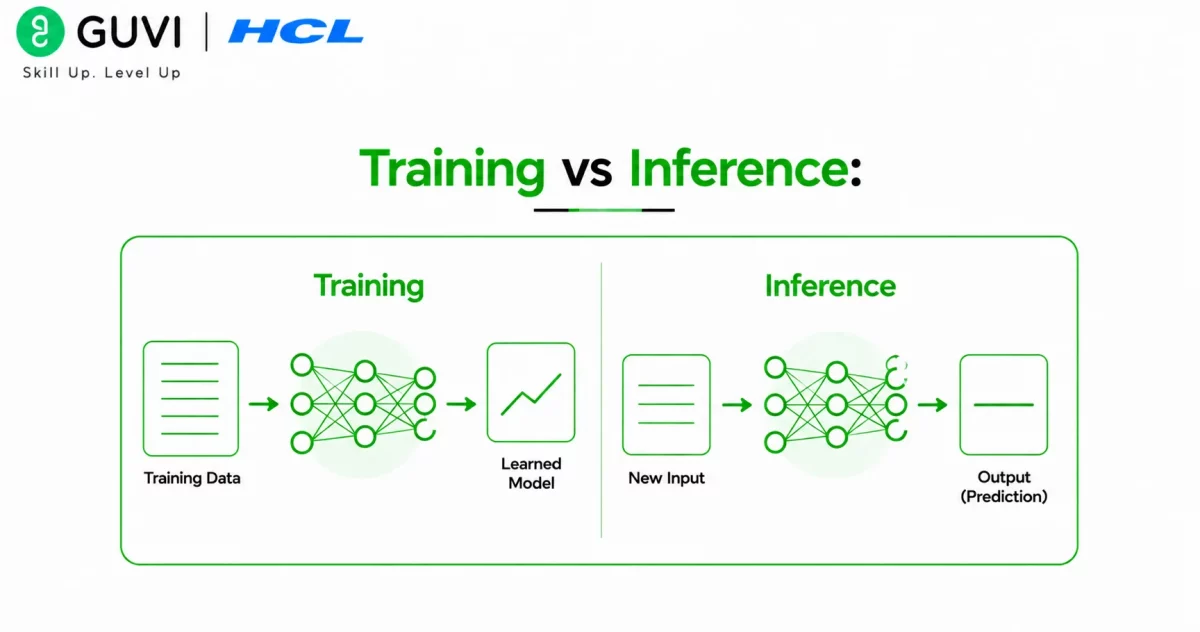
Batch Normalization behaves differently during training and during inference, and understanding this difference prevents a common source of confusion.
During training, Batch Normalization computes the mean and standard deviation from the current mini-batch. These statistics vary from batch to batch, which introduces the noise that acts as regularization.
During inference, you are often making predictions one example at a time or in small batches where computing meaningful statistics is not possible. Instead, Batch Normalization uses running averages of the mean and standard deviation accumulated during training. These running averages provide stable statistics that represent the overall training data distribution.
Most deep learning frameworks handle this automatically by tracking the running averages during training and switching to them automatically when you set the model to evaluation mode. In PyTorch this means calling model.eval() before inference. In Keras this is handled automatically when you call model.predict().

Forgetting to switch to evaluation mode is one of the most common bugs when deploying models with Batch Normalization, producing slightly different results during inference than during training.
Implementing Batch Normalization in Keras and PyTorch
Adding Batch Normalization to a network is a single line in both major frameworks.
In Keras:
from tensorflow.keras.models import Sequential

from tensorflow.keras.layers import Dense, BatchNormalization, ReLU

model = Sequential([

    Dense(128, input_shape=(input_dim,)),

    BatchNormalization(),

    ReLU(),

    Dense(64),

    BatchNormalization(),

    ReLU(),

    Dense(num_classes, activation="softmax")

])
In PyTorch:
import torch.nn as nn

class Network(nn.Module):

    def __init__(self):

        super().__init__()

        self.layers = nn.Sequential(

            nn.Linear(input_dim, 128),

            nn.BatchNorm1d(128),

            nn.ReLU(),

            nn.Linear(128, 64),

            nn.BatchNorm1d(64),

            nn.ReLU(),

            nn.Linear(64, num_classes)

        )

    def forward(self, x):

        return self.layers(x)
For convolutional networks use BatchNorm2d in PyTorch or the same BatchNormalization layer in Keras. For recurrent networks, Batch Normalization is less commonly used because sequence lengths vary. Layer Normalization is the preferred alternative for RNNs and Transformers.
Despite being introduced in 2015, the theoretical explanation for exactly why Batch Normalization works so well remained controversial for years. The original paper attributed its success to reducing internal covariate shift, but a 2018 paper from MIT showed that Batch Normalization’s main benefit is actually smoothing the optimization landscape, making gradient descent more reliable, rather than directly fixing covariate shift as originally claimed.
Batch Normalization vs Other Normalization Techniques
Batch Normalization is not the only normalization technique available, and understanding the alternatives helps you choose the right one for your specific architecture.
| Technique | Normalizes Across | Best For |
| Batch Normalization | Batch dimension | CNNs, large batch sizes |
| Layer Normalization | Feature dimension | RNNs, Transformers, small batches |
| Instance Normalization | Spatial dimensions per sample | Style transfer, image generation |
| Group Normalization | Groups of channels | Object detection, small batch sizes |
The key limitation of Batch Normalization is that it depends on having a reasonably large batch size to compute meaningful statistics. With small batches of fewer than eight or sixteen examples, the per-batch statistics become noisy and unreliable. In these cases Group Normalization or Layer Normalization are better alternatives.
For any Transformer-based model like BERT, GPT, or vision Transformers, Layer Normalization is the standard choice because it normalizes across the feature dimension within each example rather than across the batch, making it independent of batch size and compatible with variable-length sequences.
Want to build strong deep learning foundations covering neural network training, optimization, and real-world model deployment? Explore HCL GUVI’s Artificial Intelligence & Machine Learning Course, designed to help you go from ML fundamentals to production-ready deep learning systems.
Conclusion
Batch Normalization changed deep learning training from a fragile, initialization-sensitive process into something significantly more reliable and fast.
By normalizing activations at each layer during training, it keeps values in stable ranges, allows higher learning rates, reduces dependence on careful initialization, and produces smoother loss landscapes that gradient descent navigates more efficiently.
FAQs
What is Batch Normalization in simple terms?
Batch Normalization normalizes the values flowing between layers in a neural network during training so they always have a consistent distribution, making training faster and more stable.
Why does Batch Normalization speed up training?
It allows higher learning rates, reduces sensitivity to weight initialization, and smooths the loss landscape so gradient descent makes faster, more reliable progress toward the optimal weights.
Where should I place Batch Normalization in my network?
After the linear or convolutional layer and before the activation function. This is the original placement from the 2015 paper and works well for most architectures.
What is the difference between training and inference in Batch Normalization?
During training it uses the current batch’s mean and standard deviation. During inference it uses running averages accumulated during training. Always call model.eval() in PyTorch before running inference.
When should I use Layer Normalization instead of Batch Normalization?
Use Layer Normalization for Transformers, RNNs, and any situation with small batch sizes where Batch Normalization’s per-batch statistics become too noisy to be reliable.
Does Batch Normalization replace dropout for regularization?
Not completely. Batch Normalization has a mild regularization effect but is weaker than dropout. Many architectures use both together, especially when overfitting is a significant concern.
Success Stories

About the Author
HCL GUVI
This article was selected and published as part of the HCL GUVI AI Blogathon 2026, an initiative designed to encourage students, AI enthusiasts, and aspiring tech writers to simplify complex AI concepts through impactful technical content. The contest recognized high-quality, original, and insightful AI-focused blogs, with selected authors receiving publication opportunities on the HCL GUVI blog platform along with official author credits and recognition.
View all posts by HCL GUVI
Connect with me @












Did you enjoy this article?