


Digital Marketing Articles
What is Performance Marketing? Complete Guide for 2026
What is the Voice of the Customer and Why Does it Matter
What is A/B Testing in Marketing? A Beginner’s Guide to Smarter Campaign Optimization
What is Marketing Analytics? A Beginner’s Guide to Metrics, Tools, and Career Scope


Get In Touch For Details! Request More Information
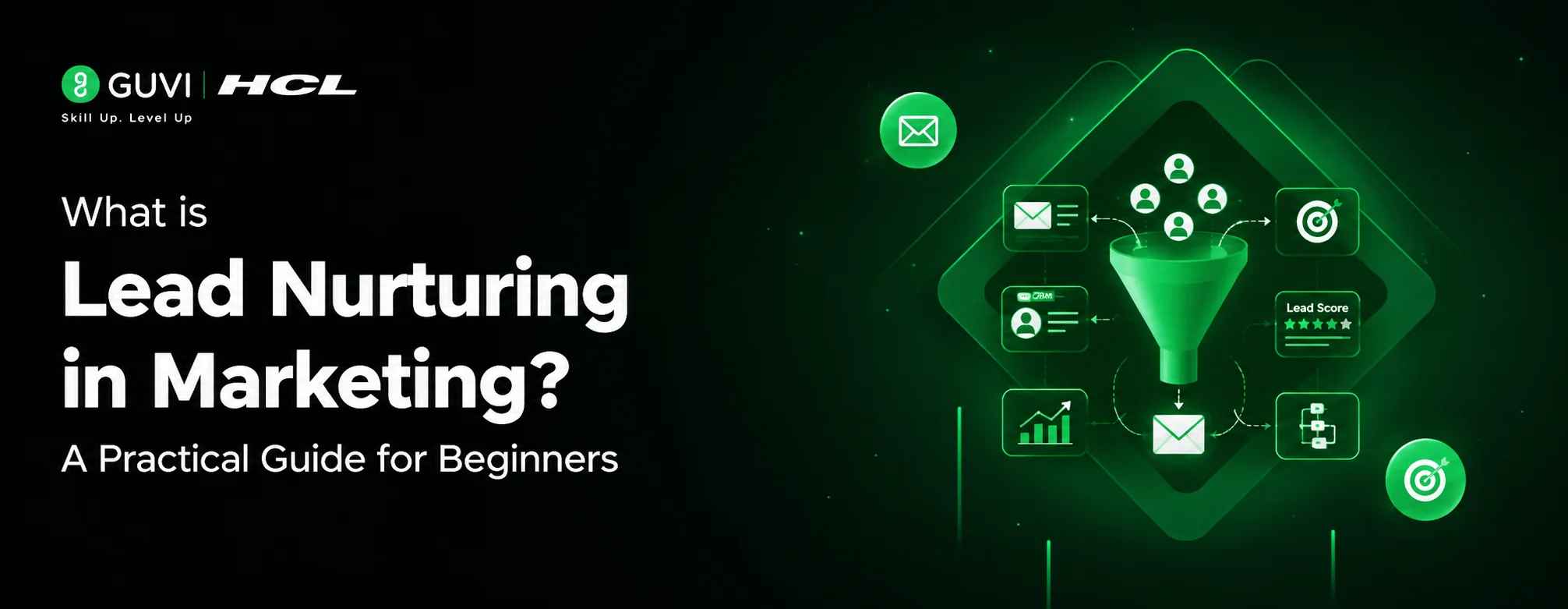
What is Lead Nurturing in Marketing? A Practical Guide for Beginners
Aug 04, 2026 7 Min Read 320 Views
(Last Updated)
Table of contents
- TL;DR Summary
- Introduction
- What is Lead Nurturing?
- Lead Nurturing Meaning in Simple Words
- Why Leads Need Nurturing
- Why Lead Nurturing Matters in Marketing
- Key Benefits of Lead Nurturing
- The Role of Email and Automation
- Lead Nurturing Process: How It Works Step by Step
- Step 1: Capture the Right Leads
- Step 2: Segment Leads by Intent
- Step 3: Map Content to the Customer Journey
- Step 4: Set Up Marketing Automation
- Step 5: Score and Hand Off Sales-Ready Leads
- Lead Nurturing Strategy: What Actually Works
- Build Around Problems, Not Products
- Use Personalization Carefully
- Measure More Than Opens and Clicks
- Lead Nurturing Examples Across Industries
- SaaS Example: Free Trial to Paid Plan
- EdTech Example: Course Inquiry to Enrollment
- B2B Lead Nurturing Example: Enterprise Software
- Lead Nurturing vs Lead Generation
- Which One Should Businesses Focus On?
- Common Mistakes in Lead Nurturing
- Sending the Same Message to Every Lead
- Selling Too Early
- Ignoring Sales Feedback
- Measuring Only Email Opens
- Not Updating Nurture Flows
- Wrapping Up
- Frequently Asked Questions
- What is lead nurturing?
- Why is lead nurturing important?
- What is the lead nurturing process?
- What is an example of lead nurturing?
- How is lead generation and nurturing different?
- What is email lead nurturing?
- What is B2B lead nurturing?
- Which tools are used for lead nurturing?
- How do you measure lead nurturing success?
- Can small businesses use lead nurturing?
TL;DR Summary
Lead nurturing is the process of building trust with potential customers through timely, useful, and personalized communication until they are ready to buy. It connects lead generation and nurturing with the customer journey using emails, content, demos, retargeting, CRM updates, and marketing automation. A strong lead nurturing strategy helps businesses educate prospects, reduce drop-offs, improve sales readiness, and convert more leads without pressuring them too early.
Introduction
Most leads do not buy the moment they discover your brand. They compare options, read reviews, discuss internally, check budgets, and delay decisions.
That is exactly where lead nurturing becomes important.
Lead nurturing helps businesses stay relevant during this waiting period. Instead of pushing every prospect toward a sale immediately, you guide them with useful content, timely follow-ups, product education, and personalized communication.
In simple terms, lead nurturing turns “I’m interested” into “I’m ready to talk.”
This matters even more in B2B lead nurturing, where buying decisions often involve multiple stakeholders, longer timelines, and higher-value purchases. Demand Gen Report’s 2024 Lead Nurturing & Acceleration Benchmark Survey found that 51% of respondents felt their lead nurturing initiatives needed improvement, showing how many teams still struggle to convert interest into pipeline.
What is Lead Nurturing?
Lead nurturing is the process of developing relationships with potential customers by sharing relevant information, solving doubts, and guiding them through the customer journey until they are ready to make a purchase decision.
It usually includes email lead nurturing, product education, remarketing, webinars, case studies, sales follow-ups, and marketing automation workflows.
Lead Nurturing Meaning in Simple Words
Think of lead nurturing like mentoring a learner.
You do not expect someone to master a skill after one lesson. You guide them step by step, answer doubts, share examples, and help them build confidence.
Similarly, a business nurtures leads by understanding what they need at each stage and providing the right message at the right time.
Why Leads Need Nurturing
A lead may delay action because:
- They do not fully understand the product.
- They are comparing multiple options.
- They need approval from a manager.
- They are unsure about pricing or ROI.
- They are interested but not ready today.
Lead nurturing keeps the relationship warm during this decision-making phase.
Did You Know?
A good lead nurturing flow is like a playlist. The order matters. You cannot start with a hard sales pitch before the lead understands the problem, compares options, and trusts your solution.
Why Lead Nurturing Matters in Marketing
Lead nurturing is not just about sending follow-up emails. It is about improving how marketing and sales teams work together.
When done well, it helps you prioritize serious buyers, educate hesitant prospects, and avoid wasting sales effort on leads who are not ready.
Key Benefits of Lead Nurturing
| Benefit | How It Helps |
| Better conversions | Leads receive useful information before making a decision |
| Shorter sales cycles | Educated prospects move faster through the funnel |
| Higher trust | Consistent value builds brand credibility |
| Improved sales productivity | Sales teams focus on warmer leads |
| Better personalization | Messages match the lead’s interest and stage |
The Role of Email and Automation
Email lead nurturing remains one of the most practical channels because it is direct, measurable, and easy to personalize.
Litmus reports that 35% of companies see email ROI of 36:1 or more, while 58% of marketing teams send emails weekly or several times per week. This makes email a strong channel for consistent nurturing when used responsibly.
Marketing automation further improves this by triggering messages based on actions such as form submissions, webinar attendance, page visits, or abandoned demo requests.
HubSpot defines marketing automation as software that automates repetitive marketing tasks such as email campaigns, social posting, and lead nurturing, helping businesses deliver personalized experiences at scale.
Lead Nurturing Process: How It Works Step by Step
A good lead nurturing process follows the customer journey instead of treating every lead the same.
Before setting up emails or workflows, you need to understand who the lead is, what they care about, and what action should happen next.
Step 1: Capture the Right Leads
Lead generation and nurturing should work together.
For example, if a SaaS company gets leads from a free trial form, those leads need product usage tips. If an EdTech brand gets leads from a webinar, those leads may need course outcomes, learner stories, and placement-related information.
Good lead capture includes:
- Name and contact details
- Interest area
- Source of lead
- Budget or timeline
- Role or company size
- Problem they want solved
Step 2: Segment Leads by Intent
Not every lead has the same urgency.
A person who downloads a beginner guide may need education. A person who requests pricing may need a sales conversation.
You can segment leads by:
- Awareness stage
- Industry
- Job role
- Company size
- Past interactions
- Product interest
Step 3: Map Content to the Customer Journey
The customer journey usually includes awareness, consideration, decision, and retention.
Each stage needs different content.
| Journey Stage | Lead Need | Best Nurturing Content |
| Awareness | Understand the problem | Blogs, checklists, explainer videos |
| Consideration | Compare solutions | Webinars, guides, product demos |
| Decision | Build confidence | Case studies, pricing pages, testimonials |
| Retention | Get more value | Onboarding emails, advanced tips, support content |
Step 4: Set Up Marketing Automation
Marketing automation helps you send timely messages without manually tracking every lead.
For example, if a lead attends a webinar but does not book a demo, your CRM can trigger a follow-up email with webinar notes, a case study, and a demo link.
The goal is not to automate everything blindly. The goal is to make follow-up consistent and relevant.
Step 5: Score and Hand Off Sales-Ready Leads
Lead scoring helps marketing and sales teams decide when a lead is ready for direct outreach.
A lead may earn points for:
- Opening emails
- Visiting pricing pages
- Attending webinars
- Downloading case studies
- Requesting product comparisons
- Revisiting the website multiple times
Once the score crosses a threshold, the sales team can follow up with context.
Lead Nurturing Strategy: What Actually Works
A lead nurturing strategy should be simple enough to execute and specific enough to measure.
Start with one audience segment, one goal, and one journey stage. Then improve based on data.
Build Around Problems, Not Products
Most weak campaigns talk too much about features.
Strong nurturing focuses on the lead’s problem.
For example, instead of saying, “Our CRM has advanced dashboards,” say, “Here’s how sales managers can identify stalled deals before month-end.”
That small shift makes your communication more useful.
Use Personalization Carefully
Personalization does not mean adding only the first name in an email. It means using the lead’s context to send content that feels useful, timely, and relevant.
Useful personalization includes:
- Industry-specific examples: Show how your solution works in the lead’s industry so they can connect it to their own business problem.
- Role-based pain points: A marketing manager, sales head, and founder will care about different outcomes, so your message should speak to their specific goals.
- Product recommendations: Suggest features, plans, or resources based on what the lead has already explored or downloaded.
- Relevant case studies: Share success stories from similar companies, industries, or use cases to build trust faster.
- Location or language preferences: Adapt communication based on region, language, or market context to make the experience more relatable.
- Behavior-based follow-ups: Send the next message based on actions such as visiting a pricing page, attending a webinar, or abandoning a demo request.
Measure More Than Opens and Clicks
A good lead nurturing strategy should track business outcomes, not only surface-level activity. Email opens and clicks are helpful, but they do not always show whether a lead is becoming sales-ready.
Measures to consider:
- Lead-to-MQL conversion: This shows how many raw leads become marketing-qualified leads after engaging with your nurturing content.
- MQL-to-SQL conversion: This helps you understand whether nurtured leads are actually strong enough for sales conversations.
- Demo booking rate: This measures how effectively your nurturing campaigns move interested prospects toward a product discussion.
- Sales cycle length: This shows whether nurturing is helping prospects make decisions faster by answering doubts early.
- Pipeline contribution: This connects nurturing efforts to qualified opportunities created in the sales pipeline.
- Email replies: Replies often reveal stronger buying intent than opens because the lead is actively starting a conversation.
- Revenue influenced: This measures how much closed or potential revenue was supported by your nurturing campaigns.
Lead Nurturing Examples Across Industries
Lead nurturing examples become easier to understand when you see how different businesses use them in real situations.
These examples show how the same concept changes based on industry, product, and buying intent.
SaaS Example: Free Trial to Paid Plan
A project management software company gets a lead through a 14-day free trial. Instead of waiting until the last day to ask for payment, the company can use a structured lead nurturing process to help the user experience value step by step.
| Timeline | Nurturing Message | Purpose | Example CTA |
| Day 1 | Welcome email with setup guide | Helps the user understand where to begin and reduces first-day confusion. | Create your first project |
| Day 3 | Short video on creating tasks and assigning teammates | Encourages the user to try a core feature instead of passively exploring the tool. | Add your first teammate |
| Day 6 | Use case email on team collaboration | Shows how the software solves a practical workplace problem. | Try the collaboration board |
| Day 10 | Case study from a similar company | Builds trust by showing how another team used the product successfully. | Read the customer story |
| Day 13 | Trial expiry reminder with upgrade benefits | Creates urgency while reminding the user what they gain by moving to a paid plan. | Upgrade before trial ends |

EdTech Example: Course Inquiry to Enrollment
An EdTech company receives a lead for a business analytics course. Since learners usually compare curriculum, career outcomes, fees, mentor support, and placement guidance before enrolling, the nurturing flow should build confidence at every step.
The nurturing flow may include:
- Career scope blog: Helps the learner understand why business analytics is in demand and what career paths they can explore after learning it.
- Skills roadmap: Shows the learner which tools, concepts, and practical skills they need to become job-ready.
- Mentor-led webinar: Allows learners to hear from industry experts, ask doubts, and understand the learning experience better.
- Learner success story: Builds trust by showing how another learner used the program to move closer to a career goal.
- Curriculum comparison: Helps the learner compare modules, tools, projects, and outcomes before making a decision.
- Free consultation reminder: Encourages the learner to speak with an advisor and clarify doubts about eligibility, fees, or career fit.
This works because education purchases often require confidence, clarity, and career relevance before a learner is ready to enroll.
B2B Lead Nurturing Example: Enterprise Software
A manufacturing company downloads an ERP comparison guide. Since enterprise purchases involve multiple decision-makers, the nurturing journey should answer business, technical, financial, and operational concerns.
The nurturing flow may include:
- Industry-specific ROI report: Helps business leaders understand how the software can reduce costs, improve productivity, or improve operational visibility.
- Workflow automation checklist: Shows operations teams where manual processes can be improved using automation.
- Product demo invite: Gives decision-makers a guided look at how the platform works for their specific business use case.
- Security documentation: Helps IT and compliance teams review data protection, access control, system reliability, and risk factors.
- Procurement-ready proposal: Supports finance and leadership teams with pricing, scope, implementation plan, and expected business value.
In B2B lead nurturing, the buying committee may include operations, finance, IT, and leadership. So each stakeholder needs different proof before the purchase decision can move forward.
Lead Nurturing vs Lead Generation
Lead generation brings potential customers into your funnel. Lead nurturing helps convert them after they enter.
Both are connected, but they are not the same.
| Factor | Lead Generation | Lead Nurturing |
| Purpose | Attract new leads | Build trust with existing leads |
| Timing | Top of funnel | Middle and bottom of funnel |
| Channels | Ads, SEO, webinars, forms | Email, CRM, retargeting, sales follow-up |
| Goal | Capture interest | Move leads toward purchase |
| Example | Downloading an eBook | Sending a case study after download |
Which One Should Businesses Focus On?
You need both.
Without lead generation, there are no prospects to nurture. Without lead nurturing, many generated leads go cold.
A balanced system attracts the right people and guides them until they are ready to make a decision.
Common Mistakes in Lead Nurturing
Even good marketing teams make mistakes when they rush the nurturing process.
Here are the most common ones to avoid.
1. Sending the Same Message to Every Lead
Many businesses create one email sequence and send it to all leads. This usually fails because a beginner, a decision-maker, and a price-sensitive buyer do not need the same information.
For example, a startup founder may care about cost and speed, while an enterprise manager may care about security and approvals. If both receive the same generic message, neither feels understood.
The better approach is segmentation. Group leads based on intent, role, industry, or journey stage before sending content.
This makes your lead nurturing strategy more relevant and improves the chance of meaningful engagement.
2. Selling Too Early
A common mistake is asking for a purchase before the lead understands the value.
Imagine someone downloads a beginner guide and immediately receives three sales calls. That experience feels pushy and may reduce trust.
Instead, match your message to the lead’s readiness. Early-stage leads need education, not pressure.
Use blogs, explainers, checklists, and webinars first. Move toward demos, pricing, and sales conversations only when the lead shows stronger intent.
3. Ignoring Sales Feedback
Marketing may think a lead is ready because they clicked five emails. Sales may discover that the same lead has no budget or authority.
If marketing and sales do not share feedback, the lead nurturing process becomes disconnected.
Create a feedback loop where sales teams report lead quality, common objections, and conversion blockers.
This helps marketing refine scoring rules, improve content, and send better-qualified leads to sales.
4. Measuring Only Email Opens
Email opens are useful, but they do not prove buying intent.
A lead may open emails out of curiosity without being ready to purchase. Another lead may not open every email but may directly visit the pricing page or request a demo.
Track deeper signals such as content downloads, repeat visits, replies, demo bookings, and sales conversations.
This gives a more realistic picture of whether your email lead nurturing campaigns are working.
5. Not Updating Nurture Flows
Customer behavior changes. Market trends change. Product positioning changes.
If your nurture sequence was created two years ago and never reviewed, it may include outdated messaging, weak CTAs, or irrelevant content.
Review nurturing workflows every quarter. Remove low-performing emails, update statistics, refresh case studies, and align content with current buyer concerns.
A good lead nurturing system is not a one-time setup. It is a living process.
If you want to understand how customer behavior, campaign data, dashboards, and business decisions connect, learning analytics can help you build stronger marketing judgment. HCL GUVI’s AI-Powered Business Analytics Course covers tools like Excel, SQL, Power BI, Tableau, Python, and Generative AI through live learning and business-focused projects.
Wrapping Up
Lead nurturing is the bridge between interest and conversion. It helps you guide prospects through the customer journey with relevant content, timely follow-ups, and useful context instead of aggressive selling.
A strong lead nurturing process combines segmentation, email lead nurturing, marketing automation, lead scoring, and sales alignment. Start small, measure real outcomes, and keep improving your workflows.
The next step is simple: choose one lead segment, map its journey, and build a focused nurture sequence that helps the buyer make a confident decision.
Frequently Asked Questions
1. What is lead nurturing?
Lead nurturing is the process of building relationships with potential customers by sharing relevant information and guiding them until they are ready to buy.
2. Why is lead nurturing important?
Lead nurturing helps businesses convert more leads by educating prospects, building trust, and reducing drop-offs during the customer journey.
3. What is the lead nurturing process?
The lead nurturing process includes capturing leads, segmenting them, mapping content to the customer journey, using marketing automation, scoring leads, and handing sales-ready leads to the sales team.
4. What is an example of lead nurturing?
A SaaS company sending trial users setup guides, product tips, case studies, and upgrade reminders is a practical lead nurturing example.
5. How is lead generation and nurturing different?
Lead generation attracts new prospects, while lead nurturing develops those prospects into sales-ready opportunities through consistent communication.
6. What is email lead nurturing?
Email lead nurturing uses automated or manual email sequences to educate, engage, and move leads closer to a purchase decision.
7. What is B2B lead nurturing?
B2B lead nurturing focuses on guiding business buyers through longer sales cycles, multiple stakeholders, budget approvals, and solution comparisons.
8. Which tools are used for lead nurturing?
Common tools include CRM platforms, email marketing software, marketing automation platforms, analytics dashboards, retargeting tools, and lead scoring systems.
9. How do you measure lead nurturing success?
Measure conversion rates, demo bookings, sales-qualified leads, sales cycle length, pipeline value, email replies, and revenue influenced.
10. Can small businesses use lead nurturing?
Yes. Small businesses can start with simple email sequences, helpful content, WhatsApp follow-ups, CRM notes, and basic automation before investing in advanced tools.
Success Stories








Did you enjoy this article?