


Digital Marketing Articles
What is Performance Marketing? Complete Guide for 2026
What is the Voice of the Customer and Why Does it Matter
What is Lead Nurturing in Marketing? A Practical Guide for Beginners
What is Marketing Analytics? A Beginner’s Guide to Metrics, Tools, and Career Scope


Get In Touch For Details! Request More Information
What is A/B Testing in Marketing? A Beginner’s Guide to Smarter Campaign Optimization
Aug 04, 2026 7 Min Read 380 Views
(Last Updated)
Table of contents
- TL;DR Summary
- Introduction
- What is A/B Testing in Marketing?
- Simple Example of A/B Testing in Marketing
- Why It Is Also Called Split Testing
- Why Does Marketing A/B Testing Matter?
- Key Statistics Marketers Should Know
- A/B Testing vs Split Testing
- Where Can You Use A/B Testing in Marketing?
- Landing Page Testing
- Email A/B Table
- Ad Campaign Optimization
- Website Conversion Rate Optimization
- How to Run an A/B Test Step by Step
- Step 1: Pick One Goal
- Step 2: Choose One Variable
- Step 3: Create Version A and Version B
- Step 4: Split the Audience Fairly
- Step 5: Measure the Result
- Step 6: Apply the Learning
- Practical Marketing Scenarios Where A/B Testing Helps
- Scenario 1: EdTech Course Landing Page
- Scenario 2: eCommerce Cart Recovery Email
- Scenario 3: B2B SaaS Demo Page
- Common Mistakes to Avoid in A/B Testing
- 1: Testing Too Many Things at Once
- 2: Ending the Test Too Early
- 3: Testing Without a Clear Hypothesis
- Skills Needed to Work With Digital Marketing Experiments
- Key Skills to Build
- Career Benefits of Learning A/B Testing
- Conclusion
- Frequently Asked Questions
- What is A/B testing in marketing?
- Is A/B testing the same as split testing?
- What can I test in marketing A/B testing?
- Why is A/B testing important for conversion rate optimization?
- How long should an A/B test run?
- What is an example of email A/B testing?
- Can small businesses use A/B testing?
- What tools are used for A/B testing?
TL;DR Summary
A/B testing in marketing is a method of comparing two versions of a campaign element, such as a headline, email subject line, CTA button, ad copy, or landing page, to see which performs better. Also called split testing, it helps marketers make decisions based on real user behavior instead of assumptions. It is widely used for conversion rate optimization, landing page testing, email A/B testing, and campaign optimization.
Introduction
A/B testing in marketing has become essential because even small changes can affect leads, sales, sign-ups, and ad spend. When marketing budgets are tight and customer attention is limited, guessing is risky.
Instead of asking, “Which version do we like better?”, A/B testing asks, “Which version did users actually respond to better?”
In simple terms, A/B testing helps you compare two marketing versions using data. For example, you may test two email subject lines, two landing page headlines, or two call-to-action buttons to find the version that gets more clicks or conversions.
What is A/B Testing in Marketing?
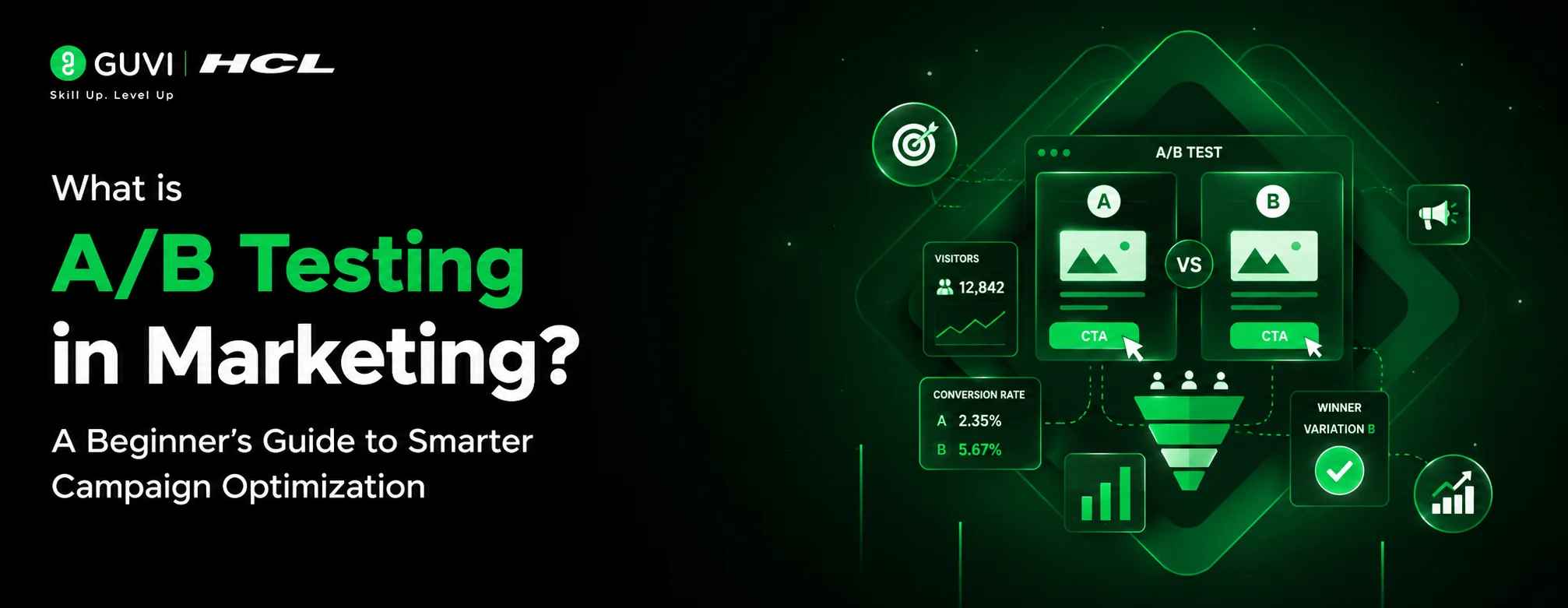
A/B testing in marketing is a controlled experiment where two versions of a marketing asset are shown to similar audience groups to identify which version performs better against a chosen goal.
That goal could be more clicks, higher sign-ups, better email opens, more purchases, or lower cost per lead. The key is to test one major change at a time so you can clearly understand what influenced the result.
Simple Example of A/B Testing in Marketing
Imagine you are running a landing page testing experiment for an online course.
Version A says: “Start Learning Digital Marketing Today”
Version B says: “Build Job-Ready Marketing Skills in 12 Weeks”
If Version B gets more sign-ups, you now have evidence that outcome-focused copy works better for that audience.
Why It Is Also Called Split Testing
A/B testing is also known as split testing because your audience is split into two groups.
One group sees Version A.
The other group sees Version B.
After enough users interact with both versions, you compare results and choose the winner.
Why Does Marketing A/B Testing Matter?
Marketing A/B testing matters because it reduces guesswork. It helps you understand what your audience prefers, what message motivates them, and which design or copy choices improve performance.
This is especially useful in conversion rate optimization, where the goal is not just to get more traffic but to get more value from existing traffic.
Key Statistics Marketers Should Know
| Statistic | What It Means for Marketers |
| Unbounce analyzed over 41,000 landing pages, 464 million visitors, and 57 million conversions in its benchmark report. | Landing page testing should be based on large-scale performance patterns, not assumptions. |
| The median landing page conversion rate across industries was 6.6%. | A/B testing helps you compare your page against realistic conversion benchmarks. |
| Optimizely’s analysis of 127,000+ experiments found that each revenue-focused experiment delivered an average 0.4% incremental digital revenue lift when applied and refined. | Small experiment gains can compound when testing becomes a continuous practice. |
| Litmus reports that email generates an average ROI of $36 for every $1 spent. | Email A/B testing can be valuable because email remains a high-ROI marketing channel. |
A “failed” A/B test is not useless. If Version B does not beat Version A, you still learn what your audience does not prefer. That insight can save future ad spend and improve campaign optimization.
A/B Testing vs Split Testing
Many beginners use A/B testing and split testing interchangeably. In most marketing conversations, that is acceptable.
However, there is a small practical difference worth knowing. A/B testing usually compares two versions with one clear variation, while split testing may compare completely different page layouts or experiences.
| Factor | A/B Testing | Split Testing |
| Meaning | Compares two versions of one element or asset | Splits traffic between different versions |
| Best For | CTA, headline, email subject line, button text | Full landing page, campaign flow, page design |
| Complexity | Lower | Medium to high |
| Example | Red CTA vs green CTA | Short landing page vs long landing page |
| Goal | Find the better-performing variation | Compare broader experience differences |
Where Can You Use A/B Testing in Marketing?
A/B testing in marketing can be used across almost every digital channel. The best place to start is where you already have traffic, clicks, or leads.
Here are the most practical areas where marketers use it.
Landing Page Testing
Landing page testing helps you understand what makes visitors take action after they click an ad, email, or search result. Since landing pages are often where conversions happen, even small improvements can increase sign-ups, downloads, purchases, or demo requests.
| Element to Test | What to Compare | Why It Matters |
| Headlines | Benefit-driven headline vs generic headline | The headline is usually the first message visitors read. A clear, outcome-focused headline can quickly communicate value and encourage users to stay on the page. |
| Hero section copy | Short copy vs detailed explanatory copy | The hero section sets the context for the entire page. Testing copy length helps you understand whether users need quick clarity or more information before taking action. |
| CTA buttons | “Start Free Trial” vs “Book a Free Demo” | CTA text influences the next step users take. Testing button copy helps identify whether visitors are ready for immediate action or prefer a guided interaction. |
| Form length | Short form vs detailed form | Short forms may increase submissions, while longer forms may improve lead quality. Testing form length helps balance conversion volume with useful customer information. |
| Testimonials | No testimonials vs reviews, logos, or case study snippets | Testimonials reduce doubt and build trust. Testing social proof helps you understand whether credibility signals improve user confidence and conversions. |
| Pricing layout | Monthly pricing vs annual pricing or highlighted plans | Pricing presentation affects decision-making. A clear layout can make it easier for users to compare options and choose the right plan. |
| Trust badges | No badges vs security badges, ratings, or guarantees | Trust badges can reduce hesitation, especially on pages that ask for payment or personal details. Testing them shows whether reassurance improves conversion rates. |
Email A/B Table
Email A/B testing helps you improve how subscribers respond to your emails. Since inboxes are crowded, testing different email elements can improve open rates, click-through rates, and conversions.
| Element to Test | What to Compare | Why It Matters |
| Subject lines | Curiosity-based vs benefit-driven vs urgency-based subject lines | Subject lines influence whether users open your email. Testing different styles helps identify what motivates your audience to pay attention. |
| Preview text | Generic preview text vs value-focused preview text | Preview text supports the subject line and gives users another reason to open. A strong preview can improve open rates by making the email value clearer. |
| Send time | Morning vs afternoon, weekday vs weekend | Email performance can change depending on when your audience is active. Testing send time helps you reach users when they are more likely to engage. |
| CTA copy | “Download the Guide” vs “Get My Free Checklist” | CTA copy guides the user’s next action. Testing direct vs personalized wording helps improve click-through rates and campaign performance. |
| Email length | Short action-focused email vs detailed explanatory email | Some audiences prefer quick emails, while others need more context. Testing length helps match the message style to user intent. |
| Personalization | Generic email vs email personalized by name, interest, or behavior | Personalized emails can feel more relevant to the reader. Testing personalization helps measure whether relevance improves engagement. |
| Offer positioning | Discount-led message vs value-led message | The same offer can perform differently depending on how it is framed. Testing positioning shows whether users respond better to savings, benefits, urgency, or outcomes. |
Ad Campaign Optimization
Ad campaign optimization uses A/B testing to improve how paid campaigns perform across platforms like Google Ads, Meta Ads, LinkedIn Ads, and YouTube. It helps you reduce wasted spend and invest more budget in the versions that actually drive results.
| Element to Test | What to Compare | Why It Matters |
| Ad headlines | Problem-focused headline vs benefit-focused headline | Headlines decide whether users stop and read the ad. Testing headline angles helps identify what captures attention faster. |
| Creative images | Product image vs human-centered visual vs lifestyle image | Visuals shape the first impression of your offer. Testing different creative styles helps reveal what drives stronger engagement. |
| Video hooks | Direct problem statement vs bold visual opening vs question-based hook | The first few seconds of a video ad are critical. Testing hooks helps you find what prevents users from scrolling away. |
| Audience segments | Students vs working professionals vs business owners | Different audiences respond to different messages. Testing segments helps personalize campaigns and improve budget efficiency. |
| Landing page match | Generic landing page vs ad-aligned landing page | The landing page should match the promise made in the ad. Better alignment can reduce bounce rates and improve conversions. |
| Offer copy | “Free Webinar” vs “Download Free Guide” vs “Get a Free Consultation” | Offer wording affects perceived value. Testing different offers helps identify what users are willing to exchange their time or details for. |

Website Conversion Rate Optimization
Conversion rate optimization focuses on improving the percentage of users who take a desired action.
A/B testing supports CRO by helping you identify friction points. For example, reducing a form from eight fields to four fields may increase lead submissions.
How to Run an A/B Test Step by Step
A/B testing works best when you treat it like a structured marketing experiment, not a random design change.
Follow this simple roadmap.
Step 1: Pick One Goal
Start with one measurable goal.
Examples:
- Increase email open rate
- Improve landing page sign-ups
- Reduce checkout drop-offs
- Increase ad click-through rate
- Improve demo bookings
Avoid testing without a goal. Without a goal, you will not know what success means.
Step 2: Choose One Variable
Test one important change at a time.
For example, do not change the headline, CTA, image, and form length together. If performance improves, you will not know which change caused it.
Step 3: Create Version A and Version B
Version A is your current version.
Version B is the changed version.
For example:
- Version A: “Download Free Guide”
- Version B: “Get My Free Marketing Checklist”
This keeps the test focused and easy to interpret.
Step 4: Split the Audience Fairly
Your audience should be divided as evenly as possible.
A common split is 50% for Version A and 50% for Version B. This helps ensure both versions get a fair chance.
Step 5: Measure the Result
Track the metric connected to your goal.
For email A/B testing, this could be open rate or click rate.
For landing page testing, this could be conversion rate.
For ads, this could be cost per lead or click-through rate.
Step 6: Apply the Learning
The real value of A/B testing is not just choosing a winner. It is documenting what you learned.
For example, if benefit-led headlines outperform feature-led headlines, you can apply that insight to future landing pages, ads, and emails.
Practical Marketing Scenarios Where A/B Testing Helps
A/B testing becomes easier to understand when you see how different teams use it.
Scenario 1: EdTech Course Landing Page
An EdTech brand wants more learners to enroll in a business analytics course.
The team tests two headlines:
- Version A: “Learn Business Analytics Online”
- Version B: “Become Job-Ready in Business Analytics”
Version B may perform better because it focuses on the learner’s outcome, not just the course topic.
Scenario 2: eCommerce Cart Recovery Email
An online fashion store wants to recover abandoned carts.
The team tests:
- Version A: “You left something behind”
- Version B: “Your cart is waiting — complete your order today”
The second version may drive urgency and improve clicks.
Scenario 3: B2B SaaS Demo Page
A SaaS company wants more demo bookings.
The team tests a long form against a shorter form. If the shorter form increases submissions without reducing lead quality, it becomes the default.
Common Mistakes to Avoid in A/B Testing
Even simple digital marketing experiments can produce misleading results if they are not planned properly.
Here are the biggest mistakes beginners should avoid.
1: Testing Too Many Things at Once
Many marketers change the headline, CTA, image, form, and layout in the same test. This makes the result confusing.
If Version B wins, you will not know whether the headline worked, the CTA helped, or the image made the difference.
A better approach is to test one high-impact variable first. Start with elements directly connected to user decisions, such as CTA copy, offer clarity, or headline positioning.
This makes your learning reusable across future campaigns.
2: Ending the Test Too Early
A test may look like it has a winner after the first few hours or days. But early results can be misleading, especially when traffic is low.
For example, ten extra clicks on Day 1 may not mean Version B is truly better. It may simply be random variation.
Allow the test to collect enough data before making changes. The larger the decision, the more careful you should be.
Good marketers do not just chase quick wins. They wait for reliable signals.
3: Testing Without a Clear Hypothesis
A weak test says, “Let us try a new button color.”
A strong test says, “Changing the CTA from generic to benefit-driven will increase sign-ups because users will understand the value faster.”
That second version gives you a reason, a prediction, and a learning opportunity.
A/B testing is not about random changes. It is about understanding user behavior.
Skills Needed to Work With Digital Marketing Experiments
A/B testing is a valuable skill for marketers, business analysts, product teams, and growth professionals.
You do not need advanced statistics to begin, but you do need structured thinking.
Key Skills to Build
| Skill | Why It Matters |
| Copywriting | Helps you test headlines, CTAs, and email messaging |
| Analytics | Helps you read conversion data correctly |
| User psychology | Helps you understand why users act |
| Landing page optimization | Helps improve sign-ups and sales |
| Campaign analysis | Helps connect test results to business goals |
| Reporting | Helps explain insights to stakeholders |
Career Benefits of Learning A/B Testing
A/B testing is useful for roles such as:
- Digital Marketing Executive
- Performance Marketer
- Growth Marketer
- Business Analyst
- Product Marketing Associate
- Conversion Rate Optimization Specialist
For learners aiming to connect marketing decisions with data, this skill is especially valuable because it sits between creativity and analytics.
To build stronger analytical thinking for marketing, product, and business decisions, explore HCL GUVI’s Business Analyst Career Program. It can help you move from reading campaign numbers to making structured, insight-backed recommendations. Plus, you get access to a network of 1000+hiring partners, along with guidance from an expert faculty.
Conclusion
A/B testing in marketing helps you replace assumptions with evidence. Whether you are improving an email, landing page, ad, or website flow, split testing shows what your audience actually responds to.
Start small. Pick one goal, test one variable, measure the result, and document the learning. Over time, these digital marketing experiments can improve conversion rate optimization, reduce wasted spend, and make campaign optimization more predictable.
Frequently Asked Questions
1. What is A/B testing in marketing?
A/B testing in marketing is the process of comparing two versions of a campaign element to see which performs better. It is commonly used for emails, ads, landing pages, and website conversions.
2. Is A/B testing the same as split testing?
Yes, they are often used interchangeably. Split testing usually refers to dividing traffic between two versions, while A/B testing often focuses on comparing one controlled change.
3. What can I test in marketing A/B testing?
You can test headlines, CTA buttons, landing pages, email subject lines, ad creatives, pricing messages, form fields, and offers.
4. Why is A/B testing important for conversion rate optimization?
A/B testing helps identify which changes increase conversions. This makes conversion rate optimization more data-driven and less dependent on guesswork.
5. How long should an A/B test run?
An A/B test should run until it has enough traffic and conversions to produce a reliable result. The exact duration depends on your traffic volume and business goal.
6. What is an example of email A/B testing?
A brand may test two subject lines for the same email. The version with a higher open rate or click rate can be used for the larger audience.
7. Can small businesses use A/B testing?
Yes. Small businesses can test emails, landing pages, and ads. However, they should focus on high-impact tests because low traffic can make results harder to trust.
8. What tools are used for A/B testing?
Common tools include Optimizely, VWO, Google Analytics, HubSpot, Mailchimp, Unbounce, and platform-native ad testing tools.
Success Stories













Did you enjoy this article?