


Artificial Intelligence and Machine Learning Articles
Deploying Claude on AWS: Architecture and Cost Guide
Claude vs. AI21 Jurassic: Which Is Better for Long-Form Content?


Get In Touch For Details! Request More Information

Claude for Enterprises: ROI Calculator and Business Case
Aug 10, 2026 3 Min Read 46 Views
(Last Updated)
Artificial Intelligence is transforming how Claude for enterprises automate workflows, improve productivity, and reduce operational costs. However, before investing in AI solutions like Claude, organizations need a clear business case supported by measurable return on investment (ROI). Evaluating costs, expected savings, and business outcomes helps decision-makers justify AI adoption with confidence.
Table of contents
- TL;DR
- Direct Answer Box
- Why Should Enterprises Evaluate Claude's ROI?
- How to Build a Claude Enterprise Business Case
- Step 1: Identify Business Objectives
- Step 2: Identify Current Business Costs
- Step 3: Estimate Expected Business Benefits
- Step 4: Calculate Return on Investment (ROI)
- Step 5: Measure Business Impact
- Step 6: Present the Business Case
- Step 7: Continuously Optimize Enterprise AI Performance
- Claude Enterprise Tasks You Can Automate
- Tasks Claude Should Not Replace
- Best Practices for Building a Claude Enterprise Business Case
- Conclusion
- FAQs
- What is an enterprise ROI calculator for Claude?
- Why is a business case important before implementing Claude?
- What factors affect Claude's ROI?
- How can enterprises measure AI ROI?
- Which business functions can benefit from Claude?
- Can Claude replace business analysts or managers?
- What are the best practices for maximizing Claude's ROI?
TL;DR
- Claude helps enterprises improve productivity and automate business processes.
- An ROI analysis compares implementation costs with expected business benefits.
- Organizations should evaluate financial, operational, and strategic outcomes before deployment.
- A structured business case supports informed AI investment decisions.
- Regular performance measurement helps maximize long-term ROI.
Data Point: Generative AI has the potential to create significant business value by improving employee productivity, accelerating decision-making, and automating repetitive tasks across multiple business functions.
Source: McKinsey & Company – The Economic Potential of Generative AI
Direct Answer Box
| An enterprise ROI calculator estimates the financial value of implementing Claude by comparing deployment costs with measurable business benefits such as productivity gains, operational savings, and process efficiency. A well-developed business case helps organizations evaluate whether AI investments align with their strategic and financial objectives. |
Why Should Enterprises Evaluate Claude’s ROI?
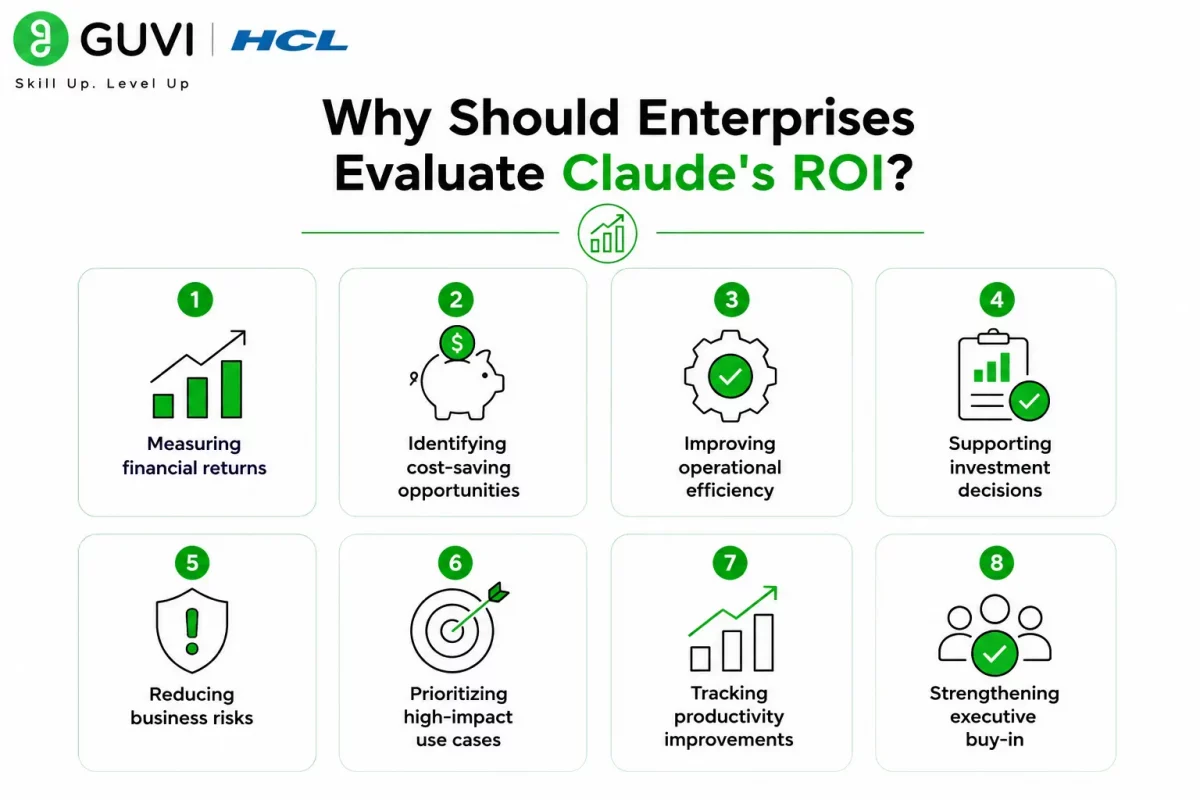
Implementing Claude involves technology investment, employee adoption, and process changes. Measuring ROI helps organizations determine whether these investments generate meaningful business value while supporting long-term growth.
Key benefits of conducting an ROI analysis include:
- Measuring financial returns
- Identifying cost-saving opportunities
- Improving operational efficiency
- Supporting investment decisions
- Reducing business risks
- Prioritizing high-impact use cases
- Tracking productivity improvements
- Strengthening executive buy-in
How to Build a Claude Enterprise Business Case
Step 1: Identify Business Objectives
Start by defining the business problems Claude will solve. Clear objectives make it easier to estimate expected benefits and measure success after implementation.
Examples include:
- Automating customer support
- Improving employee productivity
- Accelerating content creation
- Enhancing knowledge management
- Reducing manual workloads
- Supporting faster decision-making
Step 2: Identify Current Business Costs
Measure the existing costs associated with manual processes before implementing Claude. This creates a baseline for comparing future improvements.
Evaluate areas such as:
- Employee labor costs
- Process completion time
- Operational expenses
- Error correction costs
- Customer support costs
- Training expenses
Step 3: Estimate Expected Business Benefits
Estimate how Claude can improve business performance by reducing costs, increasing productivity, and accelerating workflows. Wherever possible, use measurable business metrics instead of assumptions.
Potential benefits include:
- Time savings
- Lower operating costs
- Faster response times
- Increased employee productivity
- Improved customer experience
- Better decision-making
Step 4: Calculate Return on Investment (ROI)
Compare implementation costs with expected financial benefits to estimate ROI. Include both one-time deployment expenses and ongoing operational costs when building your business case.
Your ROI analysis should consider:
- AI implementation costs
- Subscription or usage costs
- Infrastructure expenses
- Productivity gains
- Cost savings
- Revenue impact
Step 5: Measure Business Impact
After deployment, track business performance using key performance indicators (KPIs). Continuous measurement helps validate your ROI assumptions and identify opportunities for further optimization.
Monitor metrics such as:
- Productivity improvements
- Cost reductions
- Employee adoption
- Customer satisfaction
- Process efficiency
- Return on investment

Step 6: Present the Business Case
Summarize your findings in a clear, data-driven business case for stakeholders. Include financial projections, expected benefits, implementation risks, and measurable success metrics to support investment decisions.
A strong business case should include:
- Business objectives
- Cost analysis
- Expected ROI
- Risk assessment
- Implementation roadmap
- Success metrics
Step 7: Continuously Optimize Enterprise AI Performance
Enterprise AI initiatives should be reviewed regularly to ensure they continue delivering business value. Monitor ROI, gather user feedback, refine workflows, and identify new automation opportunities as business needs evolve. Professionals looking to evaluate AI investments and make data-driven business decisions can strengthen these skills through HCL GUVI’s Business Analytics Course.
Many enterprises begin with a single AI use case, such as customer support or internal knowledge management, before expanding adoption across departments. Measuring ROI at each stage helps organizations identify high-value opportunities and scale AI investments with greater confidence.
Claude Enterprise Tasks You Can Automate
Claude can help enterprises automate a wide range of business processes.
It can assist with:
- Customer support responses
- Document summarization
- Knowledge base search
- Business report generation
- Meeting note summaries
- Content creation
- Data analysis support
- Email drafting
- Policy documentation
- Workflow automation
- Internal documentation
- Employee self-service assistance
The HCL GUVI’s Artificial Intelligence eBook is an excellent starting point for learning practical Artificial Intelligence concepts, prompt engineering, enterprise AI adoption, and real-world business applications. It helps learners understand how organizations use AI to improve productivity, automate workflows, and drive business growth.
Tasks Claude Should Not Replace
Claude is a powerful enterprise assistant, but certain responsibilities should remain with business leaders and subject matter experts.
Claude should not replace:
- Executive decision-making
- Strategic business planning
- Financial approvals
- Legal and regulatory compliance
- Human resource decisions
- Customer relationship management
- Risk management
- Final quality assurance
- Confidential business judgments
While Claude can support decision-making with insights and automation, business-critical decisions should always involve human expertise and oversight.
Warning: A positive ROI estimate does not guarantee successful AI adoption. Organizations should validate assumptions, monitor actual business outcomes, manage implementation risks, and continuously review performance to ensure Claude delivers measurable value over time.
Best Practices for Building a Claude Enterprise Business Case
Follow these best practices to create a strong business case:
- Define clear business objectives.
- Identify measurable success metrics.
- Calculate implementation and operational costs.
- Estimate productivity gains using realistic assumptions.
- Measure ROI using business KPIs.
- Start with high-impact use cases.
- Monitor adoption and user feedback.
- Review ROI regularly and optimize workflows.
- Maintain human oversight for business-critical decisions.
Conclusion
Building a strong business case for Claude requires more than estimating costs and savings. Organizations should evaluate operational efficiency, productivity improvements, implementation expenses, and long-term business value to calculate a realistic return on investment. By continuously measuring performance and refining AI initiatives, enterprises can maximize ROI while making informed, data-driven investment decisions.
FAQs
1. What is an enterprise ROI calculator for Claude?
An enterprise ROI calculator estimates the financial impact of implementing Claude by comparing deployment costs with measurable benefits such as productivity gains, cost savings, and operational improvements.
2. Why is a business case important before implementing Claude?
A business case helps organizations evaluate expected costs, benefits, risks, and return on investment before committing resources to an AI initiative.
3. What factors affect Claude’s ROI?
ROI depends on implementation costs, subscription or usage fees, employee adoption, productivity improvements, operational savings, and the overall business impact of AI automation.
4. How can enterprises measure AI ROI?
Organizations can measure AI ROI using key performance indicators such as time saved, cost reductions, employee productivity, customer satisfaction, process efficiency, and revenue improvements.
5. Which business functions can benefit from Claude?
Claude can support customer service, content creation, knowledge management, document summarization, workflow automation, reporting, and internal employee assistance.
6. Can Claude replace business analysts or managers?
No. Claude can automate repetitive tasks and provide insights, but strategic planning, financial decisions, compliance reviews, and executive approvals should remain with experienced professionals.
7. What are the best practices for maximizing Claude’s ROI?
Define clear objectives, start with high-value use cases, measure business outcomes using KPIs, monitor adoption, collect user feedback, optimize workflows continuously, and maintain human oversight for important business decisions.
Success Stories

About the Author
Vishalini Devarajan
An Aerospace Engineer turned content writer, I focus on making complex concepts easy to understand through well-structured, reader-friendly blogs. Whether it’s a technical topic or a non-technical one, I love creating content that is clear, engaging, and impactful.
View all posts by Vishalini Devarajan
Connect with me @











Did you enjoy this article?