


Artificial Intelligence and Machine Learning Articles
AI/ML Skills Gap 2026: Why Companies Can't Find Job-Ready Talent
20 AI/ML Interview Questions Recruiters Can Use Without a Tech Background - Best Guide
How Industry-Backed AI/ML Bootcamps Are Changing the AI/ML Hiring Pipeline - Best Guide 2026
From IT Support to AI Engineer: A Realistic Career Switch Guide 2026


Get In Touch For Details! Request More Information

Prompt Chaining with Claude: Advanced Techniques
Aug 05, 2026 4 Min Read 352 Views
(Last Updated)
Large Language Models (LLMs) perform better when complex tasks are broken into smaller steps instead of being handled in a single prompt. This approach, called prompt chaining, helps Claude solve problems more systematically and accurately.
Table of contents
- TL;DR
- Why Prompt Chaining Matters
- How Prompt Chaining Works
- Advanced Prompt Chaining Techniques
- Sequential Chaining
- Conditional Chaining
- Parallel Prompt Chaining
- Review and Refinement Chains
- Break Complex Tasks into Smaller Steps
- Avoid Overly Long Prompt Chains
- Common Mistakes to Avoid
- What is prompt chaining in Claude?
- Why is prompt chaining better than using a single prompt?
- What are the different types of prompt chaining?
- Where is prompt chaining commonly used?
- How can developers improve prompt chains?
- Does prompt chaining reduce AI hallucinations?
- Is prompt chaining suitable for beginners?
TL;DR
- Prompt chaining breaks complex tasks into multiple connected prompts instead of relying on a single prompt.
- It improves response quality, reasoning, accuracy, and consistency.
- Each prompt builds on the output of the previous step, creating a structured workflow.
- Claude prompt chaining is widely used for content creation, coding, research, and AI automation.
- Advanced chaining techniques help developers build more reliable and scalable AI applications.
In this guide, you’ll learn how prompt chaining works, advanced techniques, best practices, and how HCL GUVI’s AI & Machine Learning Course helps you build real-world AI applications.
What Is Prompt Chaining?
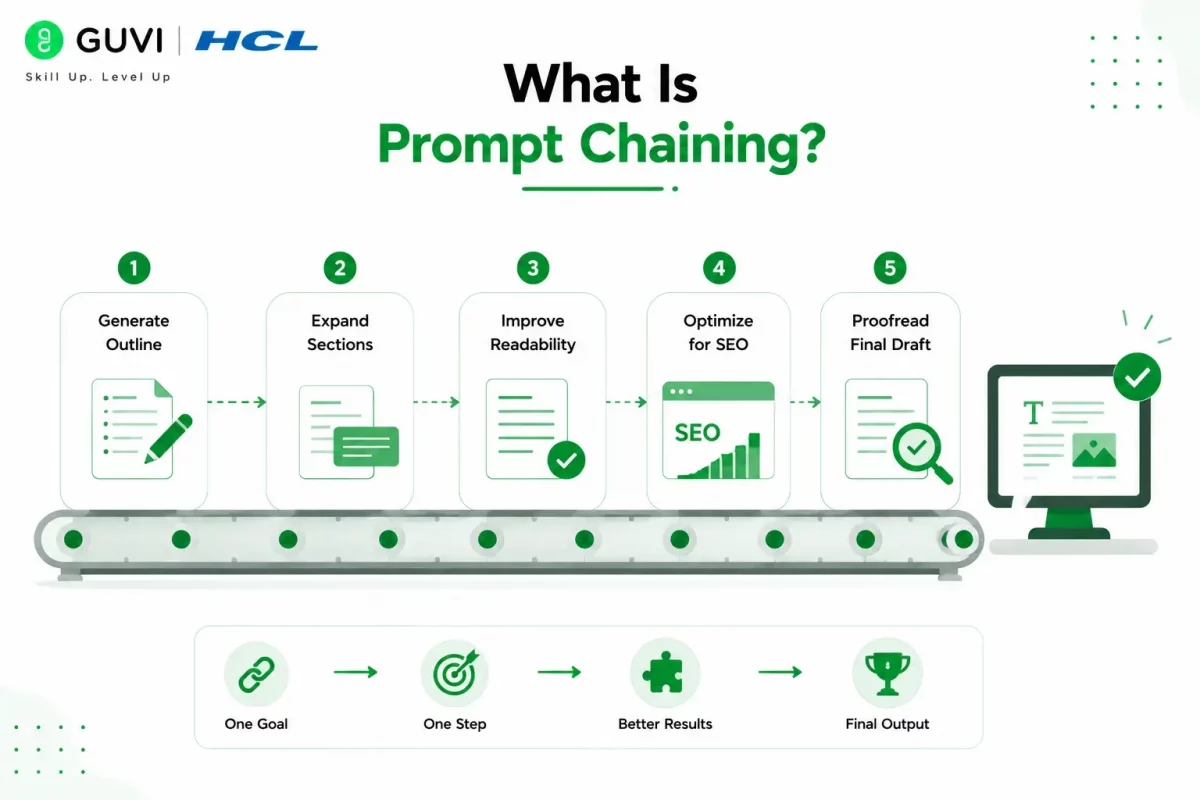
Prompt chaining is a technique where multiple prompts are connected together to solve a larger task. Instead of asking Claude to complete everything in one request, each prompt focuses on a single objective before passing its output to the next prompt.
Think of it like an assembly line. Rather than expecting one worker to build an entire product, each worker completes one specialized task before handing it over to the next stage. Similarly, Claude completes one prompt at a time, with every step contributing to the final result.
For example, instead of asking Claude to write an entire technical article immediately, a prompt chain could follow this workflow:
- Generate an outline.
- Expand each section.
- Improve readability.
- Optimize for SEO.
- Proofread the final draft.
Because every prompt has a focused responsibility, the final output is usually more accurate and better organized.
Download HCL GUVI’s free AI eBook to explore prompt engineering, generative AI, large language models, and practical AI techniques with beginner-friendly explanations and real-world examples.
Why Prompt Chaining Matters
Complex prompts often require Claude to reason, organize information, generate content, and review its own work simultaneously. This increases the likelihood of missed instructions or inconsistent responses.
Prompt chaining solves this problem by separating large tasks into logical stages.
Some key benefits include:
- Better reasoning across complex problems.
- Improved response consistency.
- Reduced hallucinations and unsupported assumptions.
- Easier debugging when something goes wrong.
- Greater control over the final output.
This makes prompt chaining especially valuable for developers building AI applications that require predictable and repeatable results.
How Prompt Chaining Works
A prompt chain consists of multiple prompts that execute in sequence. Each stage performs a specific task before passing structured information to the next stage.
A typical workflow looks like this:
Step 1: Understand the user’s request.
Step 2: Create a structured plan.
Step 3: Generate the required content.
Step 4: Verify factual accuracy.
Step 5: Refine formatting and presentation.
Since Claude focuses on one objective at a time, each stage can be optimized independently without affecting the rest of the workflow.
Advanced Prompt Chaining Techniques
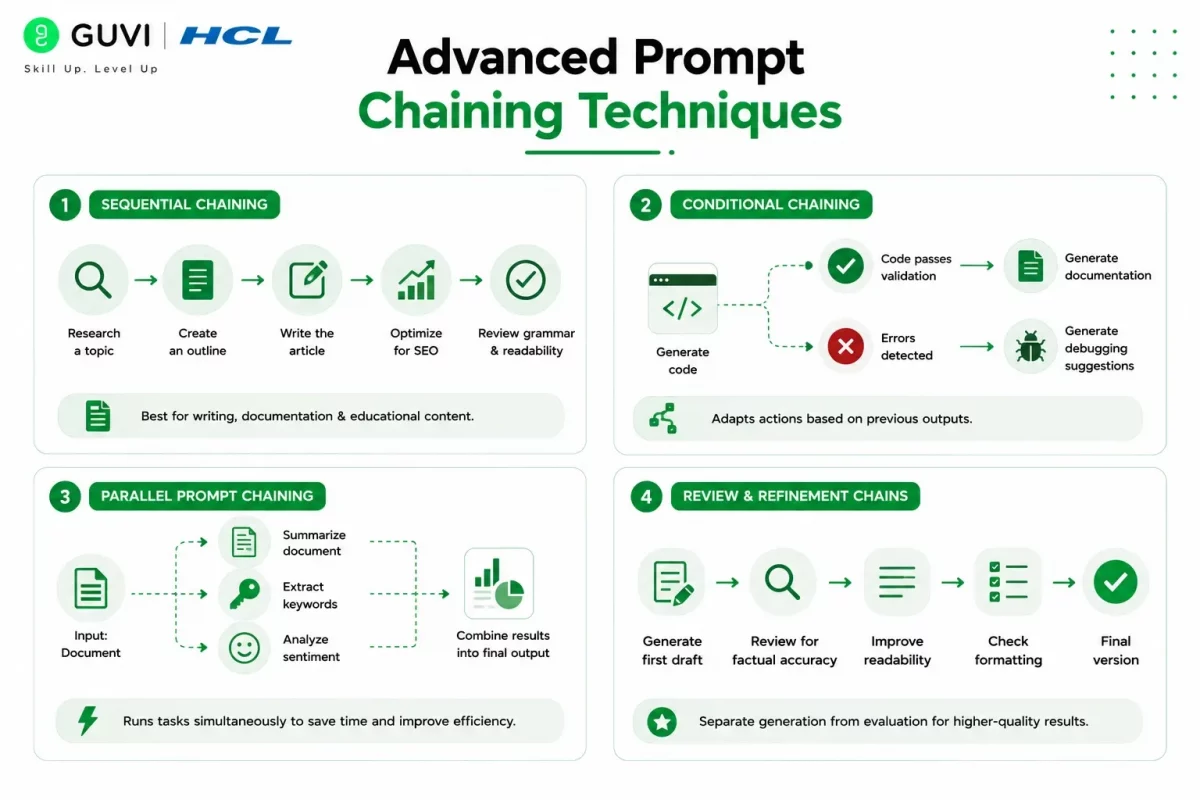
Once you understand the basics, you can design more sophisticated prompt chains that improve efficiency and output quality.
Sequential Chaining
Sequential chaining is the simplest approach. Every prompt depends on the output generated by the previous prompt.
Example workflow:
- Research a topic.
- Create an outline.
- Write the article.
- Optimize for SEO.
- Review grammar and readability.
This technique works well for writing, documentation, and educational content.
Conditional Chaining
Conditional chaining introduces decision-making into the workflow. Claude performs different actions depending on previous outputs.
For example:
- If the generated code passes validation, proceed to documentation.
- If errors are detected, generate debugging suggestions first.
This creates more dynamic AI systems capable of adapting to different situations.
Parallel Prompt Chaining
Instead of processing every task sequentially, independent tasks can run simultaneously.
For example, while one prompt summarizes a document, another extracts keywords and a third performs sentiment analysis. The results are then combined into a final response.
Parallel chaining reduces processing time and improves efficiency in larger AI pipelines.
Review and Refinement Chains
Many production AI systems include dedicated review stages.
A typical refinement chain may include:
- Generate the first draft.
- Review for factual accuracy.
- Improve readability.
- Check formatting.
- Produce the final version.
Separating generation from evaluation often produces higher-quality results than asking Claude to perform both simultaneously.

Master prompt engineering, AI automation, and advanced generative AI techniques with HCL GUVI’s AI & Machine Learning Course. Learn how to design intelligent AI workflows, build production-ready applications, and work with large language models through hands-on projects guided by industry experts.
Modern AI applications frequently use prompt chaining behind the scenes to improve reliability and maintain context across complex workflows. Breaking tasks into smaller reasoning steps allows language models to produce more structured, consistent, and controllable outputs compared to relying on a single large prompt.
Best Practices for Claude Prompt Chaining
Building an effective prompt chain requires more than simply connecting multiple prompts. Each step should have a clear purpose, produce structured outputs, and pass only the information needed by the next stage. Following established best practices makes your AI workflows more reliable, scalable, and easier to maintain.
Break Complex Tasks into Smaller Steps
One of the biggest advantages of prompt chaining is task decomposition. Instead of asking Claude to complete several objectives simultaneously, divide the workflow into smaller prompts that each solve a single problem.
For example, when creating a research report, the chain could look like this:
- Collect relevant information.
- Organize the findings.
- Summarize key insights.
- Write the complete report.
- Proofread and refine the final version.
Smaller prompts reduce ambiguity and allow Claude to focus on one objective at a time, leading to higher-quality responses.
Avoid Overly Long Prompt Chains
Although prompt chaining improves complex workflows, creating too many stages can increase latency and introduce unnecessary complexity.
Whenever possible:
- Combine related steps.
- Remove redundant prompts.
- Keep workflows concise.
- Focus only on tasks that genuinely require multiple stages.
The goal is to balance simplicity with accuracy rather than building the longest possible chain.
Common Mistakes to Avoid
Even experienced prompt engineers encounter issues when designing prompt chains. Recognizing these common mistakes can significantly improve the quality of AI-generated outputs.
Some mistakes include:
- Giving vague or incomplete instructions.
- Passing unstructured outputs to the next prompt.
- Including conflicting requirements across different stages.
- Ignoring validation or review steps.
- Creating unnecessarily complicated workflows.
Avoiding these issues helps Claude produce more consistent and dependable responses across different applications.
Conclusion
Prompt chaining is one of the most effective techniques for improving the quality and reliability of AI-generated responses. By breaking complex problems into smaller, connected prompts, developers can achieve better reasoning, greater consistency, and easier workflow management.
Whether you’re building AI chatbots, content generation tools, coding assistants, or business automation systems, prompt chaining provides a structured framework that simplifies complex tasks while improving overall performance. As AI applications continue to evolve, mastering advanced prompt chaining techniques will remain an essential skill for developers, prompt engineers, and AI practitioners.
FAQs
1. What is prompt chaining in Claude?
Prompt chaining is a prompt engineering technique that divides complex tasks into multiple connected prompts. Each prompt completes a specific objective and passes its output to the next stage, resulting in more accurate and organized AI responses.
2. Why is prompt chaining better than using a single prompt?
Prompt chaining improves accuracy, consistency, and reasoning by allowing Claude to focus on one task at a time instead of handling multiple objectives within a single prompt.
3. What are the different types of prompt chaining?
Common approaches include sequential chaining, conditional chaining, parallel chaining, and review or refinement chains. Each technique is designed for different workflow requirements.
4. Where is prompt chaining commonly used?
Prompt chaining is widely used for content creation, software development, customer support, research automation, document processing, and AI-powered business workflows.
5. How can developers improve prompt chains?
Developers can improve prompt chains by defining clear objectives, breaking tasks into smaller steps, using structured outputs, testing with different inputs, and refining prompts based on performance.
6. Does prompt chaining reduce AI hallucinations?
While it cannot eliminate hallucinations completely, prompt chaining can reduce them by separating reasoning, validation, and review into different stages, making responses more reliable.
7. Is prompt chaining suitable for beginners?
Yes. Beginners can start with simple sequential prompt chains and gradually explore advanced techniques such as conditional logic, parallel workflows, and automated refinement as they gain experience.
Success Stories

About the Author
Vishalini Devarajan
An Aerospace Engineer turned content writer, I focus on making complex concepts easy to understand through well-structured, reader-friendly blogs. Whether it’s a technical topic or a non-technical one, I love creating content that is clear, engaging, and impactful.
View all posts by Vishalini Devarajan
Connect with me @








Did you enjoy this article?