


Artificial Intelligence and Machine Learning Articles
How to Stream Claude Responses with the API
Claude API Pricing Breakdown: Token Costs and Tiers


Get In Touch For Details! Request More Information
How Anthropic Trains Claude: RLHF vs RLAIF
Jul 15, 2026 4 Min Read 25 Views
(Last Updated)
Modern AI assistants can write code, summarize research, analyze documents, and solve complex problems with impressive accuracy. But have you ever wondered how they learn to produce helpful, safe, and coherent responses instead of simply predicting the next word?
One of the biggest advances in large language model (LLM) development is alignment training—the process of teaching models to follow human preferences while reducing harmful or low-quality outputs.
Anthropic, the company behind Claude, has been a prominent advocate of approaches such as Reinforcement Learning from Human Feedback (RLHF) and Reinforcement Learning from AI Feedback (RLAIF). In this article, you’ll learn what RLHF and RLAIF are, how they differ, why they matter, and how they contribute to Claude’s behavior.
Table of contents
- TL;DR Summary Box
- What Is AI Alignment?
- What Is RLHF?
- Why Is RLHF Important?
- What Is RLAIF?
- Why Use AI Feedback?
- RLHF vs RLAIF: Key Differences
- How Do These Methods Work Together?
- Why Doesn't Anthropic Rely Only on Human Feedback?
- Beyond RLHF and RLAIF
- Pros and Cons Comparison
- Real-World Example
- Conclusion
- FAQs
- What is RLHF?
- What is RLAIF?
- Is RLAIF replacing RLHF?
- Why is AI alignment important?
- Does RLHF guarantee accurate responses?
- Why is AI-generated feedback useful?
- Are RLHF and RLAIF the only alignment methods?
TL;DR Summary Box
- RLHF uses human preference data to improve model behavior.
- RLAIF supplements human feedback with AI-generated evaluations.
- Both approaches aim to align AI responses with desired behaviors.
- AI-assisted feedback can improve scalability while human oversight remains important.
- Modern AI alignment typically combines multiple training techniques rather than relying on a single method.
Train smarter with the right approach—RLHF vs RLAIF can shape safer, more aligned AI models. Learn AI & ML with HCL GUVI’s Artificial Intelligence and Machine Learning course.
What Is AI Alignment?
AI alignment is the process of training AI systems to behave in ways that are helpful, reliable, and consistent with intended human goals. Rather than optimizing only for prediction accuracy, alignment methods encourage models to produce responses that users find useful while reducing unsafe or misleading behavior.
Alignment involves multiple stages, including supervised training, preference learning, evaluation, and ongoing refinement.
What Is RLHF?
Reinforcement Learning from Human Feedback (RLHF) is a training approach where human evaluators compare multiple model responses and indicate which one better satisfies a given prompt.
These human preferences are then used to train a reward model that guides further optimization of the language model.
A simplified workflow looks like this:
Pretrained Language Model
│
▼
Generate Multiple Responses
│
▼
Human Reviewers Rank Responses
│
▼
Reward Model Learns Preferences
│
▼
Reinforcement Learning Improves Model
RLHF has been widely adopted across the AI industry because it helps models better follow instructions and respond more naturally.
Why Is RLHF Important?
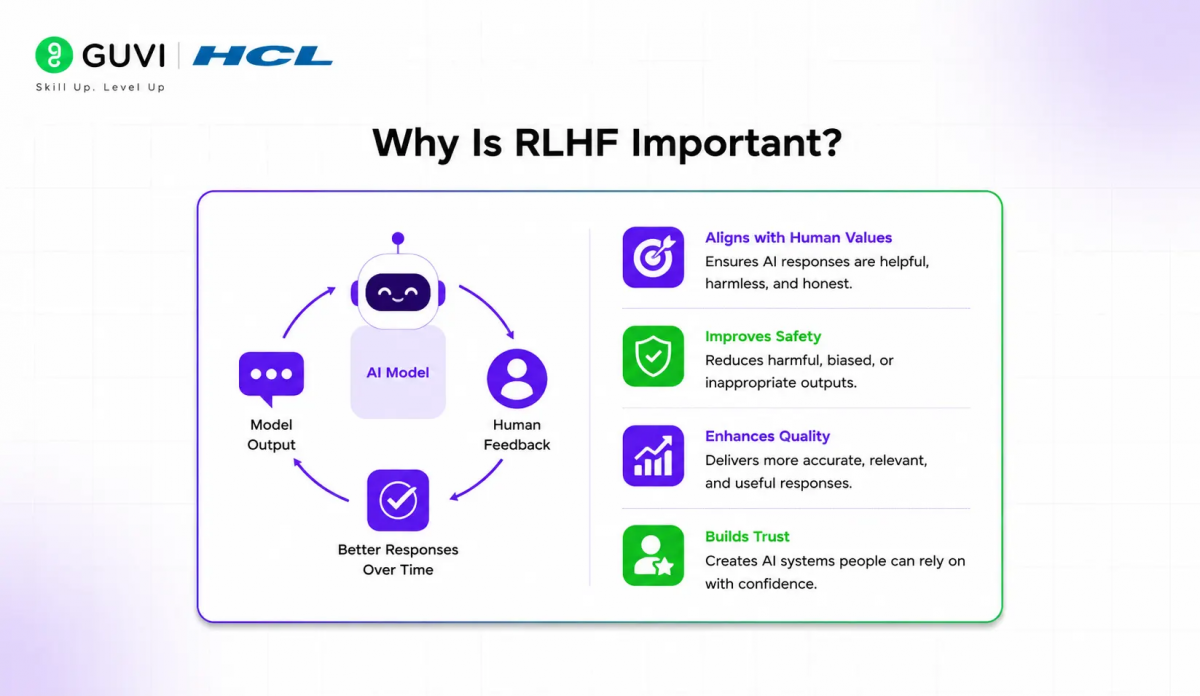
Without alignment, language models may generate responses that are inconsistent, irrelevant, or unhelpful despite having strong language capabilities.
RLHF helps improve:
- Instruction following
- Response quality
- Conversational behavior
- Helpfulness
- Consistency
- Safety
Human judgment provides valuable guidance that pure next-word prediction cannot capture.
📊 Data Point
Preference-based training has become a standard component of many leading language model development pipelines because it significantly improves user experience compared with pretraining alone.

What Is RLAIF?
Reinforcement Learning from AI Feedback (RLAIF) extends the idea of preference learning by allowing an AI model to evaluate candidate responses according to predefined principles or evaluation criteria.
Instead of relying exclusively on human comparisons, another AI system helps score outputs based on objectives such as helpfulness, clarity, or safety.
This can make parts of the alignment process more scalable while still benefiting from carefully designed evaluation methods and human oversight.
Why Use AI Feedback?
Collecting large volumes of human preference data can be expensive and time-consuming.
AI-generated feedback offers several potential advantages:
- Faster evaluation
- Lower annotation costs
- Consistent application of evaluation criteria
- Greater scalability
- Rapid experimentation
However, AI-generated feedback still depends on the quality of the evaluation model and the principles used to guide it.
💡 Pro Tip
AI-assisted evaluation is generally intended to complement—not completely replace—human judgment in alignment workflows.
RLHF vs RLAIF: Key Differences
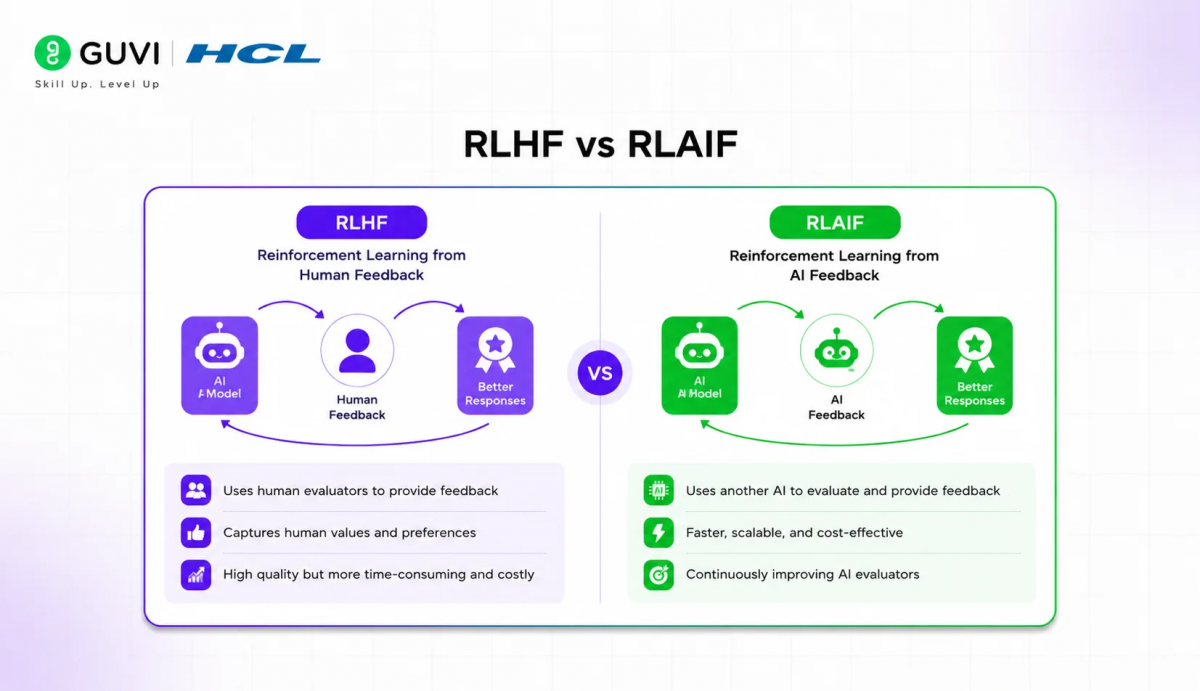
Both approaches seek to improve model behavior through preference-based learning, but they differ primarily in the source of feedback.
| Feature | RLHF | RLAIF |
| Feedback Source | Human reviewers | AI evaluator guided by defined principles |
| Scalability | Moderate | Higher |
| Cost | Higher | Lower for repeated evaluations |
| Consistency | Can vary between reviewers | More consistent once evaluation criteria are established |
| Human Involvement | Direct | Indirect with oversight |
| Typical Role | Foundational alignment | Scalable preference evaluation |
How Do These Methods Work Together?
Modern alignment pipelines often combine multiple techniques rather than choosing only one.
A simplified process may include:
- Pretrain the language model.
- Fine-tune using supervised examples.
- Collect human preference data.
- Train reward or evaluation models.
- Use AI-assisted evaluation where appropriate.
- Continue testing, auditing, and refining the model.
This layered approach helps balance scalability with quality.
Why Doesn’t Anthropic Rely Only on Human Feedback?
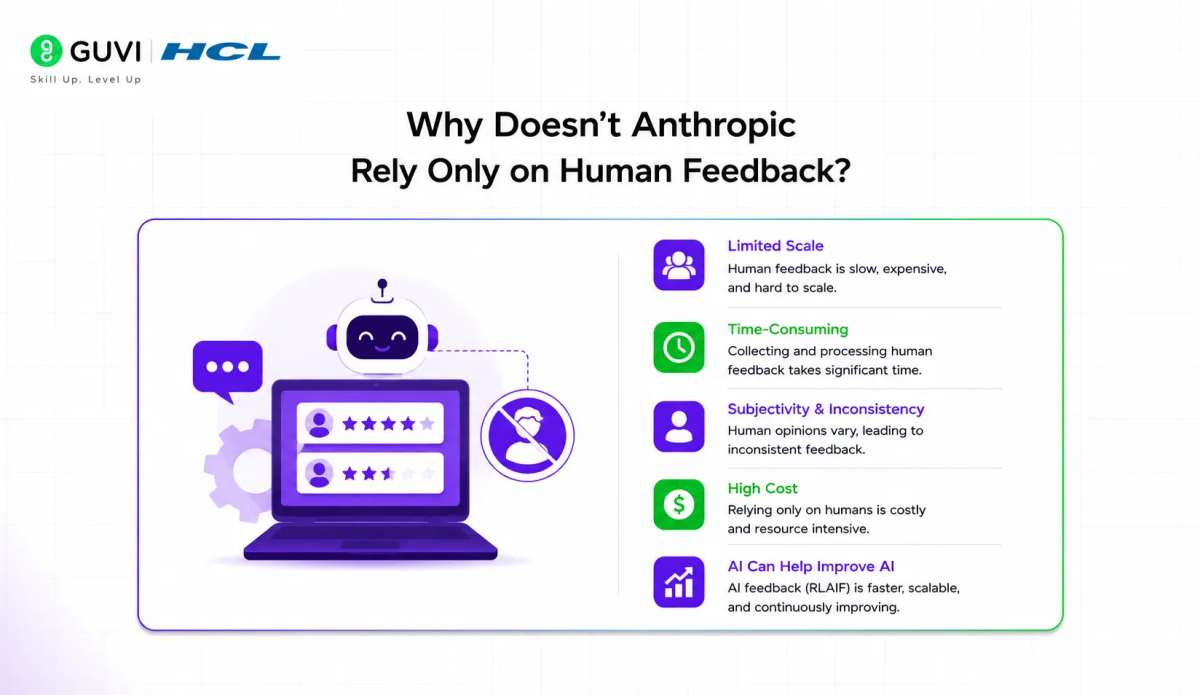
Human expertise remains valuable, but evaluating millions of responses manually is resource-intensive.
AI-assisted feedback can help:
- Evaluate larger datasets.
- Test new behaviors more quickly.
- Apply evaluation criteria consistently.
- Accelerate experimentation during research.
Human reviewers continue to play an important role in defining principles, validating evaluations, and auditing model behavior.
Beyond RLHF and RLAIF
Training a modern language model involves far more than preference optimization.
Additional components typically include:
- Large-scale pretraining
- Supervised fine-tuning
- Safety evaluations
- Red-teaming
- Benchmark testing
- Continuous monitoring
- Model updates
Alignment is an ongoing process rather than a single training step.
⚠️ Warning
No alignment technique guarantees perfect outputs. AI models can still make mistakes, generate incorrect information, or misunderstand user intent.
Pros and Cons Comparison
| Approach | Advantages | Limitations |
| RLHF | High-quality human preferences, nuanced judgments | Time-consuming, expensive, limited scalability |
| RLAIF | Faster evaluations, scalable, lower annotation costs | Depends on evaluation model quality and careful oversight |
Train smarter with the right approach—RLHF or RLAIF can shape safer, more aligned AI models. Learn AI & ML with HCL GUVI’s Artificial Intelligence and Machine Learning course.
Real-World Example
Imagine two candidate responses generated for the same user question.
With RLHF, trained human reviewers compare the responses and choose the one they believe better satisfies the prompt.
With RLAIF, an AI evaluator scores both responses according to predefined principles such as clarity, accuracy, and helpfulness. Those scores are then used to improve future model behavior.
In practice, these approaches can complement each other, combining human expertise with scalable automated evaluation.
Conclusion
Training modern AI assistants involves much more than exposing them to vast amounts of text. Alignment techniques such as RLHF and RLAIF help shape model behavior by incorporating human preferences and scalable AI-assisted evaluations into the training process.
Rather than competing approaches, RLHF and RLAIF represent complementary strategies within a broader alignment framework that also includes supervised learning, safety testing, and continuous evaluation. As AI systems continue to evolve, understanding these concepts provides valuable insight into why models behave the way they do—and why responsible alignment remains a central focus of AI research.
This article provides a high-level overview of AI alignment concepts for educational purposes. Details of proprietary training pipelines may vary between AI developers, and publicly available information may not describe every aspect of how individual models are trained.
FAQs
What is RLHF?
RLHF, or Reinforcement Learning from Human Feedback, is a training method that uses human preferences to improve how an AI model responds to user prompts.
What is RLAIF?
RLAIF, or Reinforcement Learning from AI Feedback, uses AI-generated evaluations based on predefined principles to help guide model alignment and improve scalability.
Is RLAIF replacing RLHF?
Not necessarily. AI-assisted feedback is generally viewed as complementary to human feedback rather than a complete replacement.
Why is AI alignment important?
Alignment helps AI systems produce responses that are more helpful, reliable, and consistent with intended user goals while reducing undesirable behaviors.
Does RLHF guarantee accurate responses?
No. RLHF improves model behavior but does not eliminate factual errors or misunderstandings. Users should still verify important information.
Why is AI-generated feedback useful?
AI-assisted evaluation can process large volumes of responses efficiently, reduce annotation costs, and support faster experimentation while remaining subject to human oversight.
Are RLHF and RLAIF the only alignment methods?
No. Modern AI systems also rely on supervised fine-tuning, safety testing, benchmarking, red-teaming, continuous evaluation, and other techniques throughout development.
Success Stories

About the Author
Vishalini Devarajan
An Aerospace Engineer turned content writer, I focus on making complex concepts easy to understand through well-structured, reader-friendly blogs. Whether it’s a technical topic or a non-technical one, I love creating content that is clear, engaging, and impactful.
View all posts by Vishalini Devarajan
Connect with me @








Did you enjoy this article?