


Data Analysis Articles
BPO Experience for Data Analyst Jobs Does It Count When Applying? - Best Guide
Can a BPO Team Leader Become a Data Analyst?
BPO vs Data Analyst Salary in India: What Changes After the Switch?
How to Switch From BPO to Data Analytics in 2026: Best Skills, Roadmap & Jobs


Get In Touch For Details! Request More Information
Skills to Become a Healthcare Data Analyst: A 2026 Career Guide
Sep 08, 2026 4 Min Read 1640 Views
(Last Updated)
Table of contents
- TL;DR Summary Box
- Direct Answer Box
- What Does a Healthcare Data Analyst Actually Do?
- Technical Skills You Need
- SQL and Database Querying
- Statistical Analysis
- Data Visualization
- Python or R (Recommended, Not Always Required)
- Healthcare-Specific Domain Knowledge
- HIPAA and Data Privacy
- Medical Coding Basics (ICD-10, CPT)
- Clinical Workflow Awareness
- EHR/EMR Systems
- Soft Skills That Set Strong Analysts Apart
- Tools of the Trade
- A Step-by-Step Path to Get There
- Healthcare Data Analyst vs. General Data Analyst
- Common Mistakes to Avoid
- Conclusion
- FAQs
- Q: Do I need a healthcare background to become a healthcare data analyst?
- Q: Is coding required for this role?
- Q: What certification is most valuable for beginners?
- Q: How is this different from a general data analyst role?
- Q: What's a good first project to build a portfolio?
TL;DR Summary Box
- Healthcare data analysts need a blend of technical skills (SQL, Excel, statistics, EHR/EMR systems) and domain knowledge (HIPAA, clinical terminology, healthcare workflows).
- The role sits between IT and clinical operations communication skills matter as much as technical ones.
- Entry typically requires a bachelor’s degree, but bootcamps and certifications (CHDA, CAHIMS) are increasingly accepted pathways.
- Core tools to learn: SQL, Excel/Power BI or Tableau, Python or R, and a working knowledge of EHR platforms like Epic or Cerner.
- Compliance and data privacy knowledge (HIPAA) is non-negotiable in this field, unlike most other data analyst roles.
Direct Answer Box
A healthcare data analyst needs five core skill areas: SQL and database querying, statistical analysis, data visualization (Power BI/Tableau), healthcare domain knowledge (medical coding, HIPAA compliance, clinical workflows), and communication skills to translate data into decisions for clinicians and administrators. Most roles also expect familiarity with electronic health record (EHR) systems such as Epic or Cerner.
What Does a Healthcare Data Analyst Actually Do?
Before listing skills, it helps to know what you’re actually building toward.
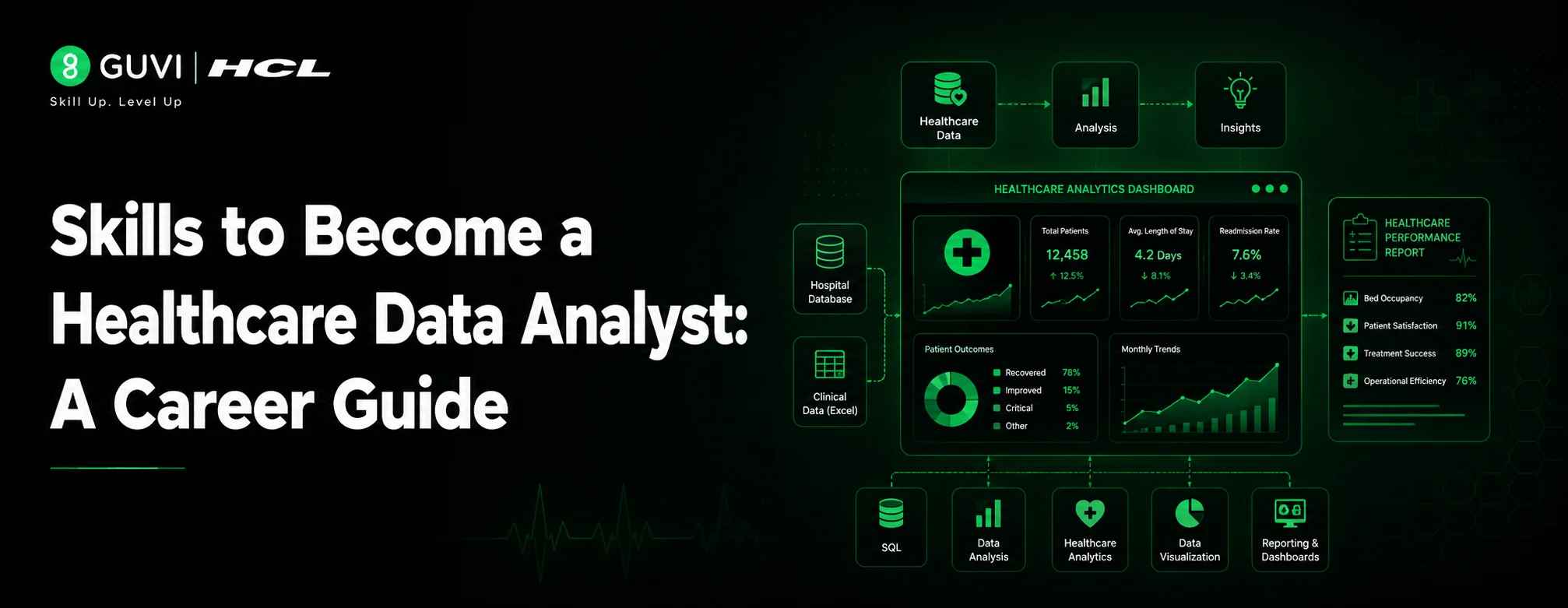
Healthcare data analysts pull data from clinical, financial, and operational systems, then turn it into something a hospital administrator, physician, or insurer can act on. That might mean flagging a rise in readmission rates, spotting billing errors, or building a dashboard that tracks patient wait times across departments.
💡 Pro Tip: Job postings in this field often blend two very different worlds — IT/analytics and clinical operations. Reading a handful of real job descriptions before you start studying will tell you more about required skills than any generic list, including this one.
[Add an infographic here showing: “A Day in the Life of a Healthcare Data Analyst” — visualizing data sources (EHR, billing, claims) flowing into analysis and out to stakeholders.]
Technical Skills You Need
1. SQL and Database Querying
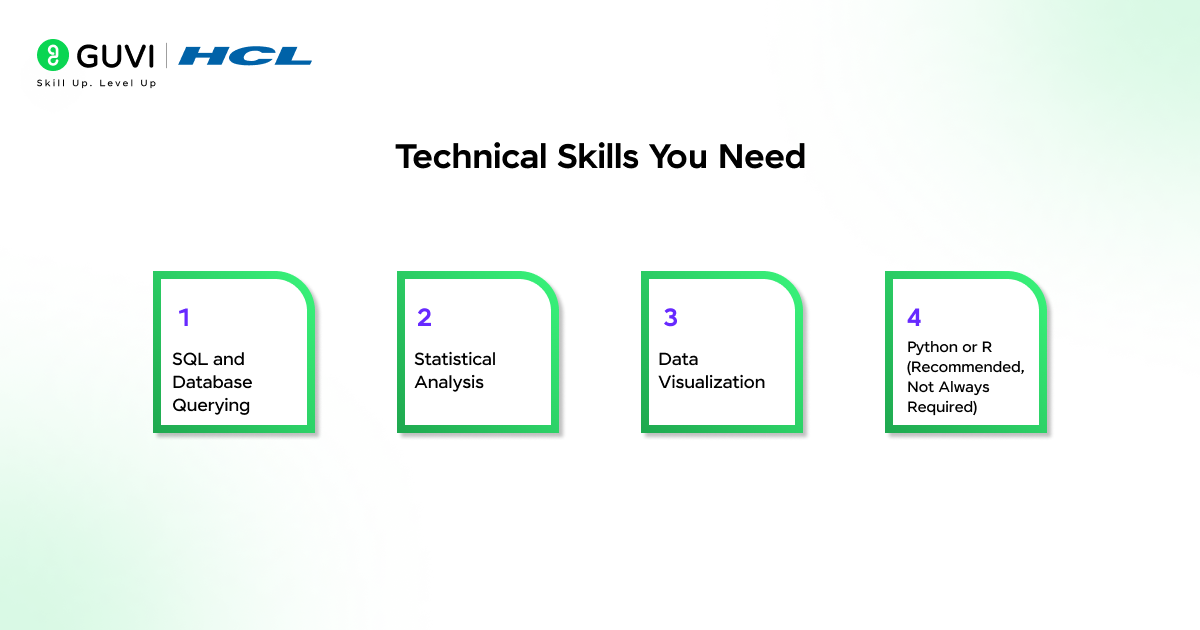
Healthcare data lives in relational databases patient records, billing systems, lab results. You’ll need to comfortably write queries to pull, filter, and join data across tables. This is arguably the single most requested skill in healthcare analyst job postings, more so than any specific software.
2. Statistical Analysis
You don’t need a PhD in biostatistics, but you should understand descriptive statistics, correlation vs. causation, and basic hypothesis testing. Healthcare decisions carry real consequences, so a shaky grasp of statistics can lead to genuinely harmful conclusions — for example, mistaking a small sample fluctuation in infection rates for a real trend.
3. Data Visualization
Raw numbers rarely persuade a hospital board. Tools like Power BI or Tableau let you turn a spreadsheet of claims data into a chart that a non-technical stakeholder can understand in seconds.
4. Python or R (Recommended, Not Always Required)
For predictive work like modeling readmission risk Python (with pandas, scikit-learn) or R is common. Many entry-level roles don’t require this on day one, but it becomes important as you move into more analytical or research-adjacent positions.
Healthcare-Specific Domain Knowledge
This is where healthcare data analysis diverges sharply from general data analytics — and where a lot of otherwise-qualified analysts stumble.
HIPAA and Data Privacy
Every healthcare analyst needs a working understanding of HIPAA not to the level of a compliance officer, but enough to know what counts as protected health information (PHI) and how it must be handled, de-identified, or restricted in any dataset you touch.
Medical Coding Basics (ICD-10, CPT)
You don’t need to be a certified coder, but recognizing ICD-10 diagnosis codes and CPT procedure codes will save you enormous time when working with claims or billing data.
Healthcare organizations generate approximately 30% of the world’s data, with the volume expected to continue growing rapidly through the widespread adoption of electronic health records (EHRs), medical imaging, wearable devices, and connected healthcare systems. This surge in healthcare data is driving strong demand for skilled healthcare data analysts who can transform raw data into actionable insights that improve patient care and operational efficiency.
Clinical Workflow Awareness
Understanding how a patient moves through a hospital admission, diagnosis, treatment, discharge helps you ask better questions of the data and spot when something in a dataset doesn’t match real-world operations.
EHR/EMR Systems
Familiarity with platforms like Epic, Cerner, or Meditech is a strong differentiator. Many organizations will train you on their specific system, but knowing the general structure of how EHR data is organized gives you a head start.
Warning: Don’t assume general data analyst skills transfer 1:1 into healthcare. A dataset that looks “clean” from a technical standpoint can still be clinically meaningless if you don’t understand the underlying medical context.

Soft Skills That Set Strong Analysts Apart
- Translating data into plain language for clinicians and executives who don’t think in pivot tables.
- Cross-functional communication you’ll work with IT, compliance, clinical staff, and finance, often in the same week.
- Attention to detail, since errors in healthcare data can have downstream effects on patient care or billing accuracy.
- Ethical judgment, particularly around what data should and shouldn’t be shared or highlighted.
Tools of the Trade
| Category | Common Tools | Priority for Beginners |
|---|---|---|
| Database Querying | SQL (PostgreSQL, MySQL, SQL Server) | High |
| Visualization | Power BI, Tableau | High |
| Spreadsheets | Excel/Google Sheets | High |
| Programming | Python, R | Medium |
| EHR Systems | Epic, Cerner, Meditech | Medium (often trained on-the-job) |
| Statistical Software | SPSS, SAS | Lower (role-dependent) |
A Step-by-Step Path to Get There
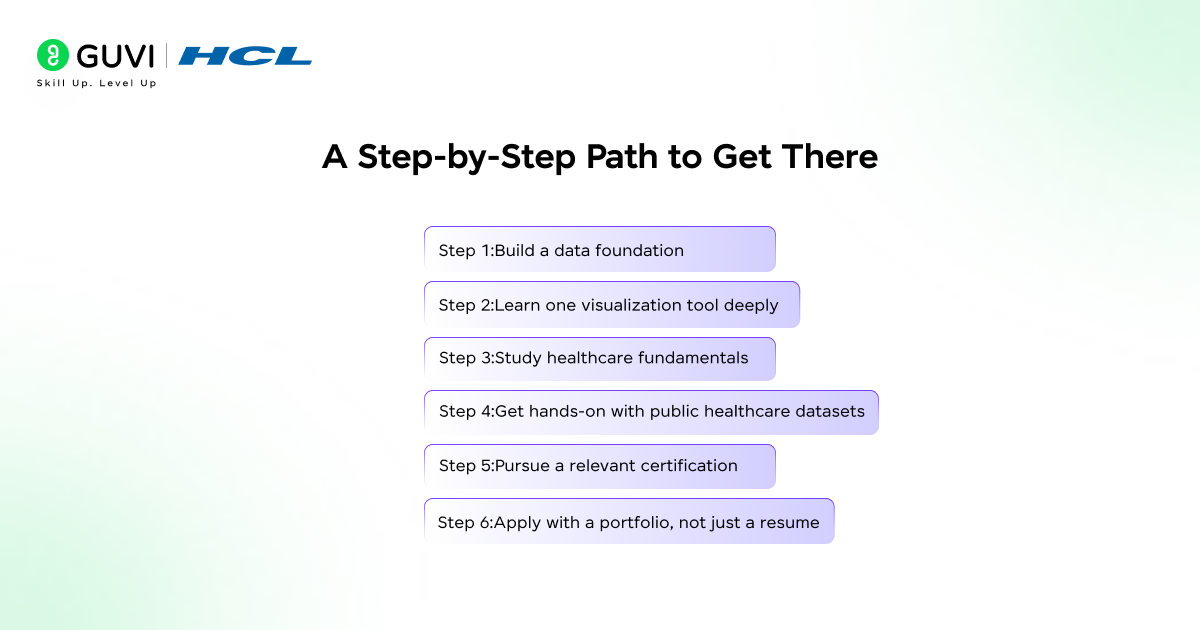
- Build a data foundation. Learn SQL, Excel, and basic statistics first — these are non-negotiable across nearly every posting.
- Learn one visualization tool deeply. Power BI or Tableau — pick one and go beyond the basics.
- Study healthcare fundamentals. HIPAA basics, medical coding structure, and how clinical data flows through a hospital system.
- Get hands-on with public healthcare datasets. CMS.gov and similar sources publish real (de-identified) healthcare data you can practice on.
- Pursue a relevant certification. CHDA or CAHIMS, depending on your background.
- Apply with a portfolio, not just a resume. A dashboard built on real public health data (e.g., analyzing hospital readmission trends) demonstrates skill far better than a bullet point.
Healthcare Data Analyst vs. General Data Analyst
| Factor | Healthcare Data Analyst | General Data Analyst |
|---|---|---|
| Regulatory Knowledge | HIPAA required | Varies by industry |
| Domain Complexity | High (clinical + billing + operations) | Varies |
| Typical Tools | SQL, Power BI/Tableau, EHR systems | SQL, Power BI/Tableau |
| Entry Barrier | Slightly higher due to compliance/domain needs | Lower |
| Job Stability | Generally strong, tied to healthcare sector growth | Varies by industry |
Common Mistakes to Avoid
- Treating this as a purely technical role and skipping domain/compliance knowledge.
- Ignoring data privacy considerations when building a portfolio project (always use properly de-identified or synthetic data).
- Over-indexing on programming skills while under-preparing on SQL and Excel, which remain the most requested baseline skills.
If you want to learn more about data science related domains like this and its functionalities in the real world, then consider enrolling in HCL GUVI’s Certified Data Science Course which not only gives you theoretical knowledge but also practical knowledge with the help of real-world projects.
Conclusion
Becoming a healthcare data analyst requires more than learning SQL or building dashboards. The strongest professionals combine technical expertise with healthcare domain knowledge, regulatory awareness, and the ability to communicate insights that improve patient care and operational efficiency. Start by mastering the fundamentals—SQL, Excel, statistics, and a visualization tool—then build healthcare-specific knowledge around HIPAA, EHR systems, and medical coding. Strengthen your portfolio with real-world healthcare datasets, earn relevant certifications, and continue developing both technical and analytical thinking. As healthcare becomes increasingly data-driven, professionals who can bridge the gap between data and clinical decision-making will remain in high demand, making this a rewarding and future-ready career path.
FAQs
Q: Do I need a healthcare background to become a healthcare data analyst?
A: No, but you’ll need to learn healthcare-specific knowledge like HIPAA and medical coding basics alongside your technical skills.
Q: Is coding required for this role?
A: SQL is essentially required. Python or R is helpful but often not mandatory for entry-level positions.
Q: What certification is most valuable for beginners?
A: CHDA is well-recognized, though a general data analytics certificate can be a useful starting point if you’re new to the field entirely.
Q: How is this different from a general data analyst role?
A: The core technical skills overlap significantly, but healthcare analysts also need regulatory knowledge (HIPAA) and clinical/operational context that general roles don’t require.
Q: What’s a good first project to build a portfolio?
A: Analyze a public, de-identified dataset from a source like CMS.gov for example, hospital readmission rates or patient satisfaction scores and build a dashboard around it.
Success Stories

About the Author
Vishalini Devarajan
An Aerospace Engineer turned content writer, I focus on making complex concepts easy to understand through well-structured, reader-friendly blogs. Whether it’s a technical topic or a non-technical one, I love creating content that is clear, engaging, and impactful.
View all posts by Vishalini Devarajan
Connect with me @











Did you enjoy this article?