


Digital Marketing Articles
What is Performance Marketing? Complete Guide for 2026
What is the Voice of the Customer and Why Does it Matter
What is A/B Testing in Marketing? A Beginner’s Guide to Smarter Campaign Optimization
What is Lead Nurturing in Marketing? A Practical Guide for Beginners


Get In Touch For Details! Request More Information
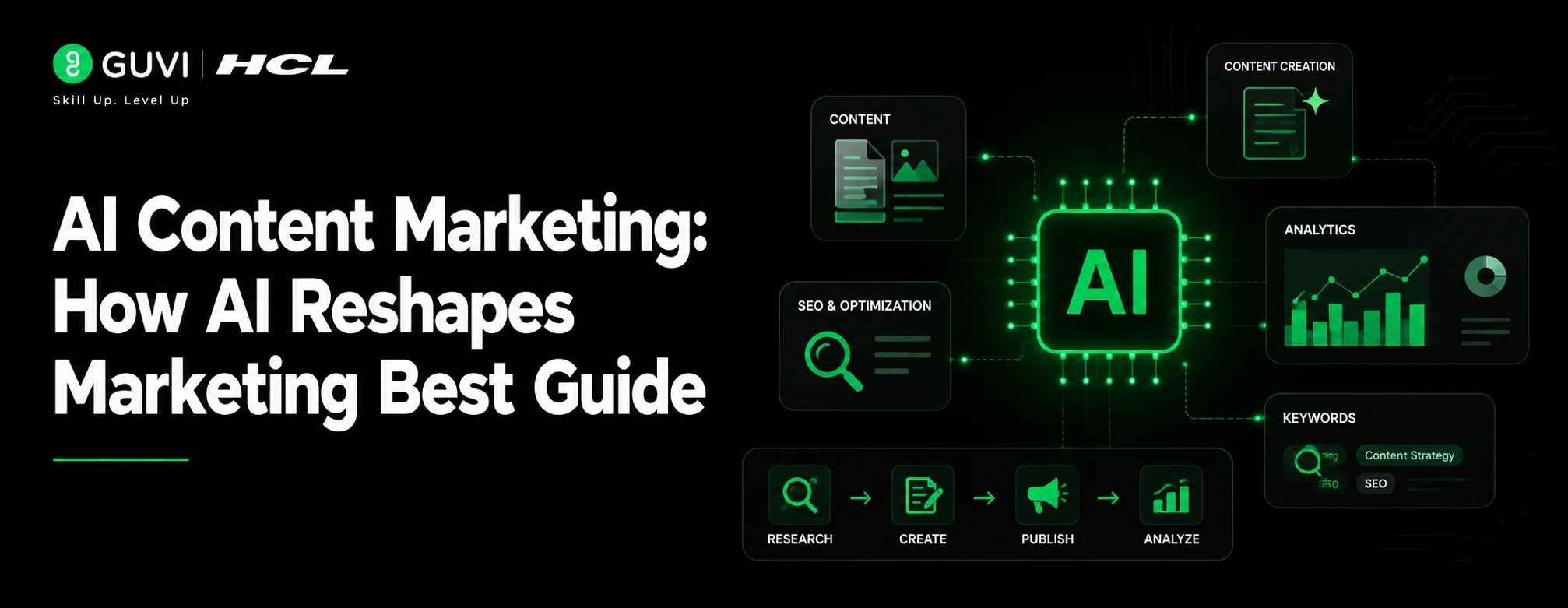
AI Content Marketing: How AI Reshapes Marketing in 2026 Best Guide
Jul 13, 2026 9 Min Read 470 Views
(Last Updated)
Table of contents
- TL;DR Summary
- What is AI Content Marketing?
- Quick Answer: What does AI do in content marketing?
- Why is AI Content Marketing Important in 2026?
- AI is changing content speed
- AI is changing content personalization
- AI is changing search behavior
- How is AI Reshaping Content Marketing?
- AI is improving content research
- AI is helping with content ideation
- AI is accelerating content creation
- AI is making SEO and GEO more important
- AI is improving content repurposing
- AI is improving analytics and optimization
- AI Content Marketing Workflow for Beginners
- Example workflow for a beginner
- AI Content Marketing Tools and Use Cases
- Common AI tools for content marketing
- Best use cases for beginners
- Best use cases for marketing teams
- AI Content Marketing vs Traditional Content Marketing
- Real-World Examples of AI in Content Marketing
- Example 1: Indian D2C skincare brand
- Example 2: EdTech company promoting a digital marketing course
- Skills Marketers Need in the AI Content Era
- Search intent understanding
- Prompt writing
- SEO and GEO writing
- Editing and fact-checking
- Analytics and measurement
- Brand storytelling
- Best Practices for Using AI in Content Marketing
- Use AI for assistance, not blind publishing
- Create a brand voice guide
- Add original insights
- Follow Google’s people-first content guidance
- Build a human-in-the-loop workflow
- Common Mistakes to Avoid in AI Content Marketing
- Publishing AI drafts without editing
- Using AI only for writing
- Ignoring brand voice
- Forgetting fact-checking
- Creating content for search engines only
- Learn Digital Marketing with HCL GUVI
- Conclusion
- FAQs
- What is AI Content Marketing?
- How is AI changing content marketing?
- Can AI replace content marketers?
- Is AI-generated content good for SEO?
- What are the best uses of AI in content marketing?
- What skills do marketers need for AI Content Marketing?
- Is AI Content Marketing useful for beginners?
- What is the difference between AI Content Marketing and content automation?
- How can Indian students learn AI Content Marketing?
- Which digital marketing course is useful for learning AI Content Marketing?
TL;DR Summary
AI Content Marketing means using artificial intelligence to plan, create, optimize, personalize, distribute, and measure content more efficiently. In 2026, AI is helping marketers research topics faster, create first drafts, repurpose blogs into videos or social posts, improve SEO, analyze audience behavior, and personalize campaigns. However, AI does not replace human creativity, brand voice, fact-checking, or strategy. The best results come from a human-led workflow where AI handles repetitive tasks and marketers focus on ideas, storytelling, trust, and business goals.
AI Content Marketing is changing how brands plan, write, optimize, and distribute content across digital channels. Marketers are no longer using AI only to write captions or blog drafts; they are using it for research, personalization, SEO, analytics, content repurposing, and campaign decisions.
In 2026, the real advantage is not using AI blindly. It is knowing how to combine AI speed with human creativity, brand understanding, and fact-checking.
This guide explains how AI is reshaping content marketing, how it works, what tools and skills matter, and how beginners can use it responsibly.
What is AI Content Marketing?
AI Content Marketing is the use of artificial intelligence tools and models to support different stages of the content marketing process. This includes audience research, topic discovery, keyword research, outline creation, content writing, editing, SEO optimization, personalization, distribution, and performance analysis.
In simple terms, AI helps marketers work faster and make better content decisions. It can identify what your audience is searching for, suggest content ideas, create draft versions, repurpose content into different formats, and analyze which content performs well.
But AI Content Marketing is not just “AI writing blogs.” That is only one part of it.
A complete AI content workflow can include:
- Finding trending topics
- Understanding user search intent
- Creating blog outlines
- Drafting content
- Optimizing for SEO and AI search
- Writing social media captions
- Creating email variations
- Repurposing blogs into videos or carousels
- Personalizing content for different audience segments
- Measuring engagement, conversions, and ROI
AI in marketing has also been studied as a way to help brands understand customer needs in real time, personalize experiences, and decide which content to show across channels.
Quick Answer: What does AI do in content marketing?
AI helps content marketers research faster, create content drafts, personalize messages, optimize for SEO, repurpose content, automate repetitive work, and analyze campaign performance. Human marketers still need to guide the strategy, verify facts, maintain brand voice, and make creative decisions.
Why is AI Content Marketing Important in 2026?
AI Content Marketing matters in 2026 because content teams are under pressure to create more content, personalize it for different audiences, and prove results faster.
According to HubSpot’s 2026 State of Marketing Report, 80% of marketers use AI for content creation, and 75% use it for media production. The same report says 61% of marketers believe AI is causing the biggest disruption in marketing in 20 years.
This shows that AI is no longer an optional experiment. It is becoming part of everyday marketing workflows.
AI is changing content speed
Earlier, creating a blog, email campaign, and social media posts could take several days. Now, AI can help marketers create a first draft, generate headline options, summarize research, and repurpose the same content into multiple formats.
This does not mean content should be published without review. It means marketers can spend less time on repetitive drafting and more time on strategy, originality, and editing.
AI is changing content personalization
AI can analyze audience behavior and help marketers create content for different user groups. For example, a beginner may need a basic guide, while a working professional may need a comparison, checklist, or advanced strategy.
Salesforce’s 10th State of Marketing report says 83% of marketers recognize the shift toward personalized, two-way messaging, but only one in four are satisfied with how they use data for those moments.
That gap creates a major opportunity for marketers who can use AI and data responsibly.
AI is changing search behavior
Search is no longer limited to Google’s blue links. Users now ask questions on Google AI Overview, ChatGPT, Gemini, Perplexity, and other AI search tools.
This means content must be clear, structured, helpful, and easy for AI systems to understand. Blogs need direct answers, concise definitions, FAQs, examples, and updated facts.
Google also says generative AI can help with research and content structure, but using AI to create many low-value pages without adding user value may violate spam policies.
Unlike paid advertising vs content marketing, AI content marketing focuses more on long-term organic visibility and scalable content creation
HubSpot’s 2026 report says AI is now “table stakes” for marketers, but the real difference is how well teams use it. The report highlights speed, insight, personalization, and avoiding low-quality over-automated output as key focus areas.
How is AI Reshaping Content Marketing?
AI is reshaping content marketing across the full workflow, from planning to performance measurement. The biggest shift is that content marketing is becoming more data-driven, personalized, and multi-format.
Let’s break this down clearly.
1. AI is improving content research
Content research usually involves checking search trends, competitor topics, user questions, keyword gaps, and audience pain points. AI can speed up this process by summarizing large amounts of information and identifying common themes.
For example, a marketer writing about “email marketing for startups” can use AI to find user questions, competitor gaps, blog angles, and possible subtopics.
However, AI research should always be verified with reliable sources. AI can summarize patterns, but it can also make mistakes or create unsupported claims.
AI content marketing is especially useful for digital marketing for startups because it helps small teams create and optimize content faster.
2. AI is helping with content ideation
AI can generate blog ideas, social media hooks, newsletter angles, video scripts, and campaign concepts. This is useful when a team needs many creative directions quickly.
For example, a digital marketing learner can ask AI to create 20 blog title ideas for “SEO for small businesses.” Then, the human marketer can choose the strongest ideas based on search intent and audience relevance.
The best ideas still come from combining AI suggestions with real customer insights.
3. AI is accelerating content creation
Generative AI tools can create first drafts for blogs, emails, ads, product descriptions, captions, and scripts. This saves time during the early drafting stage.
But the first draft is not the final draft.
A human editor must check the structure, facts, examples, tone, originality, and brand alignment. This is especially important for educational, financial, health, legal, and technical topics.
4. AI is making SEO and GEO more important
SEO focuses on ranking in search engines. GEO, or Generative Engine Optimization, focuses on making content easy for AI search engines to understand and cite.
AI-ready content should include:
- Direct answers
- Clear headings
- Short paragraphs
- FAQs
- Definitions
- Step-by-step explanations
- Examples
- Updated statistics
- Credible sources
This is why content marketers now need to write for both humans and AI-powered search platforms.
5. AI is improving content repurposing
A single blog can become many smaller content assets with the help of AI.
For example, one long-form blog can be repurposed into:
- LinkedIn carousel points
- Instagram captions
- YouTube Shorts script
- Email newsletter
- Infographic copy
- Webinar talking points
- FAQ snippets
- Sales enablement notes
This helps brands get more value from each content piece.
6. AI is improving analytics and optimization
AI can help marketers analyze which topics, formats, channels, and audience segments perform best. It can detect patterns that may be missed during manual analysis.
For example, an AI analytics tool may show that beginner-level explainers bring more leads, while advanced opinion pieces bring more brand engagement.
That insight helps marketers plan future content more strategically.
AI Content Marketing Workflow for Beginners
A beginner-friendly AI Content Marketing workflow should be simple, repeatable, and safe. The goal is not to let AI control everything, but to use it as a smart assistant.
Here is a practical workflow you can follow.
| Step | What to Do | How AI Helps | Human Check Needed |
| 1 | Define the audience | Suggests personas and pain points | Confirm with real audience data |
| 2 | Understand search intent | Groups user queries by intent | Check Google results and competitors |
| 3 | Research topics | Summarizes trends and questions | Verify facts and statistics |
| 4 | Create outline | Builds section flow | Improve logic and originality |
| 5 | Draft content | Creates first draft | Edit tone, examples, and accuracy |
| 6 | Optimize SEO/GEO | Suggests headings, FAQs, meta tags | Avoid keyword stuffing |
| 7 | Repurpose content | Converts blog into social/email/video formats | Adjust for each platform |
| 8 | Publish and distribute | Suggests channel plan | Match brand calendar and goals |
| 9 | Measure performance | Finds patterns in data | Connect insights to business goals |
| 10 | Improve content | Suggests updates | Add new examples and human insight |
Example workflow for a beginner
Suppose you are writing a blog on “Best Digital Marketing Strategies for Small Businesses.”
You can use AI to:
- List common small business marketing problems.
- Group problems into SEO, social media, paid ads, and email marketing.
- Create an outline based on search intent.
- Draft the first version.
- Generate FAQ ideas.
- Repurpose the blog into LinkedIn and Instagram posts.
- Create a checklist for readers.
Then you should manually:
- Check every claim.
- Add Indian examples.
- Improve the tone.
- Add original insights.
- Include relevant internal links.
- Remove generic AI-sounding lines.
This is how AI becomes useful without making the content robotic.
AI Content Marketing Tools and Use Cases
AI tools are useful only when they solve a clear problem. Do not choose tools because they are trending. Choose them based on your workflow.
Common AI tools for content marketing
| Use Case | AI Can Help With | Example Tool Categories |
| Topic research | Finding questions, trends, and content gaps | AI assistants, SEO tools |
| Keyword research | Grouping keywords by search intent | SEO platforms |
| Content drafting | Blog drafts, captions, emails, ad copy | Generative AI writing tools |
| Editing | Grammar, tone, clarity, readability | AI editing tools |
| SEO optimization | Meta tags, headings, content briefs | SEO content tools |
| Visual content | Image ideas, thumbnails, ad creatives | AI design tools |
| Video repurposing | Turning long videos into clips | AI video tools |
| Email marketing | Subject lines and audience segmentation | Email automation tools |
| Analytics | Pattern detection and performance insights | Analytics platforms |
AI can suggest keywords, but marketers still need to know how to optimize keywords for SEO naturally inside the content.
Along with AI writing tools, marketers can also use SEO tools for digital marketing to track rankings, keywords, and content performance.
Best use cases for beginners
If you are new to digital marketing, start with simple use cases.
You can use AI for:
- Blog topic ideas
- Title variations
- Meta descriptions
- FAQ generation
- Content outlines
- Caption drafts
- Email subject lines
- Content repurposing
- Basic competitor gap analysis
- Readability improvement
Avoid using AI for final publishing without editing. That is where many beginners make mistakes.
Beginners can first set up a ChatGPT account before using AI for content ideation, drafting, and editing
Best use cases for marketing teams
Marketing teams can use AI for more advanced workflows.
This includes:
- Personalization at scale
- Predictive content analytics
- Lead nurturing workflows
- Campaign segmentation
- Social listening
- Content performance forecasting
- Multi-language content adaptation
- Content governance and quality checks
Content Marketing Institute’s 2025 B2B research found that 81% of B2B marketers use generative AI tools, but only 19% have AI integrated into daily workflows. This shows that many teams are using AI, but fewer teams have a mature AI content process.
AI Content Marketing vs Traditional Content Marketing
AI does not remove traditional content marketing. It changes how content marketing is planned and executed.
| Factor | Traditional Content Marketing | AI Content Marketing |
| Research | Manual keyword and audience research | AI-assisted topic discovery and query clustering |
| Content drafting | Fully written by humans | AI creates drafts; humans edit and improve |
| Personalization | Limited audience segmentation | More dynamic and data-based personalization |
| SEO | Focus on keywords and rankings | Focus on SEO, GEO, AI Overview, and answer extraction |
| Repurposing | Manual format conversion | Faster blog-to-social, blog-to-video, and email conversion |
| Analytics | Manual dashboard review | AI-assisted insights and pattern detection |
| Speed | Slower production cycle | Faster first drafts and content variations |
| Quality control | Human editor-led | Human editor + AI-assisted checks |
| Brand voice | Fully human controlled | Needs strong human review to avoid generic tone |
| Best use | High-touch creative work | Scalable content workflows with human oversight |
The best approach is not choosing one over the other. The best approach is combining both.

Traditional content marketing gives you strategy, empathy, originality, and brand voice. AI gives you speed, scale, data support, and workflow efficiency.
Real-World Examples of AI in Content Marketing
Example 1: Indian D2C skincare brand
An Indian D2C skincare brand can use AI to understand what customers search before buying products. For example, users may search for “best sunscreen for oily skin,” “how to reduce acne marks,” or “vitamin C serum for beginners.”
AI can group these queries into content clusters.
The marketing team can then create:
- Beginner guides
- Product comparison pages
- Instagram reels
- Email sequences
- FAQ content
- Dermatologist-reviewed explainers
AI helps with research and drafts, while human experts check product claims, skin-related advice, and brand tone.
Example 2: EdTech company promoting a digital marketing course
An edtech company can use AI to create content for different learner groups. A college student may need “What is digital marketing?”, while a working professional may search “How to switch to a digital marketing career?”
AI can help create separate content journeys for each audience.
For example:
- Blog for beginners
- Career roadmap for freshers
- Email nurture sequence
- Webinar landing page
- LinkedIn posts for working professionals
- YouTube Shorts scripts explaining digital marketing skills
The human marketing team still needs to check accuracy, add real learner examples, and align every content piece with the course promise.
Skills Marketers Need in the AI Content Era
AI is changing the skill set required for content marketers. Writing is still important, but marketers now need to understand strategy, data, tools, prompts, and content quality.
1. Search intent understanding
You should know what the user actually wants when they search a keyword. For example, someone searching “AI Content Marketing” may want a definition, use cases, tools, examples, benefits, and risks.
If your content does not match intent, AI tools cannot save it.
2. Prompt writing
Prompt writing means giving clear instructions to AI tools. A weak prompt gives generic output. A strong prompt gives useful, structured, and relevant output.
A good prompt should include:
- Audience
- Goal
- Tone
- Format
- Context
- Examples
- Constraints
- Output structure
3. SEO and GEO writing
Modern content marketers need both SEO and GEO skills. SEO helps the content rank in search engines. GEO helps content appear in AI-generated answers.
This means your writing should include clear headings, short answers, definitions, structured tables, FAQs, and citations where needed.
4. Editing and fact-checking
AI can write fast, but it can also create inaccurate or generic content. Human editors need to verify facts, remove unsupported claims, improve examples, and make the content sound natural.
Content Marketing Institute found that only 4% of B2B marketers report a high level of trust in generative AI outputs. This shows why human review is still essential.
5. Analytics and measurement
AI can help you understand what is working, but you must know which metrics matter.
Important content metrics include:
- Organic traffic
- Click-through rate
- Engagement rate
- Scroll depth
- Leads generated
- Conversion rate
- Assisted conversions
- Content updates needed
- Brand mentions in AI search
6. Brand storytelling
As AI-generated content increases, brand voice becomes more important. People can easily ignore generic content, but they remember strong opinions, useful examples, and honest explanations.
Human storytelling is what makes AI-assisted content trustworthy.
Content Marketing Institute found that 51% of B2B marketers using generative AI noticed fewer tedious tasks, 45% saw more efficient workflows, and 42% experienced improved content optimization. This shows AI’s biggest early impact is workflow support, not full creative replacement.
Best Practices for Using AI in Content Marketing
AI works best when it is used with a clear process. Without guidelines, teams may create fast content that lacks originality, accuracy, and brand voice.
1. Use AI for assistance, not blind publishing
AI can help you create a draft, but a human should review and improve the final version.
Before publishing, check:
- Is the information accurate?
- Are the examples relevant?
- Is the tone human?
- Are the statistics verified?
- Is the content useful for the reader?
- Is the brand voice consistent?
2. Create a brand voice guide
A brand voice guide helps AI tools produce more consistent drafts.
Include:
- Words your brand uses
- Words your brand avoids
- Sample introductions
- Preferred tone
- Formatting rules
- CTA style
- Example paragraphs
- Banned phrases
For GUVI-style educational content, the tone should be simple, helpful, conversational, and learner-friendly.
3. Add original insights
AI can summarize what already exists, but original insights help your blog stand out.
Add:
- Indian examples
- Real project examples
- Course relevance
- Tool workflows
- Mistake-and-fix sections
- Expert tips
- Fresh data
- Beginner-friendly explanations
This makes the content more useful than a generic AI-generated article.
4. Follow Google’s people-first content guidance
Google recommends creating helpful, reliable, people-first content rather than content made mainly to manipulate rankings.
So, AI-assisted content should still answer real user questions and provide value.
Use AI to improve content quality, not to mass-produce thin pages.
To build strong results, marketers should also understand the basics of effective content marketing before using AI tools.
5. Build a human-in-the-loop workflow
A human-in-the-loop workflow means AI helps with tasks, but humans approve important decisions.
A simple workflow can be:
- Strategist defines the content goal.
- AI helps with research and outline.
- Writer creates or improves the draft.
- Editor checks tone, flow, and accuracy.
- SEO specialist checks search intent and optimization.
- Designer creates visual assets.
- Analyst tracks performance after publishing.
This workflow gives you AI speed without losing trust.
Common Mistakes to Avoid in AI Content Marketing
1. Publishing AI drafts without editing
Many beginners copy AI-generated drafts directly into blogs or captions. This often leads to generic, repetitive, or inaccurate content.
Fix this by editing every draft for facts, tone, examples, and user intent.
2. Using AI only for writing
AI Content Marketing is not limited to writing blogs. It can also help with research, content planning, repurposing, personalization, analytics, and workflow automation.
Fix this by using AI across the full content lifecycle, not just the drafting stage.
3. Ignoring brand voice
AI-generated content can sound similar across brands if you do not give it clear voice instructions.
Fix this by creating a brand voice document and using it in your prompts.
4. Forgetting fact-checking
AI tools can produce wrong statistics, fake references, or outdated information.
Fix this by verifying every factual claim with reliable sources before publishing.
5. Creating content for search engines only
Some marketers use AI to create content only for rankings. This can lead to thin, repetitive, and unhelpful pages.
Fix this by writing for real readers first, then optimizing for SEO and AI search.
As AI becomes a bigger part of marketing, understanding the scope of digital marketing can help beginners choose the right career path.
Beginners can also explore a digital marketing syllabus for beginners to understand the key topics needed before learning AI content marketing.
Learn Digital Marketing with HCL GUVI
AI is becoming a major part of digital marketing, but tools alone are not enough. To use AI well, you need to understand SEO, content strategy, social media marketing, paid ads, analytics, email marketing, and campaign planning.
If you want structured learning, explore HCL GUVI’s Digital Marketing course. It helps learners build practical digital marketing skills across SEO, social media, email marketing, Google Ads, analytics, content creation, and marketing tools.
Conclusion
AI Content Marketing is reshaping how marketers research, create, optimize, personalize, distribute, and measure content. In 2026, the most successful marketers will not be the ones who publish the most AI-generated content. They will be the ones who use AI wisely while keeping strategy, creativity, accuracy, and brand trust human-led. If you are learning digital marketing, start by understanding content strategy, SEO, analytics, and AI-assisted workflows. These skills will help you stay relevant as marketing becomes more data-driven, automated, and AI-powered.
FAQs
1. What is AI Content Marketing?
AI Content Marketing is the use of artificial intelligence to plan, create, optimize, personalize, distribute, and measure content. It helps marketers work faster while improving content relevance and performance.
2. How is AI changing content marketing?
AI is changing content marketing by speeding up research, drafting, SEO optimization, personalization, repurposing, and analytics. It allows marketers to create more targeted content with better workflow efficiency.
3. Can AI replace content marketers?
No, AI cannot fully replace content marketers. It can support repetitive tasks, but humans are still needed for strategy, creativity, storytelling, fact-checking, and brand voice.
4. Is AI-generated content good for SEO?
AI-generated content can perform well in SEO if it is helpful, accurate, original, and reviewed by humans. Google focuses on content quality and user value, not only on whether AI was used.
5. What are the best uses of AI in content marketing?
The best uses include topic research, keyword clustering, outline creation, first drafts, social media captions, email variations, content repurposing, personalization, and performance analysis.
6. What skills do marketers need for AI Content Marketing?
Marketers need search intent understanding, prompt writing, SEO, GEO, editing, analytics, brand storytelling, and fact-checking skills. These skills help them use AI responsibly and effectively.
7. Is AI Content Marketing useful for beginners?
Yes, AI Content Marketing is useful for beginners because it helps them understand content structure, generate ideas, create drafts, and learn workflows faster. However, beginners should always verify and edit AI outputs.
8. What is the difference between AI Content Marketing and content automation?
Content automation usually focuses on scheduling or repeating tasks. AI Content Marketing goes further by helping with research, personalization, content creation, optimization, and decision-making.
9. How can Indian students learn AI Content Marketing?
Indian students can start by learning digital marketing basics, SEO, content writing, analytics, and AI tools. Then they can practise by creating blogs, social media campaigns, email sequences, and content calendars.
10. Which digital marketing course is useful for learning AI Content Marketing?
A digital marketing course that covers SEO, content marketing, analytics, social media, email marketing, paid ads, and AI tools is useful. GUVI’s Digital Marketing course is a relevant option for beginners who want structured learning.
Success Stories

About the Author
Reemsha Khan
Always been a storyteller at heart. Now, I turn complex topics into simple, easy-to-understand stories through content. Hope you find it helpful.
View all posts by Reemsha Khan
Connect with me @











Did you enjoy this article?