


Python Articles
Freelancing as a Python Developer: Getting Your First Client
Common Python Mistakes Beginners Make And How to Fix Them
Python Best Practices: Writing Clean, Maintainable Code Like a Pro
How to Build a Python Developer Portfolio That Gets You Hired


Get In Touch For Details! Request More Information
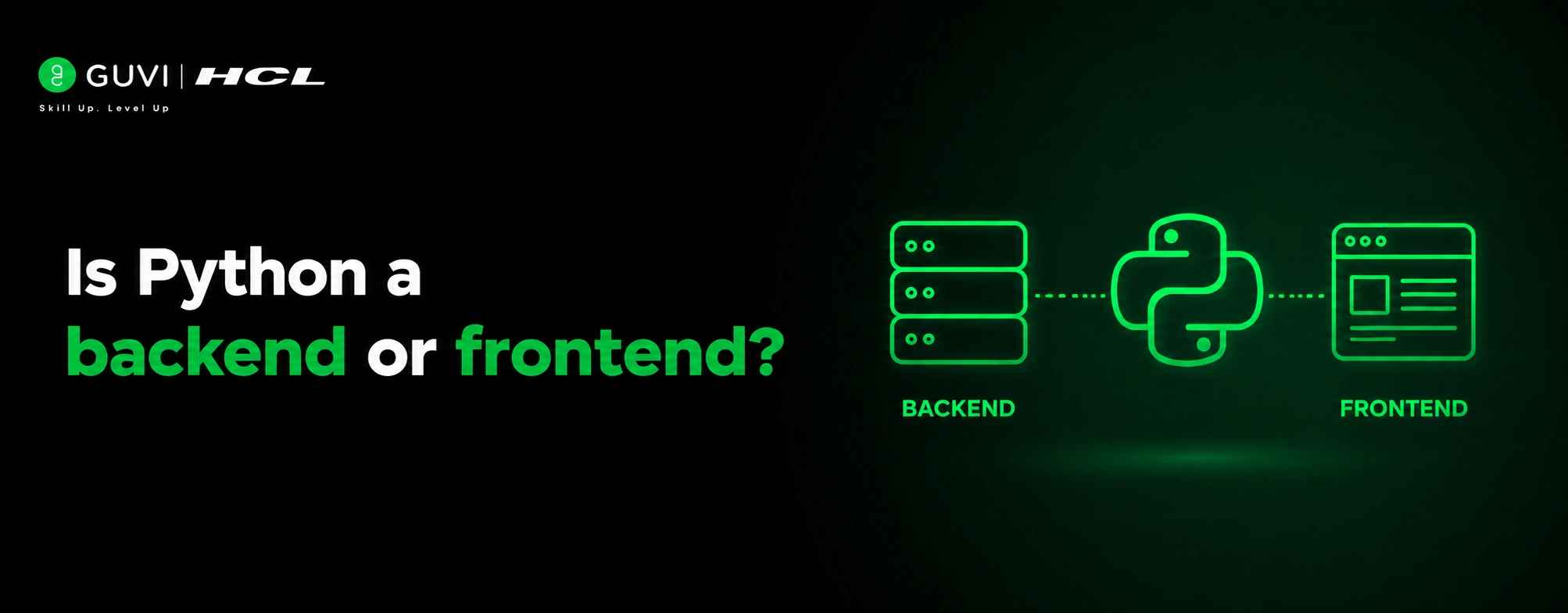
Is Python a backend or frontend? The Clear Answer
Jul 08, 2026 4 Min Read 406 Views
(Last Updated)
If you’re new to web development, you’ve probably noticed that some languages feel tied to a specific job. HTML and CSS clearly belong to the frontend, for instance. Python doesn’t fit that mould as neatly, and that ambiguity is exactly what brings people searching for an answer.
Table of contents
- TL;DR Summary
- What Backend and Frontend Actually Mean
- Why Python Is Considered a Backend Language
- Real Companies Running Python on the Backend
- Can Python Be Used for Frontend Development?
- Where Python Blurs the Line: Templating
- Backend vs Frontend at a Glance
- Can Python Be Used for Full-Stack Development?
- Choosing What to Learn
- Conclusion
- FAQs
- Is Python a frontend or backend language?
- Why is Python considered a backend language?
- Can Python be used for frontend development?
- Can I build a full-stack application using Python?
- What is the difference between frontend and backend development?
- Which Python framework should beginners learn for backend development?
- Should I learn JavaScript if I already know Python?
TL;DR Summary
- Python is primarily a backend language, powering server-side logic, databases, APIs, and web applications through frameworks like Django, Flask, and FastAPI.
- Python can be used for frontend development through tools such as PyScript and Brython, but these solutions remain niche compared to JavaScript’s dominance in the browser.
- Most modern Python web applications are full-stack systems, combining a Python backend with frontend technologies like HTML, CSS, JavaScript, React, or Vue.
Python is primarily a backend language, used for APIs, servers, and data processing. Master Python for backend development with HCL GUVI’s Python Zero to Hero course. Start your Python journey here
Is Python a backend or frontend language?
Python is primarily a backend language. It powers server-side logic, databases, and APIs through frameworks like Django, Flask, and FastAPI.
Python can technically be used for frontend tasks through tools like Brython or PyScript, but this is rare in practice. JavaScript remains the standard for frontend development, and Python’s real strength lies firmly on the backend.
What Backend and Frontend Actually Mean
Before settling the Python question, it helps to be clear on the two terms.
- Frontend
It refers to everything a user sees and interacts with directly the layout, the colours, the buttons, the navigation menu. It’s the visual and interactive layer of a website or app.
- Backend
It is everything happening behind the scenes the server, the database, the business logic, and the code that processes requests and sends back responses. Users never see the backend directly; they experience its effects through what the frontend displays.
A simple way to think about it: when you click “Add to Cart” on a website, the frontend handles the click and the visual update, while the backend verifies stock, updates the database, and confirms the action actually happened.
Why Python Is Considered a Backend Language
Python’s dominance on the backend comes down to its frameworks, its ecosystem, and the kind of work it’s genuinely good at.
- Python offers mature, production-grade frameworks built specifically for server-side work: Django, Flask, and FastAPI. A recent Python developer survey confirmed these three frameworks remain developers’ top choices for backend web development with Python.
- Each handles the core responsibilities of a backend routing requests, querying databases, managing authentication, and returning data in a way that’s fast to build and easy to maintain.
- Django is a full-stack framework built on the model-template-view architecture, with a core objective of simplifying the creation of complex, database-driven websites.
- Flask, by contrast, is a lightweight, flexible microframework that lets developers choose their own tools, making it well-suited for smaller projects.
- APIs, rapid prototyping, and microservices. FastAPI is a more recent framework designed for building high-performance web APIs using modern Python features like type hints and async capabilities.
- These frameworks all share the same purpose: handling what happens on the server, not what the user sees on screen. That’s the core reason Python sits on the backend side of the divide.
Real Companies Running Python on the Backend
Python’s backend role isn’t theoretical; major platforms run on it in production today.
- Instagram uses Django for backend infrastructure.
- Pinterest relies on Python for content delivery and recommendation algorithms.
- YouTube uses Python for video processing and analytics,
- And Netflix employs Python for content recommendation and data analysis.
- Spotify uses Django in the backend to manage real-time user interactions and data updates.
- The Washington Post uses Django’s ability to serve dynamic content and handle heavy traffic loads.
- These aren’t small projects; they’re some of the highest-traffic platforms on the internet, and Python handles the server-side logic behind all of them.
Some of the world’s largest platforms, including Instagram, Spotify, and Pinterest, rely heavily on Python for backend services. Its simplicity, scalability, and rich ecosystem of libraries and frameworks have made it one of the most widely adopted languages for server-side development, powering everything from APIs and data processing pipelines to recommendation systems and internal tools.
Can Python Be Used for Frontend Development?
Technically, yes, but it’s the exception, not the rule. At PyCon 2022,
- Anaconda announced a new Python frontend framework called PyScript, which allows developers to create Python applications in the browser using the HTML interface. Other tools in this space include Brython, Pyjs, and Skulpt.
- Brython is a Python 3 implementation for the web browser that compiles Python code into JavaScript, making it possible to write frontend code in Python.
- It’s a genuinely interesting piece of engineering, but it hasn’t displaced JavaScript in any meaningful way.
- Front-end capabilities for Python exist through Brython and WebAssembly, yet JavaScript continues to lead as the main language for this purpose.
- The honest answer: if you’re building a serious frontend, you’ll be learning JavaScript and a framework like React, Vue, or Angular, not Python.
Where Python Blurs the Line: Templating
There’s one place Python gets genuinely close to frontend work: templating engines.
- Django includes a templating engine that allows developers to create dynamic and interactive frontend components, even though it’s primarily known as a backend framework.
- Flask relies on Jinja2 for templating, which offers significant flexibility and expressive power.
- Templating lets a Python backend generate HTML dynamically, inserting data from a database directly into a webpage before it’s sent to the browser.
- This means full-stack frameworks like Django come with tools for both backend and frontend development, such as form handling, URL routing, and template rendering, even though the actual interactive frontend layer is typically still built with HTML, CSS, and JavaScript.
- This is the closest Python gets to frontend territory in standard practice and it’s still fundamentally a backend feature generating frontend output, not Python running interactively in the browser.

Backend vs Frontend at a Glance
| Aspect | Frontend | Backend (Python’s Role) |
| What it handles | UI, layout, user interaction | Server logic, databases, APIs |
| Primary languages | HTML, CSS, JavaScript | Python, Java, Ruby, Node.js |
| Python’s typical role | Rare — PyScript, Brython | Standard Django, Flask, FastAPI |
| What users see | Directly, in the browser | Never directly, only its effects |
| Common tasks | Forms, buttons, animations | Authentication, database queries, APIs |
Can Python Be Used for Full-Stack Development?
Yes, but with a caveat. Python can be used for full-stack development, but typically with the help of additional tools and languages.
- A common full-stack setup pairs a Python backend (Django or Flask) with a JavaScript frontend (React or Vue), communicating through an API.
- Django works well with server-rendered pages or with Django REST Framework serving data to a React or Vue frontend, while Flask and FastAPI pair easily with any modern frontend by exposing clean API endpoints.
- This is the standard architecture for most modern Python-based web applications: Python handles the data and logic, JavaScript handles the interface
Python is primarily a backend language, used for APIs, servers, and data processing. Master Python for backend development with HCL GUVI’s Python Zero to Hero course. Start your Python journey here.
Choosing What to Learn
If you’re deciding what to study based on this question, the practical path is clear.
- Learn Python and a backend framework like Django or Flask if you want to work with databases, APIs, server logic, or move into data science and automation alongside web development. Python’s biggest strengths extend well beyond web work.
- Learn JavaScript, HTML, and CSS if you want to focus specifically on what users see and interact with. Some Python knowledge can still help you understand frontend frameworks like PyScript, but frontend roles overwhelmingly expect JavaScript fluency.
- Many developers end up learning both, since most real-world web projects need a backend and a frontend working together regardless of which languages power each side.
Conclusion
Python is, without question, a backend language in standard practice. Its frameworks, its production track record at companies like Instagram and Spotify, and its ecosystem are all built around server-side work.
Frontend tools for Python exist PyScript and Brython are real and functional but they remain niche compared to JavaScript’s dominance in the browser.
If you’re learning Python for web development, expect to pair it with JavaScript on the frontend rather than replacing JavaScript entirely with Python. That combination, not a Python-only stack, is how most real-world web applications are built today.
FAQs
1. Is Python a frontend or backend language?
Python is primarily a backend language. It is commonly used to build server-side applications, APIs, authentication systems, and database-driven web applications. While frontend options exist, Python is overwhelmingly used on the backend in professional development.
2. Why is Python considered a backend language?
Python provides powerful backend frameworks such as Django, Flask, and FastAPI. These frameworks are specifically designed for handling server logic, database interactions, authentication, routing, and API development.
3. Can Python be used for frontend development?
Yes, but it is uncommon. Technologies such as PyScript and Brython allow Python code to run in web browsers. However, JavaScript remains the industry standard for frontend development.
4. Can I build a full-stack application using Python?
Yes. Many developers use Python for backend development while combining it with frontend technologies such as HTML, CSS, JavaScript, React, or Vue. This approach is one of the most common architectures in modern web development.
5. What is the difference between frontend and backend development?
Frontend development focuses on the user interface, including layouts, buttons, forms, and visual elements users interact with directly. Backend development handles data processing, business logic, databases, authentication, and communication between systems behind the scenes.
6. Which Python framework should beginners learn for backend development?
For beginners, Django is often recommended because it includes many built-in features for developing complete web applications. Flask offers greater flexibility and simplicity, while FastAPI is an excellent choice for building modern, high-performance APIs.
7. Should I learn JavaScript if I already know Python?
Yes. If you want to become a full-stack web developer, learning JavaScript alongside Python is highly beneficial. Python excels on the backend, while JavaScript remains the dominant language for creating interactive frontend experiences.
Success Stories

About the Author
Vishalini Devarajan
An Aerospace Engineer turned content writer, I focus on making complex concepts easy to understand through well-structured, reader-friendly blogs. Whether it’s a technical topic or a non-technical one, I love creating content that is clear, engaging, and impactful.
View all posts by Vishalini Devarajan
Connect with me @






Did you enjoy this article?