


Artificial Intelligence and Machine Learning Articles
Finance Manager to Data Analytics: Career Growth, Salary and Seniority
How to Evaluate LLM Outputs in Production Deployments
AI/ML Skills Gap 2026: Why Companies Can't Find Job-Ready Talent
20 AI/ML Interview Questions Recruiters Can Use Without a Tech Background - Best Guide


Get In Touch For Details! Request More Information
Skills for Multimodal AI Development: What You Need to Know
Jul 06, 2026 4 Min Read 730 Views
(Last Updated)
Table of contents
- TL;DR Summary
- What is Multimodal AI?
- Core Technical Skills You Need
- Python Programming
- Deep Learning Fundamentals
- Natural Language Processing (NLP)
- Computer Vision
- Audio and Speech Processing
- Data Engineering and Multimodal Datasets
- MLOps and Model Deployment
- Tools and Frameworks to Learn
- Deep Learning
- Multimodal Models and APIs
- Deployment and Experimentation
- Soft Skills That Actually Matter
- Research Reading
- Cross-functional Communication
- Problem Decomposition
- Real-World Applications
- Common Mistakes Beginners Make
- Conclusion
- FAQs
- What is multimodal AI development?
- What programming language is best for multimodal AI?
- Do I need to know computer vision and NLP both?
- What is the difference between a unimodal and multimodal AI model?
- Which frameworks should I learn for multimodal AI development?
- Is fine-tuning required to work with multimodal models?
- How long does it take to learn multimodal AI development?
- What industries are hiring multimodal AI developers?
TL;DR Summary
Multimodal AI development involves building systems that can understand and process multiple data types, text, images, audio, and video simultaneously. To work in this space, you need a strong foundation in Python, deep learning, NLP, and computer vision, along with hands-on experience with frameworks like PyTorch, Hugging Face Transformers, and multimodal models like GPT-4o and Gemini.
This article breaks down exactly what skills you need, the tools to learn, and how to get started.
What is Multimodal AI?
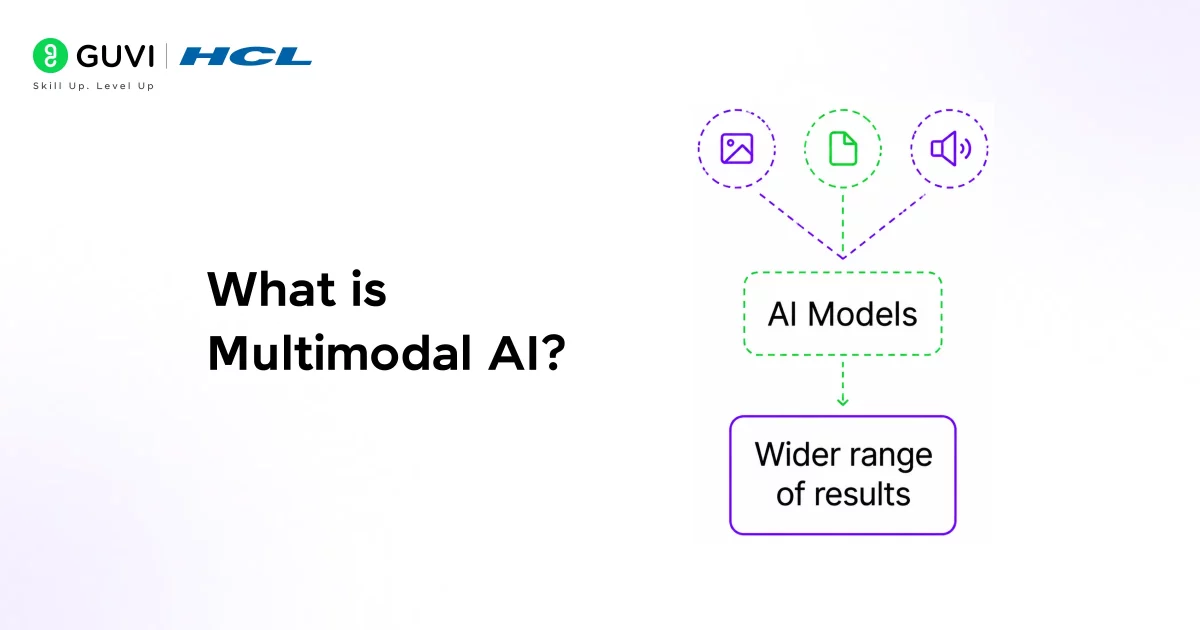
A multimodal AI system can process and understand more than one type of data, text, images, audio, or video, within a single model. Every leading foundation model released since 2023 is either natively multimodal or actively adding modalities, including GPT-4o, Gemini 2.5, Claude 3.7 Sonnet, and Llama 4.
This shift is significant. By 2026, approximately 60% of enterprise applications are built using models that combine two or more modalities. If you’re looking to build a career in AI, understanding the multimodal space is no longer optional, it’s becoming the baseline.
Core Technical Skills You Need
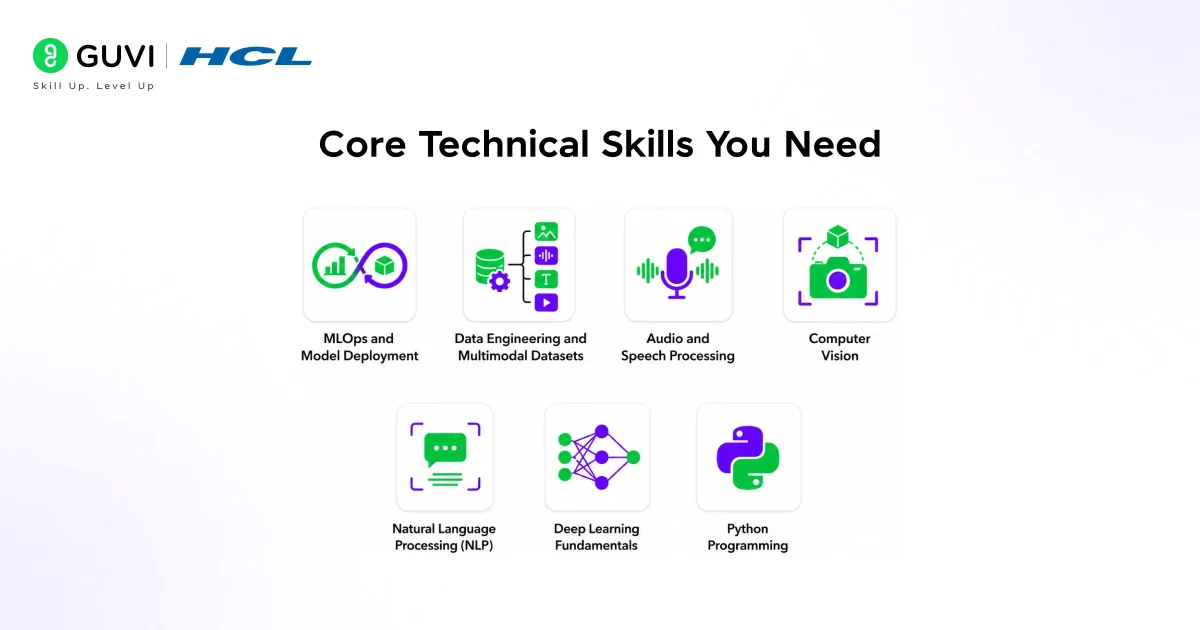
1. Python Programming
Python is the language of AI development, no debate there. Before you even touch a multimodal model, you need to be fluent in Python, specifically in writing clean, production-ready code.
You should be comfortable with:
- Object-oriented programming
- Libraries like NumPy, Pandas, and Matplotlib
- File handling, APIs, and asynchronous code
Strong proficiency in Python, with experience in frameworks like PyTorch and TensorFlow, is listed as a hard requirement in most multimodal AI engineering job descriptions.
2. Deep Learning Fundamentals
Multimodal AI is built on deep learning. Without this foundation, the rest won’t make sense. You need to understand:
- Neural network architectures (CNNs, RNNs, Transformers)
- Backpropagation and gradient descent
- Transfer learning and fine-tuning
Modern deep learning architectures like Transformers can handle multiple types of inputs by design, there are transformer models that take an image encoded by a vision network and text encoded by an NLP network, then fuse the information to find connections.
Pay particular attention to the Transformer architecture. It’s the backbone of almost every modern multimodal model.
3. Natural Language Processing (NLP)
NLP is the text side of the multimodal equation. You need to understand how language models work before you can integrate them with other data types.
Key concepts to focus on:
- Tokenization and embeddings
- Attention mechanisms and self-attention
- Prompt engineering for large language models
- Fine-tuning pre-trained models with LoRA or PEFT
4. Computer Vision
On the visual side, computer vision teaches AI to “see” and interpret images and video. In a multimodal context, computer vision and NLP are meant to work together, not separately.
Traditionally, computer vision, robotics, and NLP developed independently with separate communities. The rise of deep learning helped bridge these fields, opening up multimodal possibilities across language grounding, visual semantics, and interactive agents.
As a multimodal developer, you’ll need to understand:
- Convolutional Neural Networks (CNNs) for image processing
- Object detection and image classification
- Cross-modal attention — how the model connects image features to text
5. Audio and Speech Processing
This is an area many developers overlook. But if you’re building voice assistants, transcription tools, or audio-visual AI, you need to understand speech recognition pipelines.
Core areas include:
- Automatic Speech Recognition (ASR) basics
- Audio feature extraction (spectrograms, MFCCs)
- Text-to-speech (TTS) systems
- How audio is aligned with text transcripts for training
6. Data Engineering and Multimodal Datasets
The quality of multimodal AI is only as good as the data it trains on. This skill is often underestimated.
Multimodal AI training data requires cross-modal alignment, each example must convey consistent meaning across all modalities. For example, images paired with captions, audio recordings with transcripts, or video with synchronized sensor readings.
You need to know how to:
- Build and clean multimodal datasets
- Handle paired data (image-text, audio-transcript)
- Manage data pipelines at scale
7. MLOps and Model Deployment
Building a model is only half the job. Getting it into production is the other half.
When AI moves from pilot to production, governance, monitoring, model drift, bias mitigation, and compliance become critical, organizations must ensure models behave consistently under real-world conditions.
Skills you’ll need here:
- Containerization with Docker and Kubernetes
- API development with FastAPI or Flask
- Model monitoring and performance tracking
- Cloud deployment on AWS, GCP, or Azure
Tools and Frameworks to Learn
You don’t need to learn everything at once. Start with the essentials and expand as you go.
Deep Learning
- PyTorch, preferred for research and flexibility
- TensorFlow, widely used in production
Multimodal Models and APIs
- Hugging Face Transformers, access to pre-trained multimodal models
- OpenAI API, GPT-4o for vision + text tasks
- Google Gemini API, native multimodal support
- CLIP by OpenAI, for image-text alignment
Deployment and Experimentation
- Gradio or Streamlit, for building quick demos
- Weights & Biases, for experiment tracking
- Docker, for packaging and deploying models
CLIP (Contrastive Language-Image Pretraining) by OpenAI learns a joint representation of images and text, essentially teaching the AI that the word “dog” correlates with pictures of dogs. This technique is foundational to how modern multimodal models understand the relationship between what they see and what they read.
Soft Skills That Actually Matter
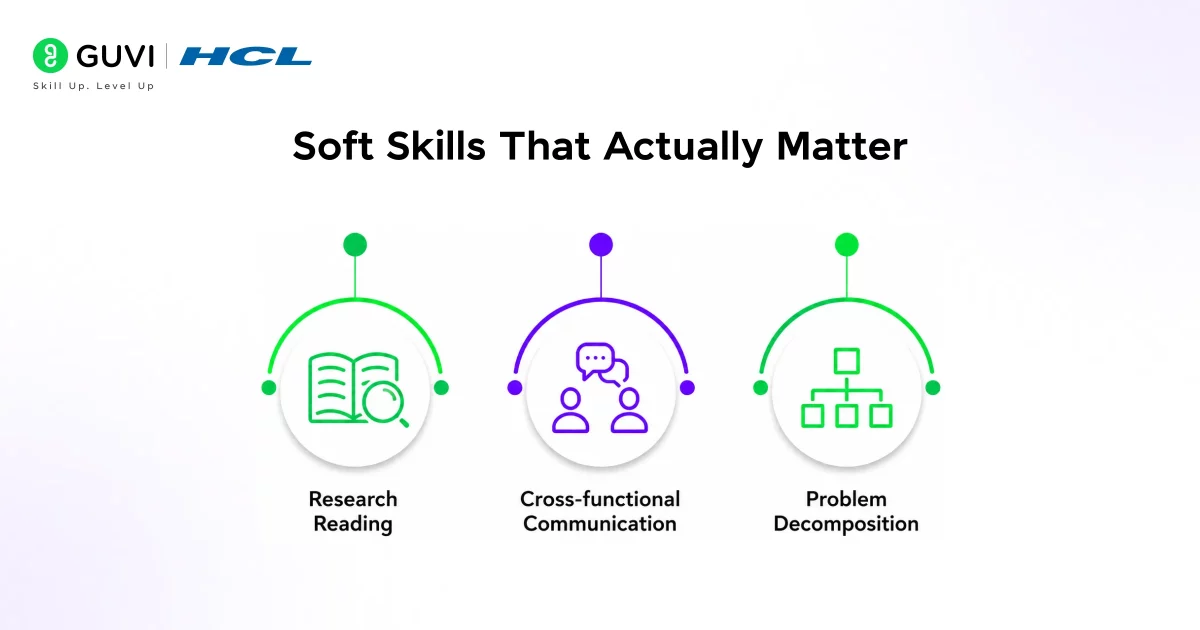
Technical skills get you in the door. But these are the skills that help you grow.
Research Reading
Multimodal AI moves fast. You need to be comfortable reading research papers from arXiv and translating them into practical implementations. The ability to read and implement from research papers and technical specifications is specifically listed in multimodal AI engineering job descriptions.

Cross-functional Communication
You’ll often work alongside product managers, designers, and domain experts. Being able to explain what a model can and can’t do, in plain language, is genuinely valuable.
Problem Decomposition
Multimodal systems have a lot of moving parts. Breaking down a complex problem into modality-specific components, then figuring out how to connect them, is a skill you’ll use every day.
Real-World Applications
Here’s where multimodal AI actually shows up in production:
Healthcare: A diagnostic system processes medical images (CT scans) alongside clinical notes to assist doctors in identifying conditions more accurately than text or imaging alone.
Retail: An e-commerce platform uses image + text search to help customers find products by uploading a photo and describing what they want, combining computer vision with NLP in a single pipeline.
Content Creation: Marketing tools like automated ad generation use multimodal models to analyse product images, generate captions, and suggest layouts, all within one workflow.
Common Mistakes Beginners Make
1. Skipping the fundamentals:
Many beginners jump straight to multimodal models without building a solid base in deep learning or NLP. This creates gaps that are hard to fill later. Start with the single-modality foundations first.
2. Treating modalities as isolated systems:
A common mistake is learning computer vision and NLP separately and never figuring out how to fuse them. Multimodal development is specifically about integration, make that the focus from the start.
3. Ignoring data quality:
Multimodal models are extremely sensitive to poor data alignment. Mismatched image-text pairs or noisy audio transcripts will quietly degrade your model without obvious error messages.
4. Underestimating deployment complexity:
Building a model that works on your laptop is very different from deploying it in production. Learn Docker, API design, and model monitoring early, not as an afterthought.
5. Overlooking ethics and bias:
Multimodal systems can pick up and amplify biases present across text, images, and audio. Build with fairness and transparency in mind from the very beginning.
If you’re serious about learning effective AI prompts and want to apply them in real-world scenarios, don’t miss the chance to enroll in HCL GUVI’s Intel & IITM Pravartak Certified Artificial Intelligence & Machine Learning Course, co-designed by Intel. It covers Python, Machine Learning, Deep Learning, Generative AI, Agentic AI, and MLOps through live online classes, 20+ industry-grade projects, and 1:1 doubt sessions, with placement support from 1000+ hiring partners.
Conclusion
Multimodal AI is quickly becoming the default standard for how AI systems are built. The models that power today’s most advanced products, from medical diagnostics to intelligent assistants, all work across multiple data types.
If you’re serious about a career in AI, building skills in deep learning, NLP, computer vision, and audio processing, and learning how to connect them, puts you ahead of the curve. Start with Python and a solid deep learning foundation, pick up one framework like PyTorch, and begin experimenting with pre-trained multimodal models on Hugging Face. The best way to learn this is by building.
FAQs
1. What is multimodal AI development?
Multimodal AI development involves building AI systems that can process and understand multiple data types simultaneously — such as text, images, audio, and video — within a unified model.
2. What programming language is best for multimodal AI?
Python is the standard language for multimodal AI development. Most frameworks, libraries, and pre-trained models are built around Python, making it essential to learn.
3. Do I need to know computer vision and NLP both?
Yes. Multimodal AI sits at the intersection of these two fields. A solid understanding of both — along with how to fuse them — is core to this role.
4. What is the difference between a unimodal and multimodal AI model?
A unimodal model processes only one type of data (for example, text-only or image-only). A multimodal model processes two or more data types together and learns relationships between them.
5. Which frameworks should I learn for multimodal AI development?
Start with PyTorch and Hugging Face Transformers. From there, explore the OpenAI API, Google Gemini API, and CLIP for image-text tasks.
6. Is fine-tuning required to work with multimodal models?
Not always. Many projects use pre-trained multimodal models via APIs. But understanding fine-tuning techniques like LoRA and PEFT gives you a significant advantage for domain-specific applications.
7. How long does it take to learn multimodal AI development?
With a consistent learning plan, most learners with a basic programming background can reach a working level in 9 to 12 months — starting from Python and deep learning basics before moving into multimodal-specific skills.
8. What industries are hiring multimodal AI developers?
Healthcare, retail, media and entertainment, autonomous vehicles, and enterprise SaaS companies are among the biggest employers of multimodal AI engineers in 2026.
Success Stories

About the Author
Lukesh S
A professional content writer who has experience in freelancing and now working as a Technical Content Writer at HCL GUVI having sound knowledge in Blog Writing and Creative Writing!
View all posts by Lukesh S
Connect with me @








Did you enjoy this article?