


Career Articles
Treasury Manager to Data Analytics: Skills and Career Growth
Tax Professional to Data Analyst: Is Tax Analytics a Good Niche?
From Investment Research to Data Analytics: How to Bridge the Technical Skills Gap
How Banking and Financial Services Professionals Can Move into Data Analytics


Get In Touch For Details! Request More Information
How to Communicate Technical Concepts to Non-Tech Stakeholders (2026 Guide)
Aug 24, 2026 4 Min Read 877 Views
(Last Updated)
You just finished explaining why the database migration will take two weeks and the business head is staring at you blankly. You say “indexing” and they nod, but you can tell they have no idea what that means. This is one of the most common and most costly communication failures in tech teams. The ability to communicate technical concepts to non-tech stakeholders is not a soft skill that sits at the bottom of a job description. In 2026, it is a core career skill that separates developers who stay individual contributors from those who move into leadership. This guide gives you a practical, no-jargon system for doing it well.
Table of contents
- TL;DR Summary
- Why This Skill Matters More Than Most Developers Think
- Know Your Audience
- How to Communicate Technical Concepts to Non-Tech Stakeholders
- Use Outcomes, Not Mechanisms
- Replace Jargon With Everyday Language
- Use Analogies to Make Abstract Concepts Concrete
- Use Visuals Whenever Possible
- Frameworks That Actually Work
- The "So What?" Test
- The Three-Layer Explanation
- Confirm Understanding Before Moving On
- What to Do When They Still Do Not Get It
- 💡 Did You Know?
- Common Mistakes to Avoid
- Conclusion
- FAQs
- Why is it important to communicate technical concepts to non-tech stakeholders?
- How do I explain technical concepts without jargon?
- What is the best framework to communicate technical concepts to non-tech stakeholders?
- How do I handle technical questions in a meeting with non-tech attendees?
- What should I do when a non-tech stakeholder still does not understand?
TL;DR Summary
- Learning to communicate technical concepts to non-tech stakeholders is one of the most career-defining skills a developer can build.
- The core principle: translate outcomes, not mechanisms. Non-tech stakeholders care what something does for them, not how it works.
- Use analogies, visuals, and plain language. Avoid jargon even when it feels obvious to you.
- Prepare differently for different audiences: a product manager needs different framing than a CFO.
- Developers who communicate technical concepts to non-tech audiences well get promoted faster, lead projects earlier, and build more trust with business teams.
Why This Skill Matters More Than Most Developers Think
Most developers underestimate how much their career depends on how well they can communicate technical concepts to non-tech people.
- Decisions get made by non-technical people. Budget approvals, timelines, and feature priorities are decided by managers and executives who rarely understand technical detail. If you cannot explain the stakes clearly, you lose the argument.
- Miscommunication costs money. A developer who cannot explain that a feature requires major architectural work ends up over-promising and damaging trust.
- It accelerates your career. Developers who get promoted to lead or staff roles are almost always the ones who can represent their team clearly to business stakeholders.
Know Your Audience
The first step to communicate technical concepts to non-tech stakeholders is understanding what they already know and what they actually care about.
| Stakeholder | What They Know | What They Care About |
| Product Manager | Basic product logic, no deep technical | Timeline, scope, user impact |
| CFO or Finance lead | Budgets, cost, ROI | Cost, risk, business continuity |
| CEO or Founder | High-level business and strategy | Revenue impact, competitive risk |
| Marketing Manager | Campaigns, funnels, content | Speed to ship, customer-facing impact |
| Legal or Compliance | Policy, regulation | Risk, liability, data privacy |
Tailoring how you communicate technical concepts to non-tech stakeholders by audience is not dumbing it down. It is professional communication.
How to Communicate Technical Concepts to Non-Tech Stakeholders
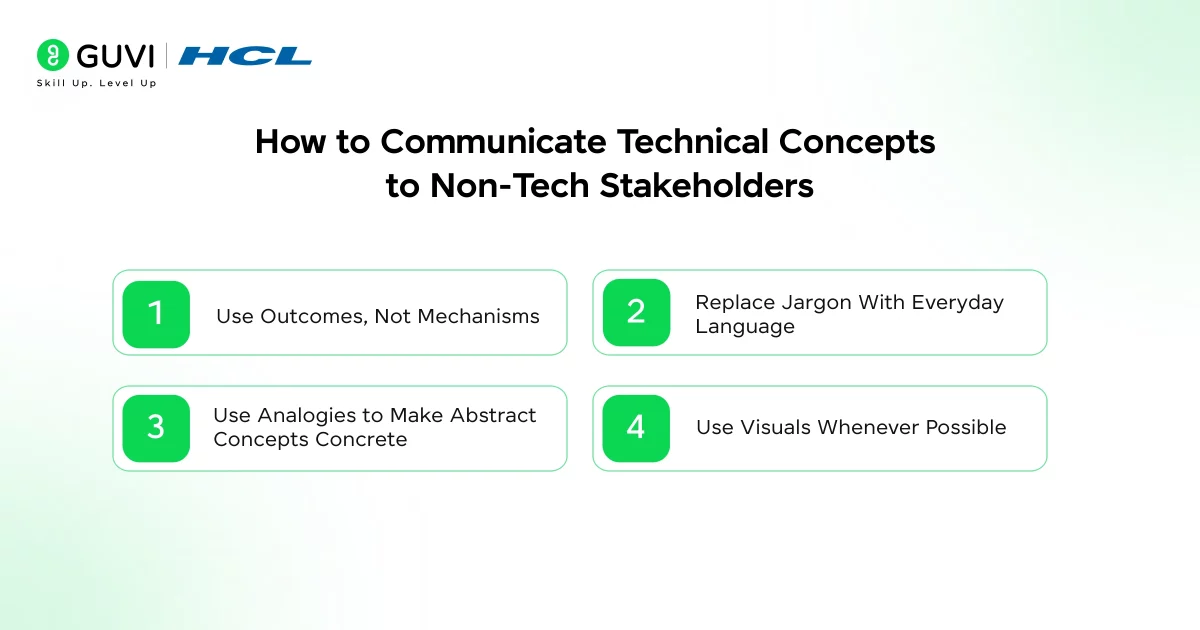
1. Use Outcomes, Not Mechanisms
This is the single biggest shift. When you communicate technical concepts to non-tech stakeholders, lead with what the thing does, not how it works.
Wrong: “We need to refactor the authentication service because the current implementation does not support horizontal scaling.”
Right: “Our login system will start failing for users during peak hours unless we upgrade it this sprint. Users will get locked out and we will see a spike in support tickets.”
Same information. Completely different impact.
2. Replace Jargon With Everyday Language
Every piece of technical jargon you use forces the listener to either ask a question or pretend they understood. Most will pretend. That is where miscommunication takes root.
Quick replacements that work:
- “Latency” → “how long it takes to respond”
- “Refactor” → “reorganise the code so it is easier to work with going forward”
- “Tech debt” → “shortcuts we took earlier that are now slowing us down”
- “API” → “the connector between two systems”
- “Downtime” → “time when the product is unavailable to users”
3. Use Analogies to Make Abstract Concepts Concrete
Analogies are the fastest way to communicate technical concepts to non-tech audiences because they attach new information to something the listener already understands.
- A database index is like a book’s table of contents: instead of reading every page, you jump directly to what you need.
- Microservices are like a food court rather than a single restaurant kitchen — if one stall has a problem, the others keep running.
Prepare two or three standard analogies for the technical concepts you explain most often. You will use them repeatedly.
4. Use Visuals Whenever Possible
A diagram converts a five-minute verbal explanation into a thirty-second scan. Tools like Excalidraw or FigJam work well. Bring one visual per complex topic to meetings — it gives people something to react to rather than trying to hold a mental model they have never worked with.
Explore: Using ChatGPT to Prepare for a Meeting
Frameworks That Actually Work
1. The “So What?” Test
After every technical sentence you plan to say, ask yourself “so what does this mean for the business?” If you cannot answer that, cut the technical detail or replace it with the business implication.
2. The Three-Layer Explanation
When you communicate technical concepts to non-tech stakeholders on complex topics, use this structure:
- The problem in business terms — what breaks or slows down if not addressed
- The solution in plain language — what you are going to do, without technical terms
- What you need from them — a decision, a budget, or simply awareness
Most non-tech stakeholders only need layers one and three.

3. Confirm Understanding Before Moving On
“Does that match what you expected?” takes ten seconds and prevents a thirty-minute misunderstanding in the next meeting. Nodding is not the same as understanding.
What to Do When They Still Do Not Get It
Sometimes you will communicate technical concepts to non-tech stakeholders as clearly as possible and still lose them.
- Switch your analogy. If the filing cabinet did not land, try a GPS that recalculates when a road is blocked.
- Ask what they heard: “Just to check I explained that clearly, how are you thinking about it?” This reveals exactly where the gap is.
- Follow up in writing. A short bullet-pointed email after the meeting is often clearer than a live explanation under time pressure.
The developers who lead in 2026 are not just technically strong. They communicate clearly, influence decisions, and build trust with the entire business team. If you want to build the technical foundation that gives you something worth communicating, HCL GUVI’s Full Stack Development Course and AI Software Development Course are both IITM Pravartak certified and built for the next generation of developer-leaders.
💡 Did You Know?
- A McKinsey survey of executives found that poor communication was cited as the number one factor in project failures, ahead of budget overruns and scope changes. Developers who can clearly explain technical concepts to non-technical stakeholders help teams make faster and more informed decisions. Strong communication skills directly reduce project failure risk, making them one of the highest-ROI professional skills a developer can develop in 2026.
Common Mistakes to Avoid
- Over-explaining the how when they asked about the what. Non-tech stakeholders almost never need the full technical mechanism. They need the outcome, the timeline, and the risk. When you over-explain, you lose the room and often get dismissed as someone who cannot see the big picture.
- Using technical terms and immediately defining them in the same breath. “We need to reduce latency, which is response time…” makes people feel talked down to. Just say “response time” from the start.
- Treating questions as interruptions. When a non-tech stakeholder asks a question mid-explanation, that is engagement, not disruption. Pause, answer it directly, and use it as a signal to adjust the level of your explanation going forward.
Conclusion
The ability to communicate technical concepts to non-tech stakeholders is not something you either have or you do not. It is a skill you build deliberately with the right frameworks, the right preparation, and a genuine intention to be understood rather than to sound impressive. Lead with outcomes. Replace jargon with plain language. Use analogies to bridge the gap. Bring one visual per complex topic. And check for understanding before assuming everyone is on the same page. Do these things consistently and you will become the developer that both engineering and business teams trust completely.
FAQs
1. Why is it important to communicate technical concepts to non-tech stakeholders?
Decisions about budgets, timelines, and priorities are made by non-technical people. If you cannot communicate technical concepts to non-tech stakeholders clearly, you lose influence over decisions that directly affect your work.
2. How do I explain technical concepts without jargon?
Focus on what something does in business terms, not how it works. Replace “latency” with “response time” and “API” with “connector between two systems.”
3. What is the best framework to communicate technical concepts to non-tech stakeholders?
The three-layer approach: business problem first, plain-language solution second, what you need from them third. Most stakeholders only need layers one and three.
4. How do I handle technical questions in a meeting with non-tech attendees?
Lead with business impact, prepare one visual per complex topic, and check for understanding before moving on with “does that match what you expected?”
5. What should I do when a non-tech stakeholder still does not understand?
Switch your analogy, ask them to describe what they heard, or send a short written summary after the meeting. Never repeat the same explanation louder.
Success Stories

About the Author
Jebasta
I translate the language of data into stories that anyone can understand. As a writer with a data science background, I simplify analytics, AI, and decision-making so beginners and enthusiasts can confidently explore the world of data.
View all posts by Jebasta
Connect with me @















Did you enjoy this article?