


Career Articles
TensorFlow Developer Certificate: Complete Prep Guide
Wipro Elite NTH Eligibility Criteria 2026: CGPA, Branch & Backlog Rules Explained
What is Wipro Elite NTH? Complete Overview for 2026 Graduates
How to Get a Tech Job Abroad From India: Visa, Platforms & Timelines


Get In Touch For Details! Request More Information

Freelancer vs Full-Time Employee: Which Is Right for You?
Aug 31, 2026 4 Min Read 355 Views
(Last Updated)
At some point in every developer’s career, the question comes up: should I stay in a full-time job or go freelance? The freelancer vs full-time employee debate does not have a single right answer, but it does have a right answer for you specifically, based on where you are in life, what you want, and what kind of work energises you. This guide breaks down both options honestly so you can make a decision you will not regret six months from now.
Table of contents
- TL;DR Summary
- Freelancer vs Full-Time Employee: The Core Difference
- Full-Time Employment: Pros and Cons
- Freelancing: Pros and Cons
- Freelancer vs Full-Time Employee: Money Comparison
- Which One Suits Your Personality?
- Can You Do Both? The Hybrid Path
- 💡 Did You Know?
- Common Mistakes to Avoid
- Conclusion
- FAQs
- Is freelancing better than full-time employment for developers?
- How much more can a freelancer earn than a full-time employee?
- When should I switch from full-time to freelancing?
- Can I do both freelancing and a full-time job at the same time?
- What is the biggest financial risk of freelancing over full-time employment?
- Is the freelancer vs full-time employee decision permanent?
TL;DR Summary
- The Freelancer vs Full-Time Employee debate comes down to what you value most: freedom or stability.
- Full-time jobs offer fixed salary, PF, health benefits, and a clear career ladder.
- Freelancing offers flexibility, higher earning ceiling, and the ability to choose your clients and projects.
- Neither is universally better. The right choice depends on your financial situation, risk tolerance, and career stage.
- Many developers start full-time, build skills, then freelance on the side before going fully independent.
Freelancer vs Full-Time Employee: The Core Difference
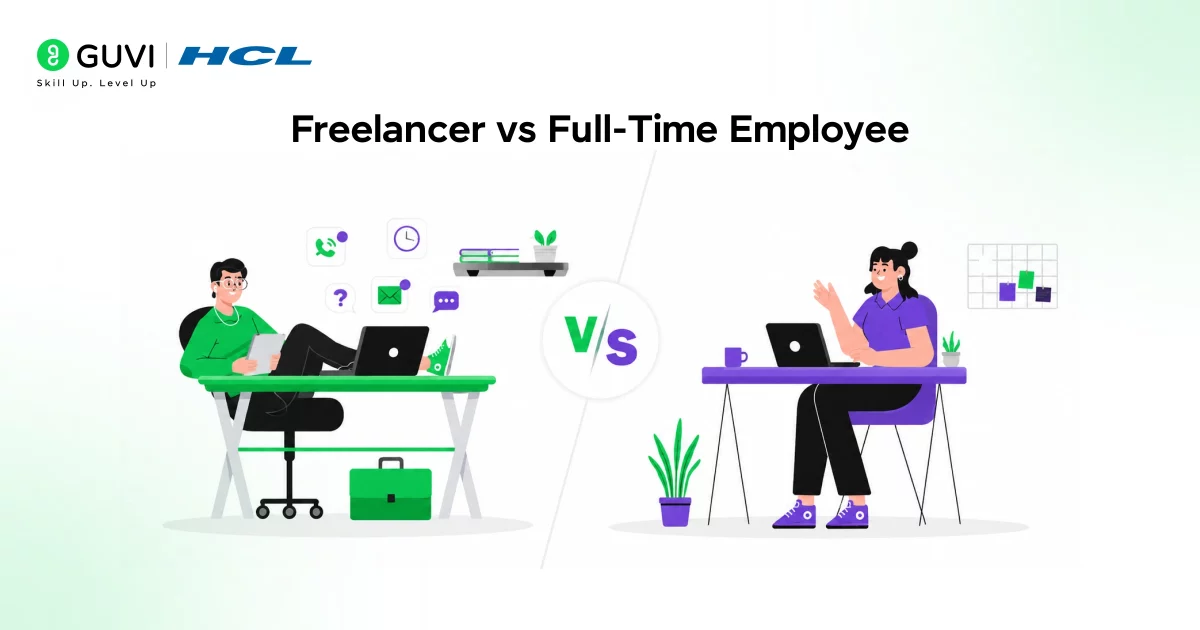
A full-time employee trades time and skills for a fixed monthly salary, benefits, and job security. A freelancer trades time and skills for project-based income, complete schedule control, and the ability to work with multiple clients simultaneously.
That sounds simple, but the implications of each choice ripple through your finances, your daily routine, your mental health, and your career trajectory in ways most people do not think through before switching.
Full-Time Employment: Pros and Cons
Full-time jobs are still the dominant path for most developers in India, and for good reason.
What you get: Fixed monthly salary, employer PF and ESI contributions, structured mentorship, a clear designation ladder (Junior → Senior → Lead), and paid leave you do not have to negotiate for.
What you give up: Freedom to choose your projects or hours, salary growth capped at 6 to 10 percent annually, and the fact that you are building someone else’s product.
Full-time makes most sense when you are early in your career, have significant financial commitments, or genuinely thrive with structure and clear expectations.
Freelancing: Pros and Cons
Freelancing gives you more control than almost any other working arrangement, but that control comes with real responsibility.
What you get: You set your rates, choose your clients, work when you want, and there is no ceiling on your income. You also build a portfolio and personal brand that belong entirely to you.
What you give up: No fixed monthly income, no employer PF or paid leave, client acquisition takes real time and energy, and tax filing is more complex.
Freelancing makes most sense when you already have marketable skills, 3 to 6 months of financial runway saved, and a specific reason why flexibility matters to you right now.
Freelancer vs Full-Time Employee: Money Comparison
This is the part most people get wrong in the freelancer vs full-time employee debate. They compare the headline freelance rate to a full-time salary without accounting for what each actually costs.
| Factor | Full-Time Employee | Freelancer |
| Monthly income | Fixed, predictable | Variable, project-dependent |
| Income taxes | Employer deducts TDS | You file ITR-4, deduct expenses |
| PF contribution | Employer contributes 12% | You contribute 100% yourself |
| Health insurance | Often employer-provided | You pay out of pocket |
| Paid leave | 12 to 24 days per year | No paid leave at all |
| Equipment and tools | Often employer-provided | You pay for everything |
| Income ceiling | Capped by band and appraisal | Uncapped, grows with reputation |
A freelancer earning ₹1,20,000 per month is not earning more than a full-time employee on ₹80,000 after accounting for the above. The real comparison requires factoring in all hidden costs of going independent.
That said, a senior freelancer in a high-demand niche earning ₹2,50,000 per month is genuinely earning far more than most equivalent full-time roles, especially at service companies.
Which One Suits Your Personality?

The freelancer vs full-time employee decision is not just financial. Your working style matters as much as the numbers.
You are better suited for full-time if you like clear structure, find client communication draining, want to grow deep within one product, or need social connection at work to stay motivated.
You are better suited for freelancing if you are self-motivated, enjoy variety, actively like selling and managing client relationships, or want to build something that feels like your own business.
One honest signal: imagine a slow month with no guaranteed income. If that thought paralyses you, full-time is probably right for now. If it motivates you to hustle, freelancing might be your natural environment.
Can You Do Both? The Hybrid Path
The freelancer vs full-time employee choice does not have to be permanent or binary. Many of the most successful independent developers in India started full-time, built skills over 2 to 3 years, took on one or two freelance projects on evenings and weekends, validated that clients would pay them, and then made the switch with real financial evidence instead of hope.

The hybrid path lowers your risk significantly. You keep your salary while testing whether you can actually find clients, manage projects, and earn enough to replace your income before you quit.
If you are considering freelancing, try earning at least 50 percent of your current salary from freelance projects before you hand in your resignation.
Whether you choose freelancing or a full-time role, the foundation is always the same: genuinely strong skills. HCL GUVI’s Full Stack Development Course and AI Software Development Course are both IITM Pravartak certified and designed to build the portfolio depth that opens doors in both paths.
💡 Did You Know?
- According to a Nasscom report, India’s freelance workforce is growing at 24% annually, making it one of the fastest-growing segments of professional work in the country. Freelancing has evolved from a side hustle into a viable long-term career path for skilled professionals across technology, design, and content domains. The freelancer vs full-time employee debate is becoming increasingly relevant as more developers choose freelancing for its flexibility, global opportunities, and income potential.
Common Mistakes to Avoid
- Going freelance before building enough skill. Freelancing amplifies whatever skills you already have. If those skills are weak, no amount of hustle closes the gap. Spend at least 1 to 2 years in a full-time role first if you are early in your career.
- Staying full-time purely out of fear. Some developers stay in jobs they have outgrown because freelancing feels too risky. If your skills are strong, you have savings, and you have received freelance interest already, fear is probably the only thing holding you back.
- Thinking the freelancer vs full-time employee choice is permanent. It is not. Plenty of developers have gone freelance, returned to full-time, and gone independent again. Your career is not a one-way door.
Conclusion
The freelancer vs full-time employee question is really a question about what kind of life you want to build. Full-time employment is not safer forever — it just feels safer because the income is visible. Freelancing is not riskier forever — the risk drops sharply as your reputation and client base grow. What matters is being honest about where you are right now, what you can afford to risk, and what kind of work actually makes you want to show up every day. Start there and the rest follows.
FAQs
1. Is freelancing better than full-time employment for developers?
Neither is universally better in the freelancer vs full-time employee comparison. Full-time offers stability and growth structure. Freelancing offers flexibility and a higher earning ceiling. The right choice depends on your skills, savings, and personality.
2. How much more can a freelancer earn than a full-time employee?
Experienced freelancers in high-demand niches earn 2 to 4 times the equivalent full-time salary. However, after self-paid PF, insurance, and slow months, the real difference is often smaller than the headline numbers suggest.
3. When should I switch from full-time to freelancing?
When you have 3 to 6 months of savings, at least two paying freelance clients already, and skills strong enough that multiple companies would want to hire you.
4. Can I do both freelancing and a full-time job at the same time?
Yes, and this is the recommended starting point. Check your employment contract for non-compete clauses before taking on clients in the same domain as your employer.
5. What is the biggest financial risk of freelancing over full-time employment?
Inconsistent income in the first 6 to 12 months. Without a financial runway, that period forces bad decisions like undercharging or taking on any client regardless of fit.
6. Is the freelancer vs full-time employee decision permanent?
No. Many developers have switched directions more than once. Freelance, return to full-time, go independent again. Your career is not a one-way door.
Success Stories

About the Author
Jebasta
I translate the language of data into stories that anyone can understand. As a writer with a data science background, I simplify analytics, AI, and decision-making so beginners and enthusiasts can confidently explore the world of data.
View all posts by Jebasta
Connect with me @









Did you enjoy this article?