


Career Articles
Accountant vs Data Analyst Salary in India After Switching Careers - Best Guide
Finance Managers: Could Data Science Be Your Next Career Move?
Insurance Claims Executive to Data Analyst: Is It a Good Switch?
Banking Executive (Loans, KYC) to Data Analyst: Skills and Career Path


Get In Touch For Details! Request More Information

Top Python Developer Roles and Responsibilities: Everything You Should Know
Jun 24, 2026 4 Min Read 6739 Views
(Last Updated)
Are you trying to figure out what Python developers actually do day-to-day, beyond just “writing code”?
Python has grown from a simple scripting tool in the early 90s to one of the most versatile languages in the tech world. Today, it powers Instagram’s backend, Spotify’s recommendation engine, and countless AI systems across industries.
But what does that mean for you as someone exploring a Python career? The role has expanded dramatically. Python developer roles and responsibilities today are expected to handle everything from building APIs to training machine learning models.
In this blog, we break down the exact roles and responsibilities of a Python developer in 2026, so you know what to expect and what to prepare for.
Table of contents
- TL;DR Summary
- Python Developer Roles and Responsibilities: Then vs Now
- Python Developer Roles and Responsibilities: An Analysis
- Full-Stack Development with Python
- Data Science & Machine Learning with Python
- Automation & Scripting
- Managing System Security and Scalability
- API Development & Integration
- Python’s Versatility in the Era of AI, Cloud, and Automation
- Skills Every Python Developer Needs in 2026
- Conclusion
- FAQs
- What are the main roles of a Python developer?
- What skills does a Python developer need in 2026?
- How long does it take to become a Python developer?
- Is Python good for AI and machine learning?
- What tools do Python developers use daily?
TL;DR Summary
- A Python developer writes, tests, and maintains code using Python across different domains.
- Key roles include full-stack development, data science, automation, API development, and system security.
- Core tools every Python developer uses: Django/Flask, Pandas, NumPy, FastAPI, Git, and Docker.
- Python is now a primary language for AI, ML, and cloud-based applications.
- In 2026, Python consistently ranks among the top 3 most-used programming languages globally.
- Learning Python opens doors to high-paying roles in fintech, healthcare, e-commerce, and more.
Python Developer Roles and Responsibilities: Then vs Now
Python developers are mainly used to work on backend scripting, small utilities, basic server-side tasks, and simple automation. The scope was narrow and fairly predictable.
Python development has come a long way in a short time.
Modern Python developers work across multiple domains, from building full-stack web apps to deploying machine learning models in production. Companies like Netflix, Uber, and Dropbox rely heavily on Python for both their core infrastructure and data systems.
As AI and cloud adoption accelerate, the expectations for Python professionals continue to rise. If you’re entering this field now, you’re stepping into a role with far more depth and far more opportunity than ever before.
Python Developer Roles and Responsibilities: An Analysis
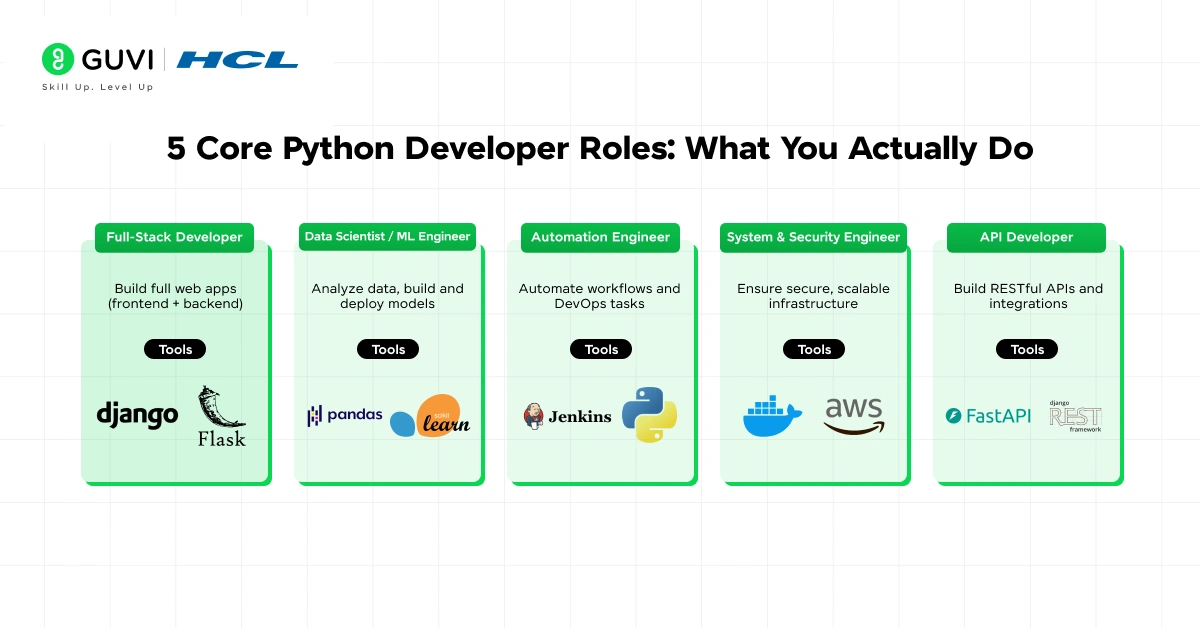
Python’s real strength is its versatility. Depending on the team and product, a Python developer’s day-to-day responsibilities can look very different. Let’s walk through the most common roles.
Let’s break down the key Python developer roles and the responsibilities that come with each.
1. Full-Stack Development with Python
Full-stack Python development is about owning the entire application, from the user interface to the database.
Modern full-stack Python developers are expected to:
- Build and manage both front-end and back-end components
- Design and maintain RESTful APIs
- Work with databases (e.g., PostgreSQL, MongoDB)
- Ensure application performance, scalability, and security
- Collaborate with UI/UX teams to deliver seamless user experiences
This role is common among mid-level to senior engineers who want end-to-end ownership of web applications.
Django, Python’s most popular web framework, was originally built to power a newsroom CMS. Today it runs platforms used by millions of users daily, including Pinterest and Disqus.
2. Data Science & Machine Learning with Python
This is one of the most in-demand applications of Python right now. Python has become the de facto language of data science, largely because of its clean syntax and powerful libraries.
Python developers in this space typically:
- Clean, analyze, and visualize datasets
- Build and train machine learning models
- Deploy predictive systems into production
- Use Jupyter Notebooks for prototyping
- Collaborate with data engineers and business analysts to derive insights
These roles are critical in industries like fintech, healthcare, and e-commerce, where data-driven decisions give companies a competitive edge.
This is one of the most in-demand applications of Python right now. Python has become the de facto language of data science, largely because of its clean syntax and powerful libraries.
Python data science developers typically:
- Clean, process, and analyze large datasets
- Build and train machine learning models using scikit-learn, TensorFlow, or PyTorch
- Deploy predictive systems into production environments
- Use Jupyter Notebooks for research and prototyping
- Work with data engineers and business teams to turn insights into action
Industries like fintech, healthcare, and e-commerce rely on these roles to make smarter, faster decisions.
3. Automation & Scripting
One of Python’s biggest strengths lies in automating repetitive tasks and streamlining workflows. Whether it’s a script to rename files in bulk or a robust DevOps pipeline, Python makes automation simple and powerful.
Key responsibilities for Python automation roles include:
- Writing scripts to automate file handling, data entry, and system tasks
- Creating cron jobs and scheduled scripts
- Integrating Python with tools like Jenkins, GitHub Actions, and Docker
- Supporting CI/CD pipelines in DevOps environments
Automation engineers and DevOps practitioners often rely on Python to eliminate manual effort, reduce human error, and improve operational efficiency.
Also Read: Top Python Terms for Beginners
4. Managing System Security and Scalability
As applications grow more complex and user demands increase, Python developers are expected to design systems that are both secure and scalable. This isn’t just about writing efficient code; it involves building resilient architectures that can withstand traffic spikes and security threats.

Key responsibilities include:
- Implementing encryption, authentication, and secure access controls
- Identifying and patching vulnerabilities in Python-based applications
- Designing scalable infrastructure to handle high traffic and data loads
- Monitoring system performance and optimizing for speed and uptime
- Collaborating with DevOps teams to ensure secure deployment pipelines
These tasks typically fall under senior Python developers or DevOps engineers who specialize in high-availability systems and enterprise-grade security.
5. API Development & Integration
APIs (Application Programming Interfaces) are the glue that connects modern software systems, and Python developers are at the heart of building them. With frameworks like Flask, FastAPI, and Django REST Framework, developers can quickly design RESTful APIs that power mobile apps, web platforms, and backend services.
Python API developers are responsible for:
- Designing and developing scalable RESTful APIs
- Managing third-party API integrations (e.g., payment gateways, analytics tools)
- Ensuring secure and efficient data transmission between systems
- Writing clear API documentation for frontend and mobile teams
- Testing endpoints and optimizing API performance
Well-architected APIs enable seamless communication between software components and are critical for modern, modular tech stacks. Python’s syntax and toolkits make it one of the best choices for API development in both startups and large-scale enterprises.
Python’s Versatility in the Era of AI, Cloud, and Automation
AI and machine learning have exploded in the last few years. Python is the dominant language in this space, with libraries like TensorFlow, Keras, and Hugging Face Transformers all built for Python-first workflows.
Cloud adoption is another major driver. Python integrates seamlessly with AWS, Google Cloud, and Azure, making it a go-to for cloud automation, serverless functions, and infrastructure management.
The developers who will stand out in 2026 and beyond are those who can bridge multiple domains, building AI-powered features, automating deployment pipelines, and designing scalable cloud architectures. Python sits at the center of all three.
Looking ahead, the most sought-after Python professionals will be the ones who can:
- Build AI-driven applications
- Automate complex business workflows
- Develop scalable cloud-based systems using tools like AWS, GCP, and Azure
- Stay adaptable in a fast-changing tech environment
For developers ready to evolve with the language, Python isn’t just relevant, it’s future-proof.
Skills Every Python Developer Needs in 2026
No matter which Python role you pursue, certain skills are non-negotiable. Here’s a quick breakdown:
| Skill Area | Tools/Technologies |
|---|---|
| Web Frameworks | Django, Flask, FastAPI |
| Data & ML | Pandas, NumPy, scikit-learn, TensorFlow |
| Databases | PostgreSQL, MySQL, MongoDB |
| DevOps & Automation | Docker, GitHub Actions, Jenkins |
| Version Control | Git |
| Cloud Platforms | AWS, GCP, Azure |
| Testing | PyTest, Unittest |
If you’re ready to go from understanding to doing, HCL GUVI’s Self-Paced Python Course gives you hands-on projects and real-world applications to build that confidence at your own pace!
Conclusion
Python isn’t just popular, it’s foundational to how modern software is built.
Whether you’re drawn to web development, data science, automation, or AI, Python gives you the tools to get there. The role of a Python developer continues to evolve, and those who keep up with the language’s expanding ecosystem will always be in demand.
Start building today, the Python ecosystem is only getting bigger.
FAQs
What are the main roles of a Python developer?
Python developers work across full-stack web development, data science, machine learning, automation, API development, and DevOps. The specific responsibilities depend on the team and domain.
What skills does a Python developer need in 2026?
Core skills include proficiency in Python, knowledge of frameworks like Django or Flask, familiarity with data tools like Pandas and NumPy, version control with Git, and exposure to cloud platforms and Docker.
How long does it take to become a Python developer?
Most learners can grasp Python basics within a few weeks. Landing a junior role typically takes 4–8 months of consistent practice, including building real projects.
Is Python good for AI and machine learning?
Yes. Python is the dominant language for AI and ML, thanks to libraries like TensorFlow, PyTorch, and scikit-learn. Most AI research and production systems today are built using Python.
What tools do Python developers use daily?
Common tools include VS Code or PyCharm as IDEs, Git for version control, Docker for containerization, Jupyter Notebooks for data work, and frameworks like Django or FastAPI depending on the role.
Success Stories











Did you enjoy this article?