


Python Articles
Go vs Python for Forward Deployed Engineering Workloads
Python for Forward Deployed Engineers: What You Actually Need to Know
Freelancing as a Python Developer: Getting Your First Client


Get In Touch For Details! Request More Information

Building a Real-Time Stock Price Predictor with Python & LSTM
Aug 17, 2026 4 Min Read 692 Views
(Last Updated)
Table of contents
- TL;DR
- Introduction
- What Is a Stock Price Predictor?
- Why Use LSTM for Stock Prediction?
- Benefits of LSTM for Stock Forecasting
- How a Real-Time Stock Price Predictor Works
- Data Collection
- Data Preprocessing
- Feature Engineering
- Model Training
- Real-Time Prediction
- Building the Project Step by Step
- Step 1: Install Required Libraries
- Step 2: Import the Libraries
- Step 3: Download Historical Stock Data
- Step 4: Prepare and Scale the Data
- Step 5: Create Training Sequences
- Step 6: Reshape the Dataset
- Step 7: Build the LSTM Model
- Step 8: Train the Model
- Step 9: Generate Predictions
- Real-World Example: Apple Stock Prediction
- Common Challenges and Limitations
- Market Volatility
- Overfitting
- Limited Context
- Data Quality Issues
- Black Swan Events
- Best Practices for Better Predictions
- Conclusion
- FAQs
- Can LSTM accurately predict stock prices?
- Why is LSTM used for stock price prediction?
- What data is required for stock price forecasting?
- Is stock prediction a machine learning or deep learning problem?
- Is LSTM better than ARIMA for stock prediction?
- Can LSTM predict cryptocurrency prices?
- What are the biggest challenges in building a stock price predictor?
TL;DR
- A stock price predictor uses historical market data and machine learning techniques to forecast future stock prices.
- LSTM (Long Short-Term Memory) networks are widely used for stock prediction because they can learn long-term patterns in sequential data.
- Python libraries such as TensorFlow, Pandas, and yfinance make it easier to build stock forecasting models.
- A real-time stock price predictor typically includes data collection, preprocessing, model training, and prediction generation.
- While LSTM models can identify trends and patterns, stock market forecasts should be treated as estimates rather than guarantees.
Introduction
Stock prices constantly fluctuate based on market trends, company performance, and investor sentiment. While no model can predict the market with complete accuracy, LSTM networks can identify patterns in historical data to generate forecasts. To build the Python, data analysis, and machine learning skills needed for projects like this, learners can explore HCL GUVI’s Data Science Course and gain hands-on experience with real-world AI and forecasting applications.
What Is a Stock Price Predictor?
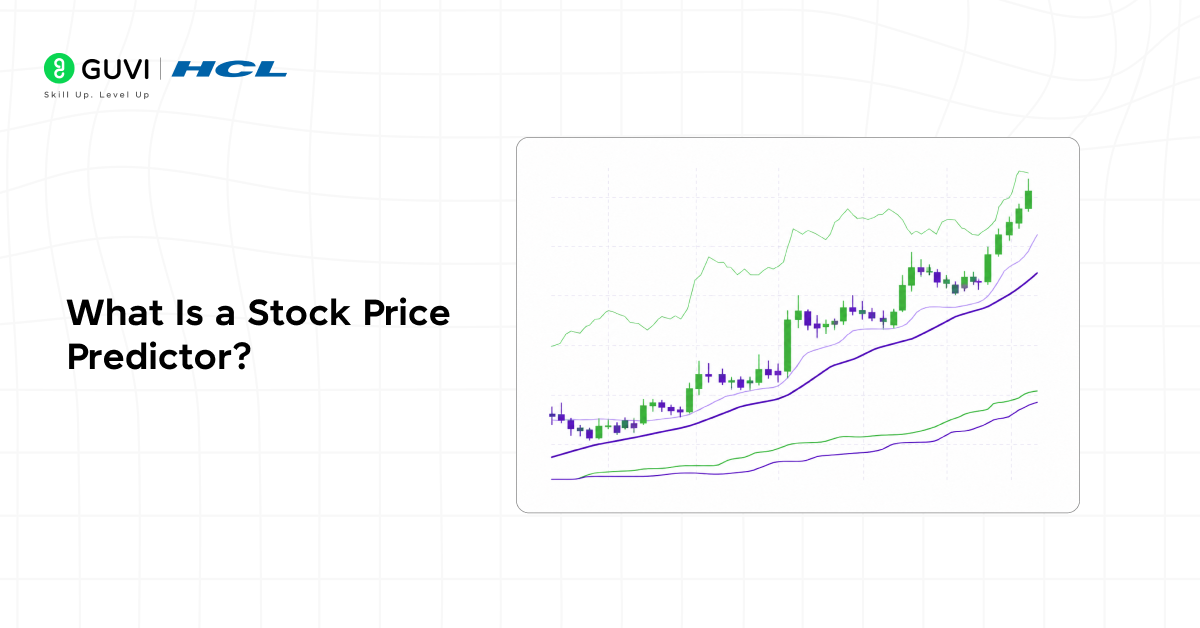
A stock price predictor is a system that analyzes historical stock market data and uses algorithms to estimate future price movements.
Traditional forecasting methods often rely on technical indicators and statistical models. Modern AI-powered systems use machine learning and deep learning algorithms to uncover hidden relationships within large datasets.
Stock prediction systems are commonly used for:
- Market trend analysis
- Investment research
- Portfolio management
- Risk assessment
- Algorithmic trading
Although these systems cannot eliminate uncertainty, they can provide valuable insights that support data-driven decision-making.
Why Use LSTM for Stock Prediction?
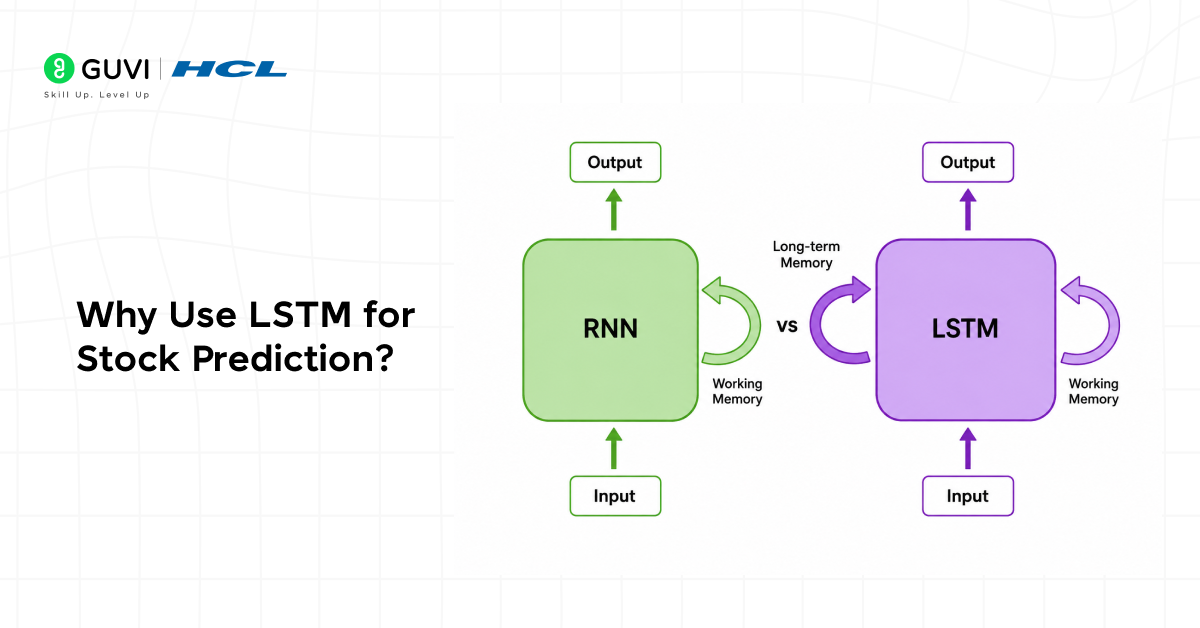
Stock prices are sequential. Today’s price is influenced by previous days, weeks, and sometimes months of market activity.
This makes stock prediction a time-series forecasting problem.
LSTM, or Long Short-Term Memory, is a specialized type of Recurrent Neural Network (RNN) designed to learn patterns from sequential data.
Unlike traditional neural networks that process data independently, LSTMs can remember important information from previous time steps and use it when making predictions.
Benefits of LSTM for Stock Forecasting
- Captures long-term market trends
- Handles sequential data effectively
- Reduces the vanishing gradient problem
- Learns complex patterns automatically
- Performs well on time-series datasets
For example, if a stock has shown a consistent upward trend over several weeks, an LSTM model can learn and incorporate that information into future predictions.
How a Real-Time Stock Price Predictor Works
A real-time stock prediction system typically follows this workflow:
Historical Data → Data Cleaning → Feature Engineering → LSTM Model → Live Market Data → Prediction Engine → Visualization Dashboard
Each stage plays a critical role in improving prediction quality.
Data Collection
The process begins by collecting historical stock data.
Popular sources include:
- Yahoo Finance
- Alpha Vantage
- Finnhub
- Polygon.io
Data Preprocessing
Raw stock data often contains inconsistencies that must be cleaned before training.
Typical data preprocessing tasks include:
- Removing missing values
- Scaling data
- Creating training sequences
- Splitting datasets
Feature Engineering
Many beginner projects only use closing prices.
More advanced systems include:
- Open price
- High price
- Low price
- Close price
- Trading volume
- Moving averages
Using multiple features often improves model performance.
Want to strengthen your Python skills for machine learning and data science projects? Check out HCL GUVI’s free Python eBook, which covers essential concepts, practical examples, and real-world applications to help you build a stronger programming foundation.
Model Training
The LSTM network learns historical patterns and relationships within the dataset.
Real-Time Prediction
Once trained, the model receives live market data and continuously generates updated predictions.
Building the Project Step by Step
Step 1: Install Required Libraries
Install the necessary Python packages:
pip install pandas numpy matplotlib scikit-learn tensorflow yfinanceThese libraries handle data collection, preprocessing, visualization, and model development.
Step 2: Import the Libraries
import numpy as np

import pandas as pd

import yfinance as yf

from sklearn.preprocessing import MinMaxScaler

from tensorflow.keras.models import Sequential

from tensorflow.keras.layers import LSTM, Dense, Dropout
This setup provides everything needed to build the forecasting pipeline.
Step 3: Download Historical Stock Data
Let’s use Apple stock as our example.
stock_data = yf.download(

   "AAPL",

   start="2018-01-01",

   end="2025-01-01"

)

print(stock_data.head())
The dataset contains:
- Open
- High
- Low
- Close
- Volume
These values represent daily trading activity.
Step 4: Prepare and Scale the Data
Neural networks perform better when the data is normalized.
data = stock_data[['Close']]

scaler = MinMaxScaler(

   feature_range=(0,1)

)

scaled_data = scaler.fit_transform(data)
Scaling ensures that large numerical values do not negatively affect training.
Step 5: Create Training Sequences
LSTM models learn from historical windows of data.
A common approach uses a 60-day lookback period.
X = []

y = []

for i in range(60, len(scaled_data)):

   X.append(

       scaled_data[i-60:i, 0]

   )

   y.append(

       scaled_data[i, 0]

   )

X = np.array(X)

y = np.array(y)
In simple terms:
- Days 1–60 predict Day 61
- Days 2–61 predict Day 62
- Days 3–62 predict Day 63
This allows the model to identify temporal relationships.
Step 6: Reshape the Dataset
LSTM models require three-dimensional input.
X = np.reshape(

   X,

   (X.shape[0],

    X.shape[1],

    1)

)
The dimensions represent:
- Samples
- Time steps
- Features

Step 7: Build the LSTM Model
model = Sequential()

model.add(

   LSTM(

       50,

       return_sequences=True,

       input_shape=(

           X.shape[1],

           1

       )

   )

)

model.add(Dropout(0.2))

model.add(

   LSTM(

       50,

       return_sequences=False

   )

)

model.add(Dropout(0.2))

model.add(Dense(25))

model.add(Dense(1))
This architecture contains:
- Two LSTM layers
- Two Dropout layers
- Dense output layers
Dropout helps reduce overfitting during training.
Step 8: Train the Model
model.compile(

   optimizer='adam',

   loss='mean_squared_error'

)

model.fit(

   X,

   y,

   epochs=10,

   batch_size=32

)
The model learns by minimizing prediction errors over multiple training iterations.
Step 9: Generate Predictions
predictions = model.predict(X)

predictions = scaler.inverse_transform(

   predictions

)
The inverse transformation converts predictions back to actual stock price values.
Building a stock price predictor is a great way to apply Python, machine learning, and deep learning concepts to a real-world problem. If you’d like to strengthen these skills and work on more hands-on AI and data science projects, you can explore HCL GUVI’s Data Science Course.
Real-World Example: Apple Stock Prediction
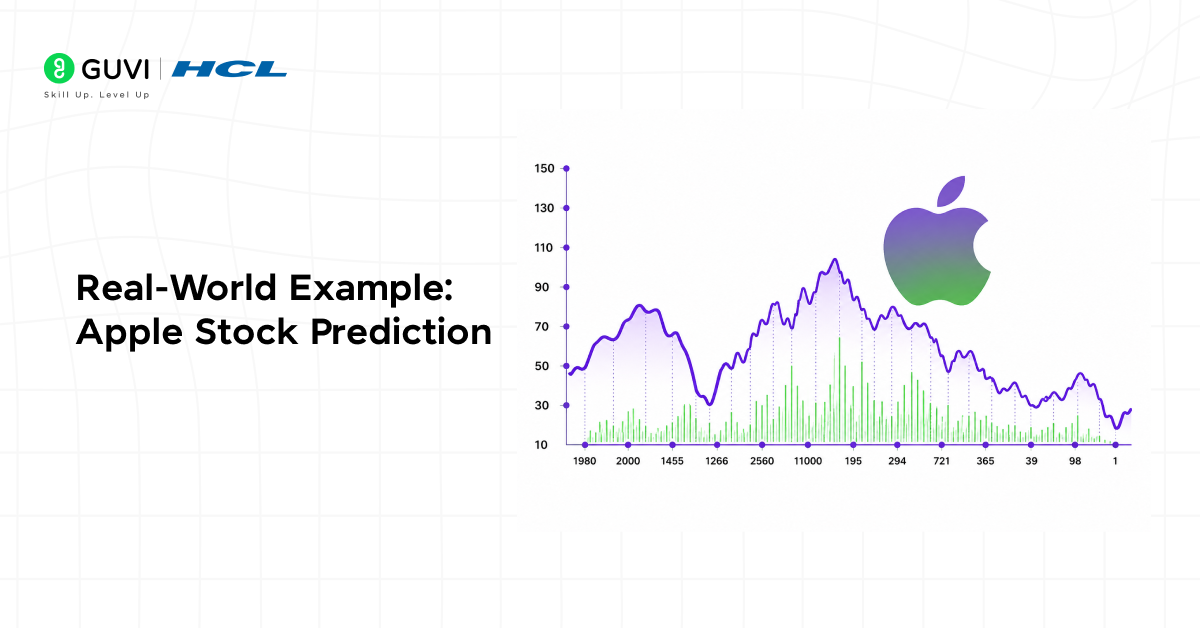
Imagine building a prediction model for Apple stock.
The workflow would be:
- Download five years of AAPL data.
- Create 60-day training windows.
- Train the LSTM network.
- Evaluate model performance.
- Connect real-time market feeds.
- Generate updated forecasts.
The resulting model may identify recurring market patterns and estimate future prices based on historical behavior.
However, predictions can still be affected by unexpected events such as earnings announcements, economic reports, or global market disruptions.
Common Challenges and Limitations
Many beginners assume AI can perfectly predict stock prices.
In reality, stock forecasting remains one of the most difficult machine learning problems.
Market Volatility
Unexpected news can significantly impact prices.
Overfitting
Models may memorize training data rather than learn meaningful patterns.
Limited Context
Historical prices alone do not capture investor sentiment or breaking news.
Data Quality Issues
Poor-quality data often leads to inaccurate predictions.
Black Swan Events
Rare events can completely disrupt historical trends.
Understanding these limitations is essential when building forecasting systems.
Best Practices for Better Predictions
To improve model performance:
- Use multiple market indicators.
- Include larger datasets.
- Retrain models regularly.
- Monitor prediction accuracy.
- Avoid data leakage.
- Test using unseen data.
- Combine technical indicators with sentiment analysis.
Many modern financial forecasting systems combine market data with news sentiment and macroeconomic indicators for more robust predictions.
Conclusion
Building a real-time stock price predictor with Python and LSTM is a practical way to apply deep learning to real-world financial data. While no model can predict stock prices with complete accuracy, LSTM networks can uncover valuable patterns and trends, making them a powerful tool for time-series forecasting and AI-driven market analysis.
FAQs
1. Can LSTM accurately predict stock prices?
LSTM can identify historical patterns and trends, but it cannot guarantee accurate predictions because stock markets are influenced by economic events, company performance, investor sentiment, and unexpected market movements.
2. Why is LSTM used for stock price prediction?
LSTM is designed for sequential data and can remember long-term dependencies, making it well-suited for time-series forecasting tasks such as stock market prediction.
3. What data is required for stock price forecasting?
Most stock prediction models use historical price data, trading volume, and technical indicators such as moving averages, RSI, and MACD. Advanced models may also include news sentiment and economic data.
4. Is stock prediction a machine learning or deep learning problem?
It can be both. Traditional machine learning models, such as Random Forest and XGBoost, are commonly used, while LSTM belongs to the deep learning category.
5. Is LSTM better than ARIMA for stock prediction?
LSTM often performs better when dealing with complex nonlinear patterns, while ARIMA works well for simpler statistical forecasting problems with stable trends.
6. Can LSTM predict cryptocurrency prices?
Yes. LSTM models are widely used for cryptocurrency forecasting because crypto markets generate sequential time-series data similar to stock markets.
7. What are the biggest challenges in building a stock price predictor?
Some of the biggest challenges include market volatility, poor data quality, overfitting, data leakage, and the inability to account for unexpected events such as economic crises, geopolitical developments, or major company announcements.
Success Stories

About the Author
Vishalini Devarajan
An Aerospace Engineer turned content writer, I focus on making complex concepts easy to understand through well-structured, reader-friendly blogs. Whether it’s a technical topic or a non-technical one, I love creating content that is clear, engaging, and impactful.
View all posts by Vishalini Devarajan
Connect with me @












Did you enjoy this article?