


Python Articles
How to Create an API in Python? A Beginner's Guide
How to Round Off in Python: A Complete Guide


Get In Touch For Details! Request More Information
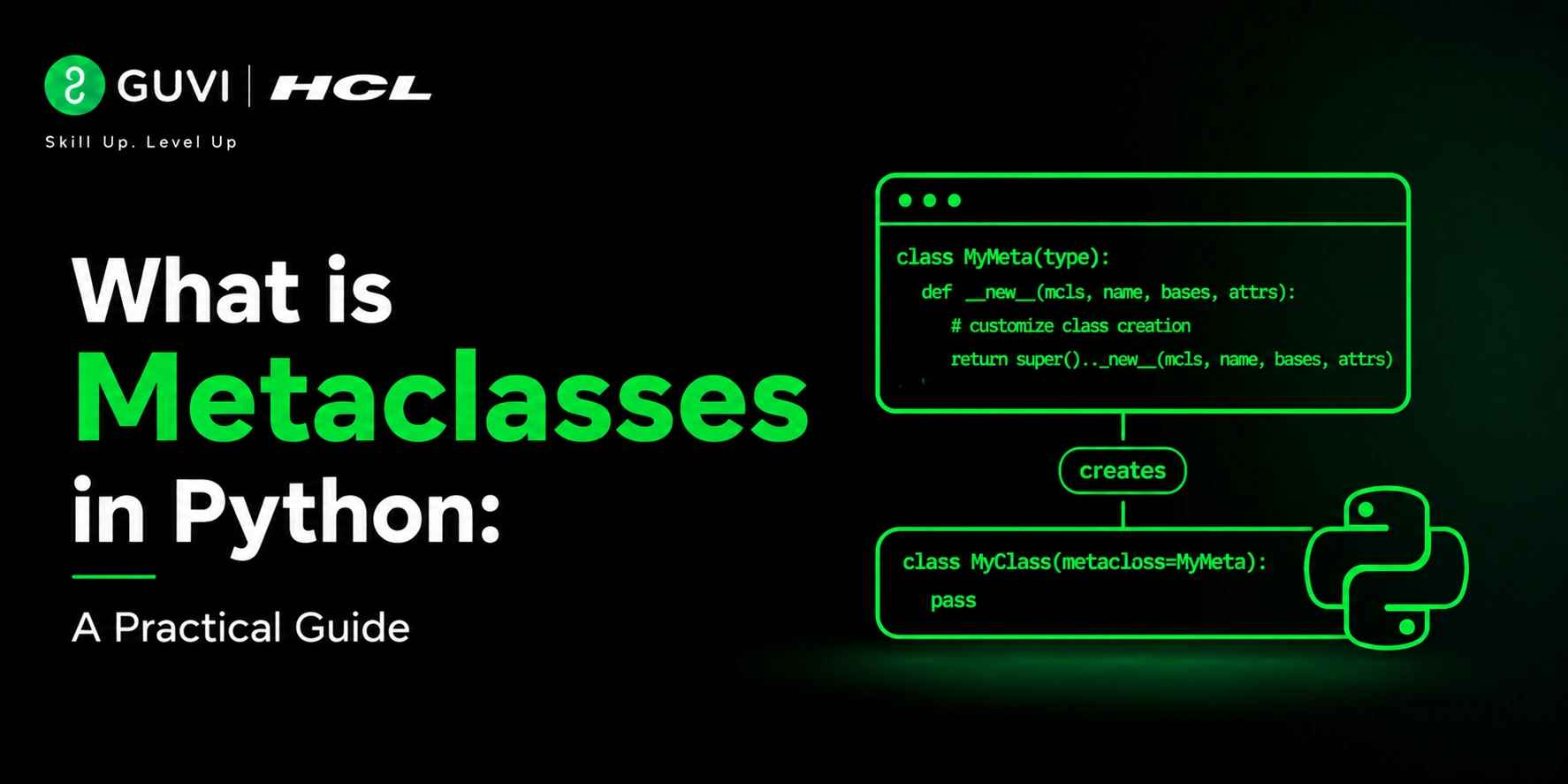
What is Metaclasses in Python: A Practical Guide
Jun 18, 2026 4 Min Read 15 Views
(Last Updated)
Many Python developers work with the language for years without ever needing to write a metaclass, yet misunderstanding how Python metaclasses work can leave you confused when reading framework code like Django ORM or SQLAlchemy. Python metaclasses are one of the most advanced and misunderstood features of the language. Once you understand the concept with real examples, the way Python creates and manages classes will make far more sense.
Table of contents
- Quick TL;DR
- What Is a Metaclass in Python?
- How Does Python Create a Class Internally?
- How to Create a Custom Metaclass in Python
- Practical Use Cases of Python Metaclasses
- Use Case 1: Enforcing Coding Standards
- Use Case 2: Automatic Method Registration
- Common Mistakes When Using Python Metaclasses
- Conclusion
- FAQ
- What is a metaclass in Python?
- When should I use a metaclass in Python?
- What is the difference between a metaclass and a class decorator in Python?
- What is the default metaclass in Python?
- How do metaclasses work in Django?
- Can metaclasses cause problems with multiple inheritance?
Quick TL;DR
- Metaclasses in Python are classes whose instances are other classes. In Python, everything is an object, including classes themselves.
- A metaclass defines how a class behaves, just like a class defines how its instances behave. Metaclasses are used to customise class creation, enforce coding standards, implement design patterns, and build frameworks.
- While most developers rarely write metaclasses directly, understanding how they work gives you a much deeper understanding of how Python itself is designed.
Want to go deep on advanced Python concepts, OOP design patterns, and backend development with real-world projects? Explore HCL GUVI’s Python Programming Course, built for developers who want to move beyond the basics and write production-quality Python code.
What Is a Metaclass in Python?
In Python, a metaclass is the class of a class. Just as an object is an instance of a class, a class is an instance of a metaclass.
By default, Python uses the built-in type as the metaclass for every class you create. When you write a class definition, Python calls type behind the scenes to construct the class object.
class Dog:

    pass

print(type(Dog))   # Output: <class 'type'>

print(type(42))    # Output: <class 'int'>
Both Dog and 42 are instances of their respective types. Dog is an instance of type, which is the default metaclass.
Read More: Demystifying Python Class Methods – A Comprehensive Guide
How Does Python Create a Class Internally?
Now let’s understand what happens under the hood when you define a class.
When Python encounters a class definition, it calls type with three arguments:
- The name of the class as a string
- A tuple of base classes
- A dictionary of attributes and methods
# This class definition:

class Animal:

    sound = "generic"

# Is equivalent to:

Animal = type("Animal", (), {"sound": "generic"})

print(Animal.sound)  # Output: generic
This means type is not just a function for checking types. It is a callable that creates class objects. A metaclass is simply a class that overrides this creation process.
In Python, the abc module that provides Abstract Base Classes (ABCs) and the @abstractmethod decorator is powered internally by a metaclass called ABCMeta. When you define an abstract method and attempt to instantiate a class without implementing all required methods, it is ABCMeta that enforces the rule and raises a TypeError. This makes ABCs a practical and widely used example of metaclasses in everyday Python development, allowing developers to define clear interface contracts and enforce implementation requirements at class creation time.
How to Create a Custom Metaclass in Python
You create a metaclass by inheriting from type and overriding its special methods.
The two most important methods to override are:
- __new__: Called when the class object is being created
- __init__: Called after the class object is created to initialise it
class MyMeta(type):

def __new__(mcs, name, bases, namespace):

        print(f"Creating class: {name}")

        return super().__new__(mcs, name, bases, namespace)

class MyClass(metaclass=MyMeta):

    pass

# Output: Creating class: MyClass
The metaclass intercepts the class creation process before the class object is finalised. This is where you can modify, validate, or augment the class.
The web framework :contentReference[oaicite:0]{index=0} uses metaclasses extensively in its ORM layer to power its Model system. When you define a Django model class, a special metaclass called ModelBase intercepts the class creation process, reads all declared fields, and registers the model with Django’s internal application registry. This is why developers never need to manually register models—Django automatically discovers and tracks them at import time. This metaclass-driven design is a key reason the Django ORM feels so declarative while still remaining tightly integrated with the framework’s internals.

Practical Use Cases of Python Metaclasses
Use Case 1: Enforcing Coding Standards
A metaclass can enforce that all methods in a class are lowercase, preventing naming inconsistencies across a large codebase.
class LowercaseMeta(type):

    def __new__(mcs, name, bases, namespace):

        for key in namespace:

            if not key.startswith("_") and not key.islower():

                raise TypeError(f"Method name '{key}' must be lowercase.")

        return super().__new__(mcs, name, bases, namespace)

class MyService(metaclass=LowercaseMeta):

    def process_data(self):  # Valid

        pass

# This would raise TypeError:

# class BadService(metaclass=LowercaseMeta):

#     def ProcessData(self):

#         pass
This pattern is useful in large teams where consistent naming conventions must be enforced automatically rather than through code review alone.
Use Case 2: Automatic Method Registration
A metaclass can automatically register all subclasses of a base class, which is a common pattern in plugin architectures and command registries.
class PluginMeta(type):

    registry = {}

    def __new__(mcs, name, bases, namespace):

        cls = super().__new__(mcs, name, bases, namespace)

        if bases:

            PluginMeta.registry[name] = cls

        return cls

class Plugin(metaclass=PluginMeta):

    pass

class AudioPlugin(Plugin):

    pass

class VideoPlugin(Plugin):

    pass

print(PluginMeta.registry)

# Output: {'AudioPlugin': <class 'AudioPlugin'>, 'VideoPlugin': <class 'VideoPlugin'>}
Every time a new plugin class is defined, it is automatically added to the registry without any manual registration step.
Want to go deep on advanced Python concepts, OOP design patterns, and backend development with real-world projects? Explore HCL GUVI’s Python Programming Course, built for developers who want to move beyond the basics and write production-quality Python code.
Common Mistakes When Using Python Metaclasses
1. Using a metaclass when a class decorator is simpler: If your goal is a one-time modification that does not need to propagate to subclasses, a class decorator achieves the same result with far less overhead.
2. Metaclass conflicts in multiple inheritance: When a class inherits from two parents that use different metaclasses, Python raises a TypeError about metaclass conflicts.
3. Overriding new without calling super(): Forgetting to call super().new() inside a metaclass new method means the class object is never properly created.
4. Confusing new and init in metaclasses: In a metaclass, new creates the class object and init initialises it after creation.
5. Using metaclasses for simple singleton patterns: A module-level variable or a simple class variable achieves a singleton with far less complexity and is easier for other developers to understand and maintain.
Conclusion
As Python continues to power backend systems, data science pipelines, and AI frameworks across the industry, understanding advanced features like metaclasses sets experienced developers apart from beginners.
Metaclasses are not something you need every day, but knowing how they work gives you a much clearer picture of how Django, SQLAlchemy, and Python’s own ABC module are built. Start by experimenting with a simple enforcement metaclass, then explore how type works under the hood.
FAQ
1. What is a metaclass in Python?
A metaclass in Python is the class of a class. Just as a class defines how its instances behave, a metaclass defines how a class itself is created and behaves. Python uses type as the default metaclass for all classes.
2. When should I use a metaclass in Python?
Use a metaclass when you need to control class creation in a way that must be inherited automatically by all subclasses, such as enforcing method naming conventions, auto-registering subclasses, or validating class structure at definition time.
3. What is the difference between a metaclass and a class decorator in Python?
A metaclass intercepts class creation before the class object is finalised and is automatically inherited by subclasses. A class decorator runs after the class is created and does not propagate to subclasses unless explicitly reapplied.
4. What is the default metaclass in Python?
The default metaclass in Python is type. Every class you define without specifying a metaclass is an instance of type. You can verify this by calling type() on any class object.
5. How do metaclasses work in Django?
Django uses a metaclass called ModelBase to process model class definitions. When you define a Django model, ModelBase intercepts the class creation, reads the field definitions, and registers the model with Django’s app registry automatically without any explicit registration call.
6. Can metaclasses cause problems with multiple inheritance?
Yes. If a class inherits from two parents that use different metaclasses, Python raises a TypeError about metaclass conflict. The resolution is to create a combined metaclass that inherits from both conflicting metaclasses, though this adds complexity and often signals a design issue.
Success Stories

About the Author
Vishalini Devarajan
An Aerospace Engineer turned content writer, I focus on making complex concepts easy to understand through well-structured, reader-friendly blogs. Whether it’s a technical topic or a non-technical one, I love creating content that is clear, engaging, and impactful.
View all posts by Vishalini Devarajan
Connect with me @















Did you enjoy this article?