


Data Structure Articles
Sliding Window Technique: Explained with Examples
Two Pointer Technique: Problems and Applications


Get In Touch For Details! Request More Information

Quick TL;DR
- A permutation array in DSA is an array of length n that contains every integer from 0 to n−1 exactly once, representing a specific rearrangement of elements. It is widely used in sorting algorithms, cycle detection, in-place operations, and competitive programming.
- Key operations include applying a permutation to another array, finding its inverse, composing two permutations, and detecting cycles, all achievable in O(n) time.
- Understanding Permutation Arrays in DSA is essential for cracking product-based company interviews and solving array manipulation problems efficiently.
Table of contents
- Introduction
- What is a Permutation Array in DSA?
- How Does a Permutation Array Work?
- Step 1: Start with an input array and a permutation
- Step 2: Apply the permutation
- Step 3: Read the output
- Types of Permutations in DSA
- Key Operations on a Permutation Array
- Checking If an Array Is a Valid Permutation
- Inverting a Permutation
- In-Place Permutation Using Cycle Detection
- Composing Two Permutations
- Real-World Example of a Permutation Array
- When Should You Use a Permutation Array?
- Common Mistakes When Working with Permutation Arrays
- Conclusion
- FAQ
- What is a permutation array in DSA?
- How do you check if an array is a valid permutation?
- What is the inverse of a permutation array?
- How do you apply a permutation to an array in O(n) time?
- What is an in-place permutation and how does it work?
- What is the minimum number of swaps to sort using a permutation?
Introduction
Many beginners working through DSA problems stumble upon arrays that seem sorted but are not, and the missing concept is almost always the permutation array. A Permutation Array in DSA is a fundamental building block that powers everything from sorting algorithms to graph traversal. Understanding how it works, how to apply it, and where it goes wrong will sharpen your problem-solving skills and make a large class of interview questions significantly easier to tackle.
What is a Permutation Array in DSA?
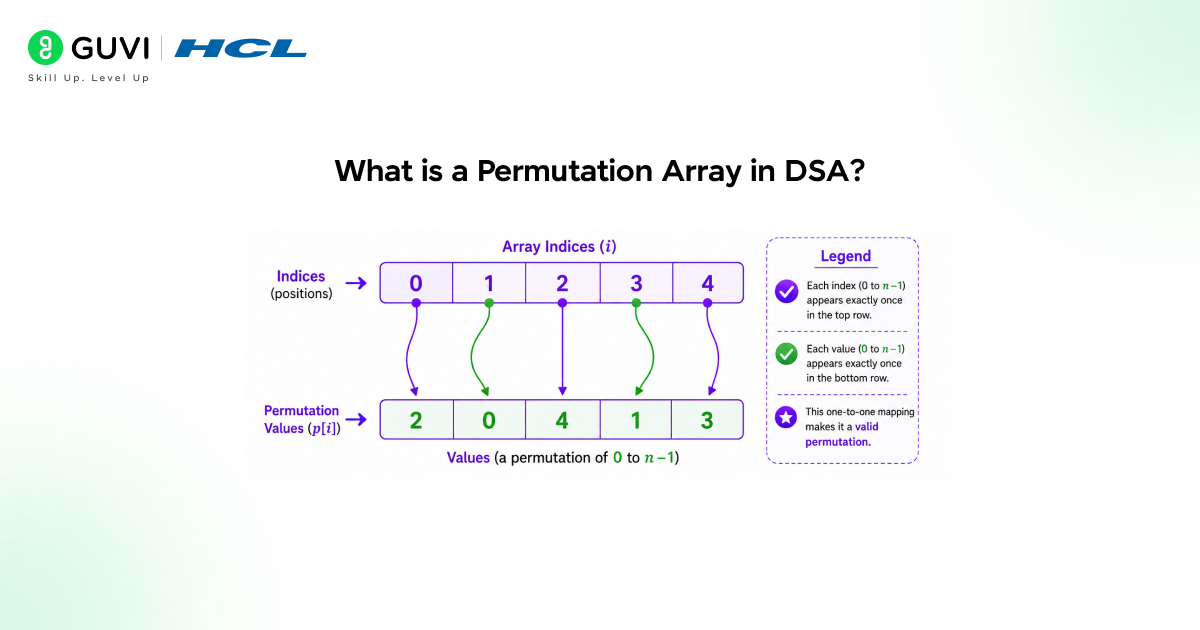
A Permutation Array in DSA is an array P of length n where every integer from 0 to n−1 appears exactly once. It defines a bijection, a one-to-one mapping from the set of indices to itself.
Think of it as a rearrangement instruction. Each index i holds a value that says: the element at position i should move to position P[i].
For example, if n = 4 and perm = [2, 0, 3, 1], the mapping is:
• Index 0 → position 2
• Index 1 → position 0
• Index 2 → position 3
• Index 3 → position 1
This simple structure becomes extremely powerful when you need to rearrange data, undo a shuffle, or solve complex in-place manipulation problems.
Read More: Basic Coding Problems in DSA for Beginners
How Does a Permutation Array Work?
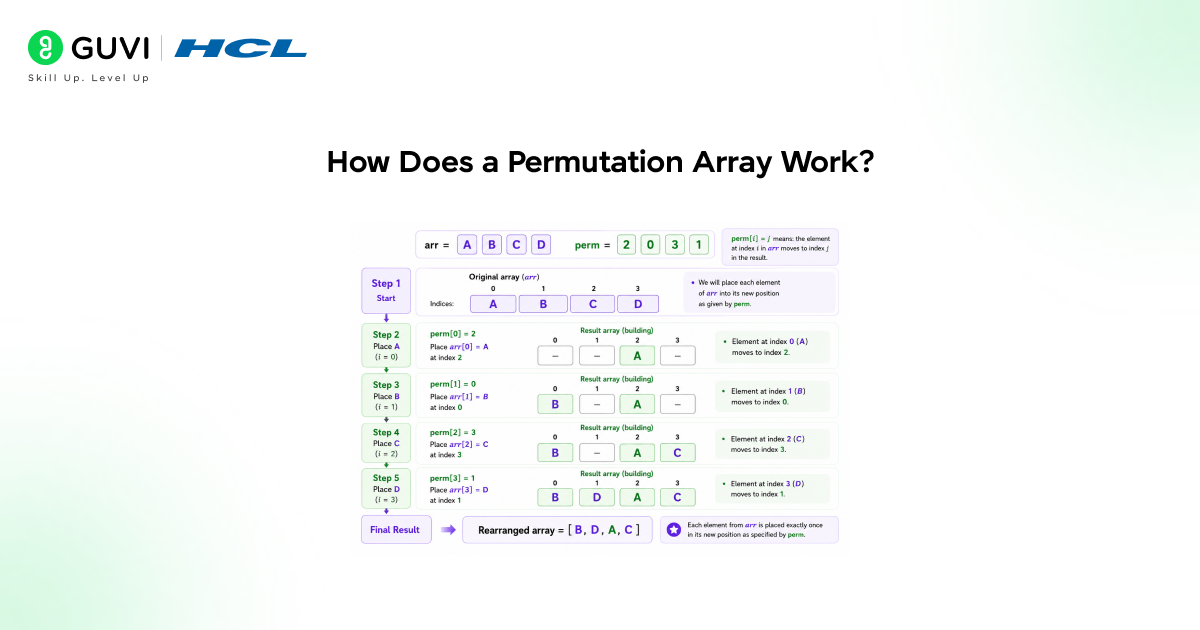
Let’s walk through how a permutation array actually rearranges elements, step by step.
Step 1: Start with an input array and a permutation
Suppose arr = [‘A’, ‘B’, ‘C’, ‘D’] and perm = [2, 0, 3, 1]. The permutation tells you exactly where each element in arr needs to go.
Step 2: Apply the permutation
Create a result array of the same size. For each index i, place arr[i] at result[perm[i]].
result[perm[0]] = result[2] = 'A'

result[perm[1]] = result[0] = 'B'

result[perm[2]] = result[3] = 'C'

result[perm[3]] = result[1] = 'D'
Step 3: Read the output
result = [‘B’, ‘D’, ‘A’, ‘C’]. The array has been rearranged exactly as specified by the permutation in a single O(n) pass.
Here is the complete code in Python:
def apply_permutation(arr, perm):

    n = len(arr)

    result = [None] * n

    for i in range(n):

        result[perm[i]] = arr[i]

    return result

arr  = ['A', 'B', 'C', 'D']

perm = [2, 0, 3, 1]

print(apply_permutation(arr, perm))

# Output: ['B', 'D', 'A', 'C']
Types of Permutations in DSA
Not every permutation behaves the same way. Here are the main types you will encounter in DSA problems and interviews:
| Type | Description | Example (n=4) |
| Identity | Every element stays in place: P[i] = i | [0, 1, 2, 3] |
| Inverse | Reverses the mapping: inv[P[i]] = i | perm=[2,0,3,1] → inv=[1,3,0,2] |
| Cyclic | Rotates elements: P[i] = (i+1) % n | [1, 2, 3, 0] |
| Derangement | No element is in its original position | [1, 0, 3, 2] |
| In-place | Applied without an extra array using cycle detection | Swap along each cycle |
Key Operations on a Permutation Array
Once you understand what a Permutation Array in DSA is, the next step is knowing what you can do with it. Here are the four operations that appear most frequently in interviews and competitive programming.
1. Checking If an Array Is a Valid Permutation
A valid permutation of size n must contain each integer from 0 to n−1 exactly once. The cleanest approach uses a boolean visited array.
def is_valid_permutation(perm):

    n = len(perm)

    visited = [False] * n

    for x in perm:

        if x < 0 or x >= n or visited[x]:

         return False

        visited[x] = True

    return True
Time complexity: O(n). Space complexity: O(n).
2. Inverting a Permutation
The inverse of a permutation satisfies inv[perm[i]] = i. If perm moves element at index 2 to index 5, the inverse moves it back from 5 to 2. Inversion is essential when you need to undo a rearrangement.
def invert_permutation(perm):

    inv = [0] * len(perm)

    for i, p in enumerate(perm):

        inv[p] = i

    return inv
3. In-Place Permutation Using Cycle Detection
Applying a permutation without a result array is possible using cycle detection. Every permutation decomposes into independent cycles. For each cycle, you rotate the elements along it without needing extra storage.
def apply_inplace(arr, perm):

    visited = [False] * len(arr)

    for i in range(len(arr)):

        if not visited[i]:

         j = i

         while not visited[j]:

             visited[j] = True

             next_j = perm[j]

             arr[i], arr[next_j] = arr[next_j], arr[i]

             j = next_j
Time complexity: O(n). Space complexity: O(n) for the visited array, or O(1) using a sign-flipping trick.
The minimum number of swaps required to sort an array can be determined using the concept of cycle decomposition in permutations. When an array is viewed as a permutation of indices, it breaks down into disjoint cycles. Each cycle of length k requires k − 1 swaps to place all elements in their correct positions. As a result, the total number of swaps needed to sort the array equals n − number of cycles. For example, the permutation [2, 0, 3, 1] forms a single cycle of length 4, meaning it requires exactly 3 swaps to sort. This insight is widely used in algorithm design problems involving optimal rearrangement and sorting efficiency.
4. Composing Two Permutations
If you have two permutations P and Q, their composition is a new permutation: composed[i] = Q[P[i]]. This represents applying P first, and then Q. Composition appears in multi-step rearrangement problems and cryptographic key scheduling.
def compose(P, Q):

    return [Q[P[i]] for i in range(len(P))]
Read More: Sorting in Data Structure: Categories & Types
Real-World Example of a Permutation Array
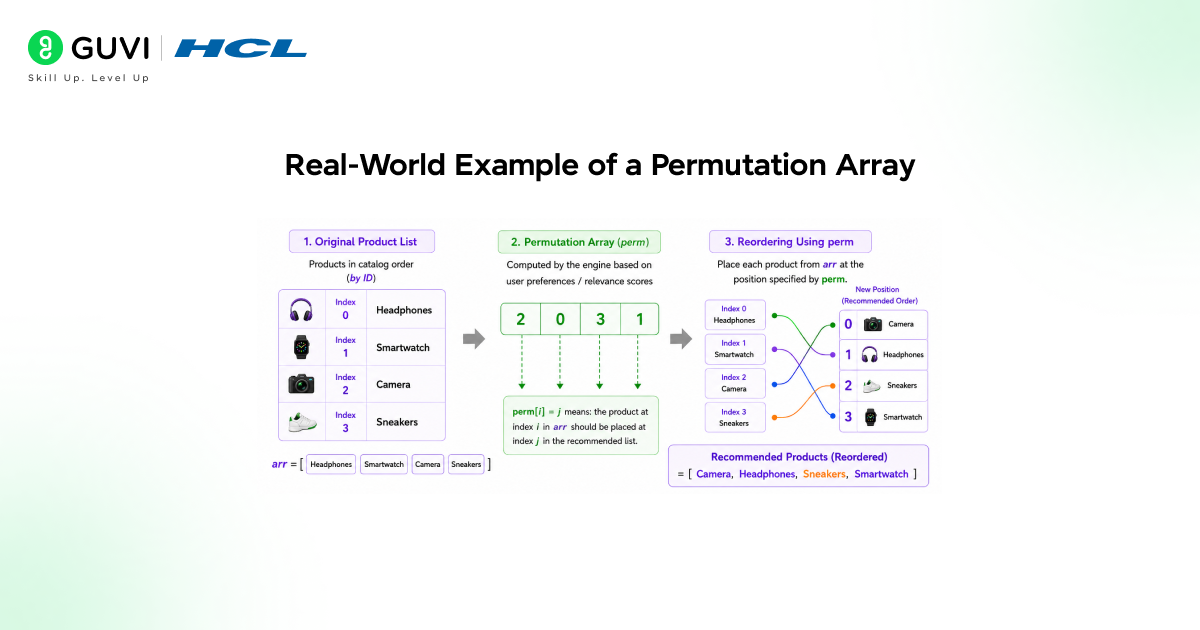
Let’s look at a practical scenario that companies like Amazon and Flipkart deal with at scale every day.
Imagine a product recommendation engine storing one million products. After a machine learning model runs, it produces a ranked order for each user, stored as a permutation array, where each index represents a product slot, and the corresponding value is the product ID that fills that slot.
When displaying products to the user, the system applies the permutation to the master product list in O(n) no re-sorting required. If the user’s preferences change, the system inverts the permutation to recover the original order, then efficiently applies a fresh permutation.

class RecommendationEngine:

    def __init__(self, products):

        self.products = products

        self.perm = list(range(len(products)))  # identity permutation

    def apply_ranking(self, perm):

        self.perm = perm

        result = [None] * len(self.products)

        for i, p in enumerate(perm):

         result[p] = self.products[i]

        return result

    def reset_to_original(self):

        inv = [0] * len(self.perm)

        for i, p in enumerate(self.perm):

         inv[p] = i

        self.perm = inv
This same pattern is used in operating system schedulers, database query planners, and competitive programming problems like ‘Sort Array with Minimum Swaps’ and ‘Reconstruct Original Array from Shuffled Output’.
Many popular competitive programming problems, including First Missing Positive and Find All Duplicates in an Array, can be solved efficiently by treating the array as a form of permutation or index-mapping structure. Instead of using extra memory for hash tables or sets, these solutions often place each value at its “correct” index, allowing the array itself to act as a bookkeeping mechanism. Recognizing this pattern is a valuable problem-solving skill because it frequently transforms an apparently complex task into an O(n) time solution with constant extra space. Experienced programmers often look for clues such as values constrained to the range 1...n, which commonly indicate that a permutation-based approach may be the key to an optimal solution.
When Should You Use a Permutation Array?
Use a permutation array when:
• You need to track exactly where each element has moved after a rearrangement.
• You want to sort an array in-place with the minimum number of swaps.
• You need to undo a rearrangement by inverting the permutation.
• You are solving cycle detection problems on arrays in O(n) time.
• You need to compose multiple rearrangements into a single step.
Avoid using a permutation array when:
• The values in your array are not in the range [0, n−1]. Permutation-based tricks will not apply directly.
• The array contains duplicates. A valid permutation requires every value to appear exactly once.
Common Mistakes When Working with Permutation Arrays
1. Assuming 1-indexed permutations: Most DSA problems use 0-indexed permutations. Treating perm[0] as unused introduces off-by-one errors that are difficult to debug. Always confirm the index range before writing code.
2. Modifying the permutation during in-place application: When applying a permutation in-place without a visited array, it is easy to overwrite values before they are used. Use a sign-flipping trick or a separate visited array to prevent data loss.
3. Confusing apply and compose: Applying perm to an array (result[perm[i]] = arr[i]) and composing two permutations (composed[i] = Q[P[i]]) are different operations. Mixing them up produces incorrect output that can be hard to trace.
4. Not validating input before in-place operations: Passing an invalid permutation one with duplicates or out-of-range values into a cycle-detection algorithm causes undefined behaviour. Always validate the permutation first, especially in interview settings where tricky inputs are common.
5. Using O(n log n) sort to validate: Sorting the array to check if it is a valid permutation works but is unnecessary. A simple boolean visited array gives O(n) time, faster and cleaner for large inputs.
Want to master arrays, permutations, graphs, and dynamic programming with real projects and mentorship? Check out HCL GUVI’s Data Structures & Algorithms Programme designed for students and working professionals who want to crack top product-based company interviews with structured, hands-on learning.
Conclusion
As data structures continue to form the backbone of software engineering interviews and real-world systems, mastering concepts like the Permutation Array in DSA gives you a meaningful edge. From applying permutations in O(n) and inverting them efficiently, to detecting cycles and composing rearrangements, each operation unlocks a whole class of problems that would otherwise seem difficult. Start by writing a valid permutation checker, then build up to in-place application using cycle detection. These two exercises alone will make the concept click. From there, explore LeetCode problems like ‘Find All Duplicates in an Array’ and ‘First Missing Positive’ to see permutation thinking in action.
FAQ
1. What is a permutation array in DSA?
A permutation array in DSA is an array of length n that contains each integer from 0 to n−1 exactly once, representing a specific rearrangement or mapping of elements from their original positions.
2. How do you check if an array is a valid permutation?
Create a boolean visited array of size n. For each element, mark it as visited. If any element is out of range [0, n−1] or is marked visited twice, the array is not a valid permutation.
3. What is the inverse of a permutation array?
The inverse permutation inv satisfies inv[perm[i]] = i for all i. It reverses the mapping so applying the permutation and then its inverse restores the original order of elements.
4. How do you apply a permutation to an array in O(n) time?
Create a result array of the same size. For each index i, set result[perm[i]] = arr[i]. This rearranges the array in a single pass with O(n) time and O(n) space.
5. What is an in-place permutation and how does it work?
An in-place permutation rearranges elements without a result array using cycle detection. For each unvisited cycle, elements are rotated along it using O(1) extra space beyond a visited marker.
6. What is the minimum number of swaps to sort using a permutation?
The minimum swaps equals n minus the number of cycles in the permutation. A cycle of length k requires k−1 swaps to resolve, so more cycles means fewer swaps needed overall.
Success Stories

About the Author
Vishalini Devarajan
An Aerospace Engineer turned content writer, I focus on making complex concepts easy to understand through well-structured, reader-friendly blogs. Whether it’s a technical topic or a non-technical one, I love creating content that is clear, engaging, and impactful.
View all posts by Vishalini Devarajan
Connect with me @

















Did you enjoy this article?