


Product Management Articles
Enterprise Product Management: Unique Challenges, Skills & Strategy
B2B vs B2C Product Management: Key Differences, Skills, Strategy & Career Scope
Working with Engineers as a Product Manager: A Practical Guide


Get In Touch For Details! Request More Information
Career Switch From Software Engineer to Product Manager: A Step-by-Step Guide
Aug 19, 2026 7 Min Read 1293 Views
(Last Updated)
If you find yourself asking, “Why are we building this?” more than “how do we build this?”, you’re likely drawn to product thinking, a strong sign that product management could be your next step.
Transitioning from software engineer to product manager is natural and advantageous: your technical background gives you a clear edge in understanding feasibility, communicating with engineers, and shaping realistic roadmaps.
In this article, you will get a clear, honest, and step-by-step breakdown of everything you need to know to make this transition, from understanding what the PM role actually involves, to building the right skills, updating your resume, preparing for interviews, and landing your first product role.
Table of contents
- TL;DR
- Why Software Engineers Make Great PMs
- Step 1: Understand the Real Difference Between the Two Roles
- Step 2: Start Thinking Like a PM While Still in Your Engineering Role
- Step 3: Build the Four Core Product Management Skills
- Step 4: Explore Paths to Make the Transition
- Step 5: Update Your Resume and Build a Portfolio
- Step 6 : Prepare for PM Interviews
- Step 7: Watch Out for Common Mistakes
- Final Thoughts
- FAQs
- Q: How long does it typically take to move from engineer to PM?
- Q: What’s the single most important skill to develop first?
- Q: Do I need an MBA or formal certification to become a PM?
- Q: How should I rewrite my engineering resume for PM roles?
- Q: How can I get hands‑on PM experience without leaving my engineering job?
TL;DR
- Transitioning from software engineer to product manager shifts your success metric from code quality to product outcomes: impact on users and business.
- Start practicing product thinking now: write one‑page briefs, sit in on research, draft PRDs, and build a small portfolio of artifacts.
- Build four core PM skills: product sense, data & metrics literacy, stakeholder communication, and clear written communication.
- Best paths: internal transfer, hybrid technical PM roles, or a side project that demonstrates end‑to‑end product work. Tailor your resume to show outcomes, not just technical tasks.
- Prepare for PM interviews by practicing product design, analytics, strategy, and behavioral questions; focus on your thinking process and use engineering examples that show product impact.
What Does a Product Manager Actually Do?
A product manager is responsible for defining what products or features should be built and why they are important for both users and the business. While engineers focus on how to build a solution, product managers identify customer problems, prioritize opportunities, create product strategies, and ensure that development efforts align with business goals. They collaborate closely with design, engineering, marketing, sales, and leadership teams to maintain a shared product vision, guide decision-making, and ensure the final product delivers meaningful value to customers.
Take the next step in your career with HCL GUVI’s Product Management Programme by IIM Indore. Learn the skills to build, launch, and scale products while preparing for a successful transition into product management.
Why Software Engineers Make Great PMs
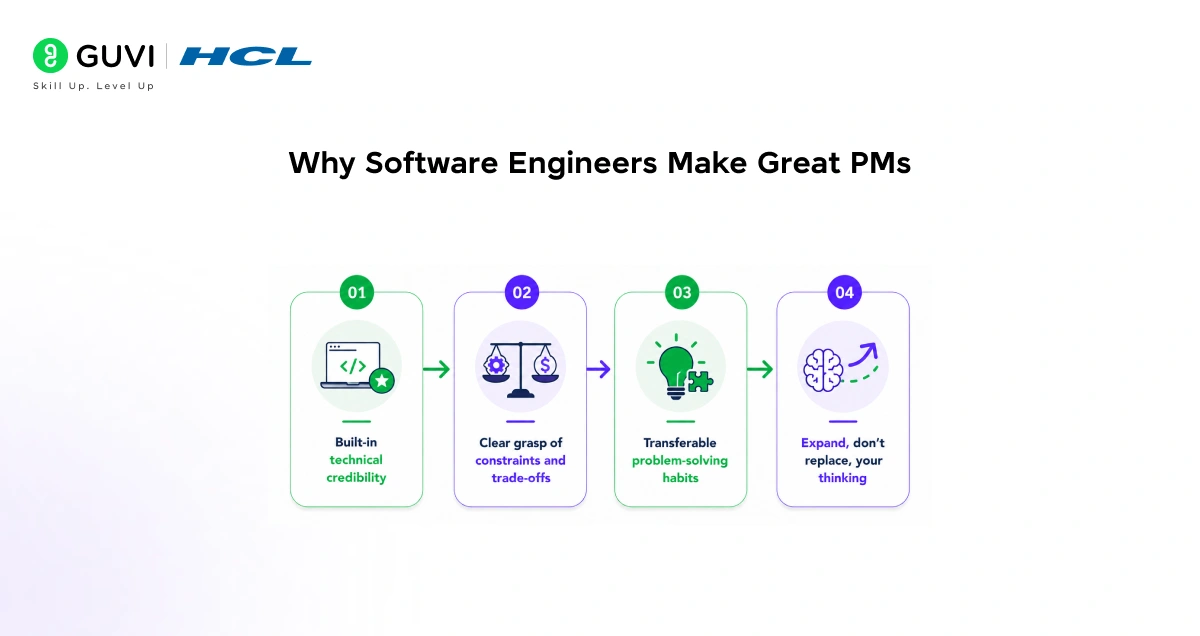
- Built-in technical credibility
As an engineer, you already understand how software works, so you can have honest, detailed technical conversations with the dev team and earn their trust more quickly than many non‑technical PMs.
- Clear grasp of constraints and trade-offs
You know timelines, technical debt, and system limits, so you can set realistic expectations, prioritize appropriately, and explain why some features require more effort.
- Transferable problem‑solving habits
Engineering trains you to think logically, decompose complex problems, and spot patterns in data habits that map directly to product tasks like diagnosing issues, forming hypotheses, and deciding under uncertainty.
- Expand, don’t replace, your thinking
Transitioning to PM work isn’t about abandoning engineering thinking; it’s about widening your focus to include users, business goals, and strategy while applying the analytical skills you already have.
Step 1: Understand the Real Difference Between the Two Roles
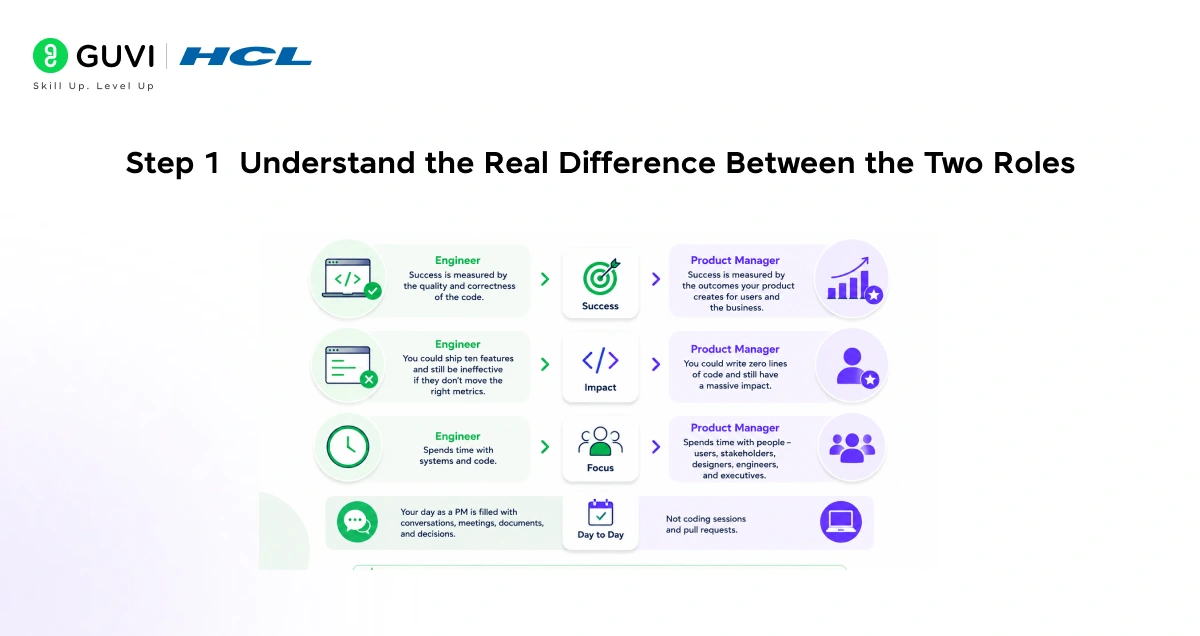
- One of the first things you need to do is clearly understand how a PM role differs from your current role as an engineer. This is not just about job titles; it is a genuine shift in mindset and responsibility.
- As a software engineer, your success is measured by the quality and correctness of the code you write. As a product manager, your success is measured by the outcomes your product creates for users and the business.
- You could write zero lines of code as a PM and still have a massive impact. Conversely, you could ship ten features in a quarter and still be considered ineffective if those features did not move the right metrics.
- Another key difference is how you spend your time. Engineers primarily work with systems and code. PMs primarily work with people users, stakeholders, designers, engineers, and executives.
- Your day will be filled with conversations, meetings, documents, and decisions rather than coding sessions and pull requests. If you enjoy deep technical focus and find people-heavy work draining, it is worth reflecting on whether this transition is truly the right fit for you before diving in.
Step 2: Start Thinking Like a PM While Still in Your Engineering Role
- Practice product thinking now
You don’t need the PM title to start demonstrate product thinking while you’re an engineer by asking broader questions in meetings about user problems and success metrics. - Create simple context documents
Write one-page briefs for features that explain the user need, business rationale, and expected outcome. Voluntary docs signal product ownership and improve team clarity. - Draft a basic PRD
Try writing a Product Requirements Document for a project: who it’s for, the problem it solves, what to build, and how success is measured. It doesn’t need to be perfect writing it sharpens your decisions. - Build a portfolio of artifacts
Keep your context docs and PRDs as tangible examples to show future employers; real artifacts make your transition and job search much easier.
Step 3: Build the Four Core Product Management Skills
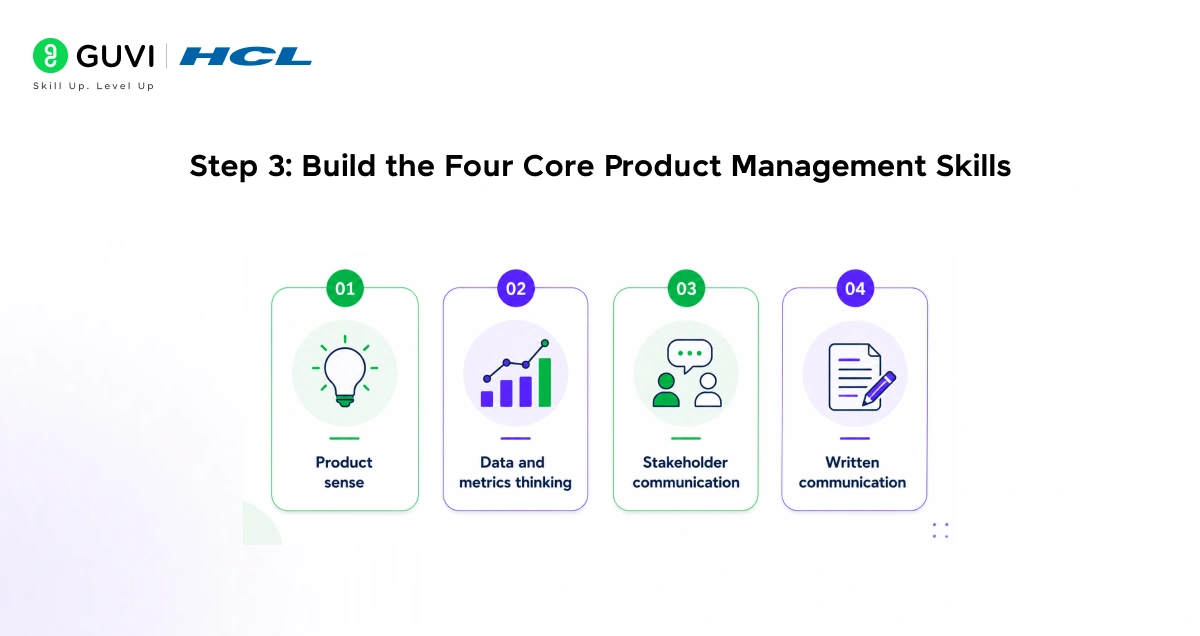
Four key skills separate strong product managers from average ones. As you prepare for your transition, focus your energy on developing all four.
- Product sense is the ability to understand what users actually need, not just what they say they want. You build this by spending time with real users. Read customer support tickets. Sit in on user research calls.
If your company runs usability tests, ask if you can observe. The more you expose yourself to genuine user frustration and feedback, the sharper your product instincts will become.
- Data and metrics thinking is about understanding how to measure whether a product is working. As an engineer, you are already comfortable with data.
But PM-level metrics thinking goes further; you need to understand what to measure and why, how to distinguish between vanity metrics and actionable ones, and how to connect a technical improvement to a user behavior change or a business outcome.
Start by looking at the analytics for features you have already built and asking yourself whether those features actually succeeded.
- Stakeholder communication is about aligning people who have different goals and priorities. This is often the hardest adjustment for engineers coming into product management, because there is rarely one clear right answer just tradeoffs to navigate.
Practice this by volunteering to run cross-functional meetings, presenting your team’s technical work to non-technical audiences, or helping draft project updates for leadership.
- Written communication is underestimated but critical. PMs live in documents: strategy memos, roadmaps, PRDs, meeting notes, and executive updates. Strong writing makes your thinking clear and builds trust with your team and leadership.
Start writing more at work, whether that is detailed ticket descriptions, post-mortems after feature launches, or short internal summaries of things your team is working on
Read More: Cursor for Product Managers: A Complete Guide to AI Workflows.
Step 4: Explore Paths to Make the Transition
There is more than one way to move from a software engineering role into product management, and the right path depends on your situation.
- The fastest and most common route is an internal transfer. If the company you currently work for has a product team, this is your best starting point. You already know the product, the users, the codebase, and the business.
- Companies are far more willing to take a chance on someone they know and trust than on an external candidate with no PM title on their resume.
- Start by expressing interest to your manager and looking for opportunities to take on product-adjacent work, like helping with roadmap planning, leading a discovery project, or owning a small feature end to end.
- If an internal transfer is not possible, consider hybrid roles as a stepping stone. Technical Product Manager roles, Platform PM roles, and Developer Relations roles all blend engineering and product work.
- These are often more accessible than pure PM roles for someone making their first transition, and they let you build product management experience while still using your technical skills.
- Building a side project is another powerful option. When you create your own product from scratch even something small you get the full product management experience.
- You have to do user research, decide what to build, write specs, measure results, and iterate. Documenting that process gives you real stories to tell in interviews, even without a formal PM title on your resume.

Step 5: Update Your Resume and Build a Portfolio
- Your engineering resume needs a reframe before you start applying to PM roles. You are not lying about your experience you are translating it into the language that product hiring managers care about.
- Every bullet point on your resume should connect technical work to user or business impact. Instead of writing that you implemented a payment feature, write that you led the development of a payment feature that reduced checkout drop-off and increased conversion.
- Instead of saying you fixed a performance bug, say you resolved a latency issue that improved page load time and resulted in measurable improvement in user engagement. The technical achievement matters less than the outcome it produced.
- On top of your resume, build a small portfolio that demonstrates your product thinking. This can be as simple as a Notion page or a personal website that includes one or two case studies a PRD you wrote, a product teardown of an app you love, a post-mortem from a project you led, or a short strategy document explaining how you would improve a feature at your current company.
- This portfolio does not need to be extensive. Even one strong case study can set you apart significantly from other candidates who have nothing to show.
Software engineers often have a strong foundation for transitioning into Product Management because their technical knowledge helps them communicate effectively with development teams, evaluate trade-offs, and understand the feasibility of product decisions. Many organizations prefer internal transitions into PM roles since existing employees already understand the company’s products, customers, and culture, reducing hiring risk. Engineers who demonstrate product thinking through artifacts such as Product Requirement Documents (PRDs), user research summaries, feature proposals, or product teardowns can significantly strengthen their case for a transition. By combining technical expertise with customer empathy and strategic thinking, engineers can position themselves as strong candidates for product leadership roles.
You just read the step-by-step guide on transitioning from software engineer to product manager. Take the next step with HCL GUVI’s Product Management Program by IIM Indore.Learn to build, launch, and scale products with expert guidance from IIM Indore.
Step 6 : Prepare for PM Interviews
- Product management interviews are very different from software engineering interviews. Instead of solving well-defined coding problems, you will be asked open-ended questions about products, users, and decisions.
- The format can feel uncomfortable at first if you are used to coding rounds with clear right and wrong answers.
- The most common types of PM interview questions fall into a few categories. Product design questions ask you to improve an existing product or design a new one from scratch.
- Analytical questions ask you to define success metrics for a feature or diagnose why a key metric has dropped. Strategy questions ask how you would prioritize a roadmap or respond to a competitive threat. Behavioral questions ask about how you have handled specific situations in the past.
- For all of these, what interviewers are really evaluating is your thinking process, not just your final answer. Walk through your reasoning out loud. Show that you consider multiple perspectives, make tradeoffs consciously, and always tie your decisions back to user needs and business goals.
- Use real examples from your engineering career whenever you can describing a time you identified a user problem in your work, led a cross-functional effort, or made a prioritization call will all land well in PM interviews.
Take the next step in your career with HCL GUVI’s Product Management Programme by IIM Indore. Learn the skills to build, launch, and scale products while preparing for a successful transition into product management.
Step 7: Watch Out for Common Mistakes
There are a few patterns that trip up engineers making this transition, and being aware of them will help you avoid them.
- The most common one is micromanaging engineering after you become a PM. Because you know how the code works, there will be a strong temptation to tell your team not just what to build, but how to build it.
- This is one of the quickest ways to damage your relationship with your engineering team and undermine their ownership of the technical work. Your job as a PM is to define the problem clearly; the how is theirs to own.
- Another common mistake is focusing too much on features and not enough on outcomes. Engineers naturally think in terms of deliverables, tickets, tasks, and pull requests.
- As a PM, you need to shift your focus to what changes in user behavior or business performance and let that drive what gets built. A feature that ships on time but does not actually solve a real problem is a failure, not a success.
Final Thoughts
Making the move from software engineer to product manager doesn’t require an MBA or a new job. Start with small, deliberate actions you can take now. Pick one skill from research, specs, prioritization, or analytics and focus on it this week: sit in on a user interview, draft a PRD for a feature, or present your team’s work to a nontechnical audience.
Small, consistent steps compound. Engineers who transition successfully show curiosity about users, a habit of seeing the bigger picture, and the initiative to take on work beyond their job description.
Keep your technical foundation; it’s an advantage. Build on it to become a PM who effectively bridges engineering and business rather than abandoning your technical skills.
FAQs
Q: How long does it typically take to move from engineer to PM?
A: It varies. With focused effort and an internal opportunity, some engineers transition in 3–12 months; externally it can take longer as you need interview experience and a portfolio. Progress depends on available roles, company size, and how proactively you build PM experience.
Q: What’s the single most important skill to develop first?
A: Product sense learning to identify real user problems, define success metrics, and judge whether a proposed solution will move those metrics. It’s the foundation that makes data, communication, and strategy meaningful.
Q: Do I need an MBA or formal certification to become a PM?
A: No. Many successful PMs come from engineering backgrounds without MBAs. Practical experience (user research, metrics, PRDs, cross‑functional leadership) and demonstrated outcomes matter far more than formal credentials.
Q: How should I rewrite my engineering resume for PM roles?
A: Reframe achievements as outcomes: state the user or business problem, your action, and the measurable result. Example: “Led backend redesign for checkout flow (problem), reduced latency and retries (action), and increased conversion by 7% (result).” Include one or two portfolio links (PRD, teardown, post‑mortem).
Q: How can I get hands‑on PM experience without leaving my engineering job?
A: Volunteer for product‑adjacent tasks: write a PRD for a small feature, own the end‑to‑end launch of a component, sit in on user interviews, present product updates to non‑technical stakeholders, or lead a small cross‑functional experiment. These concrete artifacts show hiring managers you can do PM work.
Success Stories

About the Author
Vishalini Devarajan
An Aerospace Engineer turned content writer, I focus on making complex concepts easy to understand through well-structured, reader-friendly blogs. Whether it’s a technical topic or a non-technical one, I love creating content that is clear, engaging, and impactful.
View all posts by Vishalini Devarajan
Connect with me @








Did you enjoy this article?