


Artificial Intelligence and Machine Learning Articles
AI/ML Skills Gap 2026: Why Companies Can't Find Job-Ready Talent
20 AI/ML Interview Questions Recruiters Can Use Without a Tech Background - Best Guide
How Industry-Backed AI/ML Bootcamps Are Changing the AI/ML Hiring Pipeline - Best Guide 2026
From IT Support to AI Engineer: A Realistic Career Switch Guide 2026


Get In Touch For Details! Request More Information
Model-Based AI Agent: How Intelligent Systems Make Decisions
Aug 19, 2026 6 Min Read 1031 Views
(Last Updated)
Artificial Intelligence has evolved beyond simple chatbots and recommendation systems. Today’s AI systems can recall previous events, perceive environmental changes, predict future outcomes, and ultimately make smarter choices using architectures such as the Model-Based AI Agent.
Unlike simple reactive agents, which respond directly to input, a model-based agent carries internal knowledge of its environment, enabling it to function in situations where information about the world is partial and not fully known.
In this article, we’ll examine what a Model-Based AI Agent is, how it works, its architecture, applications, advantages, limitations, and practical implementation concepts.
Table of contents
- TL;DR
- Problems of the Traditional Reactive Agents
- How a Model-Based AI Agent Works
- Step 1: Perceive the Environment
- Step 2: Track the Internal State
- Step 3: Use the World Model
- Step 4: Make Decisions
- Core Components of Model-Based AI Agent
- Sensors
- Internal State
- World Model
- Decision Engine
- Actuators
- Model-Based AI Agent Architecture
- Real-World Applications of Model-Based AI Agents
- Autonomous Vehicles
- AI Virtual Assistants
- Robotics
- Smart Healthcare Systems
- Gaming AI
- Partially Observable Environments Explained
- Simple Reflex Agent vs Model-Based AI Agent
- Internal State Tracking in AI Agents
- World Models and Predictive Intelligence
- Practical Python Example of a Model-Based AI Agent
- Advantages of Model-Based AI Agents
- Better Decision Making
- Works in Uncertain Environments
- Predictive Intelligence
- Improved Adaptability
- Limitations of Model-Based AI Agents
- Higher Computational Cost
- Difficult Environment Modeling
- Slower Decision Cycles
- Future of Model-Based AI Agents
- Conclusion
- FAQs
- What is a Model-Based AI Agent?
- Why are model-based agents important in AI?
- What is the difference between a reflex agent and a model-based agent?
- Where are Model-Based AI Agents used?
- What is a world model in artificial intelligence?
- Can Model-Based AI Agents learn over time?
TL;DR
- The Model-Based AI Agent is an intelligent agent that utilizes a model of its environment to make decisions.
- These agents can remember past states and predict future outcomes, rather than just reacting to immediate input.
- These models are most useful in situations where only part of the environment can be observed at any given time, a scenario that defines partially observable environments.
- These agents are most commonly utilized in robots, autonomous vehicles, AI assistants, gaming, and industrial automation systems.
- The architecture of a Model-Based AI Agent consists of the sensors, which collect information, an internal state, a model of the world, which predicts outcomes, the decision-making component, and finally the actuators, which carry out actions based on the decision-making process.
What is a Model-Based AI Agent?
A Model-Based AI Agent is an intelligent agent that maintains an internal representation of its environment by using past and current information. Unlike simple reflex agents that respond only to immediate inputs, a model-based agent remembers previous states and uses that knowledge to make more informed decisions. This internal model helps the agent understand how the environment changes over time and choose the most appropriate action accordingly.
Problems of the Traditional Reactive Agents
Early artificial intelligence systems relied on Reflex-based AI decision-making and could only function when the environment was fully known.
A basic cleaning robot, for example, would clean dirt only if it directly senses it. If dirt exists outside its current range of view, the system would not be aware of it.
Most real-world environments are partially observable, meaning there is often incomplete information present.
A self-driving car cannot see around corners, and an AI healthcare system may not always have complete patient data.
These limitations led to the development of Model-Based AI Agents.
How a Model-Based AI Agent Works
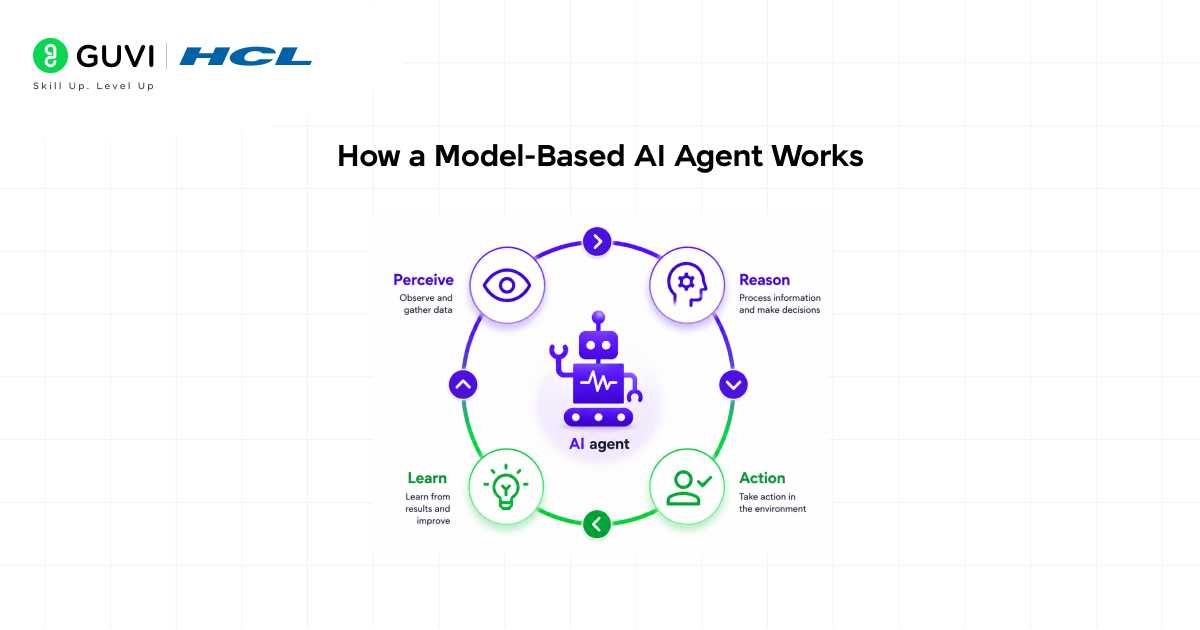
The Model-Based AI Agent is in a continuous cycle of sensing the environment around it, storing this information in its internal state, making use of the internal representation of the environment, known as the world model, and taking an action in the environment.
Step 1: Perceive the Environment
Sensors are the main component used in this step, whether they are cameras, temperature sensors, user inputs, or radar signals.
Step 2: Track the Internal State
The model-based agent will keep track of specific pieces of information about its environment, such as the current state, past states, or even unknown states.
This forms an internal representation of its world, which could allow it to do things like keep track of the rooms it has visited, obstacles in its environment, routes that are blocked, or the battery level in a mobile robot.
Step 3: Use the World Model
The world model is the part of the system that plans for the future using the information gained in steps 1 and 2.
By updating a predictive representation of its environment based on the model, the agent is capable of thinking several steps ahead.
This could be predicting traffic in front of a self-driving car, anticipating opponent movement in a video game, or estimating collision risks while an industrial robot is operating.
Step 4: Make Decisions
The Model-Based AI Agent will make the choice that seems most beneficial, based on an array of criteria from data accumulated up to that point, including current perception and historical states.
These criteria can be implemented using rule-based logic, search algorithms, or probabilistic estimation, depending on the nature of the agent and its environment.
To deepen your understanding of AI concepts and intelligent systems, you can also explore an ebook on Artificial Intelligence.
Modern autonomous driving systems continuously process enormous amounts of sensor data to estimate millions of possible internal states while navigating real-world environments. These systems simultaneously evaluate factors such as future pedestrian movement, vehicle trajectories, road conditions, and potential obstacles in real time. This massive state estimation capability is one reason self-driving technology depends heavily on advanced AI, probabilistic modeling, and high-performance computing infrastructure.
Core Components of Model-Based AI Agent
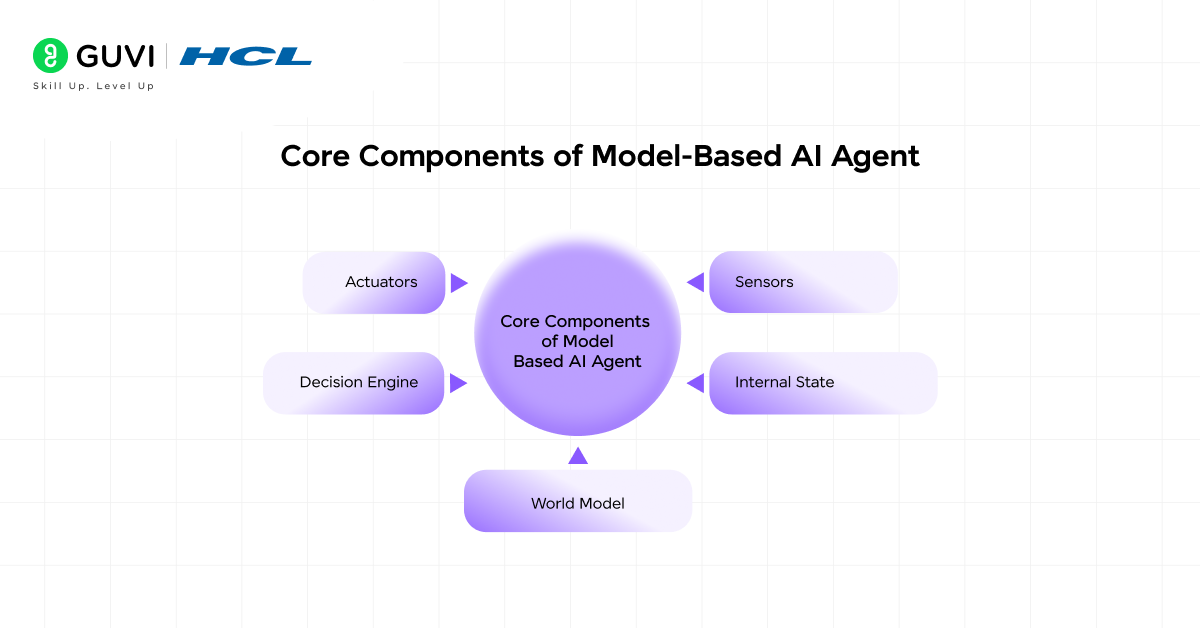
From autonomous vehicles to robotics and healthcare AI, model-based agents are powering the next generation of intelligent autonomous systems. As AI continues evolving, world models and internal state tracking will become even more central to advanced machine intelligence.
1. Sensors
Sensors pick up information from the outside world.
Sensors can be:
- Cameras.
- GPS modules.
- Microphones.
- LiDAR sensors.
- Temperature sensors.
The accuracy of the sensors determines the quality of decision-making.
2. Internal State
The internal state remembers past experiences and knowledge of the environment. This allows an agent to retain consistency across different actions.
A chatbot, for instance, can recall previous parts of the conversation to avoid saying something irrelevant to the earlier context.
Without internal state tracking, agents are “memoryless”.
3. World Model
A world model describes how an environment operates.
With a world model, the agent is able to answer questions about the behavior of the environment, such as what will happen after a given action or how an environment changes.
A world model can be:
- Rule-based.
- Probabilistic.
- Neural-network driven.
- Reinforcement learning-based.
Nowadays, many advanced AI systems utilize a learned world model in conjunction with deep learning techniques.
4. Decision Engine
This component is responsible for selecting the best action to perform based on current sensor input, current internal state information, and future behavior predictions made by the world model.
5. Actuators
Actuators perform the action decided upon by the decision engine.
These could be motors in a robot, commands to software, controls for smart devices, steering systems in a car, etc.
This is where the decisions of an AI agent are converted into real-world action.
Model-Based AI Agent Architecture
The structure of a model-based AI agent’s architecture is focused on building an adaptive system rather than one that merely reacts to incoming information.
A rough representation of a model-based agent cycle is as follows:
Environment → Sensors → Internal State Update → World Model → Decision Engine → Action
Real-World Applications of Model-Based AI Agents
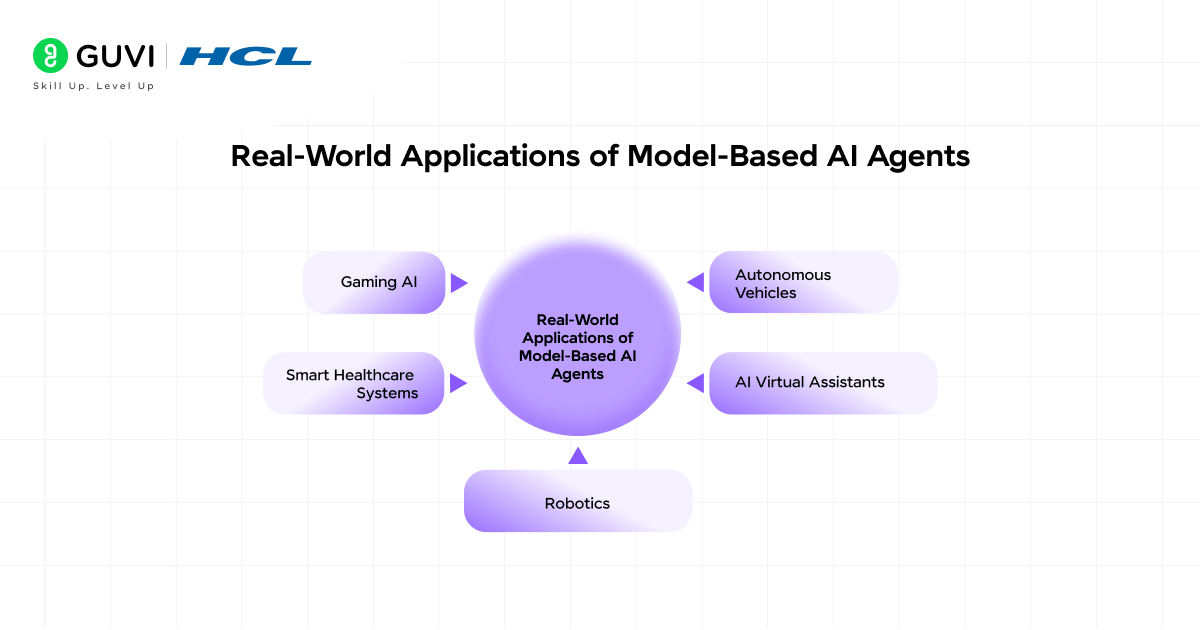
Common applications include:
1. Autonomous Vehicles
An autonomous car tracks vehicles around it, traffic lights, and obstacles.
Based on the information, it predicts future behavior such as acceleration or braking of the vehicles ahead, pedestrian crossing a street, or the lights turning red or green.
Without such internal modeling of the environment, it would be too unsafe to allow these systems to drive.
2. AI Virtual Assistants
Modern virtual assistants, such as Alexa, Siri, and Google Assistant, store information about a user’s conversation with the agent.
They can refer to previous interactions, making conversations more context-aware.
3. Robotics
In an industrial setting, a robot might build up a model of its environment to avoid collisions.
This model could represent, for instance, fixed objects like machinery, as well as dynamic ones such as the human operator.
4. Smart Healthcare Systems
Healthcare systems that monitor a patient’s well-being over a period of time use past and current symptoms of a patient along with their medical history, to assess and predict current and future risks to health.

The system also recommends actions based on the predictive model.
5. Gaming AI
Many advanced game AIs learn how the player plays and then try to adapt their strategy based on this model.
For example, a game agent will predict where the player will try to move and launch a projectile to hit them.
Partially Observable Environments Explained
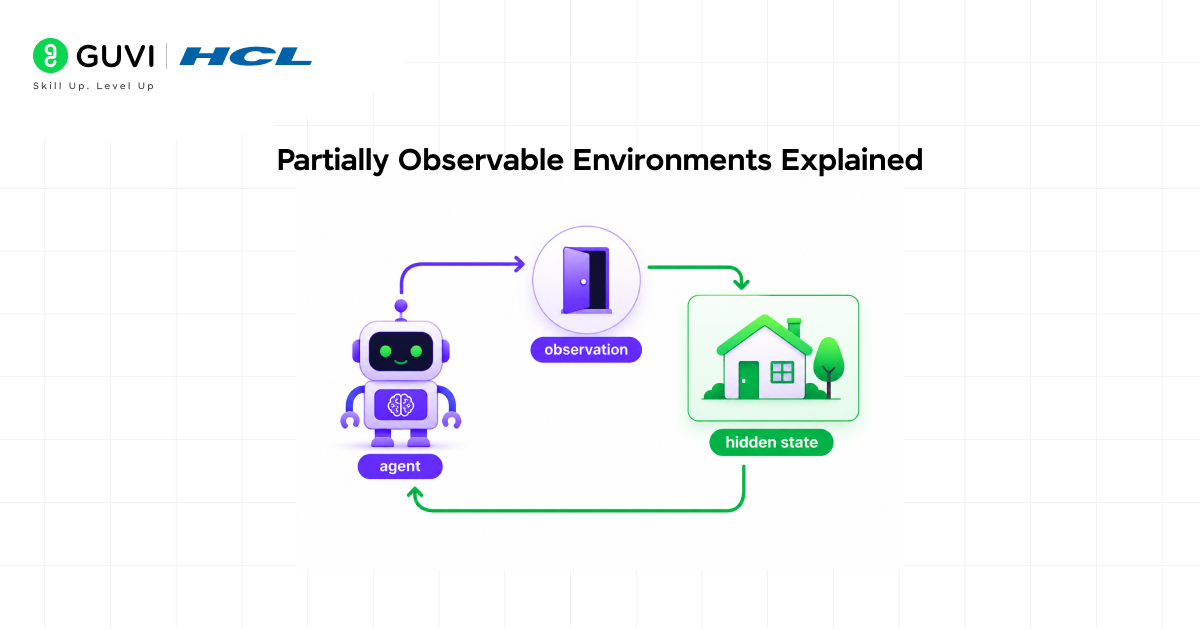
A partially observable environment is one where the agent cannot be certain of the state it is in because it does not have complete access to all the necessary information at any given point in time.
Model-based agents are particularly useful here.
For example:
- The environment around a self-driving car is partially observable because of limitations caused by fog or poor lighting.
- Robots may occasionally lose their sensors and experience temporary losses in signals.
- Security AI systems that monitor potential attacks may only have partial information about them.
Reflexive agents can perform poorly in such conditions because they only consider what is immediately present to them.
Model-based agents succeed in these scenarios because they carry historical state and prediction information forward.
Simple Reflex Agent vs Model-Based AI Agent
In complex real-world scenarios, the difference between these two architectures becomes significant.
| Feature | Simple Reflex Agent | Model-Based AI Agent |
| Memory | None | Present |
| Internal state | Absent | Present |
| Awareness of the environment | Current input | Present & past |
| Predictability | None | Present |
| Adaptability | Low | High |
| Suitability for complex systems | Low | High |
Internal State Tracking in AI Agents
It refers to remembering:
- Past actions performed by an agent.
- Changes in an environment.
- The user who interacts with an AI agent.
- What strategies have failed in the past?
- Long-term goals of an AI agent.
Without it, agents can seem lost in context and act like machines lacking any kind of memory, a situation which a machine learning agent tutor, unable to remember previous questions posed to it by a student, would exemplify.
World Models and Predictive Intelligence
World models are considered one of the most important advancements in artificial intelligence because they allow AI systems to predict possible outcomes before taking action.
They enable an AI system to simulate scenarios before acting, such as predicting traffic changes, estimating future investment outcomes, or identifying the risk of an object falling.
These predictions are generated through mathematical simulations and internal modeling rather than human-like thinking.
Reinforcement learning agents often use internal simulations to improve long-term planning in areas such as robotics, autonomous systems, and scientific AI.
Practical Python Example of a Model-Based AI Agent
A very simple illustration of internal state tracking could be as follows:
def observe_room(self, room):
If the room is not in itself.visited_rooms:
self.visited_rooms.append(room)
def decide_next_action(self):
if “Storage” not in self.visited_rooms:
return “Move to Storage Room.”
return “Return to Charging Dock.”
Advantages of Model-Based AI Agents
These agents offer significant advantages for sophisticated AI systems.
1. Better Decision Making
By processing historical and current information, these agents can make more informed decisions.
2. Works in Uncertain Environments
When there is missing or incomplete information about the environment, the internal world model helps the agent function safely and efficiently.
3. Predictive Intelligence
By understanding how the environment will behave with an action, better decisions are able to be made in the future.
4. Improved Adaptability
The model-based agent is able to adjust its actions and reasoning processes based on how the environment changes dynamically.
Limitations of Model-Based AI Agents
Although extremely powerful, these systems also have limitations.
1. Higher Computational Cost
It can be computationally intensive to constantly maintain and update a world model and simulate potential futures in it.
This can be particularly problematic with complex and constantly changing environments.
2. Difficult Environment Modeling
Building and updating an accurate world model can be challenging in highly dynamic environments.
Poor predictions based on incorrect models will likely result in poor decision-making.
3. Slower Decision Cycles
Unlike reactive agents that are designed to respond quickly, model-based agents often take a considerable amount of time to reason about the consequences of actions.
In extremely fast-paced applications such as robotic control, this can be a drawback.
Future of Model-Based AI Agents
The next progression for AI systems involves agents that can reason, plan, and learn without human intervention.
- Reinforcement learning.
- Memory systems.
- World models.
- Long-term planning.
- Multi-agent systems.
Future AI agents are expected to be capable of:
- Running full internal simulations of environments.
- Learning on an ongoing basis from their actions.
- Engaging in automated scientific research.
- Commanding and coordinating entire robot ecosystems autonomously.
To build stronger fundamentals and hands-on experience with AI agents, machine learning, and real-world automation projects, HCL GUVI’s AI & Machine Learning Course provide industry-focused training with practical implementation support.
Conclusion
A Model-Based AI Agent represents a major advancement in artificial intelligence by enabling systems to make decisions using memory, prediction, and environmental understanding.
Instead of responding only to immediate stimuli, these agents develop a comprehensive understanding of the world, track environmental changes, and forecast future possibilities before taking action.
This approach makes intelligent systems more flexible, responsive to context, and capable of operating efficiently in complex, unpredictable, real-world scenarios.
FAQs
1. What is a Model-Based AI Agent?
A Model-Based AI Agent is an intelligent system that uses an internal model of the environment to make decisions. It tracks previous states and predicts future outcomes instead of reacting only to current input.
2. Why are model-based agents important in AI?
They help AI systems operate effectively in partially observable or uncertain environments. This improves adaptability, prediction capability, and decision quality.
3. What is the difference between a reflex agent and a model-based agent?
A reflex agent reacts only to current observations, while a model-based agent maintains memory and internal state information to make smarter decisions.
4. Where are Model-Based AI Agents used?
They are used in autonomous vehicles, robotics, healthcare AI, virtual assistants, gaming systems, and industrial automation platforms.-Based AI Agents used?
5. What is a world model in artificial intelligence?
A world model is an internal representation of how an environment behaves. It helps the AI predict future states and estimate the impact of actions.
6. Can Model-Based AI Agents learn over time?
Yes. Modern model-based systems often combine reinforcement learning and neural networks to continuously improve prediction and decision-making capabilities.
Success Stories

About the Author
Vishalini Devarajan
An Aerospace Engineer turned content writer, I focus on making complex concepts easy to understand through well-structured, reader-friendly blogs. Whether it’s a technical topic or a non-technical one, I love creating content that is clear, engaging, and impactful.
View all posts by Vishalini Devarajan
Connect with me @












Did you enjoy this article?