


Artificial Intelligence and Machine Learning Articles
How to Evaluate LLM Outputs in Production Deployments
AI/ML Skills Gap 2026: Why Companies Can't Find Job-Ready Talent
20 AI/ML Interview Questions Recruiters Can Use Without a Tech Background - Best Guide
How Industry-Backed AI/ML Bootcamps Are Changing the AI/ML Hiring Pipeline - Best Guide 2026


Get In Touch For Details! Request More Information
AI Engineering: A Beginner-Friendly Guide to Building AI
Sep 08, 2026 6 Min Read 1107 Views
(Last Updated)
A few years ago, building an AI-powered product required a small army of researchers, data scientists, and infrastructure engineers working for months. Today, a single skilled developer can take a large language model, connect it to data sources, deploy it behind an API, and ship a production-ready AI feature in days.
That shift has created an entirely new discipline: AI engineering.
AI engineering sits at the intersection of software engineering and artificial intelligence. It is not research AI engineers do not typically train models from scratch or publish academic papers. It is not pure data science AI engineers are not primarily focused on statistical analysis or model selection. It is the practice of building, deploying, and maintaining AI-powered systems that work reliably in the real world.
This article explains what AI engineering is, what AI engineers actually do, what skills the role requires, how it differs from related roles, and what a career in this field looks like today.
Table of contents
- TL;DR
- Why AI Engineering Has Emerged as a Distinct Discipline
- What Does an AI Engineer Actually Do?
- Integrating LLM APIs into Products
- Building Retrieval-Augmented Generation (RAG) Systems
- Designing and Optimising AI Pipelines
- Model Evaluation and Quality Assurance
- Deployment and Infrastructure
- Core Skills Every AI Engineer Needs
- Python Programming
- LLM API Integration
- Prompt Engineering and Context Engineering
- Vector Databases and Embeddings
- Software Engineering Fundamentals
- Cloud Platforms and DevOps
- Evaluation and Observability
- Career in AI: Paths Into AI Engineering
- From Software Engineering
- From Data Science
- From Machine Learning Research
- Entering the Field Fresh
- What Makes a Great AI Engineer: Beyond Technical Skills
- Conclusion
- FAQs
- Do I need a degree in computer science or AI to become an AI engineer?
- Is AI engineering the same as machine learning engineering?
- What is the average salary for an AI engineer?
- What is the difference between an AI engineer and a prompt engineer?
- How long does it take to become an AI engineer?
- What should I look for before enrolling in an AI & ML course?
- How should I evaluate AI & ML certifications before enrolling?
TL;DR
- AI engineering is the practice of building production AI systems — not training models, but applying them effectively.
- AI engineers work with LLMs, APIs, data pipelines, vector databases, and deployment infrastructure.
- The role is distinct from data science, ML research, and traditional software engineering but draws on all three.
- Core skills include Python, API integration, prompt engineering, cloud deployment, and system design.
- AI engineering is one of the fastest-growing and highest-compensated technical roles in the industry today.
What Is AI Engineering?
AI engineering is the discipline of designing, building, deploying, and maintaining production-grade artificial intelligence systems and applications. It combines software engineering practices with machine learning, LLM APIs, data pipelines, and AI infrastructure to create AI solutions that are reliable, scalable, and practical for real-world use.
Why AI Engineering Has Emerged as a Distinct Discipline
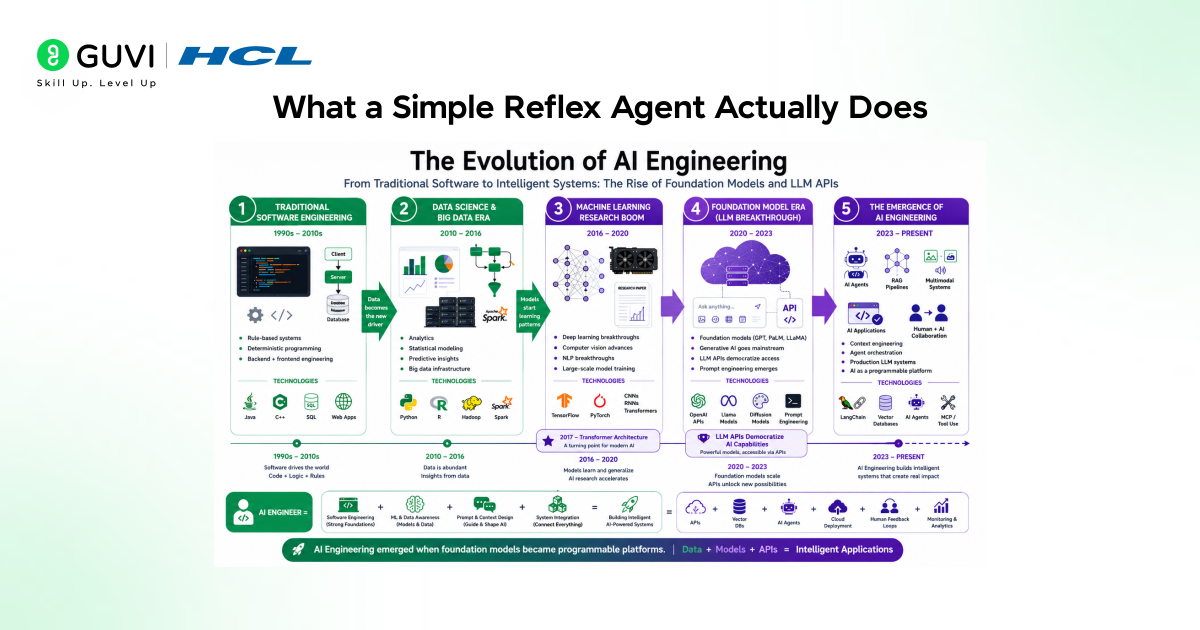
For most of AI’s history, applying machine learning in production required deep expertise in model training, statistics, and infrastructure. The barrier to entry was high. Most organisations that wanted AI capabilities needed specialised research teams.
The release of large language models and the APIs that provide access to them changed the equation fundamentally.
Suddenly, powerful AI capabilities were available to any developer who could make an API call. The hard part shifted from building the model to building the system around it: designing the prompts, managing the context, connecting the model to data sources, handling errors, ensuring reliability, and deploying the whole thing at scale.
This new layer of complexity between the raw model and the finished product is the domain of AI engineering. It requires skills that data scientists typically do not have (production software engineering), and skills that traditional software engineers typically do not have (understanding of model behaviour, prompting, and AI-specific failure modes).
AI engineering emerged to fill that gap.
What Does an AI Engineer Actually Do?
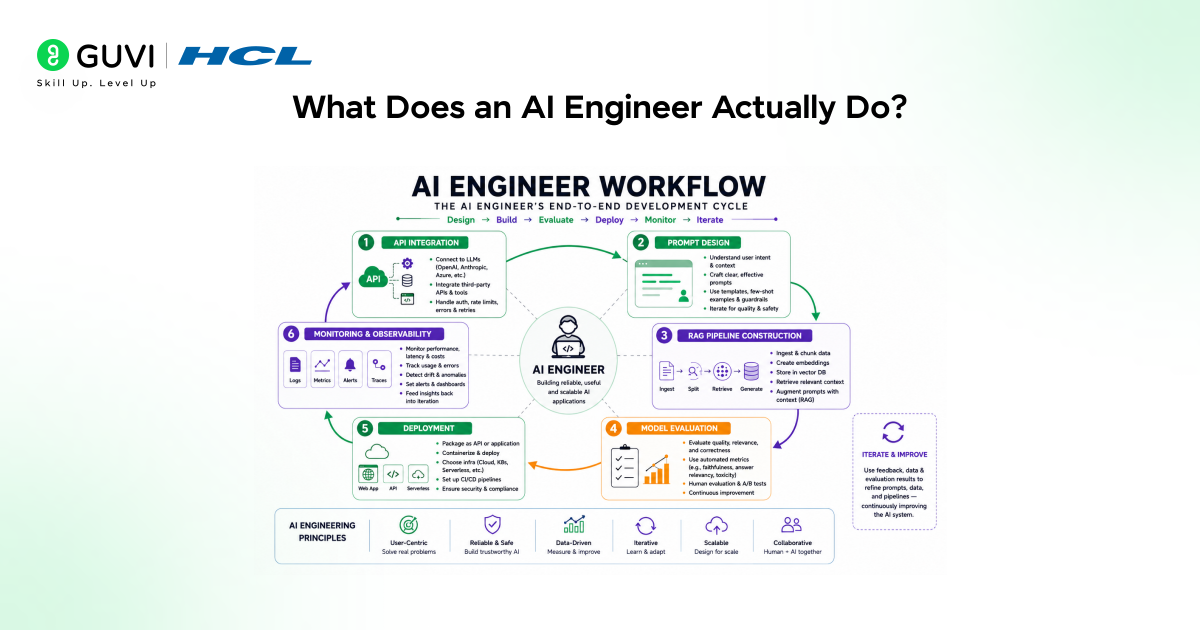
The day-to-day work of an AI engineer varies depending on the organisation and the product, but most roles involve some combination of the following activities.
Integrating LLM APIs into Products
The most common task in AI engineering is connecting a large language model to a product or workflow via API. This involves selecting the right model for the task, designing the system prompt and user prompt structure, handling API responses, managing token limits and costs, and building the application logic around the model’s outputs.
This sounds deceptively simple. In practice, it requires careful prompt engineering, robust error handling, fallback strategies for when the model produces incorrect or off-format outputs, and cost optimisation as usage scales.
Building Retrieval-Augmented Generation (RAG) Systems
Most AI applications need to ground the model’s responses in specific, up-to-date, or proprietary information that was not part of the model’s training data. RAG is the standard solution.
Building a RAG pipeline involves:
- Processing and chunking source documents into retrievable segments.
- Generate embeddings for each chunk using an embedding model.
- Storing those embeddings in a vector database such as Pinecone, Weaviate, or Chroma.
- At inference time, retrieving the most relevant chunks based on the user’s query.
- Injecting the retrieved content into the model’s context window alongside the user’s question.
Designing a RAG system that retrieves the right content reliably rather than superficially similar but contextually irrelevant content is a significant engineering challenge that defines much of the practical work in AI engineering.
Designing and Optimising AI Pipelines
Complex AI applications involve chains of operations: a query is processed, relevant data is retrieved, a model generates an initial response, another model evaluates or refines it, the output is validated, and the final result is returned to the user. Building these multi-step AI pipelines reliably with proper error handling, latency management, and observability is core AI engineering work.
Model Evaluation and Quality Assurance
AI outputs are probabilistic and variable. An AI engineer must build evaluation frameworks that measure output quality systematically, not just check that the API returned something, but verify that what it returned is accurate, relevant, safe, and appropriately formatted. This often involves building automated evaluation pipelines using LLMs as judges, human evaluation protocols, and regression test suites.
Deployment and Infrastructure
AI engineers are responsible for deploying AI systems to production environments. This includes containerising applications, configuring cloud infrastructure, setting up monitoring and alerting, managing API keys and credentials, and ensuring the system scales gracefully under varying load. Familiarity with platforms like AWS, Google Cloud, or Azure and tools like Docker and Kubernetes is typically required.
Explore: State Space Search in AI: Beginner’s Complete Guide
According to LinkedIn’s 2024 Jobs on the Rise report, AI Engineer ranked among the fastest-growing job titles globally, with demand surging dramatically year over year as organizations accelerated AI adoption across industries. The role often commands salaries higher than many traditional senior software engineering positions, reflecting both the shortage of experienced AI talent and the significant business impact AI engineers can create through automation, intelligent systems, and generative AI applications.
Core Skills Every AI Engineer Needs
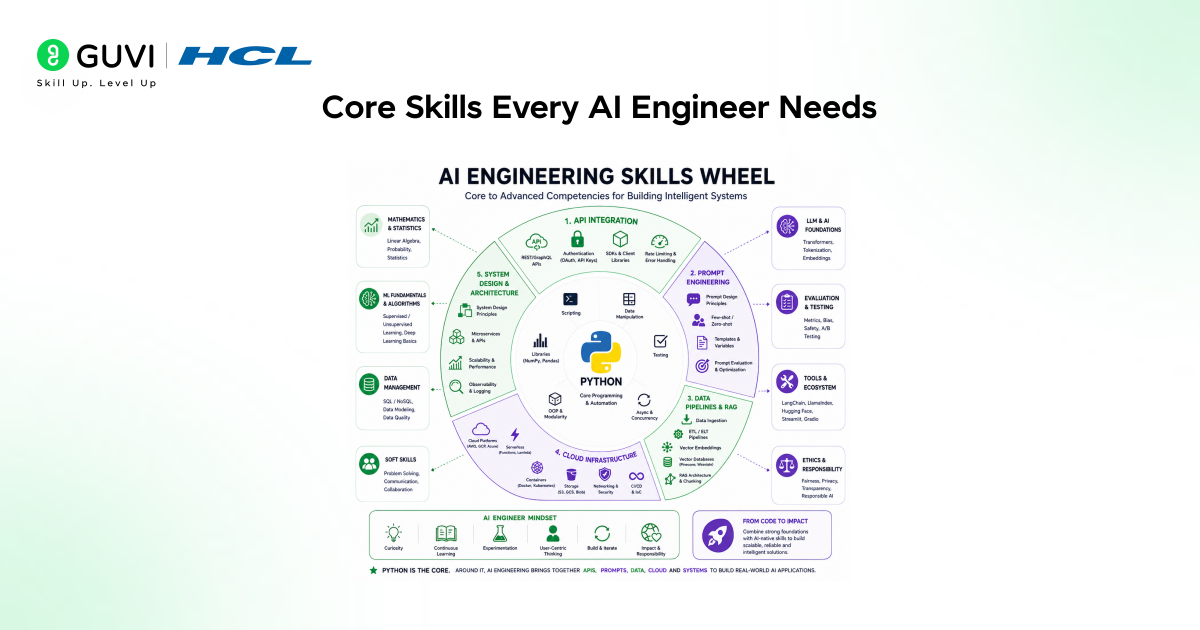
AI engineering draws from multiple disciplines. The skill set is broader than most technical roles, spanning software engineering, applied machine learning, and increasingly, system architecture.
1. Python Programming
Python is the primary language of AI engineering. The entire ecosystem of AI tools, LangChain, LlamaIndex, Hugging Face, OpenAI SDK, vector databases, and embedding libraries is Python-native. Strong Python skills, including familiarity with async programming, data structures, and package management, are non-negotiable.
2. LLM API Integration
AI engineers must be fluent in working with LLM APIs from providers including OpenAI, Anthropic, Google, Mistral, and open-source alternatives. This includes understanding tokenisation, context window management, structured output generation, function calling, streaming responses, and cost optimisation across different models and pricing tiers.
3. Prompt Engineering and Context Engineering
Knowing how to communicate with language models effectively is a core technical skill, not a soft skill. This includes designing system prompts, constructing few-shot examples, managing context window allocation, using chain-of-thought techniques, and implementing context engineering strategies that ensure the model receives the right information in the right format.
4. Vector Databases and Embeddings
Working with vector databases is a routine part of AI engineering. This requires understanding how embeddings work, how to choose and use embedding models, how to design chunking strategies for documents, and how to configure similarity search to return relevant rather than merely similar results.
5. Software Engineering Fundamentals
AI engineers write production code. This means applying software engineering best practices: version control with Git, writing tests, building APIs with FastAPI or similar frameworks, designing modular and maintainable code, and understanding system design patterns for scalable applications.
6. Cloud Platforms and DevOps
Deploying AI systems requires comfort with cloud infrastructure. AI engineers work with AWS, Google Cloud, or Azure for compute, storage, and managed services. Familiarity with Docker for containerisation, CI/CD pipelines for automated deployment, and monitoring tools for observability is increasingly expected at the senior level.
7. Evaluation and Observability
Building AI systems that work in demos is straightforward. Building systems that work reliably in production requires rigorous evaluation. AI engineers need to understand how to measure output quality, build automated evaluation pipelines, detect regressions when models are updated, and monitor production systems for quality degradation over time.

Career in AI: Paths Into AI Engineering
AI engineering is accessible from multiple career backgrounds. The field is young enough that there is no single canonical path, and experienced engineers who transition from adjacent roles can move quickly.
From Software Engineering
Software engineers are well-positioned to enter AI engineering. The core software skills are Python, APIs, system design, and deployment transfer directly. The gap is typically in understanding LLM behaviour, prompt engineering, RAG architecture, and evaluation. Engineers with a strong software background can close this gap through focused study and hands-on projects within three to six months.
From Data Science
Data scientists understand models, data pipelines, and experimentation, all relevant to AI engineering. The gap is typically in production software engineering: building robust APIs, deploying to cloud infrastructure, writing maintainable code at scale. Data scientists who invest in strengthening their software engineering fundamentals are well-positioned to transition.
From Machine Learning Research
ML researchers have deep knowledge of model architectures, training dynamics, and evaluation invaluable for senior AI engineering roles. The transition typically requires developing application-layer skills: working with APIs, building user-facing systems, and thinking about product requirements rather than research benchmarks.
Entering the Field Fresh
For those entering AI engineering without a directly adjacent background, a structured learning path matters. Solid Python foundations, a focused course in LLM application development, hands-on projects building RAG systems and AI pipelines, and a portfolio demonstrating production-quality work are the most effective routes to a first AI engineering role.
What Makes a Great AI Engineer: Beyond Technical Skills
Technical proficiency is necessary but not sufficient for excellence in AI engineering. The most effective AI engineers combine technical depth with a set of broader competencies that shape how they approach problems.
- Systems thinking: AI systems interact with users, data sources, other services, and infrastructure in complex ways. Great AI engineers think about the whole system, not just the model call.
- Product intuition: AI engineering is ultimately about building things that work for people. Engineers who understand what users actually need — and can translate that into system requirements create far more valuable products than those who focus purely on technical optimisation.
- Comfort with uncertainty: AI outputs are probabilistic. Plans change as model capabilities evolve. The AI engineering landscape shifts rapidly. Effective AI engineers embrace this uncertainty rather than being paralysed by it.
- Ethical awareness: AI systems can cause harm through biased outputs, privacy violations, misuse, or unintended consequences. AI engineers who proactively consider these risks and build appropriate safeguards create more trustworthy systems.
- Continuous learning: The field changes faster than almost any other in technology. New models, new frameworks, and new architectural patterns emerge constantly. A genuine commitment to staying current is non-negotiable for long-term success in AI engineering.
If you want to learn more about building skills for Claude Code and automating your procedural knowledge, do not miss the chance to enroll in HCL GUVI’s Intel & IITM Pravartak Certified Artificial Intelligence & Machine Learning courses. Endorsed with Intel certification, this course adds a globally recognized credential to your resume, a powerful edge that sets you apart in the competitive AI job market.
Conclusion
AI engineering is the discipline that turns AI’s potential into a production reality. It is the work of connecting powerful models to the data, infrastructure, and interfaces that make them genuinely useful and of ensuring those systems are reliable, safe, and scalable enough to trust with real-world tasks.
The role is demanding precisely because it spans so many domains: software engineering, applied machine learning, system design, evaluation, and product thinking. But that breadth is also what makes it one of the most intellectually engaging and practically impactful technical careers available today.
For software engineers looking to move into AI, data scientists looking to move into production, or new entrants to the field, AI engineering offers a clear value proposition: the skills are learnable, the demand is high, the work is genuinely consequential, and the field is young enough that those who invest now will help define what it becomes.
FAQs
1. Do I need a degree in computer science or AI to become an AI engineer?
Not necessarily. While a computer science or engineering degree provides a strong foundation, many working AI engineers come from self-taught backgrounds, bootcamps, or adjacent fields. What matters most is a demonstrable ability to build production AI systems shown through a portfolio of real projects. Practical skills and evidence of applied work consistently outweigh formal credentials in this field.
2. Is AI engineering the same as machine learning engineering?
They overlap but are distinct. Machine learning engineering focuses on training, optimising, and deploying custom ML models requiring deep knowledge of model architectures and MLOps infrastructure. AI engineering, particularly in the LLM era, more often focuses on building applications with pre-trained models via API, requiring strong software engineering, prompt design, RAG architecture, and system design skills. Some roles and organisations use the terms interchangeably; in practice, the distinction matters for understanding what skills a specific role requires.
3. What is the average salary for an AI engineer?
AI engineering salaries vary significantly by location, experience, and organisation. In the United States, mid-level AI engineers typically earn between $150,000 and $220,000 in total compensation. Senior and staff-level roles at major technology companies frequently exceed $300,000. Outside the US, salaries are lower, but the premium over traditional software engineering roles is consistent. The field remains supply-constrained, keeping compensation high relative to adjacent technical roles.
4. What is the difference between an AI engineer and a prompt engineer?
Prompt engineering is one skill within AI engineering, the practice of designing effective inputs for language models. An AI engineer is a broader role that encompasses prompt design alongside software engineering, system architecture, data pipeline construction, deployment, evaluation, and infrastructure. “Prompt engineer” as a standalone job title was common early in the LLM era but has largely been absorbed into the broader AI engineer role as the field has matured.
5. How long does it take to become an AI engineer?
For someone with existing software engineering experience, a focused transition into AI engineering typically takes three to six months of dedicated learning and project-building. For those coming from data science or ML backgrounds, a similar timeline applies for developing the production engineering skills the role requires. For those entering the field fresh, building the foundational Python, software engineering, and AI application skills needed for a first role typically takes twelve to eighteen months of structured learning.
What should I look for before enrolling in an AI & ML course?
Look for a structured curriculum, practical projects, experienced mentors, updated AI tools, certification value, and career support. Compare programmes carefully before enrolling in an AI & ML Programme.
How should I evaluate AI & ML certifications before enrolling?
Evaluate AI & ML certifications based on industry recognition, curriculum relevance, hands-on learning, project experience, and career outcomes. You can also compare what’s included in the HCL GUVI AI & ML Programme before making a decision.
Success Stories

About the Author
Vishalini Devarajan
An Aerospace Engineer turned content writer, I focus on making complex concepts easy to understand through well-structured, reader-friendly blogs. Whether it’s a technical topic or a non-technical one, I love creating content that is clear, engaging, and impactful.
View all posts by Vishalini Devarajan
Connect with me @







Did you enjoy this article?