


Artificial Intelligence and Machine Learning Articles
Finance Manager to Data Analytics: Career Growth, Salary and Seniority
How to Evaluate LLM Outputs in Production Deployments
AI/ML Skills Gap 2026: Why Companies Can't Find Job-Ready Talent
20 AI/ML Interview Questions Recruiters Can Use Without a Tech Background - Best Guide


Get In Touch For Details! Request More Information
CycleGAN Explained: AI Image Translation
Aug 18, 2026 5 Min Read 787 Views
(Last Updated)
Modern AI systems are revolutionizing the way machines comprehend and translate images. It is now possible for an AI to turn an image of one type into another while completely retaining its shape and context.
One of the most important breakthroughs in image translation was CycleGAN. The primary advantage of CycleGAN over existing image translation models was that it did not require paired images for training. Therefore, it was particularly useful in real-world AI applications where paired images are hard to find.
This article explores how CycleGAN works, its importance in deep learning, its architecture, applications, limitations, and future scope in computer vision.
Table of contents
- TL;DR
- Why Image Translation Matters
- The Problem with Traditional Image Translation
- Understanding GAN Models
- What Makes CycleGAN Different
- How CycleGAN Works
- Generator and Discriminator Architecture
- Understanding Cycle Consistency Loss
- Real World Applications of CycleGAN
- Style Transfer
- Medical Imaging
- Autonomous Driving
- Satellite Imagery
- CycleGAN vs Traditional GAN Models
- CycleGAN vs Diffusion Models
- Why Diffusion Models Are So Popular
- Why CycleGAN Still Matters
- Implementing CycleGAN in Python
- Challenges and Limitations of CycleGAN
- Future of CycleGAN in AI
- Conclusion
- FAQs
- What is CycleGAN used for?
- How is CycleGAN different from traditional GAN models?
- What is cycle consistency loss in CycleGAN?
- Does CycleGAN require paired datasets?
- Is CycleGAN still relevant in 2026?
- Which libraries are commonly used to implement CycleGAN?
TL;DR
- CycleGAN is a deep learning model used for unpaired image translation.
- It falls under the category of Generative Adversarial Networks (GANs).
- The most interesting feature is that it does not require pairwise datasets to be trained.
- It is extremely popular in transferring the style of images, and various applications are also found in healthcare and automotive systems.
- Its lightweight architecture and fast image translation capabilities keep it highly relevant.
What is CycleGAN?
CycleGAN is a deep learning model used for image-to-image translation without requiring paired training datasets. It learns how to transform images from one domain into another while preserving the original structure and content. This allows tasks such as converting horses into zebras, turning sketches into realistic images, or changing image styles without needing exact input-output image pairs during training.
Why Image Translation Matters
Image translation helps an AI system to convert one type of image to another. For instance, AI can learn to transform daytime images of roads into nighttime scenarios to implement a self-driving system. In the same way, healthcare-based platforms can enhance the quality of images and X-ray scans using image translation methods.
Earlier image translation systems struggled because they depended heavily on labeled datasets and complex manual rules.
The Problem with Traditional Image Translation
Most systems of image translation till that time were trained with paired data, that is, images that needed to be translated along with their replica in another domain.
Example:
Horse image → Exact zebra replica.
However, obtaining such paired images is not feasible and requires much effort and investment. In fields such as medical and satellite imaging, the desired paired image might not be found at all.
This became one of the biggest obstacles in applying AI for real-time image translation and also acted as an impediment to achieving scalability.
Understanding GAN Models
A Generative Adversarial Network (GAN) is a deep learning framework that uses two neural networks. You can also explore how generative AI models work in modern AI systems.
- Generator.
- Discriminator.
The Generator creates synthetic images and attempts to make them appear realistic.
The Discriminator evaluates whether the generated image is real or artificially created.
Both networks improve continuously during training, allowing the GAN to generate highly realistic images.
What Makes CycleGAN Different
The biggest limitation solved by CycleGAN was the dependency on paired datasets for training.
In contrast to models based on directly learning a one-to-one mapping, CycleGAN can learn the relationship between images of two domains independently.
Examples include:
- Horse and zebra transformation.
- Winter and summer scenery conversion.
- Photo to sketch translation.
- Sketch to photo conversion.
This makes CycleGAN practical for real-world AI applications where paired datasets are difficult to obtain.
How CycleGAN Works
CycleGAN utilizes:
- Two generators.
- Two discriminators.
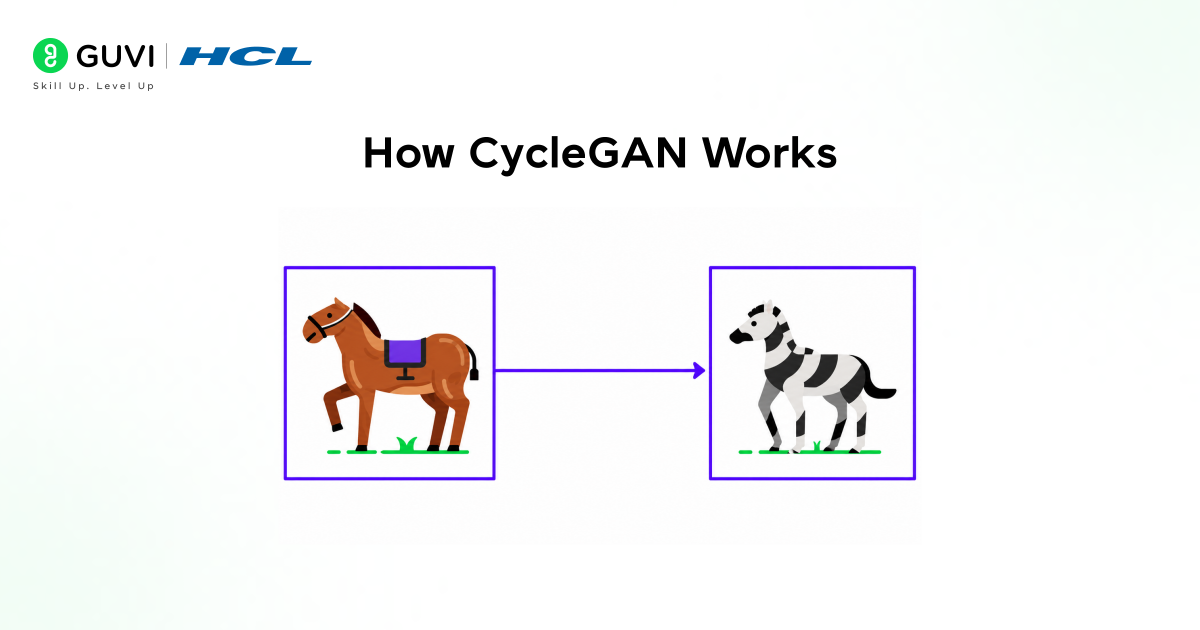
The first generator translates an image of Domain A into a translated image of Domain B.
Example:
Horse → Zebra.
The second generator translates the translated image of Domain B back into an image of Domain A.
Example:
Zebra → Horse.
Each discriminator checks the authenticity of the image being generated from a particular domain.
Through this two-step method, the model generates the required translated images.
Generator and Discriminator Architecture
The Generator network uses convolution layers, residual blocks, and upsampling layers. These layers are responsible for preserving the shape of the image while translating its exterior style.
The Discriminator model uses the PatchGAN architecture to analyze smaller patches of the image rather than the entire image.
This helps reduce redundancy and improve the texture quality of the generated image. Modern AI systems also depend on layered generative AI architectures for efficient image processing.
Understanding Cycle Consistency Loss
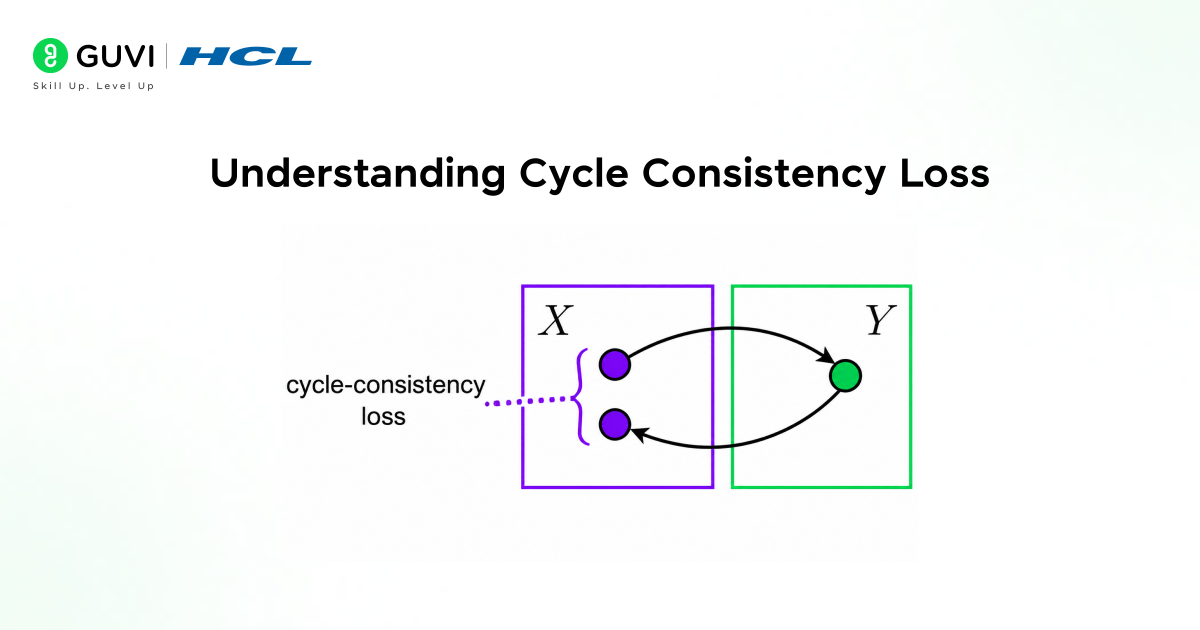
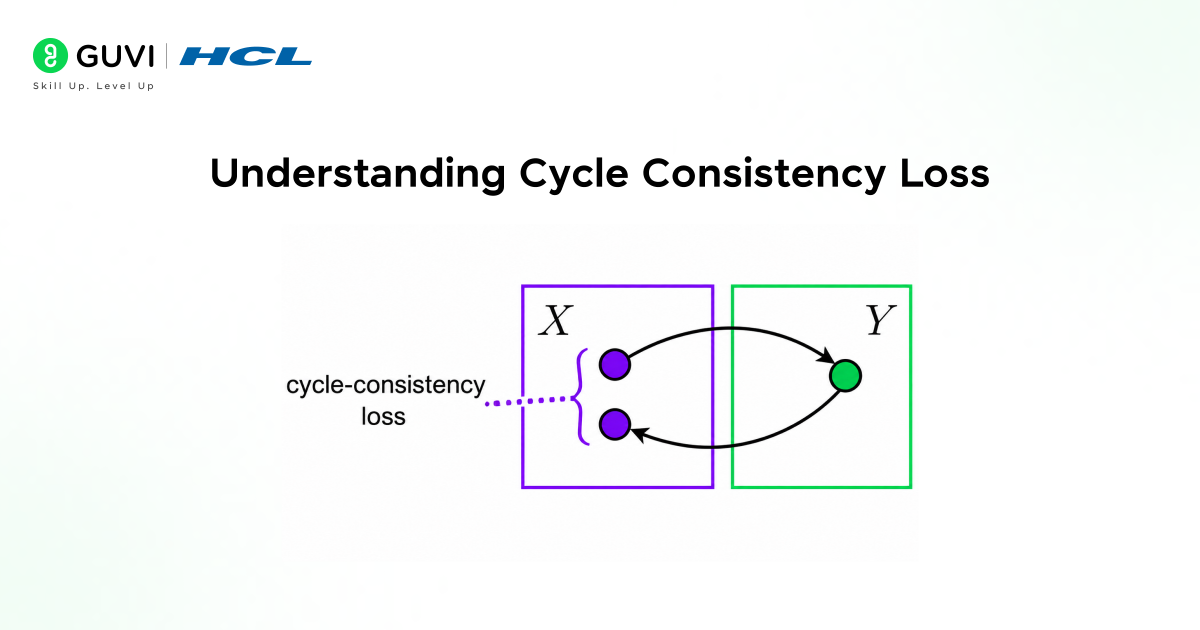
The basic concept of the CycleGAN architecture is cycle consistency loss.
If an image from one domain is converted into another and then translated back again, ending with a similar image to the original, it signifies that the model has achieved good translation.
Example:
Horse → Zebra → Horse.
Cycle consistency loss helps maintain the image in its initial form even after translation and restoration.
One of the most famous CycleGAN demonstrations transformed horse images into zebras with remarkably realistic results, showcasing how models could learn image-to-image translation without requiring perfectly matched training pairs. Today, similar CycleGAN-based approaches are being explored in medical imaging, where they can help synthesize transformations between modalities such as MRI and CT scans without needing paired datasets, addressing one of the major challenges in healthcare AI data collection.
Real World Applications of CycleGAN
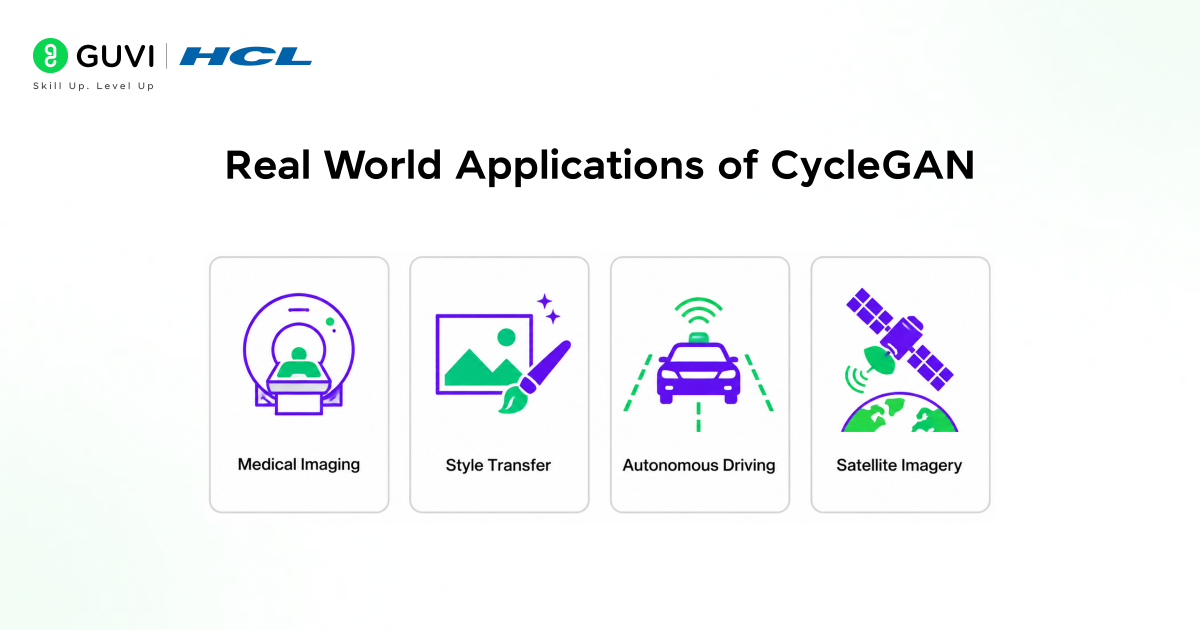
1. Style Transfer
Style transfer can be utilized by artists and designers for the following purposes:
- Converting artwork from one style into another.
- Creating cartoon images.
- Generating pencil sketch images.
Unlike traditional style filters, CycleGAN can learn deeper artistic transformations.
2. Medical Imaging
Researchers in healthcare can use CycleGAN for:
- MRI to CT image transformation.
- Image resolution enhancement.
- Noise reduction in scans.
These applications can assist in better diagnosis.

3. Autonomous Driving
Autonomous vehicles need extensive environmental datasets. CycleGAN can be used for generating:
- Rainy road scenarios.
- Nighttime driving situations.
- Foggy and hazy images.
This improves the robustness of computer vision systems.
4. Satellite Imagery
Satellite imaging is another useful application of CycleGAN for:
- Terrain mapping.
- Cloud removal.
- Seasonal terrain translation.
It can also assist in agriculture, land monitoring, and climate analysis.
CycleGAN vs Traditional GAN Models
The main goal of a traditional GAN is to generate realistic images from randomly generated noise.
However, CycleGAN specifically focuses on translating images from one domain to another.
Some of the key differences between traditional GAN and CycleGAN are:
- Traditional GANs usually require paired datasets, while CycleGAN can work without them.
- In traditional GANs, images are generated independently, while CycleGAN retains structural consistency between images after translation.
- CycleGAN is more applicable to real-world image translation problems than traditional GANs.
CycleGAN vs Diffusion Models
Diffusion models are currently very popular for image generation because they can achieve excellent image quality. However, CycleGAN is still useful in several applications.
Why Diffusion Models Are So Popular
Diffusion models can be applied to achieve:
- High realism image generation.
- Creative and artistic AI systems.
- Large-scale image generation applications.
However, they are resource-intensive to train.
Why CycleGAN Still Matters
- Training is relatively cheaper.
- Real-time inference is quite fast.
- Deployment on smaller systems is feasible.
- Performance on structured image translation tasks is quite strong.
You can also explore other generative AI models used in modern AI systems.
Implementing CycleGAN in Python
Here is a basic code example to load a pretrained CycleGAN model in PyTorch.
import torch
from torchvision import transforms
from PIL import Image
model = torch.hub.load(
‘junyanz/pytorch-CycleGAN-and-pix2pix’,
‘cyclegan’,
pretrained=True
)
image = Image.open(“input.jpg”)
transform = transforms.Compose([
transforms.Resize((256, 256)),
transforms.ToTensor()
])
input_tensor = transform(image).unsqueeze(0)
with torch.no_grad():
output = model(input_tensor)
print(“Image translation completed.”)
To better understand the deep learning and computer vision concepts behind CycleGAN, learn more about GAN models, neural networks, and AI-based image processing through relevant e-books.
Challenges and Limitations of CycleGAN
Even with all its advantages, CycleGAN does have some limitations.
- Structural distortion: It might distort important object structures, which can become an issue for domains like healthcare.
- Unstable training: Slight changes in hyperparameters might lead to completely different results.
- High computational cost: Large-scale translation is still resource-intensive.
- Lack of control: Precision in fine-tuning is comparatively limited.
Understanding these factors is important before implementing CycleGAN in production systems.
Future of CycleGAN in AI
While Vision Transformers and attention-based models have become popular in image generation and translation, researchers are still trying to optimize and improve CycleGAN.
CycleGAN is now being combined with:
- Vision Transformers.
- Attention mechanisms.
- Lightweight AI models.
- Frequency-based learning systems.
These methods help improve image quality, stability, and efficiency.
Hybrid GAN models combined with diffusion models for achieving better real-time performance and finer control are also being explored. You can further improve your practical skills through real-world PyTorch projects.
If you want practical experience building deep learning projects like CycleGAN, HCL GUVI’s AI and ML programs can help you learn how to train and deploy neural networks and computer vision models using frameworks such as PyTorch and TensorFlow through hands-on projects.
Conclusion
CycleGAN has revolutionized image translation by overcoming the need for paired images.
Its ability to train on unpaired image domains enabled the development of applications across healthcare, self-driving vehicles, digital art, and computer vision research.
Even in an era dominated by diffusion and transformer-based models, CycleGAN remains important for its real-time performance and relative computational efficiency.
For anyone learning GANs and modern AI image translation, CycleGAN remains a foundational architecture.
FAQs
1. What is CycleGAN used for?
CycleGAN is mainly used for unpaired image translation tasks such as style transfer, medical imaging, satellite imagery transformation, and autonomous driving simulations.
2. How is CycleGAN different from traditional GAN models?
Traditional GANs mainly generate images from random noise, while CycleGAN focuses on translating images between two domains without requiring paired datasets.
3. What is cycle consistency loss in CycleGAN?
Cycle consistency loss ensures that when an image is translated from one domain to another and back again, the final output remains similar to the original image.
4. Does CycleGAN require paired datasets?
No. This is one of the biggest advantages of CycleGAN. It can learn from unpaired datasets where direct image matches are unavailable.
5. Is CycleGAN still relevant in 2026?
Yes. Although diffusion models are highly popular, CycleGAN remains valuable for lightweight and real-time image translation tasks.
6. Which libraries are commonly used to implement CycleGAN?
Developers commonly use PyTorch and TensorFlow for building and training CycleGAN models because both frameworks provide strong deep learning support.
Success Stories

About the Author
Vishalini Devarajan
An Aerospace Engineer turned content writer, I focus on making complex concepts easy to understand through well-structured, reader-friendly blogs. Whether it’s a technical topic or a non-technical one, I love creating content that is clear, engaging, and impactful.
View all posts by Vishalini Devarajan
Connect with me @












Did you enjoy this article?