


Artificial Intelligence and Machine Learning Articles
Finance Manager to Data Analytics: Career Growth, Salary and Seniority
How to Evaluate LLM Outputs in Production Deployments
AI/ML Skills Gap 2026: Why Companies Can't Find Job-Ready Talent
20 AI/ML Interview Questions Recruiters Can Use Without a Tech Background - Best Guide


Get In Touch For Details! Request More Information

Sigmoid Activation Function: A Complete Beginner’s Guide
Jul 06, 2026 6 Min Read 1271 Views
(Last Updated)
If you’ve ever wondered how neural networks decide if an email is spam or a medical AI outputs cancer probability from a scan, sigmoid activation is usually behind it. It converts raw numbers, large positives to negatives, into a bounded 0-1 range, perfect for probabilistic decisions.
One of the oldest neural network concepts (popularized by McCulloch and Pitts in 1943), the sigmoid remains essential for binary classification where outputs need probability interpretation. This guide covers its formula, role in networks, vanishing gradient issues, Python implementation, and modern best practices.
In this article, we will walk through what the sigmoid activation function is, the mathematical formula behind it, why activation functions are needed in the first place, how sigmoid is used in neural networks, what the vanishing gradient problem is and why sigmoid causes it, how to implement it in Python, and when you should and should not use it in your models.
Table of contents
- Quick TL;DR:
- OVERVIEW OF SIGMOID FUNCTION
- Why Do Neural Networks Need Activation Functions at All?
- The Sigmoid Formula and What It Does to Numbers
- The Derivative of Sigmoid: Why It Matters for Training
- Backpropagation Needs Derivatives
- Sigmoid's Clean Derivative Formula
- The Problem: Derivatives Fade to Zero
- The Vanishing Gradient Problem
- How It Happens During Backpropagation
- The Math: Exponential Gradient Decay
- Implementing Sigmoid in Python
- When to Use Sigmoid and When Not To
- 1 Rule: Use a sigmoid in the output layer for binary classification.
- 2nd Rule: Avoid sigmoid in hidden layers of deep networks.
- 3rd Rule: Use ReLU and variants (Leaky ReLU, ELU) for hidden layers.
- Rule: For multi-class (>2 classes), use softmax in the output layer.
- Final Thoughts
- Frequently Asked Questions
- Why not use sigmoid in hidden layers anymore?
- What's the difference between sigmoid and softmax?
- Is logistic regression just sigmoid?
- How do I avoid sigmoid numerical issues in code?
- When sigmoid output is 0.85, what does that mean?
Quick TL;DR:
- Maps any real number to 0-1 range: σ(x) = 1 / (1 + e^(-x))
- Adds non-linearity so neural networks learn complex patterns
- Perfect for binary classification output (e.g., spam/not spam probabilities)
- Derivative σ'(x) = σ(x)(1-σ(x)) enables backpropagation
- Causes vanishing gradients in deep layers (gradients shrink to ~0)
- Use in output layers only; ReLU is better for hidden layers
What Is the Sigmoid Activation Function?
The sigmoid activation function is a mathematical function that converts any real-valued input into an output between 0 and 1. It produces a smooth S-shaped curve, making it especially useful for representing probabilities in binary classification problems within machine learning and neural networks.
OVERVIEW OF SIGMOID FUNCTION
The sigmoid function maps any real-valued input to the interval 0 to 1, making it particularly useful for neural networks where output values need to be interpreted as probabilities. The decision boundary in binary classification is typically set at a threshold of 0.5. If the sigmoid output is greater than 0.5, the input is classified as one class as the other.
The formula is σ(x) = 1 / (1 + e^(-x)), where e is Euler’s number (approximately 2.718), and x is the input value.
Why Do Neural Networks Need Activation Functions at All?
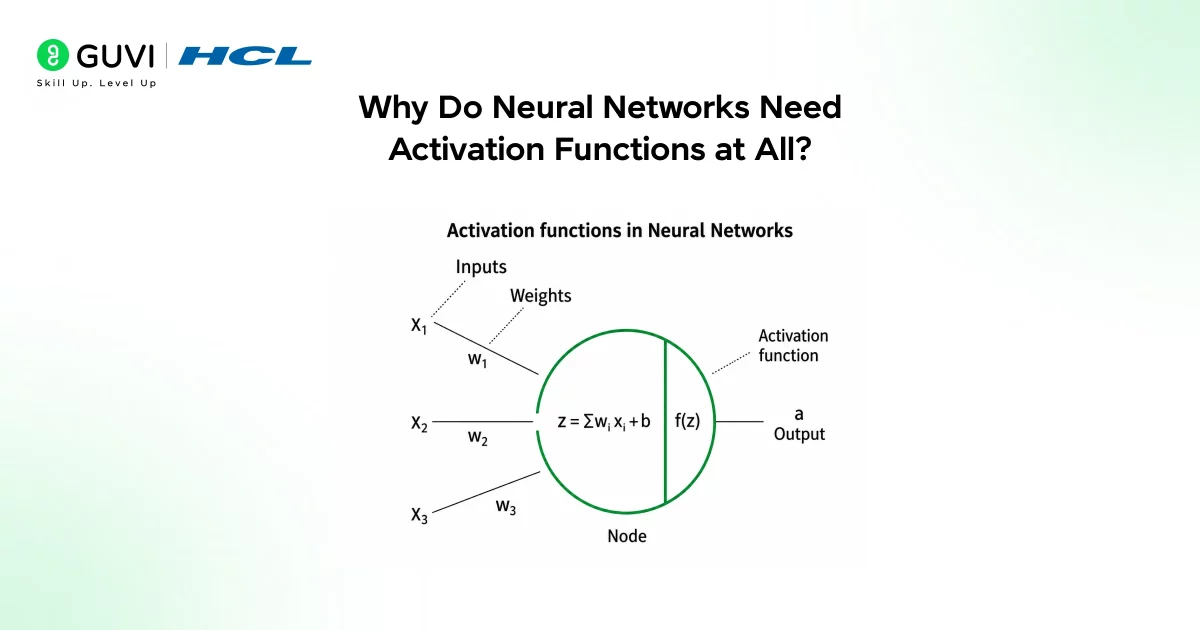
Before getting deeper into sigmoid specifically, it is worth understanding why activation functions exist in the first place.
- Without one, a neural network, no matter how many layers it has, behaves like a single linear function. And a single linear function cannot learn the complex, non-linear patterns that make neural networks powerful.
- Think about a problem like recognizing handwritten digits. The relationship between the pixel values in an image and the digit it represents is not linear; you cannot draw a straight line through the data and separate the classes cleanly.
- The introduction of the sigmoid function as an activation function adds non-linearity to neural networks, enabling them to learn complex patterns and approximate intricate relationships between input and output data.
- Without non-linearity, stacking more layers would add no expressive power; it would just be the same linear transformation repeated. Activation functions are what allow networks to learn curves, boundaries, and complex decision surfaces.
The Sigmoid Formula and What It Does to Numbers
- The Sigmoid Formula Explained
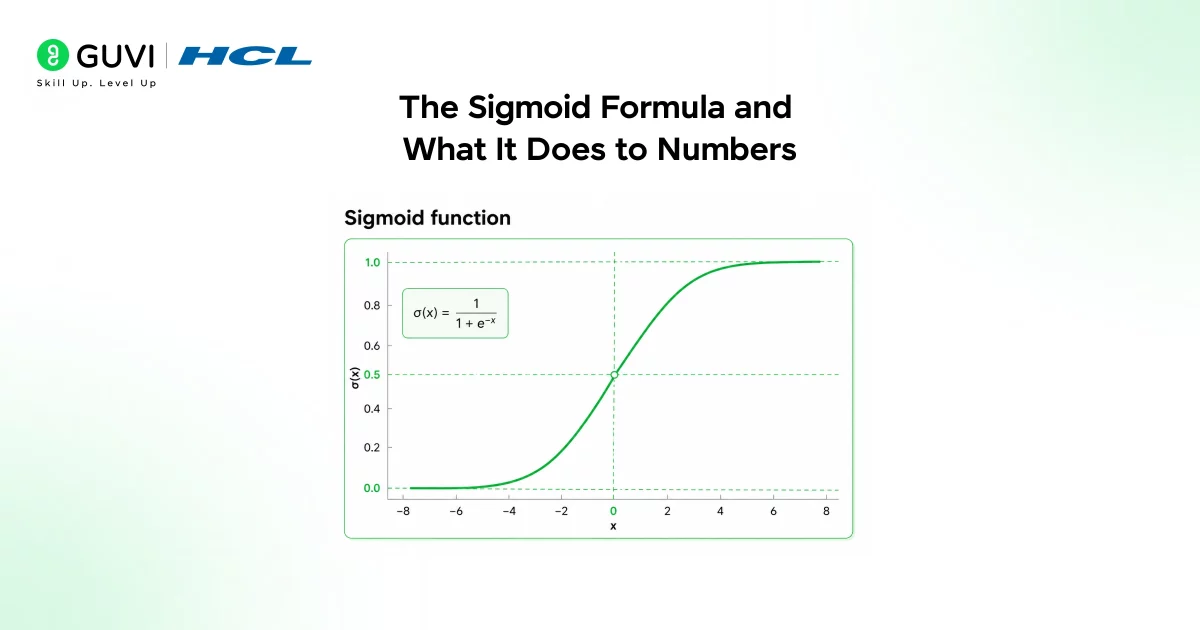
The sigmoid formula, denoted as σ(x) = 1 / (1 + e^(-x)), defines a mathematical function that transforms any real number input into a value strictly between 0 and 1. This function is fundamental in machine learning, particularly in neural networks, because it introduces non-linearity while bounding outputs in a predictable range.
The exponential term e^(-x) is key here, it responds dramatically to the sign and magnitude of x, creating the function’s unique shape. Understanding this formula helps demystify how models like logistic regression make probabilistic predictions.
- Behavior for Large Positive and Negative Inputs
When x is a large positive number, such as 10 or 100, the term e^(-x) becomes extremely tiny, approaching zero because the exponent is a large negative value. This makes the denominator 1 + e^(-x) roughly equal to 1, so σ(x) approaches 1.
Conversely, for a large negative x, like -10 or -100, e^(-x) explodes to a very large number since -x is positive and large. The denominator then grows enormous, pushing σ(x) close to 0. These extremes flatten out the curve, ensuring outputs saturate at the boundaries rather than shooting off to infinity.
- The Middle Ground and Characteristic S-Shape
At x = 0, the formula simplifies neatly: e^(-0) = 1, so σ(0) = 1 / (1 + 1) = 0.5, marking the inflection point. Around zero, the function rises steeply, transitioning smoothly from near 0 to near 1. This creates the iconic S-shaped curve, also called a logistic curve.
The steep middle section captures sensitivity to small changes in x, while the flat tails at both ends prevent over-amplification. This shape mimics natural growth processes, like population models, and is why it’s so effective in modeling decision boundaries.
- Probabilistic Interpretation in Neural Networks
The sigmoid’s outputs always staying between 0 and 1 isn’t a mere coincidence; it’s what allows direct interpretation as probabilities. In a neural network’s output layer for binary classification, a sigmoid value of 0.85 means the model estimates an 85% probability for the positive class (e.g., “spam” or “fraud”).
This makes sigmoid ideal for tasks like spam detection, disease diagnosis, or fraud detection, where you need calibrated confidence scores. During training, models learn to adjust inputs so sigmoid maps them to meaningful probabilities, enabling threshold-based decisions like classifying above 0.5 as positive.
How Sigmoid Powers Neural Network Decisions
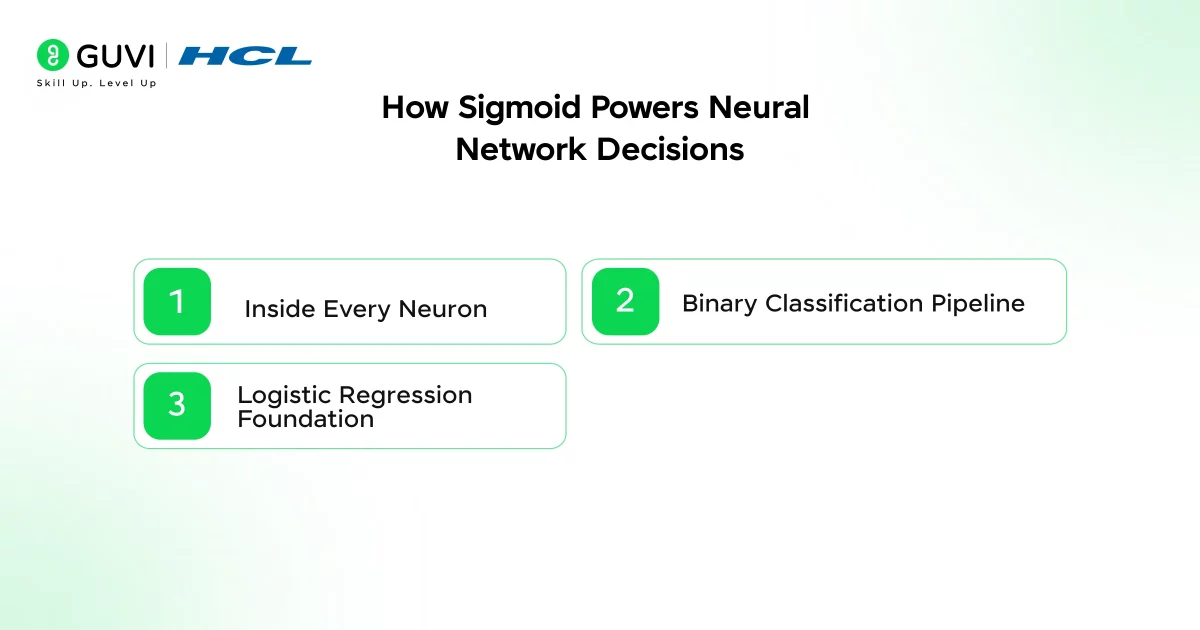
Step 1: Inside Every Neuron
In a neural network, each neuron first computes a weighted sum of its inputs (each input multiplied by learned weights, plus a bias term), producing a raw linear score that could be any real number.
When sigmoid is chosen as the activation, this final step transforms that unbounded score into the clean 0-1 range, squashing large positives toward 1, large negatives toward 0, and values near zero to 0.5 before passing it to the next layer.
Step 2: Binary Classification Pipeline
For tasks like spam detection, the network processes input through multiple hidden layers, then the final output layer applies a sigmoid to produce a single probability value between 0 and 1 representing “positive class likelihood.
Compare this to a 0.5 threshold: an output > 0.5 predicts the positive class (spam), and < 0.5 predicts the negative (not spam). This direct probability interpretation makes sigmoid the natural choice for binary problems needing calibrated outputs.
Step 3: Logistic Regression Foundation
Sigmoid’s power shines in logistic regression, where it maps a linear combination of input features and weights directly to a probability (0-1).
This is literally a single-layer neural network with sigmoid activation, proving its simplicity while enabling interpretable conditional probabilities. No wonder it remains one of machine learning’s most deployed algorithms decades later.
The Derivative of Sigmoid: Why It Matters for Training
1. Backpropagation Needs Derivatives
Training a neural network requires adjusting weights through a process called backpropagation, calculating how much each weight contributed to the error, and updating it in the direction that reduces that error. Backpropagation relies on computing derivatives, which measure how sensitive the output is to small changes in each weight.
2. Sigmoid’s Clean Derivative Formula
The derivative of the sigmoid function has a clean form: σ'(x) = σ(x) × (1 – σ(x)). This means you can express the derivative using the sigmoid’s own output, which makes it computationally convenient.
3. The Problem: Derivatives Fade to Zero
For the sigmoid function, the derivative value ranges between 0 and 0.25, influencing how weights update. The maximum derivative value 0.25 occurs when x equals 0, where the sigmoid output is 0.5. As x moves toward large positive or large negative values, the derivative approaches 0. This behavior is the root cause of the most significant limitation of the sigmoid function.

The Vanishing Gradient Problem
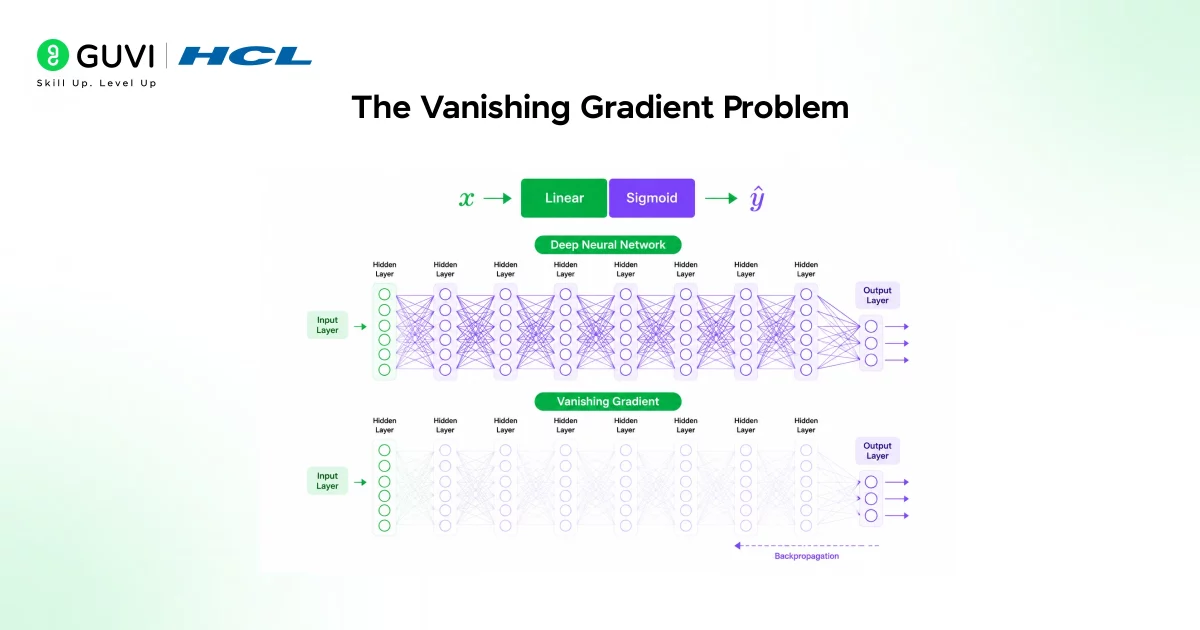
The vanishing gradient problem is the most important limitation of the sigmoid activation function, and it is the primary reason why the sigmoid fell out of favor for hidden layers in deep neural networks.
How It Happens During Backpropagation
During backpropagation, gradients are multiplied layer by layer. If multiple layers have sigmoid activations and their neurons operate in saturated regions, the gradients flowing backward will be repeatedly multiplied by small numbers, the derivatives, which are less than or equal to 0.25.
This can cause the gradients reaching the earlier layers to become extremely small, making it very difficult for the weights in those layers to update effectively. The network essentially stops learning in its deeper layers.
The Math: Exponential Gradient Decay
The mathematical consequences accumulate quickly. The derivative of the sigmoid function is typically small, around 0.25. If we have 5 layers, the gradient of the loss function with respect to the weights in the first layer would be multiplied by 0.25 to the power of 5, resulting in a value of approximately 0.001.
This can cause the weights in the earlier layers to be updated very slowly, leading to the network failing to learn anything useful. The deeper your network, the more severe this problem becomes.
A 10-layer network with sigmoid activations throughout would have gradients at the first layer reduced by a factor of 0.25 raised to the 10th power, which is an astronomically small number. Learning becomes practically impossible for those early layers.
Implementing Sigmoid in Python
Implementing sigmoid from scratch in Python helps build intuition for how it works before using framework implementations.
import numpy as np
import matplotlib.pyplot as plt
def sigmoid(x):
return 1 / (1 + np.exp(-x))
def sigmoid_derivative(x):
s = sigmoid(x)
return s * (1 – s)
# Test across a range of values
x = np.linspace(-10, 10, 100)
y = sigmoid(x)
y_deriv = sigmoid_derivative(x)
# Observe behavior at key points
print(f”sigmoid(0) = {sigmoid(0):.4f}”) # 0.5000
print(f”sigmoid(5) = {sigmoid(5):.4f}”) # 0.9933
print(f”sigmoid(-5) = {sigmoid(-5):.4f}”) # 0.0067
print(f”Max derivative: {max(y_deriv):.4f}”) # 0.2500
Modern deep learning frameworks implement sigmoid as a built-in function. In PyTorch, torch.sigmoid(x) or torch.nn.
Sigmoid() works directly on tensors. In TensorFlow and Keras, tf.nn.sigmoid(x) and tf.keras.activations.sigmoid(x) are the equivalents. Using the framework implementations is preferred for actual training because they include numerical stability optimizations that the naive formula lacks.
The sigmoid activation function traces its roots back to some of the earliest neural network models, including the McCulloch–Pitts neuron framework from the 1940s. For decades, sigmoid functions were central to neural network training because their smooth, differentiable form made gradient-based learning practical, and their derivative can be expressed directly in terms of the function itself, simplifying computation. However, after 2010, activation functions like ReLU became dominant in hidden layers because they enabled much faster and more stable training in deep networks. Today, sigmoid activations are still widely used in binary classification output layers even though modern deep architectures rarely rely on them internally.
When to Use Sigmoid and When Not To
1 Rule: Use a sigmoid in the output layer for binary classification.
Its 0-1 range naturally represents the probability of the positive class (e.g., spam=1, not spam=0). The deep learning community agrees: this is sigmoid’s primary modern role.
2nd Rule: Avoid sigmoid in hidden layers of deep networks.
Vanishing gradients (derivatives ≤0.25) and non-zero-centered outputs cause slow training. Deeper layers stop learning entirely.
3rd Rule: Use ReLU and variants (Leaky ReLU, ELU) for hidden layers.
They avoid vanishing gradients, enable faster convergence, and are the modern standard across CNNs, RNNs, and transformers.
4. Rule: For multi-class (>2 classes), use softmax in the output layer.
Softmax generalizes sigmoid outputs probabilities across all classes that sum to 1 (vs. sigmoid’s single binary probability).
If you’re serious about mastering the Sigmoid Activation Function: A Complete Beginner’s Guide, building low-code workflows, task automation, and production-ready AI deployments, don’t miss enrolling in HCL GUVI’s Intel & IITM Pravartak Certified Artificial Intelligence & Machine Learning Course, co-designed by Intel.
Final Thoughts
The sigmoid activation function is where most people’s journey into neural networks and deep learning begins, and for good reason. Its mathematical properties are elegant, its output is directly interpretable as probability, and its role in binary classification makes it immediately practical.
While sigmoid can be used in hidden layers, it is not typically recommended due to the vanishing gradient problem. Other activation functions like ReLU and tanh are more commonly used in hidden layers.
Understanding the sigmoid deeply, including why it works, why it fails, and exactly when to use it gives you the conceptual foundation to understand every other activation function you will encounter. ReLU makes more sense once you understand what vanishing gradients are and why sigmoid causes them.
Softmax makes more sense once you understand sigmoid’s role in binary classification and what changes when you have more than two classes. Start by implementing sigmoid from scratch, plotting its curve and its derivative, and tracing through a small binary classification example by hand. That foundational work pays dividends across everything that follows in deep learning.
Frequently Asked Questions
1. Why not use sigmoid in hidden layers anymore?
Vanishing gradients! Derivatives ≤0.25 get multiplied across layers, making early-layer weights update too slowly (0.25^10 ≈ 10^-7).
2. What’s the difference between sigmoid and softmax?
Sigmoid for binary (one probability 0-1). Softmax for multi-class (probabilities across N classes that sum to 1).
3. Is logistic regression just sigmoid?
Yes, it’s a single-layer neural net with a linear combo + sigmoid output.
4. How do I avoid sigmoid numerical issues in code?
Use framework built-ins (torch.sigmoid, tf.nn.sigmoid) they handle exp overflow with log-sigmoid tricks.
5. When sigmoid output is 0.85, what does that mean?
85% probability of positive class. Threshold at 0.5 for classification.
Success Stories

About the Author
Vishalini Devarajan
An Aerospace Engineer turned content writer, I focus on making complex concepts easy to understand through well-structured, reader-friendly blogs. Whether it’s a technical topic or a non-technical one, I love creating content that is clear, engaging, and impactful.
View all posts by Vishalini Devarajan
Connect with me @













Did you enjoy this article?