


Artificial Intelligence and Machine Learning Articles
How to Evaluate LLM Outputs in Production Deployments
AI/ML Skills Gap 2026: Why Companies Can't Find Job-Ready Talent
20 AI/ML Interview Questions Recruiters Can Use Without a Tech Background - Best Guide
How Industry-Backed AI/ML Bootcamps Are Changing the AI/ML Hiring Pipeline - Best Guide 2026

Get In Touch For Details! Request More Information
Multi-Agent AI Systems: Intelligent Agents Solving Problems
Aug 18, 2026 6 Min Read 902 Views
(Last Updated)
Some problems are simply too large, too distributed, or too dynamic for a single AI agent to solve effectively. A single traffic management system cannot simultaneously optimize every intersection in a city. A single robot cannot search an entire disaster site. A single algorithm cannot model every participant in a global financial market.
Multi-Agent Systems address this limitation by distributing intelligence. Instead of one monolithic system, MAS deploys multiple autonomous agents that each handle a portion of the problem — sensing their local environment, communicating with other agents, and coordinating their actions to produce outcomes that no individual agent could achieve alone.
In this article, we explore the architecture of Multi-Agent AI Systems, the types of agents and their interactions, the coordination and communication mechanisms that make MAS work, and the real-world applications where this paradigm is transforming artificial intelligence.
Table of contents
- TL;DR
- What Is an Autonomous Agent? The Building Block of MAS in AI
- Core Properties of an Autonomous Agent
- Types of Multi-Agent AI Systems: Cooperative, Competitive, and Mixed
- Cooperative Multi-Agent Systems
- Competitive Multi-Agent Systems
- Mixed (Coopetitive) Multi-Agent Systems
- Agent Communication: The Language of Multi-Agent Systems
- Agent Communication Languages (ACL)
- Communication Architectures
- AI Coordination in MAS: How Agents Align Their Actions
- Centralised Coordination
- Distributed Coordination: The Contract Net Protocol
- Emergent Coordination
- Swarm Intelligence: Collective Behaviour from Simple Agents
- Ant Colony Optimization (ACO)
- Particle Swarm Optimization (PSO)
- Real-World Applications of Multi-Agent Systems in AI
- Challenges and Limitations of Multi-Agent Systems
- Conclusion
- FAQs
- What is a Multi-Agent System in AI?
- What is the difference between cooperative and competitive agents in MAS?
- What is swarm intelligence, and how does it relate to Multi-Agent Systems?
- How do agents communicate in a Multi-Agent System?
- What are the main challenges of building Multi-Agent Systems?
TL;DR
- Multi-Agent Systems (MAS) consist of multiple autonomous agents operating in a shared environment.
- Agents can be cooperative, competitive, or a mix, each pursuing individual or shared goals.
- Agent communication and coordination are the core mechanisms that make MAS effective.
- Swarm intelligence, inspired by nature, produces intelligent collective behaviour from simple agent rules.
- MAS powers robotics, autonomous vehicles, smart grids, financial markets, and supply chain AI.
What Are Multi-Agent Systems in AI?
Multi-Agent Systems (MAS) are decentralized AI frameworks where multiple autonomous agents operate within a shared environment. Each agent has its own goals, perception, and decision-making logic. These agents can work cooperatively to achieve common objectives, compete to maximize individual outcomes, or combine both cooperative and competitive behaviors depending on the problem being solved.
What Is an Autonomous Agent? The Building Block of MAS in AI
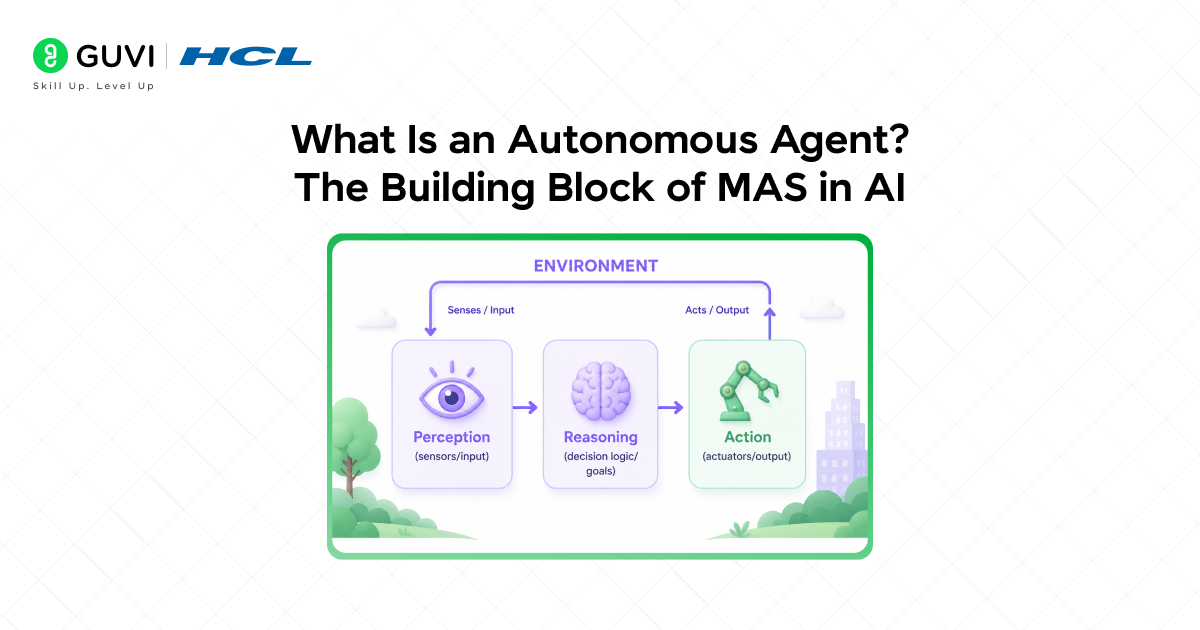
Before understanding the system, you need to understand the unit. An autonomous agent is a computational entity that perceives its environment through sensors, processes that information according to its internal logic, and acts on the environment through actuators, all without requiring continuous human intervention.
Core Properties of an Autonomous Agent
- Autonomy: The agent operates without direct external control. It makes its own decisions based on its goals and its perception of the environment.
- Reactivity: The agent responds to changes in its environment promptly. If conditions change, the agent adapts its behaviour accordingly.
- Proactiveness: The agent not only react it takes initiative to pursue its goals, planning rather than waiting for events to force a response.
- Social ability: The agent interacts with other agents via communication protocols—sharing information, coordinating actions, and negotiating outcomes.
In a Multi-Agent System, each agent brings these properties to a shared environment. The collective behaviour that emerges from their interactions is what gives MAS its power and its complexity.
Types of Multi-Agent AI Systems: Cooperative, Competitive, and Mixed
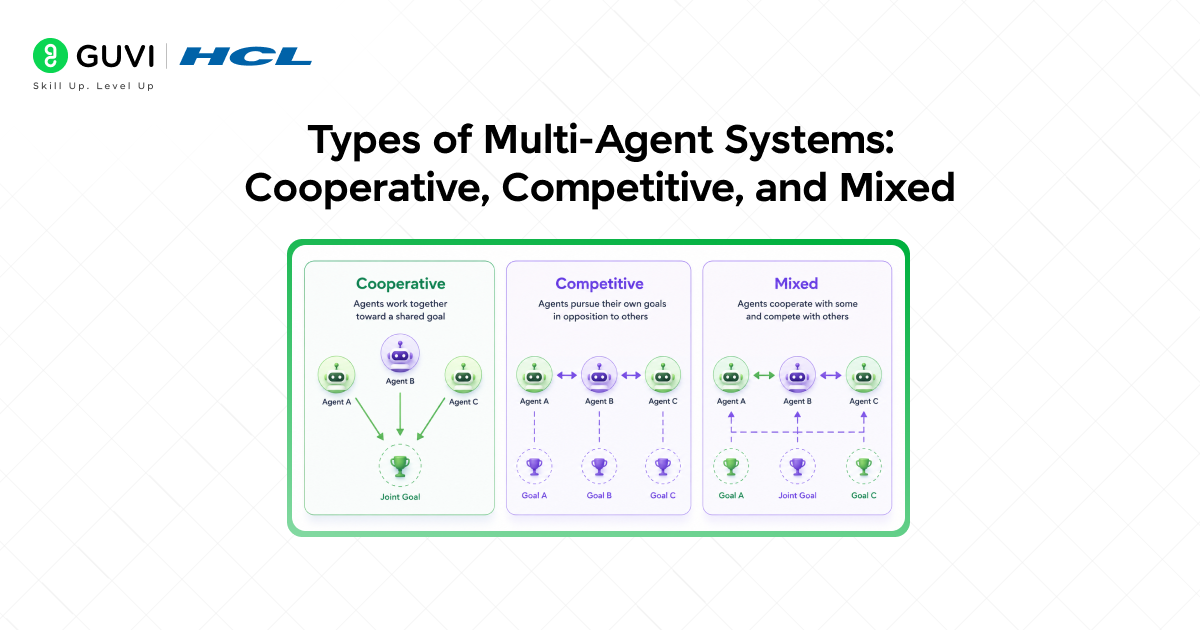
Not all multi-agent systems work toward the same goal in the same way. The relationship between agents, whether they help each other, compete against each other, or do both simultaneously, defines the fundamental character of the system.
Cooperative Multi-Agent Systems
In cooperative MAS, agents share a common objective and actively assist each other to achieve it. No single agent has all the information or capability required — cooperation is structurally necessary. This is the model behind search-and-rescue robot teams, distributed sensor networks, and collaborative AI planning systems.
- Agents share information freely to improve collective decision-making.
- Task decomposition assigns sub-problems to the agents best positioned to solve them.
- Agents may sacrifice individual efficiency to improve the performance of the group.
Competitive Multi-Agent Systems
In competitive MAS, agents pursue conflicting goals, so that what one agent gains, another may lose. Game theory provides the mathematical framework for analyzing competitive agent behaviour. Financial markets, auction systems, and adversarial game environments are all naturally modelled as competitive multi-agent systems.
- Agents optimize for individual outcomes without coordinating with opponents.
- Nash equilibrium concepts from game theory describe stable competitive outcomes.
- Adversarial AI training, such as Generative Adversarial Networks (GANs), uses a competitive two-agent structure.
Mixed (Coopetitive) Multi-Agent Systems
Real-world systems are rarely purely cooperative or purely competitive. Mixed MAS contains agents that cooperate within coalitions while competing between them. Supply chain networks, multi-team robotics competitions, and electricity grid management all exhibit this coopetitive structure where strategic alliances form and dissolve dynamically as conditions change.
Agent Communication: The Language of Multi-Agent Systems
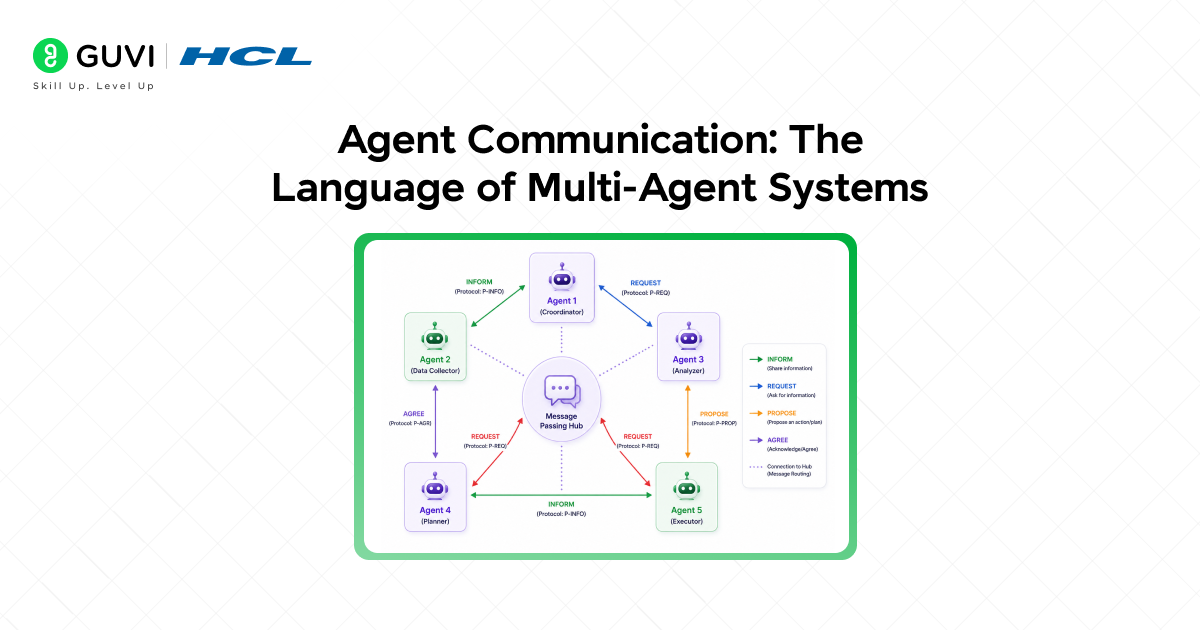
Agents cannot coordinate what they cannot communicate. Agent communication is the mechanism by which individual agents in a MAS share information, express intentions, make requests, and reach agreements. The quality and efficiency of communication directly determine the effectiveness of the overall system.
Agent Communication Languages (ACL)
Standardized agent communication languages define the vocabulary and syntax agents use to exchange messages. The two most established standards are FIPA-ACL and KQML. Both define a set of performative message types with specific communicative intent.
- INFORM: One agent notifies another of a fact it believes to be true.
- REQUEST: One agent asks another to act.
- PROPOSE: One agent offers a plan or solution for another to accept or reject.
- AGREE / REFUSE: An agent accepts or declines a request or proposal.
- QUERY-IF: An agent asks whether a particular fact is true in another agent’s knowledge base.
Communication Architectures
- Broadcast: An agent sends a message to all other agents. Simple but inefficient at scale, every agent receives messages regardless of relevance.
- Direct messaging: An agent sends a message to a specific target agent. Efficient but requires the sender to know the recipient’s identity.
- Blackboard systems: All agents read from and write to a shared data structure. Agents monitor it for relevant information — enabling indirect communication without explicit message exchange.
AI Coordination in MAS: How Agents Align Their Actions
Communication establishes what agents know about each other. Coordination determines how they act in relation to each other. In a Multi-Agent System, coordination is the process by which agents align their individual actions to avoid conflicts, eliminate redundancy, and produce coherent collective behaviour.
Centralised Coordination
In centralized coordination, a designated coordinator agent receives information from all agents, computes a global plan, and assigns tasks. This approach is straightforward to reason about and can produce globally optimal plans, but it creates a single point of failure and does not scale well to large, dynamic environments.
Distributed Coordination: The Contract Net Protocol
Distributed coordination has no central authority. The Contract Net Protocol is one of the most widely used distributed coordination mechanisms:
1. A manager agent broadcasts a task announcement to all agents.
2. Capable agents submit bids specifying their ability and cost to complete the task.
3. The manager evaluates bids and awards the contract to the best-qualified agent.
4. The winning agent executes the task and reports completion.
Emergent Coordination
In many natural-inspired MAS, coordination emerges from simple local rules that each agent follows independently. Ant colony optimization, flocking algorithms, and market-based allocation all produce sophisticated collective behaviour from agents that only interact locally with no agent having a global view of the system.
Explore: Cowork Claude Code: AI Coding Partner Beyond Code Generation
Swarm Intelligence: Collective Behaviour from Simple Agents
Swarm intelligence describes the emergence of intelligent collective behaviour from populations of simple agents, each following basic rules with no awareness of the global system state. It is one of the most directly nature-inspired phenomena in Multi-Agent Systems.

Ant Colony Optimization (ACO)
Inspired by the pheromone-trail behaviour of real ants, ACO is a metaheuristic optimization algorithm in which artificial ants iteratively construct solutions to combinatorial problems such as the Travelling Salesman Problem or network routing. Short, efficient paths accumulate more virtual pheromone, attracting more ants, which reinforces good solutions and converges toward the optimum.
Particle Swarm Optimization (PSO)
Inspired by the flocking behaviour of birds, PSO uses a population of candidate solution particles that move through the solution space. Each particle adjusts its velocity based on its own best-known position and the best-known position of the swarm. PSO is widely used in continuous optimization problems, including neural network training and engineering design.
Real-World Applications of Multi-Agent Systems in AI
Multi-Agent Systems are the operational backbone of some of the most complex AI deployments in the world systems where distributed intelligence, adaptability, and scalability are not optional features but core requirements.
- Autonomous Vehicle Fleets: Self-driving vehicles operate as agents in a shared road environment. They communicate to coordinate lane changes, merge safely at junctions, and optimize traffic flow across the network.
- Smart Grid Energy Management: Power grids managed by MAS use agents representing generators, storage systems, and consumers. Agents negotiate in real time to balance supply and demand and integrate renewable energy sources.
- Robotic Swarms: Teams of robots coordinate to perform warehouse fulfilment, agricultural monitoring, search-and-rescue, and planetary exploration tasks impractical for a single robot.
- Algorithmic Trading: Financial markets are natural multi-agent environments. Trading agents compete and interact across markets, executing strategies at millisecond speeds far beyond human capability.
- Supply Chain Optimization: Agents representing suppliers, logistics providers, and warehouses coordinate inventory, routing, and delivery schedules, adapting dynamically to disruptions and demand shifts.
Hill climbing forms the conceptual basis of many hyperparameter optimization systems in machine learning. When data scientists iteratively adjust settings like learning rates, regularization strength, or network architectures to improve performance, they are effectively exploring a search landscape and moving toward better-performing configurations. Modern automated optimization systems, including techniques used in neural architecture search, build on hill climbing variants and related search strategies to automate this process at scale.
Challenges and Limitations of Multi-Agent Systems
- Coordination overhead: Communication and negotiation between agents consume computational resources and time. In large systems, coordination cost can become a bottleneck that offsets the benefits of distribution.
- Emergent unpredictability: When intelligent agents interact, unexpected collective behaviours can emerge, some beneficial, some harmful. Predicting and controlling emergence in complex MAS remains an open research challenge.
- Security and trust: Malicious or malfunctioning agents can disrupt the system. Establishing trust, verifying agent behaviour, and defending against adversarial agents are active areas of MAS security research.
- Verification and testing: Formally verifying a MAS under all conditions is extremely difficult. The state space of interacting agents grows exponentially, making exhaustive testing infeasible for large systems.
- Scalability limits: Many coordination mechanisms degrade in performance as agent populations grow. Designing MAS that scales gracefully requires careful architectural choices from the outset.
If you want to learn more about building skills for Claude Code and automating your procedural knowledge, do not miss the chance to enroll in HCL GUVI’s Intel & IITM Pravartak Certified Artificial Intelligence & Machine Learning courses. Endorsed with Intel certification, this course adds a globally recognized credential to your resume, a powerful edge that sets you apart in the competitive AI job market.
Conclusion
Multi-Agent Systems represent a fundamental shift in how artificial intelligence is architected for complex, real-world challenges. By distributing intelligence across populations of autonomous agents,s each with its own perception, reasoning, and action capabilities, MAS achieves a flexibility, robustness, and scalability that single-agent systems simply cannot match.
The principles underlying MAS agent autonomy, communication protocols, coordination mechanisms, and emergent collective behaviour are the operational foundations of robotic warehouses, smart power grids, autonomous vehicle networks, and global financial markets. Wherever the problem is too large, too dynamic, or too distributed for one system to handle, Multi-Agent Systems provide the answer.
As AI continues to scale in ambition and deployment scope, the relevance of MAS will only grow. Understanding how intelligent agents cooperate, compete, and coordinate is not just useful; it is essential for anyone building the next generation of AI systems.
FAQs
1. What is a Multi-Agent System in AI?
A Multi-Agent System (MAS) is a decentralized AI framework in which multiple autonomous agent,s each with their own goals, perception, and decision-making logic, operate within a shared environment. Agents interact through communication and coordination mechanisms to produce collective behaviour that no single agent could achieve alone. MAS is used across robotics, logistics, financial markets, smart grids, and many other domains requiring distributed, adaptive AI.
2. What is the difference between cooperative and competitive agents in MAS?
Cooperative agents share a common goal and actively help each other achieve it, sharing information, dividing tasks, and sacrificing individual efficiency for collective gain. Competitive agents pursue conflicting goals, each trying to maximize its own outcome. Many real-world MAS are coopetitive, containing both cooperative relationships within coalitions and competitive relationships between them.
3. What is swarm intelligence, and how does it relate to Multi-Agent Systems?
Swarm intelligence is a property of Multi-Agent Systems in which intelligent collective behaviour emerges from populations of simple agents following basic local rules. Inspired by natural systems like ant colonies and bird flocks, swarm intelligence algorithms (ACO, PSO) solve complex optimization problems without any agent having a global view. Swarm systems are highly robust, adaptive, and scalable.
4. How do agents communicate in a Multi-Agent System?
Agents in a MAS communicate using standardized Agent Communication Languages (ACL), primarily FIPA-ACL and KQML, that define message types such as INFORM, REQUEST, PROPOSE, and AGREE. Communication architectures include direct messaging, broadcast to all agents, and blackboard systems where agents read from and write to a shared data structure without direct message exchange.
5. What are the main challenges of building Multi-Agent Systems?
The key challenges include: coordination overhead as agent populations grow; emergent behaviours that are difficult to predict or control; security vulnerabilities from malicious or faulty agents; the exponential complexity of formally verifying MAS correctness; and scalability limits in coordination mechanisms not designed for large agent populations. Addressing these is an active area of AI and distributed systems research.
Success Stories

About the Author
Vishalini Devarajan
An Aerospace Engineer turned content writer, I focus on making complex concepts easy to understand through well-structured, reader-friendly blogs. Whether it’s a technical topic or a non-technical one, I love creating content that is clear, engaging, and impactful.
View all posts by Vishalini Devarajan
Connect with me @






Did you enjoy this article?