


Software Development Articles
How to Read and Understand System Design Diagrams?
System Engineer Roles and Responsibilities: 12 Proven Duties for Growth
SAP Consultant Roles and Responsibilities: 12 Proven Duties for Growth and Success
Network Engineer Roles and Responsibilities: 12 Essential Duties for Success


Get In Touch For Details! Request More Information
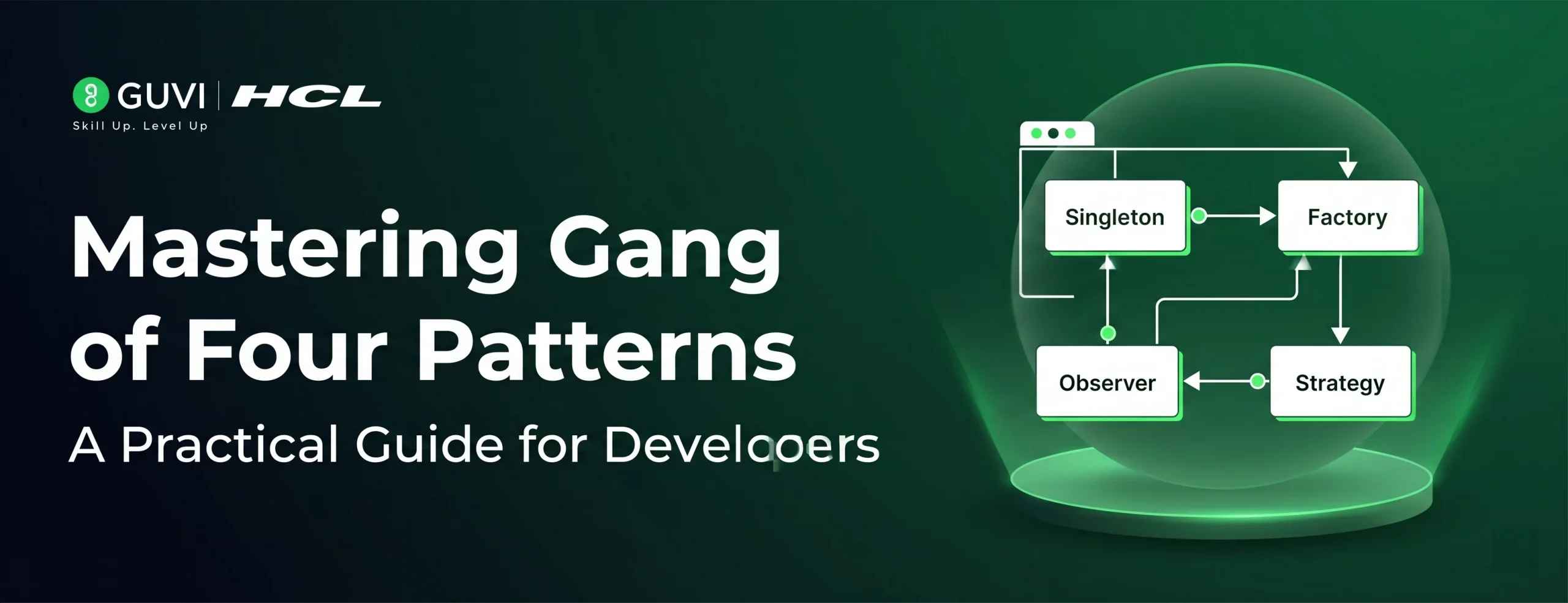
Mastering Gang of Four Patterns: A Practical Guide for Developers
May 12, 2026 7 Min Read 678 Views
(Last Updated)
If you’ve spent even a little time in software development, you have most likely experienced code that works, but that feels fragile, repetitive, or painful to scale. It is just the type of issue that the Gang of Four Patterns were created to solve.
In 1994, four authors, Erich Gamma, Richard Helm, Ralph Johnson, and John Vlissides, published a book that would go on to shape modern software architecture: Design Patterns: Elements of Reusable Object-Oriented Software.
They did not come up with just design patterns. They documented recurring solutions to common issues that developers encounter. And decades later, these trends continue to shape all things, including enterprise systems, and the modern frontend frameworks.
This blog is not just one of those overviews. You will see the relevance of such patterns, how they actually solve real-world problems, and how to think like a developer who writes maintainable, scalable systems and not code that just runs.
Table of contents
- Three Types of Gang of Four Patterns
- Creational Design Patterns
- Types of Creational Design Patterns
- Singleton Pattern
- Factory Method Pattern
- Abstract Factory Pattern
- Builder Pattern
- Prototype Pattern
- Structural Design Patterns
- Types of Structural Design Patterns
- Adapter Pattern
- Decorator Pattern
- Facade Pattern
- Composite Pattern
- Proxy Pattern
- Bridge Pattern
- Flyweight Pattern
- Behavioral Design Patterns
- Types of Behavioral Design Patterns
- Observer Pattern
- Strategy Pattern
- Command Pattern
- Mediator Pattern
- State Pattern
- Template Method Pattern
- Chain of Responsibility
- Visitor Pattern
- Memento Pattern
- Iterator Pattern
- How to Actually Learn Gang of Four Patterns (Without Getting Overwhelmed)
- Step 1: Start with Problems, Not Patterns
- Step 2: Learn Patterns in Small Clusters
- Step 3: Build Small Real-World Examples
- Step 4: Recognize Patterns in Real Frameworks
- Wrapping it up:
- FAQs:
- Are Gang of Four patterns only for object-oriented programming?
- Do companies actually use design patterns?
- Is it necessary to memorize all 23 patterns?
- Which is the most commonly used GoF pattern?
Three Types of Gang of Four Patterns
The Gang of Four Patterns are divided into three categories based on the type of problem they slove:
- Creational Patterns: Focuses on the creation of objects.
- Structural Patterns: Focuses on the organization of objects.
- Patterns of Behavior: Focuses on the object’s interaction and communications.
Each category solves a different layer of software complexity.
Creational Design Patterns
The majority of beginners don’t think much about the creation of objects. They simply use constructors or direct instantiation. This method, however, soon becomes restricted in large systems.
Suppose, you hard-code the creation of objects everywhere. However, to make any changes to the way an object is created you will need to make the same changes in a number of different locations. The result of this is tight-coupled and brittle systems.
This is addressed by creational patterns that separate the creation of objects and their utilization.
Types of Creational Design Patterns
1. Singleton Pattern
The Singleton pattern ensures that a class has only one instance throughout the application.
This may be easy to say but its implications are significant.
In real-world systems, some resources require a centralized control:
- A logging system should not create multiple log managers
- Consistent settings must be given everywhere by a configuration manager.
- The cache must be shared among modules.
This consistency is imposed by Singleton.
2. Factory Method Pattern
The Factory Method pattern shifts the creation of objects to a different method or class.
Instead of writing code that directly creates objects, you delegate that responsibility.
This may be considered an additional step, but it enhances flexibility dramatically.
Suppose we have a system which processes various kinds of notifications:
- SMS
- Push notifications
If you directly instantiate these classes everywhere, your code becomes cluttered with conditions. But with a Factory, you centralize creation logic.
The biggest advantage here is extensibility. When a new notification type is introduced, you need not rewrite any existing logic, you just need to extend the factory.
3. Abstract Factory Pattern
While Factory Method handles single object creation, Abstract Factory deals with creating groups of related objects.
This pattern is critical when systems require consistency among numerous elements.
In a UI system e.g.:
- A dark theme should have dark buttons, dark cards, dark modals.
- Light themes need light components.
Instead of mixing and matching components manually, Abstract Factory guarantees that the overall system is consistent.
It can also be switched between configurations easily, something that’s extremely valuable in scalable applications.
4. Builder Pattern
When things get complicated, constructors soon get messy. Excessive parameters make the code unreadable and prone to errors.
This is addressed in the Builder pattern, which breaks down the object construction process into small and manageable steps.
This improves:
- Readability
- Maintainability
- Flexibility
It also makes optional parameters easier to handle without overloading constructors.
In real-world development, Builder is commonly used in:
- API request construction
- Configuration objects
- Data pipelines
5. Prototype Pattern
In certain cases, creating a new object from scratch is expensive. In such cases, it is more effective to clone an already existing object.
That is just what the Prototype pattern enables.
This is particularly useful in:
- Game development (cloning of characters or assets)
- Systems that have a lot of initializing logic.
- Applications that have a large number of similar objects.
Instead of repeating the same setup process, you simply duplicate an existing instance.
The Gang of Four (GoF) design patterns, first published in 1994, still heavily influence modern software development, even if they are not always explicitly named. Frameworks like React, Spring, and Angular implicitly rely on many of the same architectural ideas, such as separation of concerns, reusable components, and structured object creation, showing how foundational these patterns remain in today’s software systems.
Structural Design Patterns
The complexity of the relationship between components increases as the complexity of the systems increases. The well written code may be hard to maintain without proper structure.
Structural patterns focus on how components are connected and organized.
Types of Structural Design Patterns
1. Adapter Pattern
In real-world development, you often work with third-party libraries or legacy systems that don’t match your current architecture.
The Adapter pattern acts as a bridge between incompatible interfaces.
Rather than changing the existing code, you wrap it in a way that makes it compatible.
This is especially useful when integrating:
- External APIs
- Legacy systems
- Third-party tools
2. Decorator Pattern
One of the biggest challenges in software design is adding features without breaking existing code.
Decorator solves this by allowing behavior to be added dynamically.
You wrap objects with new functionality, instead of writing a series of subclass.
This makes systems:
- More flexible
- Easier to extend
- Not as reliant on inheritance.
In modern frameworks, middleware systems often follow this pattern.
3. Facade Pattern
One of the common problems with systems is that as the number of interfaces increases, so do the number of interfaces that are exposed. This makes them hard to operate and maintain.
Facade introduces a simplified interface that hides underlying complexity.
Instead of interacting with multiple components, users interact with a single entry point.
This improves:
- Usability
- Readability
- System organization
4. Composite Pattern
Composite can be applied in case of hierarchical structures.
It will enable you to treat:
- Individual objects
- Groups of objects
…in the same way.
This has widespread application in:
- File systems
- UI components
- Organizational structures
5. Proxy Pattern
Proxy is used as an alternative to another object.
It can:
- Postpone the creation of objects (lazy loading)
- Control access
- Insert logging or security checks.
This is a generally popular technique in performance optimization and security layers.
6. Bridge Pattern
The Bridge pattern helps to decouple the abstraction (what it does) and the implementation (how it does it) of an object, allowing both to develop independently.
Without this separation, systems can quickly suffer from class explosion. For example, combining multiple dimensions like shape and color through inheritance leads to too many classes.
Bridge gets around this by dividing responsibilities. This means:
- You can make changes in implementations without making changes in abstractions.
- You are able to add features without changing existing code.
It is particularly applicable where there are several independent variations in a system, such as with UI systems or cross-platform applications.
7. Flyweight Pattern
The Flyweight pattern focuses on reducing memory usage by sharing common data across multiple objects.
Instead of storing duplicate data in every instance, shared information is stored once and reused. Only the unique parts of each object are stored separately.
This is particularly useful in systems that handle large volumes of similar objects, such as:
- Text editors (characters with font data)
- Game engines (recurring objects such as trees or enemies)
- Graphics rendering systems
Although it is efficient, Flyweight introduces complexity hence it is mostly applied in performance-critical applications.
Behavioral Design Patterns
Behavioral patterns are concerned with the interaction and communication of objects. Direct communication between the components results in tight coupling, and the code becomes more difficult to maintain as systems grow.
These patterns bring in an organized communication where the components could be left independent yet effective in their collaboration. This leads to more flexible, scalable and simpler to debug systems.
Types of Behavioral Design Patterns
1. Observer Pattern
The Observer pattern creates a system where one object notifies multiple others when its state changes.
This is the foundation of event-driven systems like:

- UI updates
- Notification systems
- Real-time dashboards
The key advantage is decoupling. The subject doesn’t need to know who is observing it. It simply broadcasts updates. This makes it easy to add or remove listeners without changing the core logic.
2. Strategy Pattern
The Strategy pattern allows you to define multiple algorithms and switch between them dynamically.
Instead of using large conditional blocks, each behavior is encapsulated separately. This makes the system:
- Easier to extend
- Cleaner to maintain
- More flexible
It is often applied in systems such as payment processing, where various strategies (UPI, card, wallet) can be easily changed.
3. Command Pattern
The Command pattern turns actions into objects, allowing them to be stored, queued, or reversed.
This particularly comes in handy when:
- Undo/redo functionality
- Task scheduling
- Logging operations
Systems can be more flexible and manageable by decoupling the request with its execution.
4. Mediator Pattern
In complex systems, communication between objects is sometimes achieved directly. Over time, this creates a web of dependencies that becomes difficult to manage.
This is solved by a mediator by introducing a central component that handles communication.
They do not have objects talking to one another directly but instead, they talk to each other via the mediator.
This:
- Reduces dependencies
- Simplifies relationships
- Streamlines the system to changing.
An example of a good real world situation is an air traffic control system. Aircraft do not talk to each other directly-they talk to a central controller.
5. State Pattern
The State pattern enables an object to modify its behavior with respect to its internal state.
Without this pattern, you often end up with large conditional blocks:
- If state is A: do this
- If state is B: do that
As states increase, the code becomes messy.
State addresses this issue by modeling each state as an individual class.
This:
- Improves clarity
- Reduces conditional complexity
- Simplifies behavior to be handled.
It’s commonly used in:
- Order processing systems
- Workflow engines
- Game development
6. Template Method Pattern
The Template Method defines the skeleton of an algorithm while allowing specific steps to vary.
This ensures consistency across implementations while still allowing flexibility.
For example, in a data processing pipeline:
- Load data
- Process data
- Save results
The overall structure remains the same, but individual steps can be customized.
7. Chain of Responsibility
This pattern permits a request to be passed down a chain of handlers until it is processed by one of the handlers.
Instead of hardcoding who handles what, you create a sequence of potential handlers.
This is useful in:
- Middleware systems
- Logging frameworks
- Event handling pipelines
It enhances flexibility and minimizes connections.
8. Visitor Pattern
Visitor enables you to insert new operations on the existing objects without altering their structure.
This is most applicable when:
- The object structure is stable
- New behaviors need to be added frequently
However, when used excessively, it is capable of complicating the system.
9. Memento Pattern
Memento captures the internal state of an object so it can be restored later.
This is usually applied in:
- Undo/redo systems
- Version control
- Game saves
It enables restoration of states without giving details of how this is to be done internally.
10. Iterator Pattern
Iterator provides a consistent way to traverse collections without exposing their internal structure.
Rather than worrying about the storage of data you can just use an iterator to access elements.
This improves:
- Abstraction
- Flexibility
- Code consistency
It is one of the most commonly used patterns, commonly implemented in programming languages themselves.
How to Actually Learn Gang of Four Patterns (Without Getting Overwhelmed)
Here’s the truth: trying to memorize all 23 Gang of Four Patterns at once usually doesn’t work.Most developers end up forgetting the patterns because they learn the names before understanding the problems behind them.
It would be wiser to learn patterns step by step and relate them to the real code scenarios.
Step 1: Start with Problems, Not Patterns
Instead of asking:
What pattern should I learn to-day?
Ask questions like:
- Do I have to re-write the same logic of creating objects everywhere?
- Is my code becoming tightly coupled?
- Does the addition of new behavior make the code messy?
Once you discover the problem, then the pattern begins to form itself.
Step 2: Learn Patterns in Small Clusters
Going through each of 23 patterns might be daunting, particularly for beginners. A smarter solution is to clump similar patterns together depending on the nature of the problem they are designed to solve.
For example:
- Issues to do with creation: Factory, Builder.
- Flexibility and extension problems: Strategy, Decorator
- Issues that relate to communication: Observer, Mediator.
This makes learning more systematic and not so intimidating. You begin to see connections between patterns rather than regarding them as standalone ideas.
Step 3: Build Small Real-World Examples
Reading theory alone is not enough. Design patterns only become clear when you actually implement them.
Begin with small projects such as:
- An Observer Pattern based notification system.
- A payment gateway based on Strategy Pattern.
- A UI theme switcher using Abstract Factory
These projects don’t need to be large. Even the implementation of a simple system will make you feel:
- Why is there a pattern?
- What problem it solves
- When it becomes useful
When you create something on your own, the concepts become so easy to recall.
Step 4: Recognize Patterns in Real Frameworks
One of the best ways to truly understand patterns is to notice them in modern frameworks and libraries.
For example:
- React hooks often resemble observer-like behaviour
- Spring applies the ideas of creational patterns by dependency injection.
- Express middleware is similar to the chain of responsibility pattern.
Patterns can initially appear abstract. But once you start spotting them in real tools, you realize they are already part of modern software development.
And that’s usually the moment when design patterns stop feeling academic and start feeling practical.
Ready to take your software development knowledge to the next level? The HCL GUVI AI Software Development Course helps you learn in-demand skills through hands-on projects, real-world applications, and expert-led training. From programming fundamentals to modern AI-driven development, the course is designed to prepare you for real tech careers.
Wrapping it up:
Initially, it will take some time for you to learn all 23 forms of design patterns. What is important, though, is not how many you learn but how well you learn each one and the problems they solve. Over time, you’ll start recognising these patterns in real-world applications, frameworks, and even your own projects.
Hope you found this blog helpful and gained a clearer understanding of how design patterns are used in real-world development.
FAQs:
1. Are Gang of Four patterns only for object-oriented programming?
They originated in object-oriented programming, but many concepts are useful across modern programming paradigms as well.
2. Do companies actually use design patterns?
Yes, Design patterns are widely used in enterprise application development, software frameworks, and scalable software systems.
3. Is it necessary to memorize all 23 patterns?
No. Instead of trying to memorize definitions for the 23 design patterns, learn how to apply each of the patterns based on the problems that they solve.
4. Which is the most commonly used GoF pattern?
Patterns like Factory, Strategy, Observer, and Decorator are widely used in modern applications.
Success Stories

About the Author
Vishalini Devarajan
An Aerospace Engineer turned content writer, I focus on making complex concepts easy to understand through well-structured, reader-friendly blogs. Whether it’s a technical topic or a non-technical one, I love creating content that is clear, engaging, and impactful.
View all posts by Vishalini Devarajan
Connect with me @
















Did you enjoy this article?