


Artificial Intelligence and Machine Learning Articles
Finance Manager to Data Analytics: Career Growth, Salary and Seniority
How to Evaluate LLM Outputs in Production Deployments
AI/ML Skills Gap 2026: Why Companies Can't Find Job-Ready Talent
20 AI/ML Interview Questions Recruiters Can Use Without a Tech Background - Best Guide


Get In Touch For Details! Request More Information
The Gaussian Function: Powering Modern AI with Curves
Jul 06, 2026 6 Min Read 1007 Views
(Last Updated)
You open a photo app and it smooths out the noise in a dark photo automatically. A spam filter quietly learns what your junk mail looks like. A self-driving car estimates where the road edge probably is, even in fog.
None of this registers as remarkable. That is exactly how deeply the Gaussian function has been embedded into the machinery of modern artificial intelligence.
But underneath every one of these moments is a beautiful piece of mathematics. The bell curve, or normal distribution, is arguably the most powerful and universal shape in all of science. It describes everything from human heights to measurement error to the firing patterns of neurons and the weight distributions inside neural networks.
This guide explains what the Gaussian function actually is, how AI uses it, and why it keeps showing up everywhere you look.
Table of contents
- Quick TL;DR Summary
- Why the Bell Curve Is Everywhere in Nature and AI
- How Modern AI Uses the Gaussian Function
- Step 1: Modeling Noise and Uncertainty
- Step 2: Gaussian Processes for Prediction
- Step 3: Kernel Methods and the Gaussian Kernel
- Step 4: Variational Autoencoders and Generative AI
- Step 5: Gaussian Mixture Models for Clustering
- What the Gaussian Function Makes Possible in AI
- How AI Systems Use Gaussian Math: Step-by-Step
- Step 1: Data Collection and Normalization
- Step 2: Noise Modeling
- Step 3: Kernel Computation
- Step 4: Fitting the Distribution
- Step 5: Uncertainty Propagation
- Step 6: Prediction with Confidence Intervals
- Step 7: Anomaly Scoring
- Common Mistakes When Applying Gaussian Assumptions
- Getting the Most From Gaussian Methods in AI
- Conclusion
- FAQs
- What is the Gaussian function in simple terms?
- Why is the normal distribution so common in nature?
- What is Gaussian noise in machine learning?
- What is a Gaussian kernel and where is it used?
- How are Gaussian processes different from neural networks?
Quick TL;DR Summary
- This guide explains what the Gaussian function is and why it matters so deeply to machine learning and artificial intelligence.
- You will learn how the bell curve and normal distribution underpin key AI systems from noise modeling to kernel methods and Gaussian processes.
- The guide covers real applications across industries with concrete examples of where the Gaussian curve is already doing invisible but critical work.
- Step-by-step guidance walks you through how Gaussian probability distributions are used inside actual AI pipelines from data analysis to generative models.
- You will finish with a clear understanding of both the power and the limits of Gaussian assumptions in real-world statistics and AI.
What Is the Gaussian Function?
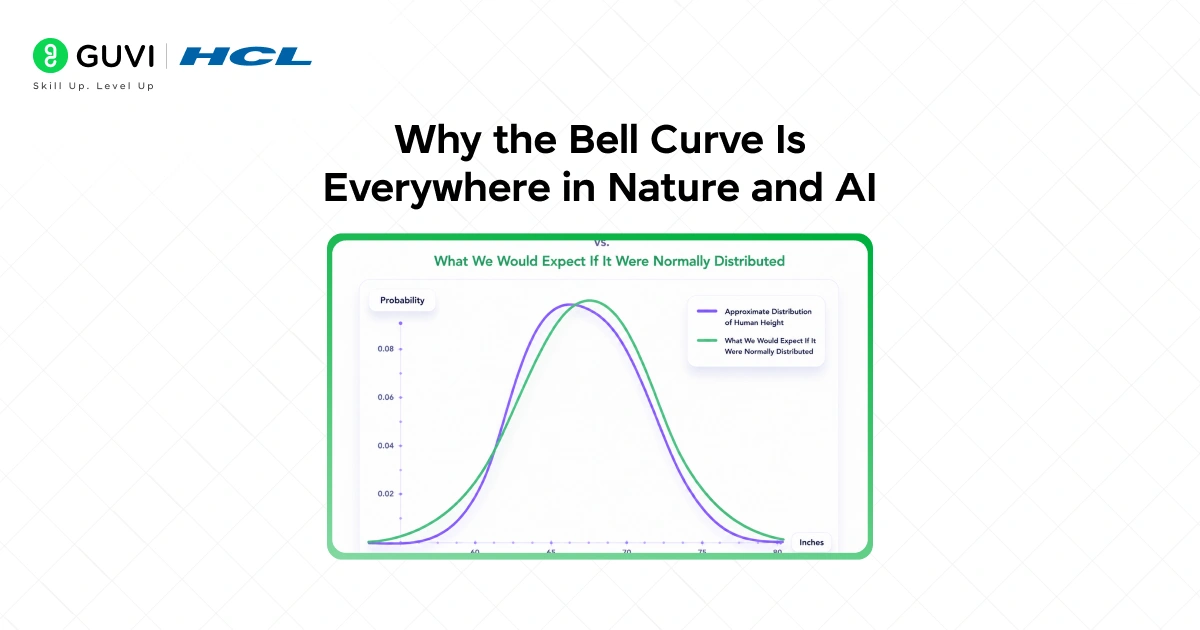
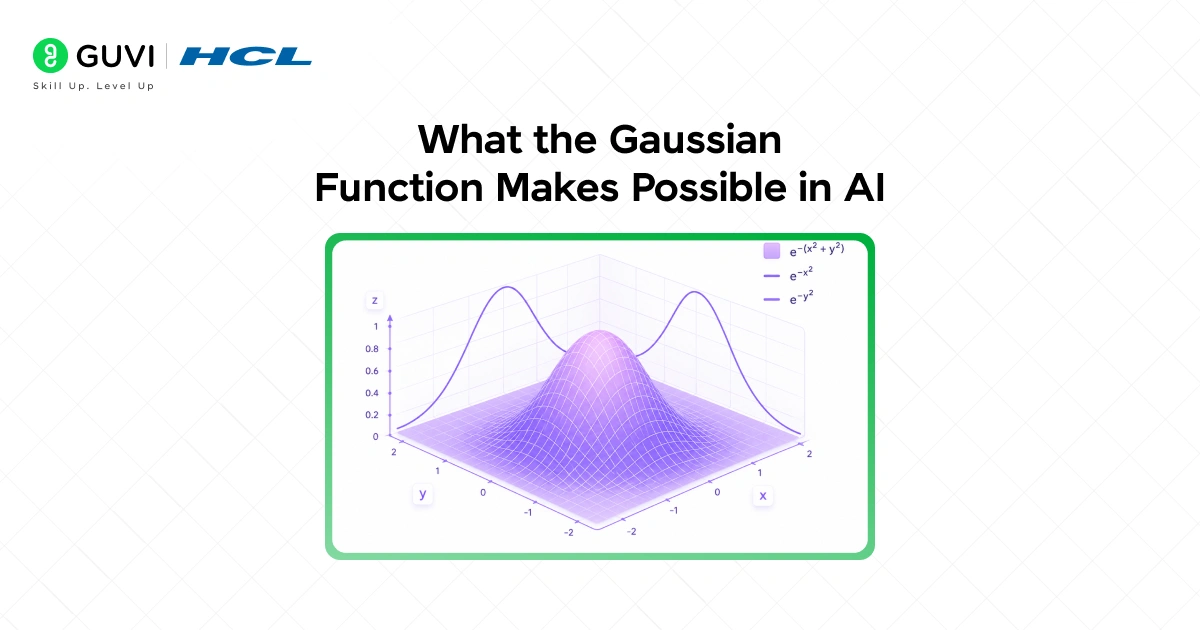
The Gaussian function is a mathematical function that produces the characteristic bell curve shape. It is defined by a mean and a standard deviation and is widely used in probability distributions, statistics, signal processing, and machine learning to model how values cluster around a central point with symmetric tails that gradually taper off.
Why the Bell Curve Is Everywhere in Nature and AI
- Nature keeps producing it independently
When you add up many small independent random effects, the result follows a normal distribution almost automatically. This is the central limit theorem, and it is why measurement errors, biological traits, and test scores all cluster into Gaussian curves without anyone designing them to.
- Machine learning assumes it constantly
Most machine learning algorithms assume that errors and residuals follow a Gaussian probability distribution. When you initialize the weights of a neural network, you almost always sample from a normal distribution. When you model uncertainty in a prediction, Gaussian math gives you the cleanest tools.
- It simplifies otherwise impossible math
The Gaussian function is one of the rare mathematical shapes that stays Gaussian when you multiply two of them together, transform them, or take their derivative. This makes it analytically tractable in ways that other distributions are not, which is why it shows up in everything from Bayesian inference to Gaussian processes to kernel methods.
Read More: Essential Linear Algebra, Calculus, and Optimization Techniques for Artificial Intelligence
How Modern AI Uses the Gaussian Function
Step 1: Modeling Noise and Uncertainty
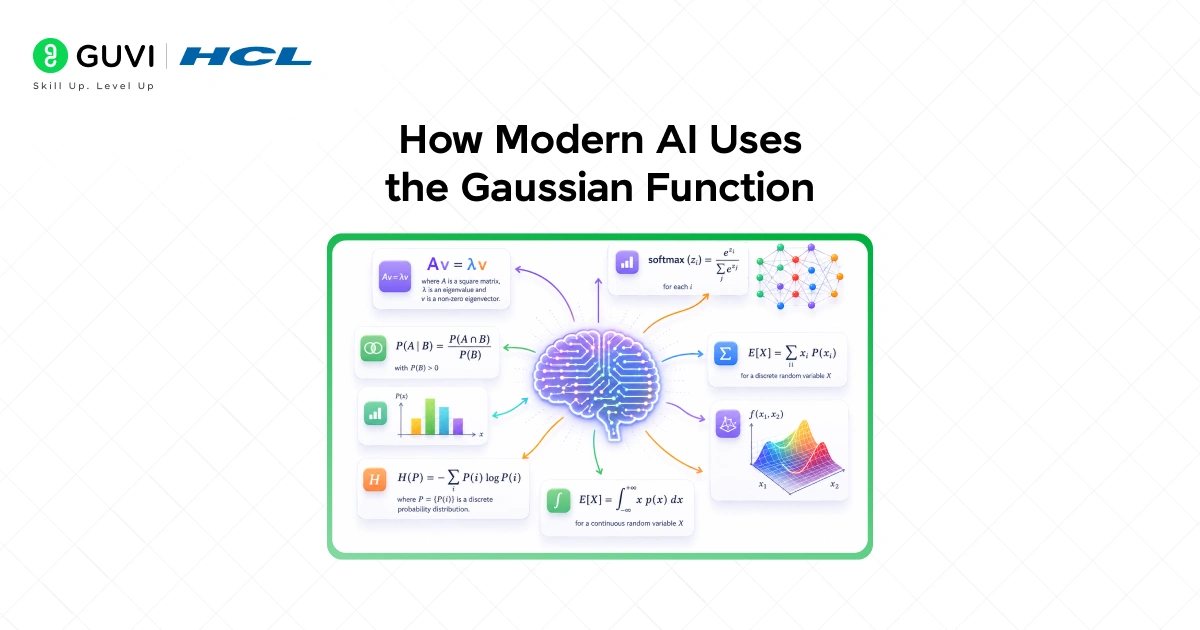
Real-world data is never clean. Gaussian noise is the standard model for the random errors and measurement uncertainties that contaminate every dataset, sensor reading, and signal. When an AI system explicitly models this noise using a normal distribution, it becomes far more robust to the messiness of real-world input.
Step 2: Gaussian Processes for Prediction
A Gaussian process is a probability distribution over functions rather than values. Instead of predicting a single output, it predicts a full probability distribution over possible outputs at every input. This is how AI systems express calibrated uncertainty, knowing not just what they predict but how confident they are.
Step 3: Kernel Methods and the Gaussian Kernel
Support vector machines and other kernel methods use the Gaussian kernel, sometimes called the radial basis function, to measure similarity between data points. It scores two points as highly similar if they are close and nearly dissimilar if far apart, following the shape of the Gaussian curve exactly. This lets non-linear patterns be detected without explicitly mapping into high-dimensional space.
Step 4: Variational Autoencoders and Generative AI
Variational autoencoders, a class of generative deep learning models, encode data as Gaussian distributions in a latent space rather than as fixed points. Sampling from these distributions is what lets them generate new images, text, or sounds that resemble training data without copying it. The normal distribution is the mathematical engine behind their creativity.
Step 5: Gaussian Mixture Models for Clustering
Gaussian mixture models represent complex probability distributions as sums of multiple overlapping Gaussian curves. They are used in data analysis to identify clusters in unlabeled data, model speaker identities in audio, and segment customers in business analytics. Each component Gaussian represents one cluster.
The normal distribution, also known as the bell curve, was formally described by Carl Friedrich Gauss in the early 19th century while studying errors in astronomical measurements.
Gauss noticed that even highly precise observations naturally scattered around the true value in a remarkably consistent bell-shaped pattern.
That same statistical pattern later turned out to describe countless real-world phenomena, from human height and exam scores to measurement noise and biological variation.
What the Gaussian Function Makes Possible in AI
- Calibrated Uncertainty in Predictions
Most neural networks output a single prediction with no attached confidence. Systems built on Gaussian processes or Bayesian statistics instead output a full probability distribution, telling you both what they predict and how sure they are. This is critical in medicine, finance, and autonomous systems where overconfident wrong predictions are dangerous.
- Image Denoising and Signal Processing
Gaussian noise removal is one of the most fundamental operations in computer vision and signal processing. Gaussian blur, which applies a Gaussian function as a convolution filter, smooths images by giving nearby pixels more weight than distant ones. Every camera app, medical imaging system, and video call uses this constantly.
- Anomaly Detection at Scale
When normal behavior follows a Gaussian distribution, anomalies are simply points that fall too far from the mean in standard deviation terms. This simple insight powers fraud detection in banking, intrusion detection in cybersecurity, and quality control in manufacturing, all built on the mathematics of the normal distribution.
- Density Estimation and Generative Modeling
Gaussian mixture models and kernel density estimation methods use sums of Gaussian curves to estimate the underlying probability distribution of any dataset without assuming a fixed form. This is the foundation of many data analysis tools and modern generative AI systems that learn the distribution of training data well enough to sample new examples from it.
How AI Systems Use Gaussian Math: Step-by-Step
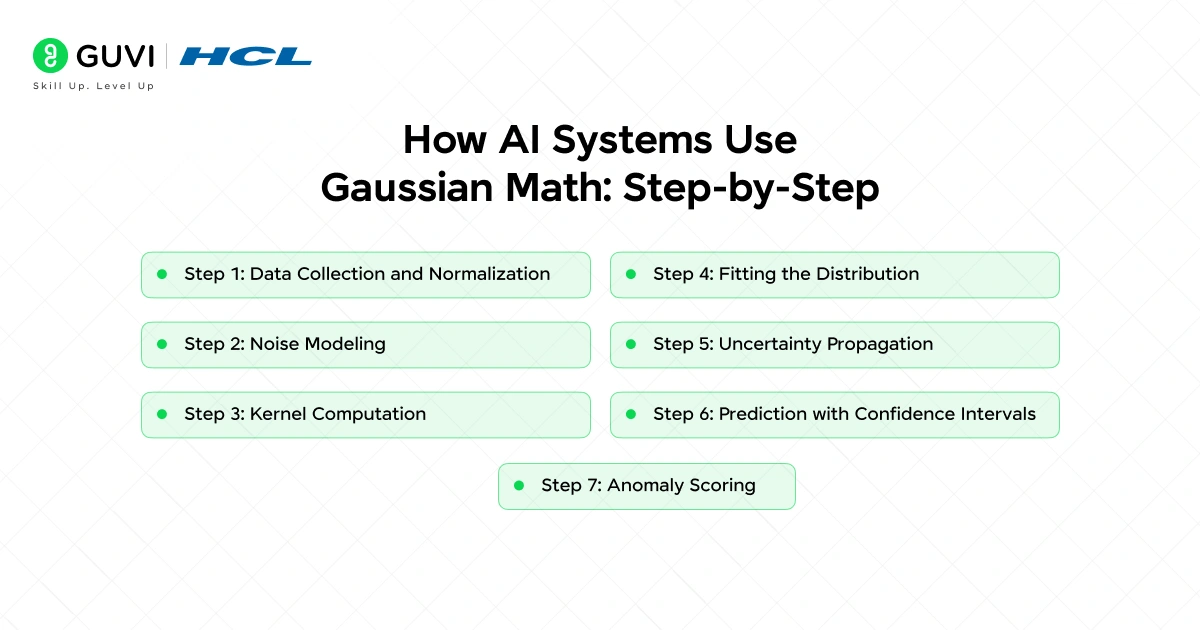
Here is exactly how a modern AI system applies Gaussian function mathematics from raw data to reliable output.
Step 1: Data Collection and Normalization
Raw data arrives at wildly different scales. Standardization transforms each feature so that it has a mean of zero and a standard deviation of one, fitting it to a standard normal distribution. Nearly every machine learning pipeline starts here because most algorithms assume this shape.
Step 2: Noise Modeling
The system explicitly models what Gaussian noise looks like in the data, estimating the mean and variance of the error distribution. This model becomes the baseline for understanding which signals are real patterns and which are just noise, a fundamental statistics operation in every serious AI system.

Step 3: Kernel Computation
For algorithms like support vector machines or Gaussian process regression, the Gaussian kernel computes a similarity score between every pair of data points. Points close together get a score near one. Points far apart get a score near zero. This similarity matrix is the foundation of the model’s understanding of the data’s structure.
Step 4: Fitting the Distribution
The system estimates the parameters of the Gaussian probability distribution, the mean and covariance, that best describe the training data. For a Gaussian mixture model, this happens for each component separately using the expectation-maximization algorithm, iterating until the mixture fits the data well.
Step 5: Uncertainty Propagation
Bayesian AI systems propagate uncertainty through every computation using Gaussian math. When the input is uncertain, the normal distribution over inputs produces a predictable probability distribution over outputs, and the mathematics of how Gaussians combine makes this tractable to compute exactly.
Step 6: Prediction with Confidence Intervals
The final prediction is not a single number but a Gaussian distribution: a mean prediction and a confidence interval. The model tells you its best guess and exactly how wide the range of plausible values is, giving users the information they need to decide how much to trust the output.
Step 7: Anomaly Scoring
Any new data point is scored by how many standard deviations it falls from the learned Gaussian curve. Points beyond two or three standard deviations are flagged as anomalies. This simple rule, derived directly from the mathematics of the normal distribution, is how most production anomaly detection systems work at their core.
Common Mistakes When Applying Gaussian Assumptions
- Assuming data is Gaussian without checking whether it actually follows a bell curve
- Ignoring heavy-tailed distributions where outliers matter far more than a normal distribution predicts
- Using Gaussian noise models in domains where errors are asymmetric or skewed
- Treating the mean as the only relevant statistic when variance and higher moments matter
- Applying Gaussian kernel methods without tuning the bandwidth parameter for the dataset
- Confusing a Gaussian mixture model component count with the true number of clusters
- Forgetting that standard normal distribution assumptions break down in high dimensions
Gaussian Processes were once considered impractical for large datasets because their computation scaled roughly cubically with the number of data points.
Modern sparse approximation techniques have dramatically reduced this computational cost, making Gaussian Process models usable on datasets containing millions of points.
This breakthrough has brought one of their biggest strengths—well-calibrated uncertainty estimates—into real-world production AI systems for the first time.
Getting the Most From Gaussian Methods in AI
- Always check your distributional assumptions first
Before applying any method that assumes a normal distribution, visually inspect your data with a histogram and a Q-Q plot. Assuming Gaussianity when data is actually bimodal or heavy-tailed will produce models that look confident but are systematically wrong in exactly the situations that matter most.
- Use Gaussian processes when uncertainty quantification matters
If your application needs to know how confident the AI is, not just what it predicts, Gaussian processes are the most principled tool available. They are especially valuable in scientific modeling, drug discovery, and any domain where acting on an overconfident wrong prediction is costly.
- Fine-tune kernel bandwidth for your specific data scale
The Gaussian kernel in kernel methods has a bandwidth parameter that controls how quickly similarity decays with distance. The default value almost never matches your data. Cross-validate this parameter on your actual dataset or your model will either be far too local or far too global in how it generalizes.
- Combine Gaussians when one is not enough
A single Gaussian curve can only represent unimodal, symmetric distributions. Real-world data is rarely that simple. Gaussian mixture models let you stack multiple bell curves to approximate almost any shape, giving you the mathematical tractability of Gaussian math without the restriction of assuming a single cluster.
To build real skills in the mathematical concepts powering modern AI systems like the Gaussian Function, do not miss the chance to enroll in HCL GUVI’s Intel & IITM Pravartak Certified Artificial Intelligence & Machine Learning course. Endorsed with Intel certification, this course adds a globally recognized credential to your resume, a powerful edge that sets you apart in the competitive AI job market.
Conclusion
The Gaussian function looks deceptively simple on paper: a symmetric bell curve defined by just two numbers, a mean and a standard deviation. But that simplicity is exactly what makes it so powerful and universally useful across science and AI.
Modern machine learning is built on Gaussian assumptions at almost every level, from weight initialization and noise modeling to kernel methods and generative AI. The bell curve is not just a statistical curiosity. It is infrastructure.
Even as systems grow more sophisticated, the normal distribution remains the baseline and often the most principled choice when you need both accuracy and tractability.
FAQs
1. What is the Gaussian function in simple terms?
The Gaussian function is the mathematical formula that produces the bell curve shape. It is defined by a mean (the center) and a standard deviation (the width) and describes how values cluster symmetrically around an average with tails that taper off smoothly.
2. Why is the normal distribution so common in nature?
The central limit theorem guarantees that when many small independent random effects add together, the result follows a normal distribution regardless of how the individual effects are distributed. This is why the bell curve appears in biological measurements, errors, and test scores independently.
3. What is Gaussian noise in machine learning?
Gaussian noise is random variation added to or present in data that follows a normal distribution. It is the standard model for measurement error and sensor noise in AI systems, and explicitly modeling it improves robustness in real-world deployments.
4. What is a Gaussian kernel and where is it used?
The Gaussian kernel, also called the radial basis function, measures similarity between data points using the Gaussian function. It is used in support vector machines, kernel density estimation, and Gaussian process regression to capture non-linear patterns without explicitly mapping into high-dimensional space.
5. How are Gaussian processes different from neural networks?
Gaussian processes output a full probability distribution over predictions rather than a single value, giving calibrated uncertainty estimates. Neural networks are more scalable and flexible but generally do not provide reliable uncertainty quantification without significant additional engineering.
Success Stories

About the Author
Vishalini Devarajan
An Aerospace Engineer turned content writer, I focus on making complex concepts easy to understand through well-structured, reader-friendly blogs. Whether it’s a technical topic or a non-technical one, I love creating content that is clear, engaging, and impactful.
View all posts by Vishalini Devarajan
Connect with me @

















Did you enjoy this article?