


Artificial Intelligence and Machine Learning Articles
How to Evaluate LLM Outputs in Production Deployments
AI/ML Skills Gap 2026: Why Companies Can't Find Job-Ready Talent
20 AI/ML Interview Questions Recruiters Can Use Without a Tech Background - Best Guide
How Industry-Backed AI/ML Bootcamps Are Changing the AI/ML Hiring Pipeline - Best Guide 2026


Get In Touch For Details! Request More Information
Human in the Loop Automation: Build AI Workflows That Keep Humans in Control
Sep 03, 2026 5 Min Read 1464 Views
(Last Updated)
What if your AI system could work at scale but still think like a human when it matters most? Human in the loop automation solves this gap. AI is fast and efficient, but struggles with ambiguity, ethics, and context, which can lead to silent and costly failures. HITL adds humans at key decision points for judgment and validation, creating systems that are both efficient and reliable.
In this guide, we break down how to design, implement, and scale humans in the loop AI workflows that keep humans in control while unlocking automation at scale.
Quick Answer:
Human in the loop automation (HITL) is a workflow design approach where AI systems handle repetitive or data-heavy tasks, but critical decisions, validations, and exceptions are managed by humans. This ensures accuracy, accountability, and trust in AI-driven processes. By combining automation with human oversight, businesses can scale operations without losing control, reduce errors, and improve outcomes in areas like content moderation, finance approvals, healthcare diagnostics, and AI model training.
Table of contents
- What is Human in the Loop Automation (HITL)?
- Core Components of HITL Workflows
- AI Model Layer
- Decision Engine
- Human Review Layer
- Workflow Orchestration
- Types of Human in the Loop Models
- Human-in-the-Loop (Active Intervention)
- Human-on-the-Loop (Monitoring)
- Human-in-Command (Full Control)
- HITL Workflow Architecture (Step-by-Step)
- Step 1: Data Input
- Step 2: AI Processing
- Step 3: Confidence Scoring
- Step 4: Decision Routing
- Step 5: Human Validation
- Step 6: Continuous Optimization
- Example: Loan Approval Workflow with Human in the Loop
- Benefits of HITL Automation
- Challenges and Limitations
- Best Practices for Designing HITL Systems
- Tools and Platforms for HITL Automation
- Future of Human + AI Collaboration
- Conclusion
- FAQs
- How do you implement Human in the Loop automation in AI workflows?
- What are real-world examples of Human in the Loop automation?
- Is Human in the Loop automation necessary for generative AI systems?
What is Human in the Loop Automation (HITL)?
Human in the loop automation (HITL) is a hybrid AI system design where machine learning models perform data processing, prediction, or generation, while humans are strategically embedded at decision points for validation, exception handling, and governance. It leverages confidence scoring, rule-based routing, and feedback loops to balance automation with oversight, ensuring accuracy and continuous model improvement in real-world deployments.
Core Components of HITL Workflows
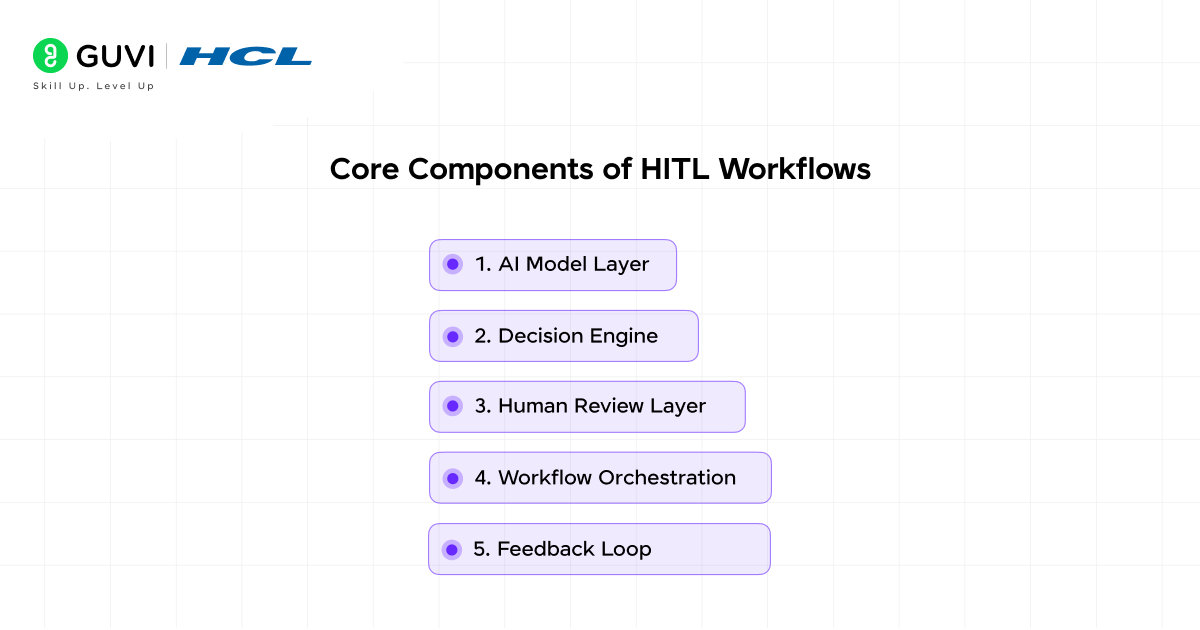
1. AI Model Layer
The AI model layer consists of production-grade NLP, computer vision, and predictive models deployed via inference services. These models generate probabilistic outputs, embeddings, or classifications using architectures like transformers, CNNs, or ensemble systems. Outputs are often calibrated (e.g., Platt scaling, temperature scaling) to produce reliable confidence scores, which are critical for downstream routing decisions.
2. Decision Engine
The decision engine acts as the control plane, combining confidence thresholds with rule-based and policy-driven logic. It may incorporate risk scoring, business constraints, and dynamic thresholds (e.g., adaptive thresholds based on drift or load). Advanced systems use decision graphs or policy engines to evaluate multiple signals before determining whether to auto-approve, defer, or escalate.
3. Human Review Layer
This layer integrates human expertise through structured review interfaces, annotation tools, and approval workflows. It supports multi-level review hierarchies, SLA-driven queues, and role-based access control. Human actions such as approvals, corrections, and overrides are logged with metadata (timestamps, reviewer ID, rationale), enabling traceability and auditability in regulated environments.
4. Workflow Orchestration
Workflow orchestration coordinates asynchronous tasks across AI and human systems using DAG-based schedulers or event-driven architectures. It manages task queues, retry mechanisms, escalation paths, and dependency resolution. Integration with message brokers and APIs ensures low-latency routing, while monitoring systems track throughput, backlog, and SLA compliance.
Build reliable AI systems with human-in-the-loop control using industry-ready skills. Join HCL GUVI’s Artificial Intelligence and Machine Learning Course to learn from industry experts and Intel engineers through live online classes, master Python, ML, MLOps, Generative AI, and Agentic AI, and gain hands-on experience with 20+ industry-grade projects, 1:1 doubt sessions, and placement support with 1000+ hiring partners.
Types of Human in the Loop Models
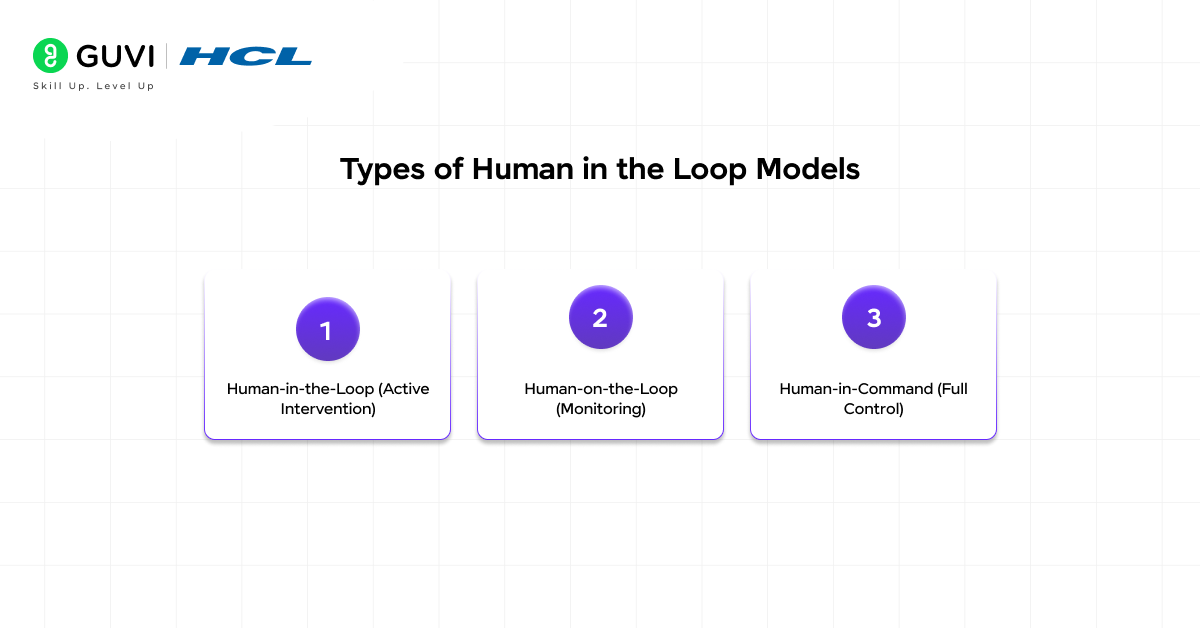
1. Human-in-the-Loop (Active Intervention)
In this model, human validation is embedded directly into the inference pipeline. Low-confidence predictions or edge cases are routed to reviewers in real time, making it suitable for applications requiring high precision, such as fraud detection or medical imaging.
2. Human-on-the-Loop (Monitoring)
This model enables autonomous system execution with human supervision through dashboards, alerts, and anomaly detection systems. Humans intervene only when predefined triggers are activated, allowing higher throughput while maintaining oversight.
3. Human-in-Command (Full Control)
Here, AI functions as a decision-support system, providing recommendations, explanations, or simulations. Humans retain full authority over final decisions, often required in domains with strict compliance, ethical considerations, or legal accountability.
HITL Workflow Architecture (Step-by-Step)
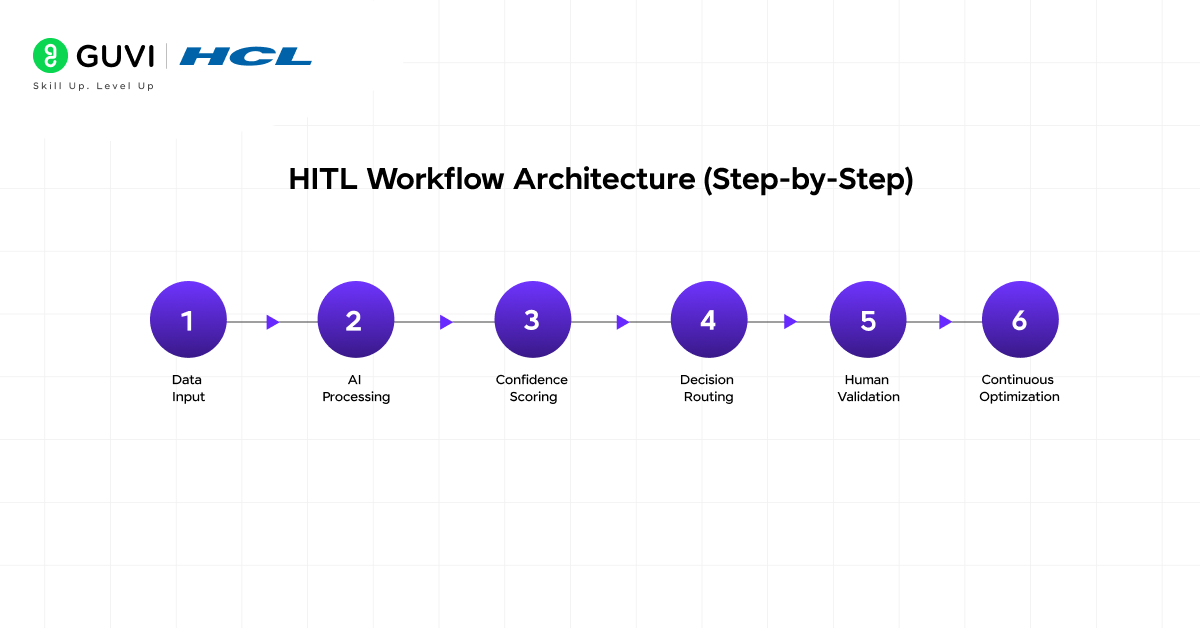
Step 1: Data Input
Data is ingested from heterogeneous sources, including user interfaces, APIs, databases, and streaming pipelines. Preprocessing steps such as normalization, feature extraction, and validation ensure data quality before inference.
Step 2: AI Processing
The model performs inference using optimized serving infrastructure (e.g., batch or real-time inference). Outputs may include predictions, classifications, generated content, or anomaly scores, often enriched with metadata for downstream evaluation.
Step 3: Confidence Scoring
Model outputs are assigned confidence scores derived from probability distributions, ensemble variance, or uncertainty estimation techniques (e.g., Bayesian methods, dropout-based uncertainty). These scores quantify prediction reliability.
Step 4: Decision Routing
A routing layer evaluates confidence scores, business rules, and risk signals to determine the execution path. High-confidence outputs are auto-approved, while uncertain or high-impact cases are routed to human queues using priority-based scheduling.
Step 5: Human Validation
Human reviewers interact with structured interfaces to approve, edit, or reject outputs. Their decisions incorporate contextual reasoning and domain expertise, often supported by explainability tools (e.g., feature importance, attention maps).
Step 6: Continuous Optimization
The system undergoes iterative optimization through monitoring metrics such as accuracy, latency, intervention rate, and drift detection. Thresholds, models, and workflows are continuously refined to reduce human dependency and scale efficiently.
Example: Loan Approval Workflow with Human in the Loop
An example of building AI workflows that keep humans in control is an AI-assisted loan approval system used by a bank or fintech company. In this workflow, AI speeds up decision-making, but humans retain authority over uncertain, high-risk, or regulated cases.
Step 1: Data Ingestion
The system collects applicant data such as income, credit score, repayment history, employment details, KYC documents, and bank statements from digital forms, APIs, and internal databases. Before inference, the data passes through validation checks for completeness, format consistency, and fraud signals.
Step 2: AI-Based Risk Assessment
A machine learning model processes the application and predicts the applicant’s credit risk. It may output:
- a risk score
- an approval probability
- a confidence score
- reason codes such as low income stability or high debt-to-income ratio
This model can be supported by rule-based checks for hard constraints, such as missing documents or policy violations.
Step 3: Decision Routing
The decision engine applies business rules and confidence thresholds:
- High confidence + low risk: application is auto-approved
- High confidence + very high risk: application is auto-rejected, if policy allows
- Low confidence or borderline risk: application is routed to a human credit officer
- Policy exception cases: always routed to human review
This guarantees AI handles routine cases, while humans manage ambiguity and exceptions.
Step 4: Human Review Layer
A credit officer reviews flagged applications through a dashboard that shows:
- applicant details
- model prediction and confidence score
- explanation signals or feature importance
- policy exceptions
- uploaded documents
The reviewer can:
- approve
- reject
- request more documents
- override the AI recommendation with justification
This keeps final control with humans in sensitive financial decisions.

Step 5: Feedback Capture
Every human action is logged with metadata such as decision type, reviewer ID, timestamp, override reason, and supporting notes. These corrections are stored as labeled feedback for future model evaluation and retraining.
Step 6: Continuous Improvement
Over time, the bank analyzes:
- override frequency
- false approvals and false rejections
- reviewer agreement rates
- model drift
- approval turnaround time
The model is then retrained using reviewed decisions, and thresholds are adjusted to reduce unnecessary escalations while preserving compliance and risk control.
Benefits of HITL Automation
- Precision Control in High-Risk Decisions
HITL enables precise intervention in scenarios where errors are costly, such as fraud detection, medical diagnosis, or financial approvals. By routing only ambiguous or low-confidence outputs to humans, systems maintain high accuracy while ensuring that critical decisions are validated with contextual judgment and domain expertise.
- Adaptive Model Improvement Through Feedback Loops
Unlike static automation, HITL systems continuously evolve. Human corrections are captured as labeled data and fed back into training or evaluation pipelines, reducing model drift and improving performance over time. This creates a self-improving system where real-world feedback directly enhances future predictions.
- Regulatory-Ready AI Systems
HITL architectures inherently support compliance by embedding human oversight, audit trails, and explainability into workflows. This is crucial for industries governed by strict regulations, where decisions must be traceable and aligned with frameworks that mandate human accountability in AI-driven processes.
Challenges and Limitations
- Cost: Requires skilled human reviewers, increasing operational expenses, especially in high-volume systems.
- Latency: Human review loops slow down decision-making, making real-time processing more complex.
- Scalability Issues: Human capacity does not scale as fast as automation, creating potential bottlenecks.
- Bias in Human Decisions: Human subjectivity can introduce inconsistencies, impacting model fairness and outcomes.
Best Practices for Designing HITL Systems
- Define Clear Intervention Points: Identify exactly where human judgment is required instead of inserting unnecessary review layers.
- Use Confidence Thresholds: Automate high-certainty outputs and route uncertain or high-risk cases to humans.
- Optimize Human Workloads: Prioritize high-impact reviews to maximize efficiency and reduce reviewer fatigue.
- Build Feedback Loops: Systematically capture human corrections and feed them into model retraining pipelines.
- Ensure Explainability: Provide interpretable outputs so humans can make faster, more consistent decisions.
Tools and Platforms for HITL Automation
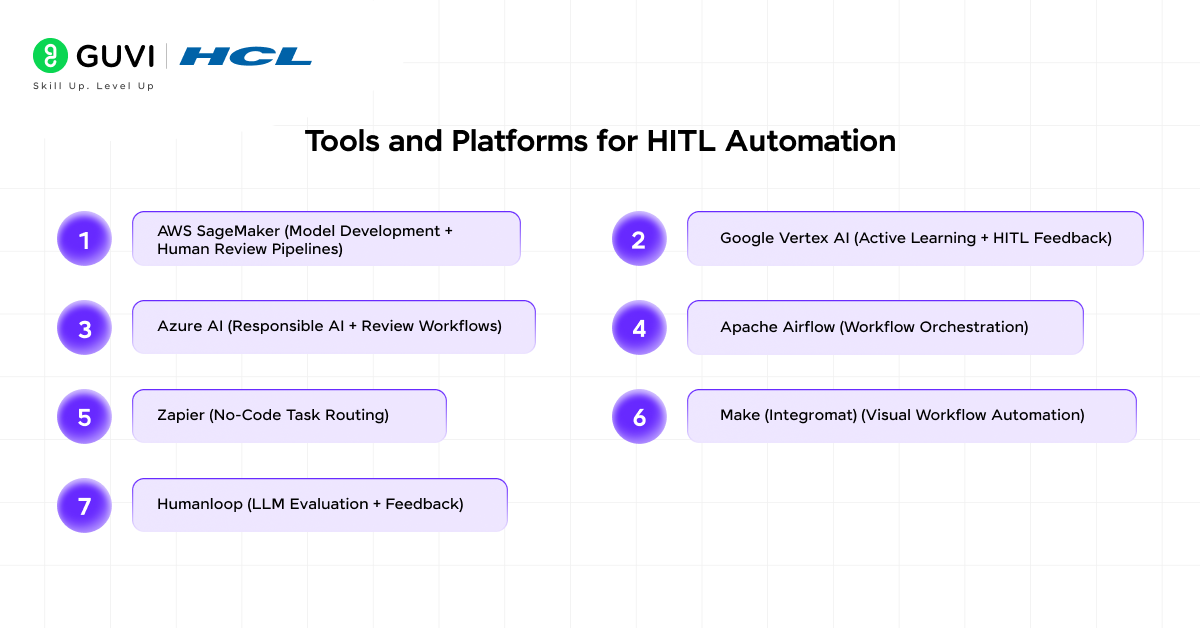
- AWS SageMaker (Model Development + Human Review Pipelines): Enables end-to-end ML workflows with built-in human labeling via Ground Truth, allowing teams to route low-confidence predictions to reviewers and retrain models using validated data.
- Google Vertex AI (Active Learning + HITL Feedback): Supports human-in-the-loop through data labeling services, evaluation pipelines, and active learning loops that continuously improve model performance with human corrections.
- Azure AI (Responsible AI + Review Workflows): Integrates human oversight with Responsible AI dashboards, enabling explainability, bias detection, and human validation checkpoints in enterprise AI systems.
- Apache Airflow (Workflow Orchestration): Orchestrates complex HITL pipelines by scheduling tasks, routing outputs to human queues, and managing dependencies across AI and human tasks.
- Zapier (No-Code Task Routing): Automates lightweight HITL workflows by connecting apps and triggering human approvals or notifications when specific conditions or thresholds are met.
- Make (Integromat) (Visual Workflow Automation): Provides visual pipelines to design HITL flows where AI outputs can be paused, reviewed, and approved by humans before proceeding.
- Humanloop (LLM Evaluation + Feedback): Specializes in human evaluation of LLM outputs, enabling prompt testing, feedback capture, and iterative improvement of generative AI systems.
Future of Human + AI Collaboration
The next phase of HITL is already taking shape in production systems. Agentic AI frameworks are moving beyond simple prompts to multi-step decision-making, where humans act as supervisors for high-risk actions rather than every output. Platforms like enterprise copilots are integrating directly into workflows, assisting in coding, finance approvals, and operations with real-time human override.
We are also seeing structured guardrails evolve, including policy-based controls, audit trails, and real-time monitoring layers that allow humans to intervene instantly when anomalies occur. On the regulatory side, frameworks like the EU AI Act are formalizing requirements for human oversight in high-risk AI systems, especially in healthcare, finance, and hiring.
Another major shift is the rise of continuous learning loops, where human corrections are directly fed into model evaluation pipelines, improving performance without full retraining cycles. At the same time, AI copilots are becoming embedded across tools like CRM, analytics, and development environments, not as replacements but as decision accelerators.
The future is not human vs AI. It is tightly coupled systems where AI scales execution and humans retain control over judgment, risk, and accountability.
Conclusion
Human in the loop automation is not about slowing AI down. It is about making it smarter, safer, and more reliable. Businesses can build AI systems that scale without losing control by combining the speed of machines with human judgment.
As AI adoption accelerates, the real competitive advantage will not come from automation alone but from how effectively you design systems where humans and AI work together.
FAQs
How do you implement Human in the Loop automation in AI workflows?
Implement HITL by defining confidence thresholds, setting up decision routing, integrating human review interfaces, and building feedback loops. Use workflow orchestration tools to manage task queues and ensure seamless collaboration between AI systems and human reviewers.
What are real-world examples of Human in the Loop automation?
Common examples include fraud detection systems, AI-powered hiring tools, medical diagnosis support, and content moderation platforms where AI flags cases and humans validate or override decisions for accuracy and compliance.
Is Human in the Loop automation necessary for generative AI systems?
Yes, HITL is critical for generative AI to ensure output quality, reduce hallucinations, and maintain brand or regulatory compliance. Human validation helps refine prompts, improve outputs, and continuously enhance model performance in production environments.
Success Stories

About the Author
Vaishali
I'm a seasoned writer with four years of experience across technical, non-technical, and just about every genre or niche you can imagine. Adaptable and curious, I enjoy exploring new topics and making information engaging and easy to understand. Fueled by a steady stream of tea, I approach each project with creativity, reliability, and genuine enthusiasm for storytelling.
View all posts by Vaishali
Connect with me @







Did you enjoy this article?