


Artificial Intelligence and Machine Learning Articles
How to Evaluate LLM Outputs in Production Deployments
AI/ML Skills Gap 2026: Why Companies Can't Find Job-Ready Talent
20 AI/ML Interview Questions Recruiters Can Use Without a Tech Background - Best Guide
How Industry-Backed AI/ML Bootcamps Are Changing the AI/ML Hiring Pipeline - Best Guide 2026

Get In Touch For Details! Request More Information
How Enterprises Are Building AI Agents in 2026
Jul 22, 2026 5 Min Read 1037 Views
(Last Updated)
Not long ago, AI in the enterprise meant a recommendation engine buried somewhere in the product team’s roadmap, or a chatbot sitting on a support page answering the same five questions in a loop. Most of it worked well enough in demos but never made it to the heart of how a company actually ran. The gap between AI’s potential and what it actually delivered in business was real, and most people in tech quietly knew it.
That gap is closing fast. In 2026, a wave of something fundamentally different has arrived AI agents. These aren’t just smarter chatbots. They are software systems that can perceive their environment, make decisions, use tools like APIs and databases, and execute multi-step tasks without waiting for a human to approve each action.
In this article, we’ll break down exactly how enterprises are building AI agents in 2026 what they are, why the timing is right, how the architecture works, what real-world use cases look like, and the honest challenges that still stand in the way.
TL;DR Summary
- Enterprises in 2026 are moving beyond basic chatbots and building AI agents that can reason, plan, and act across multi-step workflows.
- The strongest use cases are in support, engineering, finance, HR, cybersecurity, and analytics.
- The typical enterprise agent stack includes an LLM, tools, memory, orchestration, and integration with business systems.
- Most successful deployments start with one narrow business problem, not a broad “add AI” initiative.
- The biggest blockers are integration, data quality, change management, and governance.
Table of contents
- What Exactly Is an AI Agent?
- What the Numbers Say About Enterprise AI Adoption
- How Agents Are Built
- How Enterprise AI Agents Work
- Security and Governance
- What This Looks Like Inside Real Companies
- Cybersecurity, Healthcare, and Retail
- What Makes These Examples Work
- Where They Matter Most
- How Enterprises Start
- What Still Blocks It
- Where This Is Heading
- Final Thoughts
- FAQs
- How are AI agents different from chatbots?
- What is the biggest use case for enterprise AI agents?
- Do enterprises need human oversight for agents?
- What is the biggest challenge in adoption?
- Are AI agents already in production?
What Exactly Is an AI Agent?
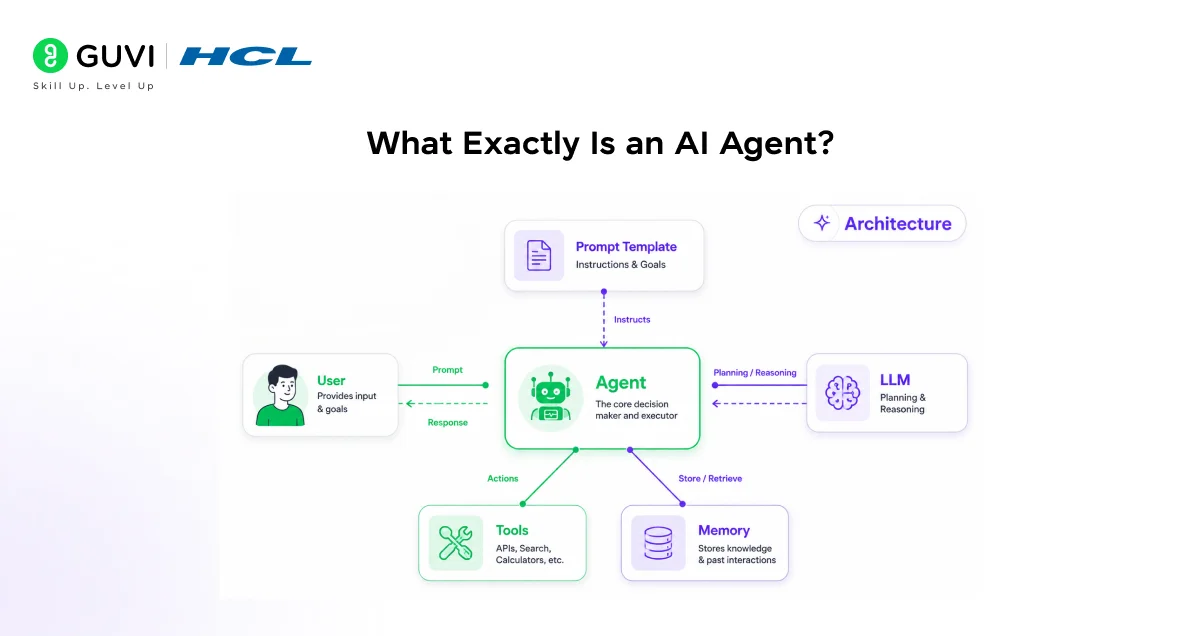
- An AI agent is a software system built on top of a large language model that can perceive inputs, reason through a problem, choose actions, and execute those actions through connected tools. In simple terms, it is not just a chatbot that talks back; it is a system that can work.
- A chatbot usually follows fixed patterns, while an agent can split a goal into steps, use tools such as databases, APIs, or internal systems, and then complete the task with less human intervention. In many enterprise setups, the model is the brain, tools are the hands, memory stores context, and planning coordinates the sequence of actions.
- This is why agents matter so much in business environments. They are designed to take over repetitive, rule-based work so employees can focus on judgment, strategy, and communication.
What the Numbers Say About Enterprise AI Adoption
It helps to look at the actual data before diving into the how. Anthropic partnered with research firm Material and surveyed over 500 technical leaders across industries to understand where AI agents stand today. The findings paint a clear picture: this is no longer a trend on the horizon. It is already happening at scale.
- Adoption and Returns
- 57%of organizations deploy agents for multi-stage workflows
- 80%report measurable economic returns on AI agent investments
- 90%use AI to assist with software development
- 81%plan to tackle more complex agentic use cases in 2026
- Cross-Functional Growth
What stands out in this data is that 16% of organizations are already running cross-functional agents systems that operate across multiple teams simultaneously.
And looking ahead, 39% are building agents for multi-step processes while 29% are deploying them for cross-functional projects. The shift from simple automation to complex, autonomous workflows is no longer a plan. It is underway.
- Long-Term Outlook
According to Gartner, by 2029 autonomous AI agents in enterprise settings are expected to resolve 80% of common customer service issues without any human intervention. And by 2028, agentic AI capabilities are projected to be embedded in nearly one-third of all enterprise applications.
These are not fringe projections; they reflect where significant investment, engineering effort, and real production deployments are already pointing.
How Agents Are Built
1. How Enterprise AI Agents Work
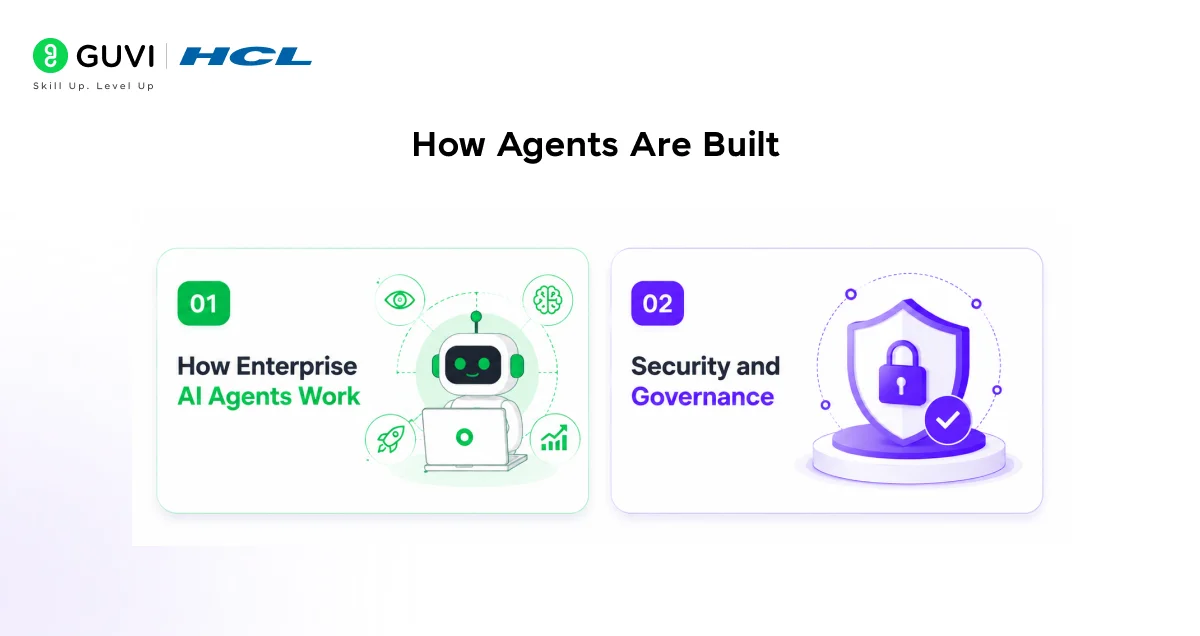
- Enterprise AI agents are usually built in layers, with each layer handling a different part of the job. A perception layer gathers information from emails, documents, logs, databases, and APIs, while a reasoning layer powered by an LLM interprets that information and decides what to do next.
- From there, an action layer carries out the task by working with systems like CRMs, ERPs, cloud apps, or ticketing tools. A memory layer preserves context across interactions, and an orchestration layer connects everything to the company’s existing tech stack.
2. Security and Governance
- Security and governance sit across the entire system, not at the end of it. Enterprises need access controls, audit logs, encryption, and clear approval rules because these agents are handling real business data and real decisions.
- Without these guardrails, even a powerful agent can create risk instead of value. That is why production-grade enterprise AI is built with oversight, traceability, and compliance in mind from day one.
More than half of organizations are already using AI agents for multi-stage workflows, with many reporting measurable business returns. Some enterprise agents can reduce tasks that once took hours to just minutes by connecting directly with documents, databases, and internal tools. However, the biggest challenge is often not the AI itself, but integration with legacy systems, clean data, and existing team workflows.
What This Looks Like Inside Real Companies
The most convincing evidence that enterprise AI agents are delivering real value is not a survey or a prediction it is what is happening on the ground inside actual companies today. Thomson Reuters uses Claude to power CoCounsel, their AI legal platform.
Lawyers who once spent hours manually searching through case documents can now access 150 years of case law and insights from thousands of domain experts in a matter of minutes. The agent does not replace the lawyer it eliminates the grunt work so the lawyer can spend time on judgment.
Cybersecurity, Healthcare, and Retail
- In cybersecurity, eSentire compressed expert threat analysis from five hours down to seven minutes, with AI-driven analysis aligning with their senior security experts’ conclusions 95% of the time. That is not incremental improvement
- It is a structural change in what a security team can accomplish in a day. In healthcare, Doctolib deployed Claude Code across their entire engineering team, replacing legacy testing infrastructure in hours instead of weeks, and shipped new features 40% faster as a result.
- And in retail, L’Oréal achieved 99.9% accuracy on conversational analytics, enabling 44,000 monthly users to query data directly rather than waiting on custom dashboards from a data team.

What Makes These Examples Work
- What is common across all of these examples is that none of these companies treated AI agents as standalone experiments. They integrated them as core infrastructure. The agents are connected to the company’s actual data, actual tools, and actual workflows not running in a sandbox. That integration is precisely what drives the results.
Where They Matter Most
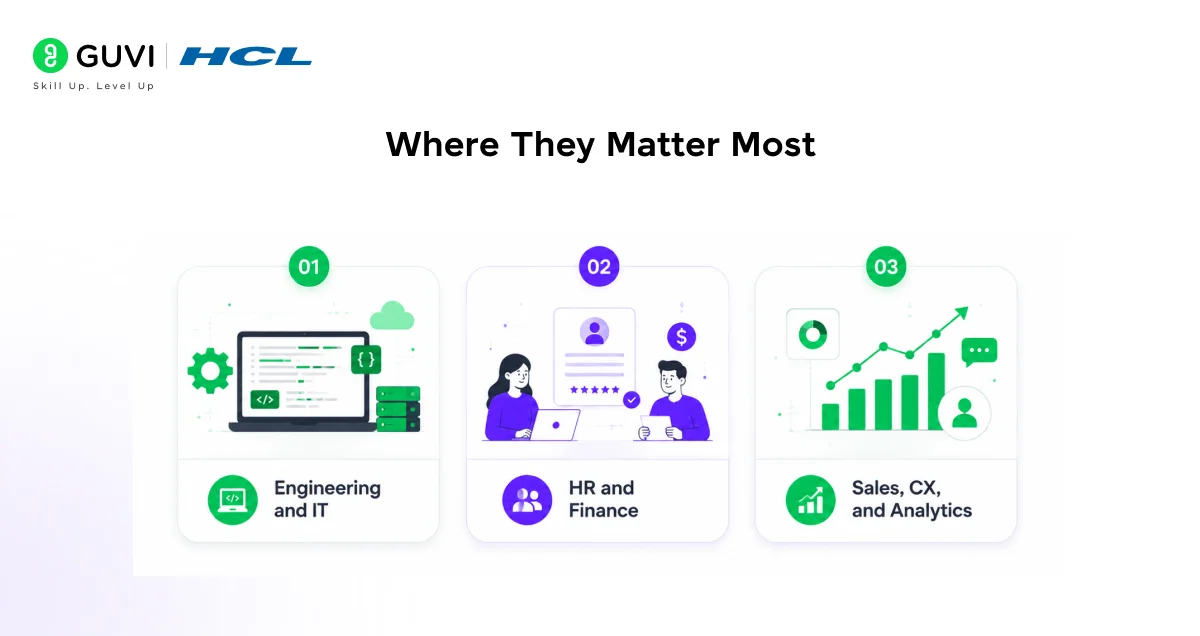
- Engineering and IT
Engineering and IT were early proving grounds for enterprise AI agents. Today, AI is widely used for code generation, documentation, code review, and support tasks, helping teams move faster and reduce repetitive work.
- HR and Finance
HR teams are using agents to help onboard employees, provision access, answer policy questions, and coordinate meetings. Finance teams are using them to read invoices, match them to purchase orders, flag exceptions, and approve routine payments.
- Sales, CX, and Analytics
Sales and customer experience teams are seeing strong results as agents monitor signals, score leads, draft outreach, and prepare CRM updates for human review. Data analysis and reporting remain among the highest-value use cases because they save time across multiple teams at once.
How Enterprises Start
- The best enterprise deployments usually begin with one clearly defined problem. Instead of asking, “How do we add AI?” strong teams ask a specific question like, “How do we reduce password reset tickets in support?”
- Once the use case is clear, teams choose the model, framework, hosting environment, and integrations needed to support it. Most organizations start with a pilot in one department, measure the results, and then expand once the workflow is stable.
- Human oversight is still essential. The most effective systems include escalation points where the agent hands control back to a person when the action is sensitive, ambiguous, or high-risk.
What Still Blocks It
- Integration remains the biggest technical barrier. Many enterprise systems were never designed to work smoothly with AI agents, so connecting legacy tools to modern workflows takes real effort.
- Data quality is another major issue. If the agent cannot access complete, structured, and trustworthy information, its output will reflect those weaknesses. Change management is the hardest human challenge, because teams need time, training, and clear expectations before they trust the system.
- Governance is also critical, especially in regulated sectors. Enterprises need explainability, auditability, and access policies built into the agent from the start, not added later as a patch.
Where This Is Heading
- The next stage is likely to be multi-agent systems, where different agents handle specialized tasks and pass context between one another. One agent might detect an issue, another might resolve it, and a third might handle follow-up communication and record updates.
- Edge computing and better orchestration will also expand where these systems can be used, especially in industries that need low-latency decisions. As the underlying models improve, agents will become better at handling ambiguity, recovering from mistakes, and adapting to different contexts.
- The bigger shift is cultural as much as technical. Enterprises are beginning to move employee time away from repetitive execution and toward higher-value work, and that is changing how organizations think about productivity itself.
If you’re exploring how AI agents are transforming enterprise operations in 2026, it’s smart to start with a focused use case, build with the right infrastructure, and scale only after proving real value. Learn how AI agents are reshaping business workflows with HCL GUVI’s Artificial Intelligence & Machine Learning Course for hands-on practice in agent design, workflow automation, and production-ready AI systems!
Final Thoughts
Enterprise AI agents in 2026 are no longer a futuristic idea. They are becoming part of the operating fabric of modern companies, especially where repetitive work, cross-functional coordination, and data-heavy workflows are common.
The organizations getting the most value are the ones treating agents as serious infrastructure: scoped tightly, governed carefully, and built around real business problems. That is what separates a proof of concept from a system that actually changes how work gets done.
FAQs
1. How are AI agents different from chatbots?
AI agents can reason, plan, and act across tools and systems, while chatbots usually respond within a fixed conversational flow.
2. What is the biggest use case for enterprise AI agents?
Support, engineering, finance, HR, and analytics are among the strongest use cases because they involve repetitive, multi-step work.
3. Do enterprises need human oversight for agents?
Yes. Most successful systems include human-in-the-loop checkpoints for sensitive or high-risk actions.
4. What is the biggest challenge in adoption?
Integration with existing systems is usually the biggest technical challenge, followed by data quality and change management.
5. Are AI agents already in production?
Yes. Many large companies are already running them in production, especially in legal, cybersecurity, healthcare, and retail workflows.
Success Stories

About the Author
Vishalini Devarajan
An Aerospace Engineer turned content writer, I focus on making complex concepts easy to understand through well-structured, reader-friendly blogs. Whether it’s a technical topic or a non-technical one, I love creating content that is clear, engaging, and impactful.
View all posts by Vishalini Devarajan
Connect with me @






Did you enjoy this article?