


Artificial Intelligence and Machine Learning Articles
How to Evaluate LLM Outputs in Production Deployments
AI/ML Skills Gap 2026: Why Companies Can't Find Job-Ready Talent
20 AI/ML Interview Questions Recruiters Can Use Without a Tech Background - Best Guide
How Industry-Backed AI/ML Bootcamps Are Changing the AI/ML Hiring Pipeline - Best Guide 2026


Get In Touch For Details! Request More Information

Types of AI Agents: A Practical Guide with Examples
Jul 13, 2026 3 Min Read 1374 Views
(Last Updated)
AI is all around us today, from the applications you use to the intelligent features you count on every day. But have you considered what makes these systems “intelligent”? Operating in the background, the AI agents continuously monitor events and take actions to achieve the goal.
It’s also worth noting that none of these agents operates the same way. There are several Types of AI Agents, each with its own logic. In this blog, we will explore each of these types.
Quick TL;DR Summary
- This blog focuses on breaking down the Types of AI Agents in a way that’s easy to follow.
- It also helps you connect each type with simple, real-life examples you already know.
- You’ll get a clear idea of how different AI agents actually make decisions.
Table of contents
- Types of AI Agents Explained in a Simple Way
- Simple Reflex Agents
- Model-Based Reflex Agents
- Goal-Based Agents
- Utility-Based Agents
- Learning Agents
- Hierarchical Agents
- Multi-Agent Systems
- Conclusion
- FAQs
- Which type of AI agent is the easiest to understand and use?
- Which AI agent can handle situations where all information is not visible?
- When should Goal-Based Agents be used instead of others?
- How do Utility-Based Agents make better choices?
- What makes Learning Agents different from other types?
- Why are Multi-Agent Systems useful in real-world scenarios?
Types of AI Agents Explained in a Simple Way
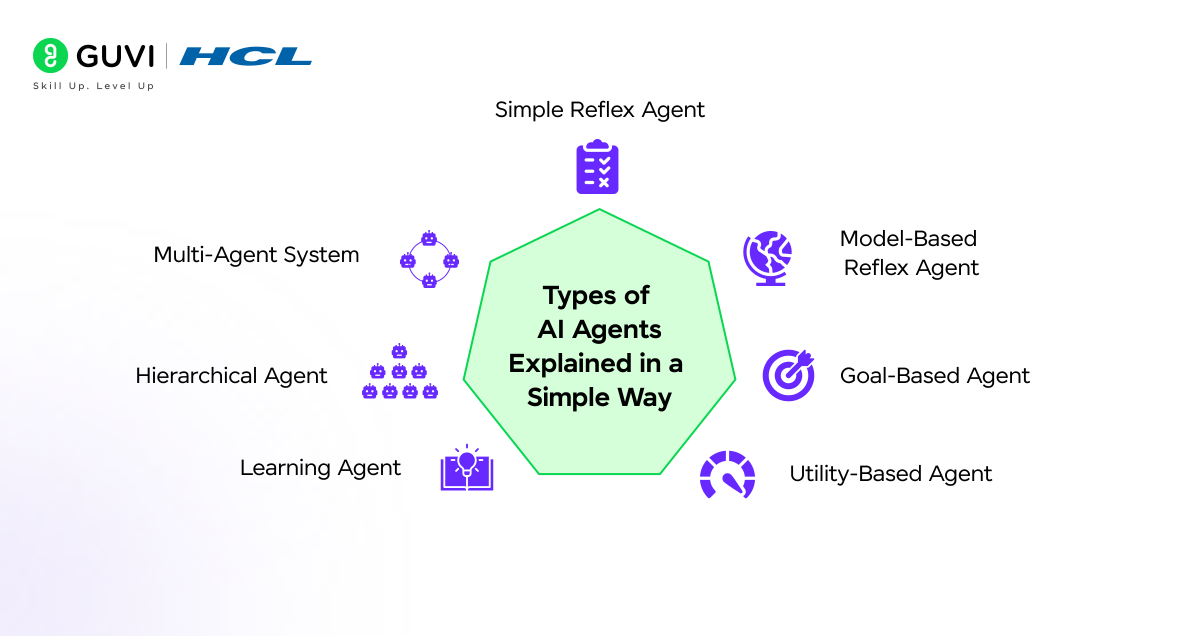
Here are the following Types of AI Agents you should know to better understand how AI systems work in real life:
1. Simple Reflex Agents
A Simple Reflex Agent is the most basic form of AI agent, which makes decisions on the basis of the present circumstances alone.
How it works
- It uses an uncomplicated “if–then” rule. It first analyses what’s occurring now.
- Then it correlates the event with a preprogrammed “if−then” condition; as soon as it is found, it reacts immediately.
- There is no memory reference or adaptation; it only reacts naturally.
Real-life example
An automatic door sensor. When it detects a person in front of it, it opens. When no one is there, it closes. It simply reacts to the current input.
Why it matters
- Fast decision-making without delay
- Easy to design and implement
- Works well for simple and predictable tasks
Explore AI/ML with our free resource—practical lessons, real-world examples, and concepts you can actually apply: AI/ML Email Course
2. Model-Based Reflex Agents
A Model-Based Reflex Agent is an AI agent that makes decisions based on the present state but also remembers past data.
How it works
- It notes what is occurring in the environment, then revises its internal memory based on past and present information.
- Based on this reformed knowledge, it aligns with the situation, utilises rules, and chooses an appropriate action. In this way, it handles obscured situations.
Real-life example
A robot vacuum cleaner that remembers which areas are already cleaned and which are left, so it can move efficiently.
Why it matters
- Can handle more complex situations
- Uses memory to improve decisions
- Works better in partially visible environments
3. Goal-Based Agents
A Goal-Based Agent is an AI agent that makes decisions according to a goal (desired state).
How it works
- It first determines what goal it is trying to achieve.
- Next, it assesses the current situation and decides on actions.
- Then it selects the best action at that moment to lead it toward its goal.
- Finally, it takes that action and repeats the process.
Real-life example
Google Maps selects the best route to reach your destination based on traffic and distance.
Why it matters
- Focuses on achieving clear objectives
- Makes smarter and more planned decisions
- Useful for solving complex problems
Explore: AI Agent Debug Mode: Runtime Logs for Smarter Debugging
4. Utility-Based Agents
A Utility-Based Agent is an AI agent that works by evaluating and selecting the alternative that maximises efficiency.
How it works
- It begins by perceiving the current circumstance and then generating possible courses of action.
- The program then diagnoses the utility that measures the benefit of each course of action.
- The program then compares the considered courses of action and chooses the one with the highest utility.
Real-life example
A food delivery app chooses the fastest and most efficient delivery route based on time, distance, and traffic.
Why it matters
- Helps in choosing the best possible option
- Considers multiple factors before deciding
- Improves decision quality in complex situations
5. Learning Agents
A Learning Agent is an AI agent that learns from its past experiences and uses them to improve its future performance.

How it works
- It initially scans the environment, performs an action, and then receives feedback based on the action.
- It then uses this information to learn from its successes and failures and to change its future decisions.
Real-life example
Netflix recommends shows based on what you watch, like, and skip over time.
Why it matters
- Improves performance with experience
- Adapts to changing situations
- Becomes more accurate over time
6. Hierarchical Agents
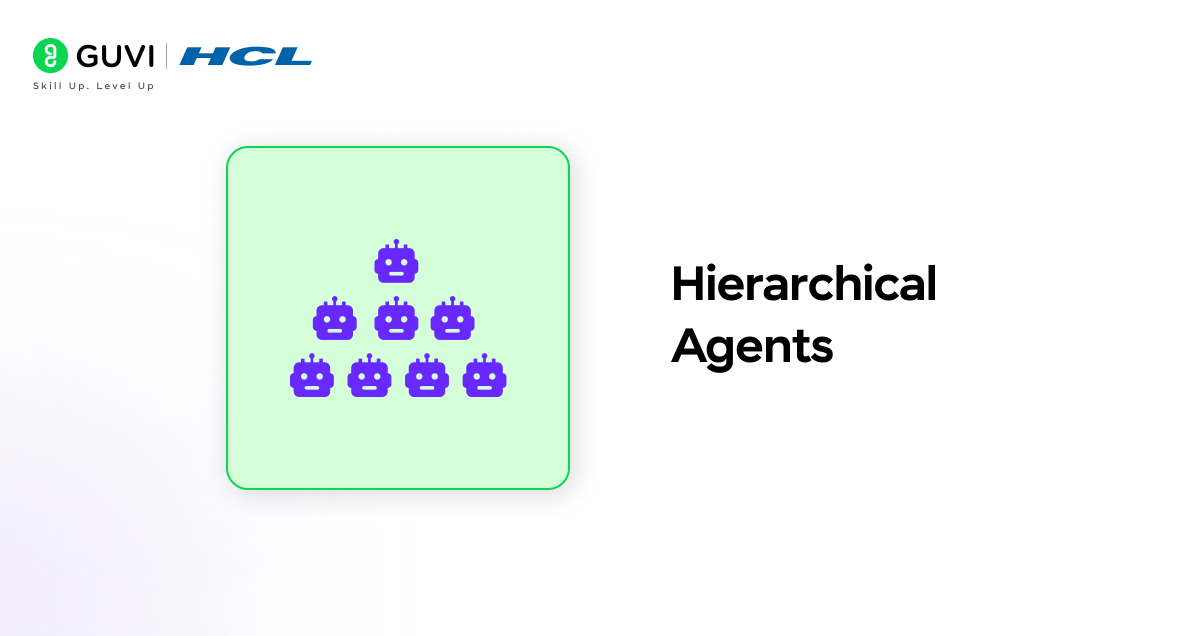
A Hierarchical Agent is an AI agent that breaks a complex task into subtasks and handles them at different levels of abstraction.
How it works
- Such a system first divides a complex task into many smaller tasks.
- Then, high-level task decisions determine the main goal, while low-level task decisions determine the individual steps.
- Each level works together in a structured way to complete the task efficiently.
Real-life example
A self-driving car system where one level plans the route, another controls speed, and another handles steering.
Why it matters
- Simplifies complex tasks into smaller parts
- Improves efficiency and control
- Makes large systems easier to manage and scale
7. Multi-Agent Systems
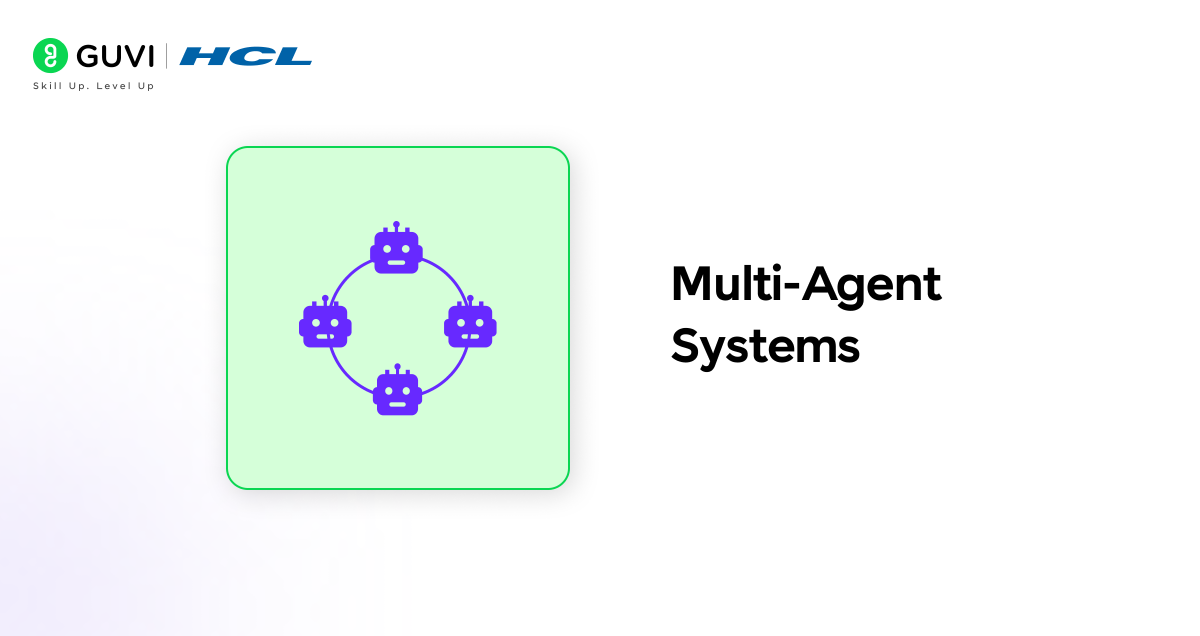
A multi-agent system is an AI system composed of multiple autonomous agents that interact within a shared environment to complete a task.
How it works
- Each AI agent observes its own part of the environment and takes actions independently.
- Then agents communicate or coordinate when needed.
- Together, they adjust their actions to achieve a common goal or improve overall performance.
Real-life example
Traffic signal systems in a city coordinate with each other to manage traffic flow smoothly.
Why it matters
- Enables teamwork between multiple AI agents
- Solves large and complex problems
- Improves efficiency through coordination
Build real AI skills with HCL GUVI’s Intel & IITM Pravartak Certified AI/ML Course. In 4–6 months, you’ll learn through live sessions with industry mentors and Intel experts. Work on 20+ projects and complete 1 capstone while learning Python, Machine Learning, and Generative AI. With 1:1 doubt support, flexible batches, and access to 1000+ hiring partners, the course is designed to get you job-ready.
Conclusion
In conclusion, there are 7 different types of AI Agents that demonstrate how machines can solve problems, from reacting to their environments in simple ways to making intelligent decisions and learning over time. Looking at these together makes it clearer how the AI relates to and is used in real-world systems.
FAQs
Which type of AI agent is the easiest to understand and use?
Simple Reflex Agents are the easiest because they just follow basic rules and react instantly to situations.
Which AI agent can handle situations where all information is not visible?
Model-Based Reflex Agents can manage such cases because they use memory to understand what’s happening.
When should Goal-Based Agents be used instead of others?
They are useful when there is a clear target to achieve, and decisions need to move step by step toward it.
How do Utility-Based Agents make better choices?
They compare options and choose the one that yields the best overall result.
What makes Learning Agents different from other types?
They don’t stay fixed—they keep improving by learning from past actions and feedback.
Why are Multi-Agent Systems useful in real-world scenarios?
They allow multiple agents to work together, making it easier to handle large and complex tasks.
Success Stories







Did you enjoy this article?