


Artificial Intelligence and Machine Learning Articles
How to Evaluate LLM Outputs in Production Deployments
AI/ML Skills Gap 2026: Why Companies Can't Find Job-Ready Talent
20 AI/ML Interview Questions Recruiters Can Use Without a Tech Background - Best Guide
How Industry-Backed AI/ML Bootcamps Are Changing the AI/ML Hiring Pipeline - Best Guide 2026


Get In Touch For Details! Request More Information

Prompt Engineering vs Fine Tuning: When to Use Each
Jun 06, 2026 5 Min Read 1468 Views
(Last Updated)
Quick Answer: Prompt Engineering vs Fine Tuning refers to two approaches used to optimize AI model outputs. Prompt engineering involves crafting structured inputs to guide model responses without modifying the model, while fine tuning involves training the model on custom data to improve performance for specific tasks. Use prompt engineering for flexibility, speed, and low cost. Use fine tuning when you need consistent outputs, domain-specific accuracy, and scalable performance in production systems.
- 85% of organizations using generative AI report that effective prompt engineering is critical to their success.
- 91% of Fortune 500 companies have adopted prompt engineering guidelines.
- Nearly 29.3% of teams are fine-tuning models on their own data.
What truly controls an AI system, the prompt you write or the data you train it on? This is something many teams struggle with when they start working with AI in real projects. The choice between Prompt Engineering vs Fine Tuning is not just technical, it directly affects how reliable and cost-efficient your solution will be.
Today, businesses expect AI systems to give accurate and context-aware responses across tasks like customer support, automation, and data analysis. But picking the wrong approach can lead to inconsistent outputs or unnecessary effort. This guide explains both methods in a clear and practical way so you can decide what works best for your use case.
Table of contents
- What is Prompt Engineering
- Key Characteristics
- Prompts
- What is Fine Tuning
- Key Characteristics
- Fine Tuning Setup
- Example Outcome
- Advantages of Prompt Engineering
- Disadvantages of Prompt Engineering
- Advantages of Fine-Tuning
- Disadvantages of Fine Tuning
- Prompt Engineering vs Fine Tuning: Key Differences
- When to Choose Fine Tuning Over Prompt Engineering
- When to Choose Prompt Engineering Over Fine Tuning
- Hybrid Approach: Combining Prompt Engineering and Fine Tuning
- Example: How to Implement a Hybrid Approach
- Step 1: Fine Tune the Model (Build Domain Understanding)
- Step 2: Apply Prompt Engineering (Control Output Behavior)
- Step 3: Add Context Dynamically
- Final Result
- Conclusion
- FAQs
- Can prompt engineering replace fine tuning completely?
- Is fine tuning always more accurate than prompt engineering?
- How do I decide the right approach for my AI project?
What is Prompt Engineering
Prompt engineering focuses on shaping how an AI model responds by carefully structuring the input you give it. Instead of modifying the model itself, you guide its output through clear instructions, context, and examples. The quality of the prompt directly influences the quality of the response.
Key Characteristics
- Does not require any model retraining
- Quick to test and refine different inputs
- Integrates easily with tools like OpenAI API
- Suitable for low-cost experimentation and rapid development
For example, if we want to build an AI resume screening app using LLMs, we can try the following prompts:
Prompts
1. Resume Evaluation Prompt
“Analyze the candidate’s resume for a Data Analyst role. Highlight key skills, relevant experience, and missing requirements in bullet points.”
2. Scoring Prompt
“Evaluate the resume based on skills, experience, and education. Give a score out of 10 and briefly justify the score.”
3. Skill Matching Prompt
“Compare the resume with the job description and list matched skills, partially matched skills, and missing skills.”
4. Shortlisting Prompt
“Decide whether the candidate should be shortlisted. Provide a clear yes or no with 2 reasons supporting the decision.”
5. Summary Prompt
“Summarize the candidate profile in 4 bullet points focusing on strengths and role fit.”
6. Bias-Control Prompt
“Evaluate the resume strictly based on skills and experience. Ignore name, gender, or personal identifiers.”
What is Fine Tuning
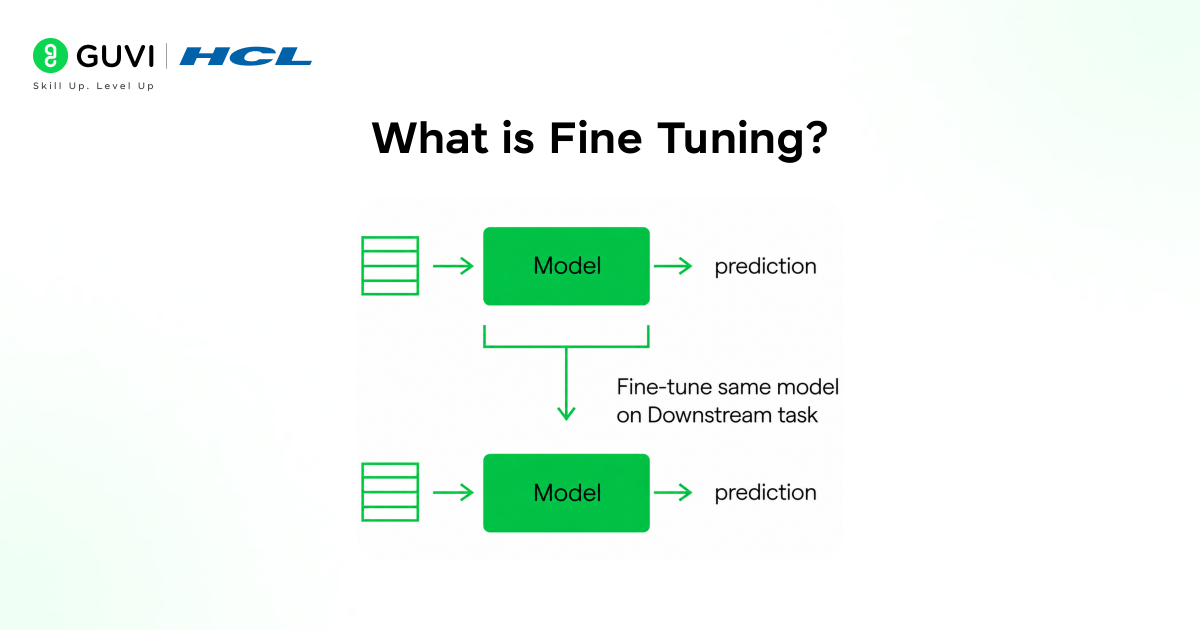
Fine tuning is a key approach in LLM optimization where a pre-trained model is further trained on domain-specific or task-specific data. Instead of relying only on general knowledge, the model learns the context, terminology, and patterns unique to a particular use case. This helps improve how accurately and consistently it performs in real-world applications.
Key Characteristics
- Requires carefully curated and labeled datasets
- Improves consistency and domain-specific accuracy
- Works well for specialized use cases where generic models fall short
- Involves higher cost, setup time, and infrastructure effort
For example, if we want to build an AI document summarization app using LLMs, we can fine tune the model in the following way:
Fine Tuning Setup
1. Define the Objective
Train the model to generate accurate, structured summaries from long documents such as reports, research papers, or articles.
2. Prepare Training Data: Create a dataset with:
- Input: Full-length documents
- Output: High-quality summaries
Example Training Pair:
Input: A 2000-word research article on climate change
Output: A 150-word summary covering key findings, causes, and impact
3. Maintain Consistent Output Style
Ensure all summaries follow a fixed structure:
- Short overview
- Key points
- Final takeaway
This helps the model learn a predictable format.
4. Include Domain-Specific Data
If the app targets a specific industry:
- Legal documents
- Financial reports
- Healthcare records
This improves accuracy and relevance.
5. Train and Evaluate the Model
- Train on curated datasets
- Validate outputs for clarity, accuracy, and completeness
- Refine based on performance gaps
Example Outcome
After fine tuning, the model:
- Understands long documents better
- Produces consistent summary formats
- Reduces the need for detailed prompt instructions
Understand when to use prompt engineering and when to apply fine tuning by building strong AI fundamentals. Join HCL GUVI’s Artificial Intelligence and Machine Learning Course to learn from industry experts and Intel engineers through live online classes, master Python, ML, MLOps, Generative AI, and Agentic AI, and gain hands-on experience with 20+ industry-grade projects, 1:1 doubt sessions, and placement support with 1000+ hiring partners.
Advantages of Prompt Engineering
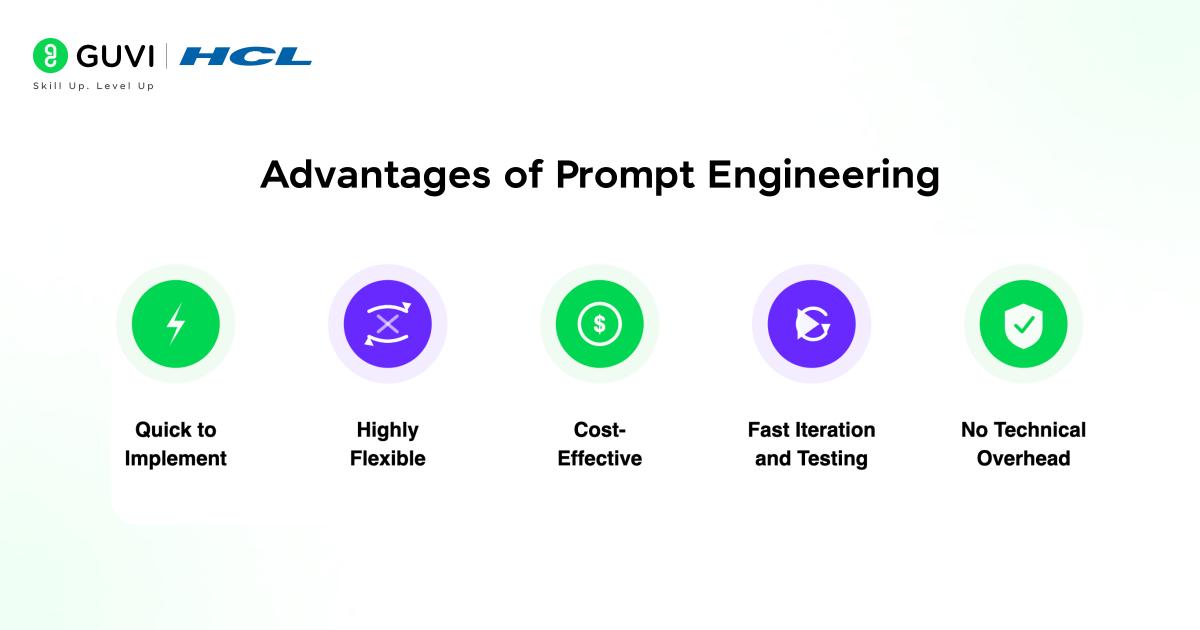
1. Quick to Implement: You can start using prompt engineering immediately without any model training or setup.
2. Highly Flexible: Prompts can be easily modified based on different tasks, formats, or user needs.
3. Cost-Effective: No need for training data or additional infrastructure, making it suitable for low-budget projects.
4. Fast Iteration and Testing: You can experiment with multiple prompt variations and quickly improve outputs.
5. No Technical Overhead: Does not require machine learning expertise or model training pipelines.
Disadvantages of Prompt Engineering
- Output can be inconsistent across prompts
- Requires careful prompt design for good results
- Not ideal for highly specialized or domain-heavy tasks
Advantages of Fine-Tuning
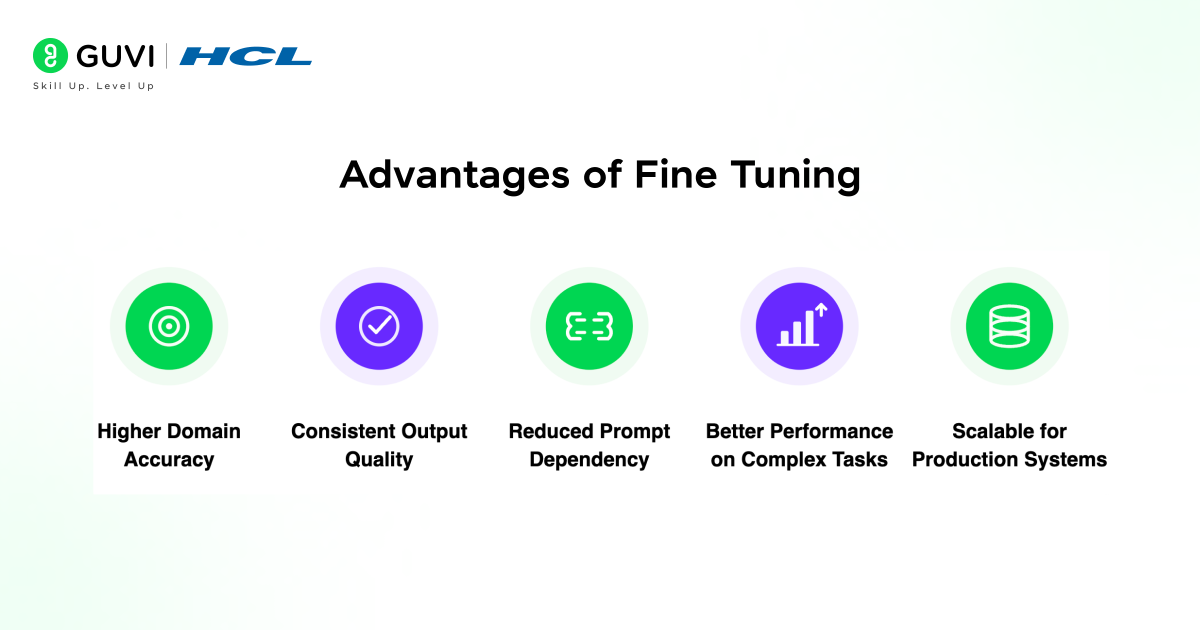
1. Higher Domain Accuracy: Fine tuning helps the model understand industry-specific terms, patterns, and context, leading to more accurate outputs for specialized tasks.
2. Consistent Output Quality: The model learns a fixed response style and structure, reducing variability across different inputs.
3. Reduced Prompt Dependency: You do not need complex or lengthy prompts every time, as the model already understands the task requirements.
4. Better Performance on Complex Tasks: Fine-tuned models handle multi-step reasoning and domain-heavy workflows more effectively.

5. Scalable for Production Systems: Once trained, the model can be deployed across large-scale applications with predictable performance.
Disadvantages of Fine Tuning
- Requires high-quality labeled data
- Higher cost compared to prompt engineering
- Time-consuming setup and training process
- Needs infrastructure and technical expertise
Prompt Engineering vs Fine Tuning: Key Differences
| Factor | Prompt Engineering | Fine Tuning |
| Definition | Controls output using structured prompts | Improves model by training on custom data |
| Model Changes | No changes to the model | Model weights are updated |
| Setup Time | Immediate | Time-consuming |
| Cost | Low | High |
| Data Requirement | No training data needed | Requires labeled dataset |
| Accuracy | Good for general tasks | High for domain-specific tasks |
| Consistency | May vary across prompts | More stable and consistent |
| Flexibility | Highly flexible and adjustable | Less flexible after training |
| Scalability | Suitable for small to mid use | Ideal for large-scale production |
| Maintenance | Minimal | Requires retraining with new data |
| Use Case Stage | Best for early-stage or testing | Best for mature production systems |
| Control Level | Controlled via instructions | Learned behavior from data |
| Dependency | Depends on prompt quality | Depends on data quality |
| Iteration Speed | Very fast | Slow |
Strengthen your understanding of prompt engineering and fine tuning with practical AI insights. Download HCL GUVI’s GenAI eBook to learn core concepts, real-world use cases, and strategies for building effective AI applications.
When to Choose Fine Tuning Over Prompt Engineering
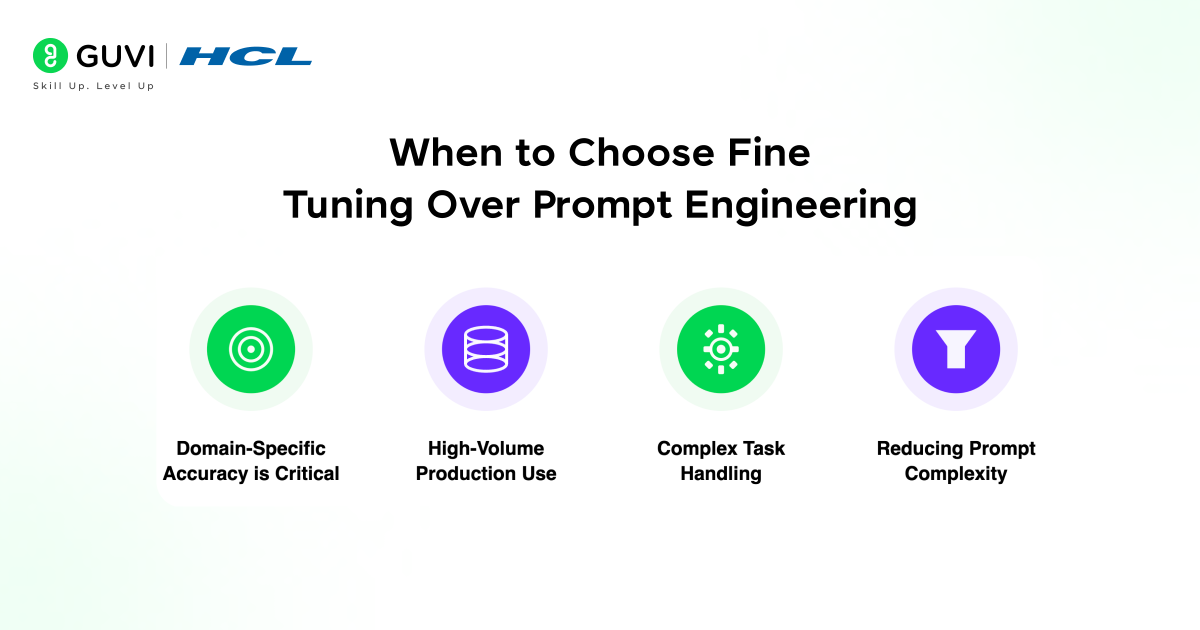
- Domain-Specific Accuracy is Critical: When your use case involves specialized knowledge such as healthcare, finance, or legal workflows, fine tuning helps the model understand domain context deeply.
- High-Volume Production Use: Fine tuning reduces variability and improves efficiency for large-scale applications where the same task runs repeatedly.
- Complex Task Handling: When tasks involve multi-step reasoning or structured outputs that prompts alone cannot reliably control.
- Reducing Prompt Complexity: If prompts are becoming too long or difficult to manage, fine tuning simplifies usage by embedding behavior into the model.
When to Choose Prompt Engineering Over Fine Tuning
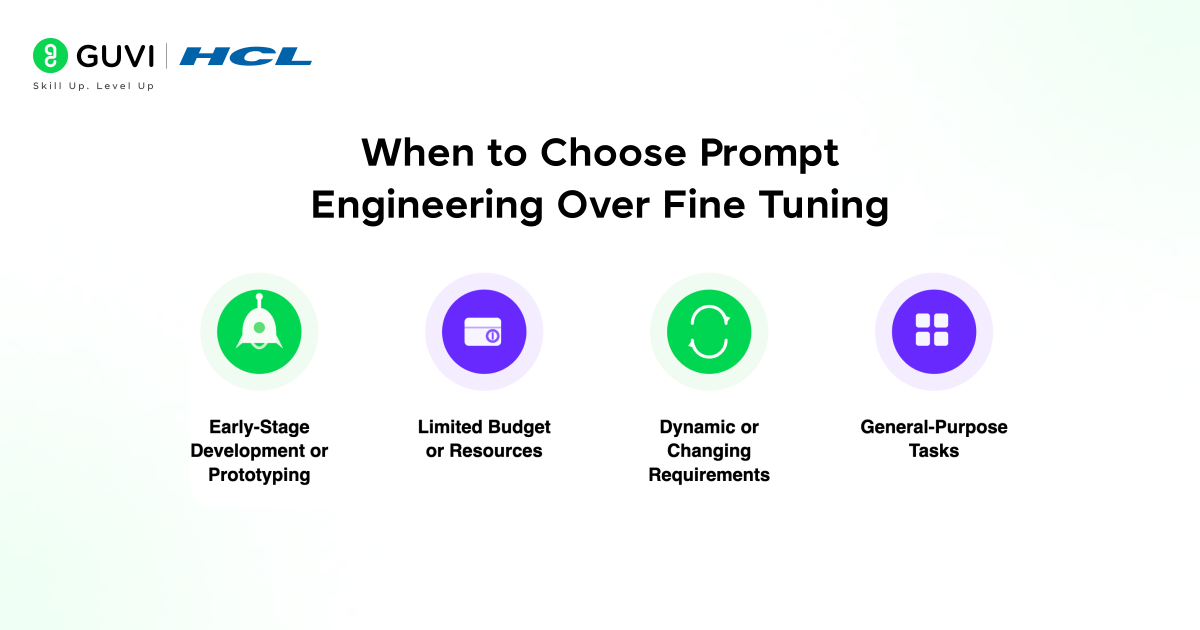
- Early-Stage Development or Prototyping: When you are still testing ideas and need quick iterations without heavy investment.
- Limited Budget or Resources: Prompt engineering avoids the cost of training, data preparation, and infrastructure.
- Dynamic or Changing Requirements: If your use case changes frequently, prompts are easier to update than retraining a model.
- General-Purpose Tasks: For tasks like summarization, content generation, or basic Q&A where base models already perform well.
Hybrid Approach: Combining Prompt Engineering and Fine Tuning
High-performing AI systems rarely rely on just one method in practice. A hybrid approach allows you to train the model for deeper understanding while still controlling outputs through prompts. Fine tuning builds domain knowledge, while prompt engineering shapes how that knowledge is delivered in different scenarios.
Example: How to Implement a Hybrid Approach
Let’s take a practical example of a customer support AI system.
Step 1: Fine Tune the Model (Build Domain Understanding)
You train the model using:
- Past support tickets
- Approved responses
- FAQs and internal documentation
Outcome: The model learns how your company handles queries, understands common issues, and follows your resolution patterns.
Step 2: Apply Prompt Engineering (Control Output Behavior)
Now you design prompts to control how the model responds in real time.
Example Prompt: “Respond to the user query in a polite and empathetic tone. Provide a clear solution in 3 steps. If the issue is unresolved, suggest escalation.”
Outcome: The same trained model now adapts its response format and structure without retraining.
Step 3: Add Context Dynamically
You can further improve responses by injecting real-time context.
Example:
- User history
- Previous interactions
- Account status
Prompt with Context: “Based on the user’s previous complaint about delayed delivery, respond with a solution and include compensation if applicable.”
Final Result
- Fine tuning → Improves accuracy and domain relevance
- Prompt engineering → Controls tone, format, and adaptability
Together, they create a system that is:
- Consistent in knowledge
- Flexible in response
- Scalable across multiple use cases
Conclusion
Understanding Prompt Engineering vs Fine Tuning is essential for building effective AI systems. Prompt engineering is usually the easiest place to start. It is quick to try, flexible to adjust, and does not require much investment, which makes it useful in early stages or when requirements keep changing. Fine tuning, on the other hand, becomes valuable when you need more consistent and accurate results, especially for specific domains. In most cases, it makes sense to begin with prompt engineering, test how well it performs, and then move to fine tuning only if needed.
FAQs
1. Can prompt engineering replace fine tuning completely?
No, prompt engineering cannot fully replace fine tuning. It works well for general tasks and early-stage applications, but for domain-specific accuracy and consistent outputs, fine tuning becomes necessary.
2. Is fine tuning always more accurate than prompt engineering?
Fine tuning is generally more accurate for specialized use cases because the model learns from domain-specific data. However, for general tasks, well-designed prompts can achieve strong results without the need for training.
3. How do I decide the right approach for my AI project?
Start by evaluating your requirements. If your use case needs quick deployment and flexibility, begin with prompt engineering. If you notice inconsistent outputs or require domain-level precision, consider moving to fine tuning after testing initial performance.
Success Stories

About the Author
Vaishali
I'm a seasoned writer with four years of experience across technical, non-technical, and just about every genre or niche you can imagine. Adaptable and curious, I enjoy exploring new topics and making information engaging and easy to understand. Fueled by a steady stream of tea, I approach each project with creativity, reliability, and genuine enthusiasm for storytelling.
View all posts by Vaishali
Connect with me @









Did you enjoy this article?